MLB LABOR WATCH
MLB bargaining: the offers and the tradeoffs
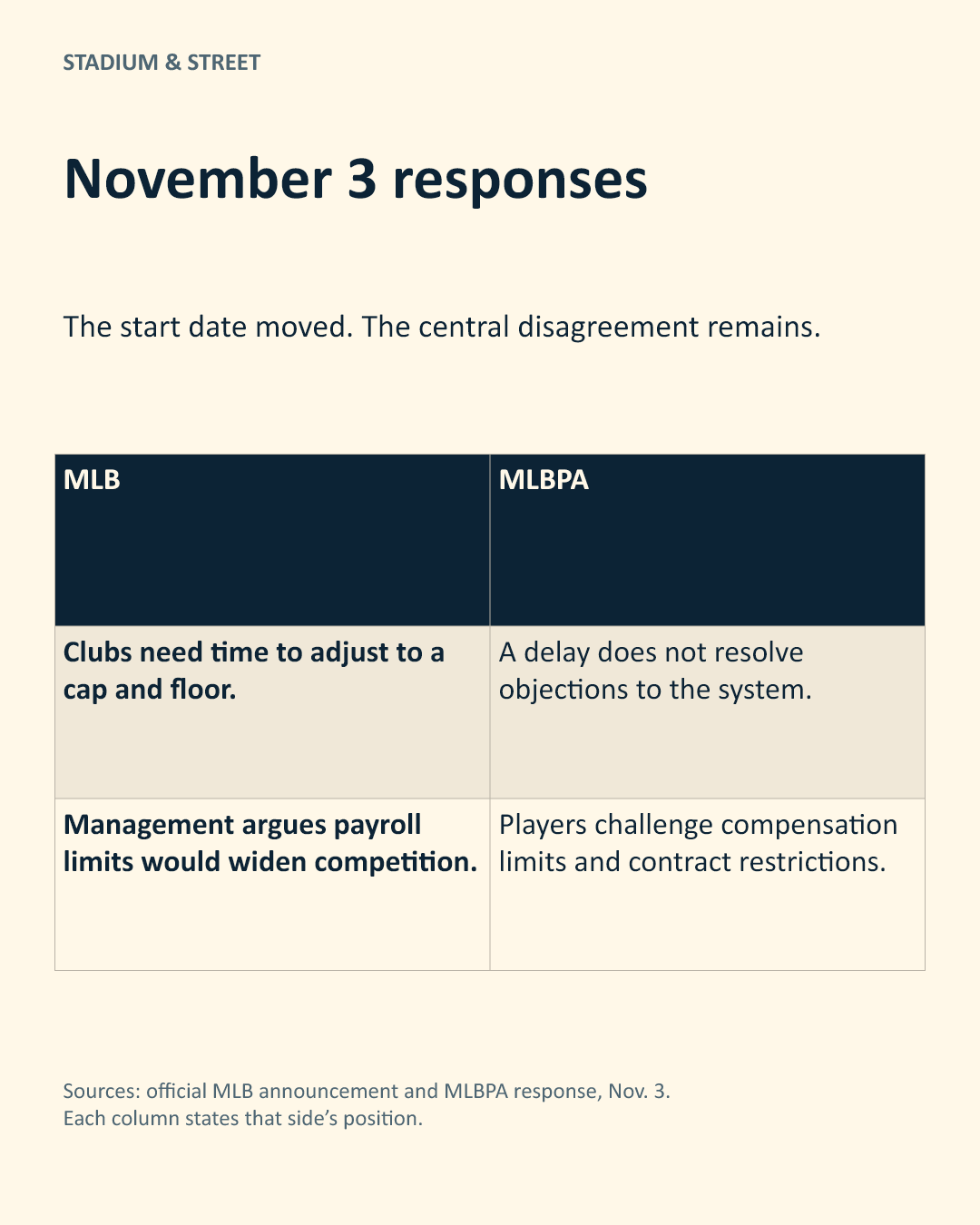
MLB has moved its proposed salary cap and floor to 2028. The players’ union says another year of transition does not resolve its objections. The negotiation concerns who can spend, who gets paid earlier and how much freedom remains in a player’s contract.
Public proposals. No new agreement announced.
By Stadium & Street Editorial Desk
Updated November 3, 2026 at 8:20 PM EST. Sources checked November 3, 2026 at 7:33 PM EST.
Current rules and public proposals
Each issue retains its proposal date. Earlier terms are shown as negotiating positions, not completed amendments. The published summaries do not replace the full agreement text.
Dollar figures are annual unless otherwise stated. Payroll limits use the proposal’s accounting basis.
Team payroll
MLB: Nov. 3. MLBPA: May 27.
- Current agreement
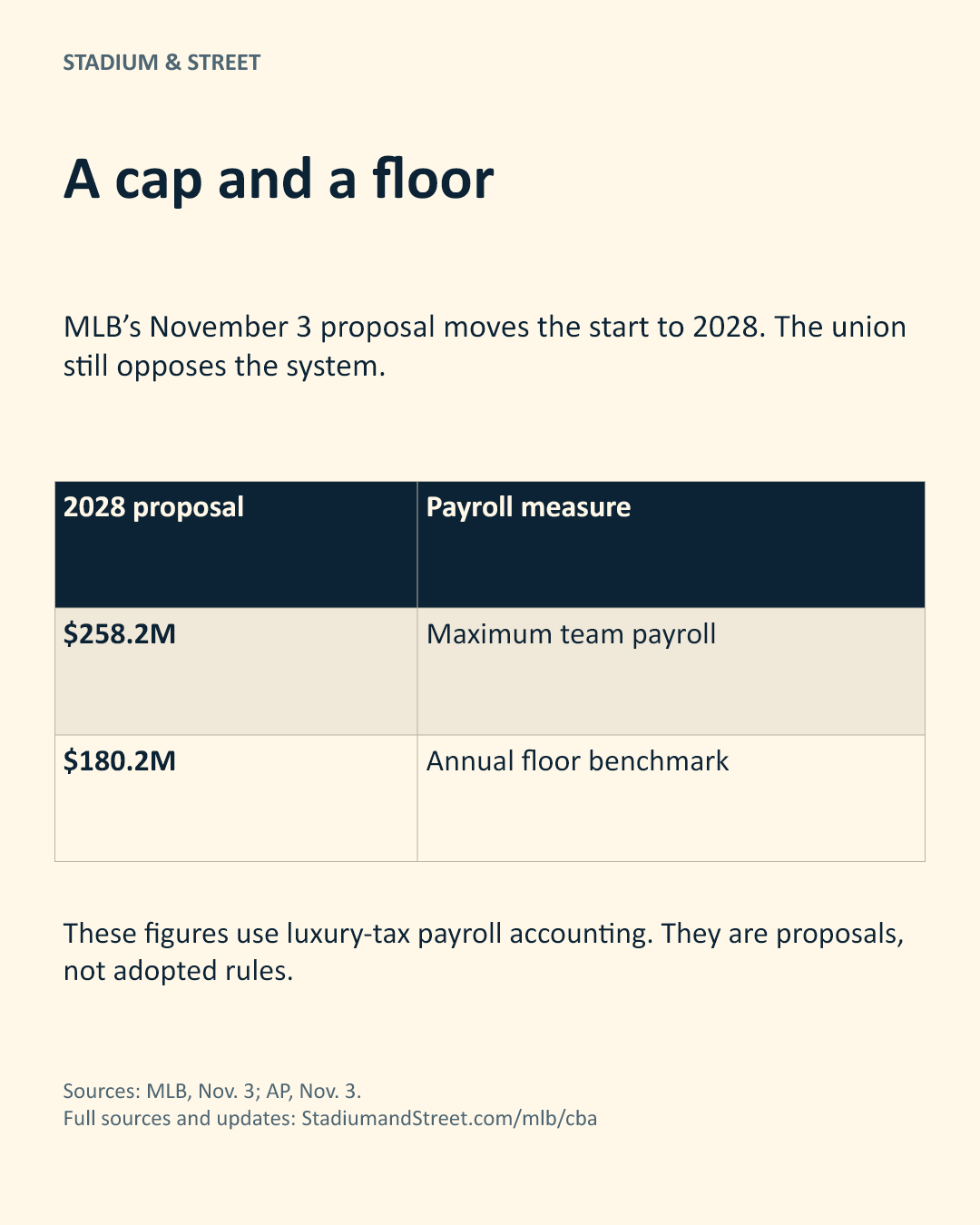
- Luxury tax, with a $244M base threshold in 2026. No hard team cap.
- MLB proposal
- A $258.2M ceiling and $180.2M floor in 2028, replacing the earlier 2027 start.
- MLBPA position
- Preserve market bargaining and penalize clubs that fall below payroll benchmarks.
Minimum salary
June proposal, retained in Nov. 3 reporting; union opening proposal.
- Current agreement
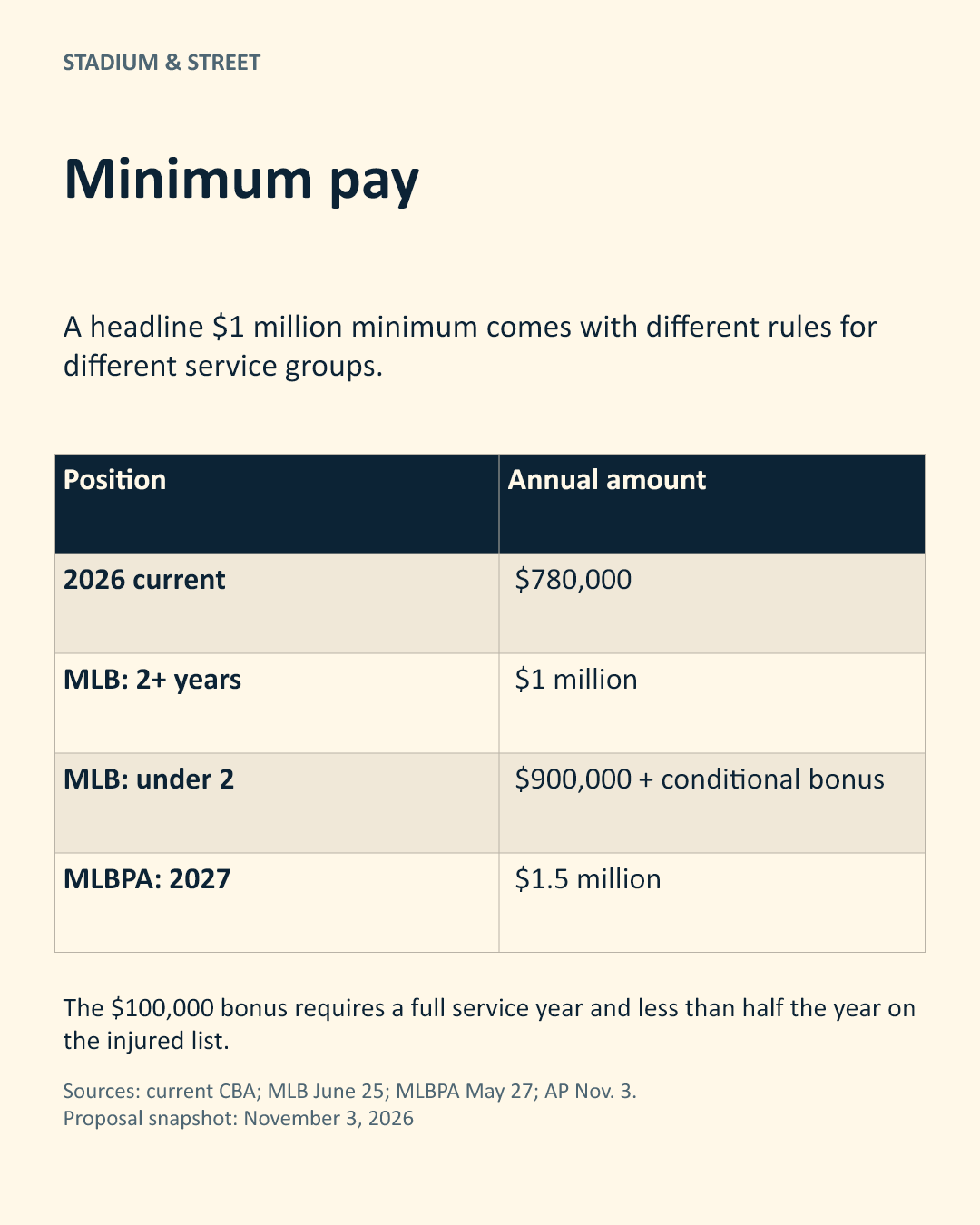
- $780,000 for a full major-league season in 2026.
- MLB proposal
- $1M for 2+ service years; $900,000 below that, plus a conditional $100,000 bonus.
- MLBPA position
- $1.5M in 2027.
Luxury-tax threshold
MLB: Nov. 3. MLBPA: May 27.
- Current agreement
- $244M base threshold in 2026.
- MLB proposal
- Keep 2026 tax thresholds and rates during the proposed 2027 transition.
- MLBPA position
- Opening offer: $300M in 2027 and further annual increases.
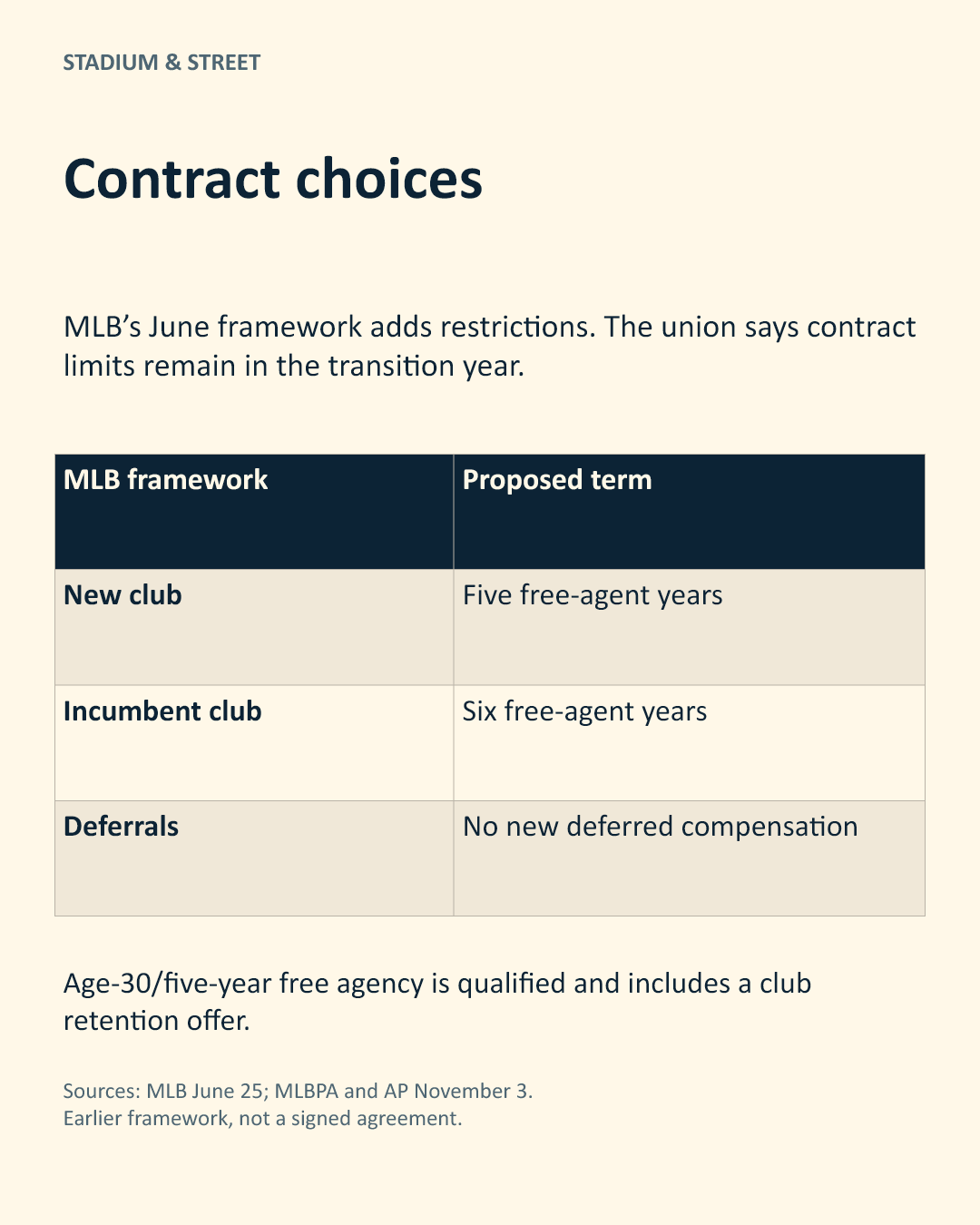
Free-agent contracts
June framework; Nov. 3 union response says contract restrictions remain.
- Current agreement
- Negotiated contract terms rather than a universal five-year ceiling.
- MLB proposal
- June framework: five free-agent years with a new club, six with the incumbent; individual salary limits and no new deferrals.
- MLBPA position
- Retain market-based compensation and contract guarantees.
Sources for this comparison
AP / Ronald Blum: contract proposals, June 25MLBPA: response, November 3Earlier free agency
May/June proposals; qualified terms in Nov. 3 reporting.
- Current agreement
- Ordinarily after six years of MLB service.
- MLB proposal
- Qualified eligibility at age 30 after five service years, subject to a club retention offer.
- MLBPA position
- Sought age-30/five-year qualified eligibility and removal of ordinary qualifying-offer penalties.
Revenue and accountability
Earlier economic proposals remain the framework under discussion.
- Current agreement
- Revenue sharing and the luxury tax operate within the current agreement.
- MLB proposal
- A fixed player share of defined baseball revenue under the cap system.
- MLBPA position
- More local-media sharing, a $240M club-revenue guarantee for small markets, and spending requirements.
Sources for this comparison
MLB: cap-and-floor explanation, July 31MLBPA: opening economic proposal, May 27Roster stability
MLB: Nov. 3 reporting. MLBPA: July 1.
- Current agreement
- Up to five optional assignments per player each season.
- MLB proposal
- Reduce that limit to four.
- MLBPA position
- Reduce it to three; add early-season active-roster spots and service-time protections.
Sources for this comparison
MLBPA: transaction and roster proposals, July 1AP / Ronald Blum: revised offer, November 3| Issue | Current agreement | MLB proposal | MLBPA position |
|---|---|---|---|
| Team payrollMLB: Nov. 3. MLBPA: May 27.MLBPA: signed 2022-2026 Basic AgreementMLB: public proposal summary, November 3, 1:56 p.m. ESTMLBPA: opening economic proposal, May 27 | Luxury tax, with a $244M base threshold in 2026. No hard team cap. | A $258.2M ceiling and $180.2M floor in 2028, replacing the earlier 2027 start. | Preserve market bargaining and penalize clubs that fall below payroll benchmarks. |
| Minimum salaryJune proposal, retained in Nov. 3 reporting; union opening proposal.MLBPA: signed 2022-2026 Basic AgreementAP / Ronald Blum: contract proposals, June 25MLBPA: opening economic proposal, May 27AP / Ronald Blum: revised offer, November 3 | $780,000 for a full major-league season in 2026. | $1M for 2+ service years; $900,000 below that, plus a conditional $100,000 bonus. | $1.5M in 2027. |
| Luxury-tax thresholdMLB: Nov. 3. MLBPA: May 27.MLBPA: signed 2022-2026 Basic AgreementAP / Ronald Blum: revised offer, November 3AP / Ronald Blum: players’ economic offer, May 27 | $244M base threshold in 2026. | Keep 2026 tax thresholds and rates during the proposed 2027 transition. | Opening offer: $300M in 2027 and further annual increases. |
| Free-agent contractsJune framework; Nov. 3 union response says contract restrictions remain.AP / Ronald Blum: contract proposals, June 25MLBPA: response, November 3 | Negotiated contract terms rather than a universal five-year ceiling. | June framework: five free-agent years with a new club, six with the incumbent; individual salary limits and no new deferrals. | Retain market-based compensation and contract guarantees. |
| Earlier free agencyMay/June proposals; qualified terms in Nov. 3 reporting.MLBPA: signed 2022-2026 Basic AgreementAP / Ronald Blum: revised offer, November 3MLBPA: opening economic proposal, May 27 | Ordinarily after six years of MLB service. | Qualified eligibility at age 30 after five service years, subject to a club retention offer. | Sought age-30/five-year qualified eligibility and removal of ordinary qualifying-offer penalties. |
| Revenue and accountabilityEarlier economic proposals remain the framework under discussion.MLB: cap-and-floor explanation, July 31MLBPA: opening economic proposal, May 27 | Revenue sharing and the luxury tax operate within the current agreement. | A fixed player share of defined baseball revenue under the cap system. | More local-media sharing, a $240M club-revenue guarantee for small markets, and spending requirements. |
| Roster stabilityMLB: Nov. 3 reporting. MLBPA: July 1.MLBPA: transaction and roster proposals, July 1AP / Ronald Blum: revised offer, November 3 | Up to five optional assignments per player each season. | Reduce that limit to four. | Reduce it to three; add early-season active-roster spots and service-time protections. |
The conditions behind the numbers
The spending floor has a transition rule
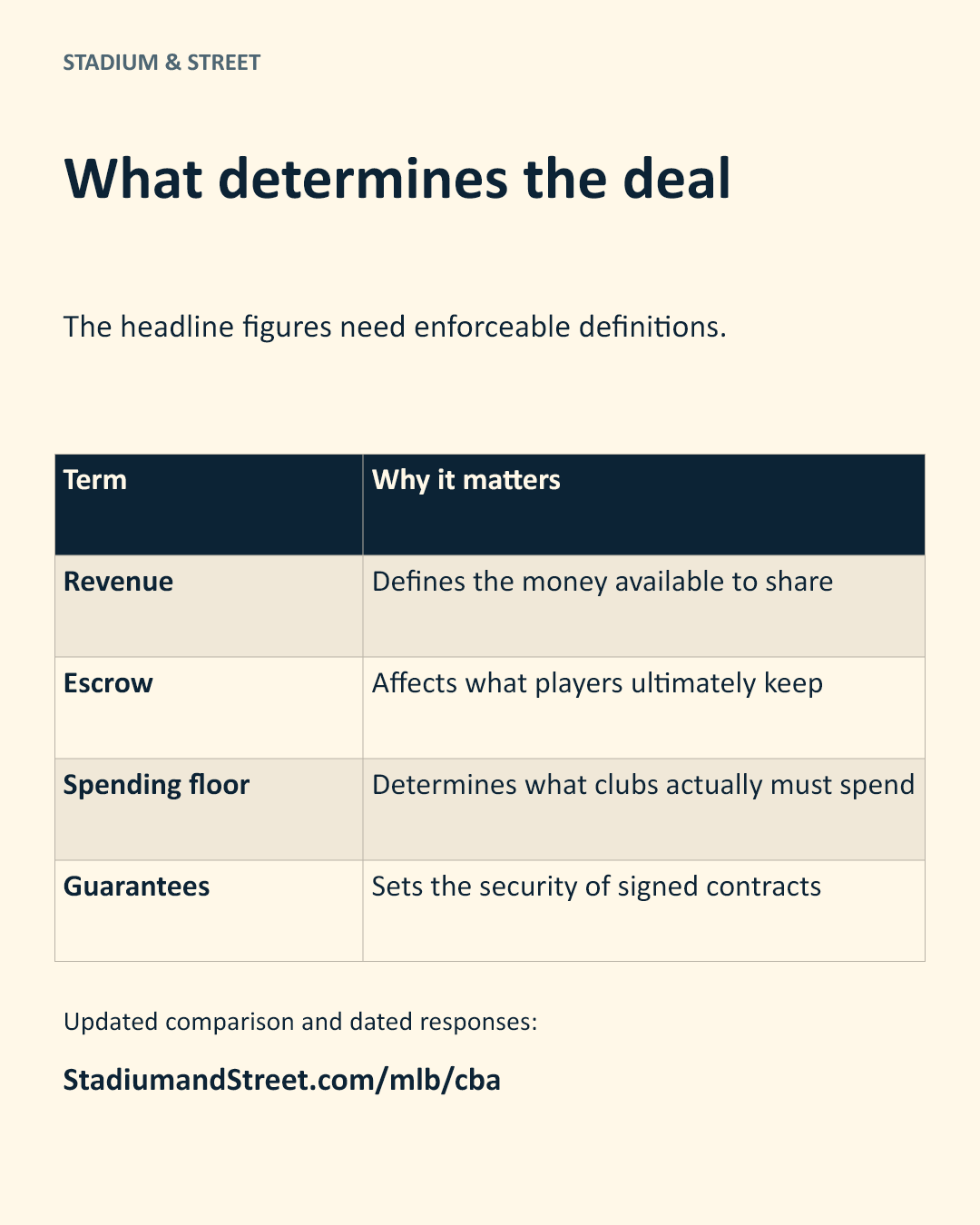
AP reports that 2028 spending could reach only 90% of the floor, with full compliance assessed over three years. The headline annual figure therefore needs to be read with its enforcement terms.
AP / Ronald Blum: revised offer, November 3The youngest players’ bonus is conditional
The additional $100,000 requires a full service year and less than half the season on the injured list. Base pay and bonus eligibility should be evaluated separately.
AP / Ronald Blum: revised offer, November 3Revenue is not the same as profit
A percentage cannot settle the value of an agreement without its accounting definition. Which revenues count, permitted deductions, included benefits and independent audit rights determine the size of the pool. S&S analysis: both sides need an enforceable reconciliation process, not only an attractive opening percentage.
MLB: cap-and-floor explanation, July 31AP: cap dispute and escrow, September 2026Escrow affects what players ultimately receive
Reported escrow terms could return salary money when compensation exceeds the negotiated revenue share. That is a real issue for the value of guarantees. It is different from a verified blanket power to cancel existing contracts.
AP: cap dispute and escrow, September 2026Amateur players are part of the bargain
The union’s draft proposal preserves 20 rounds and negotiated bonuses, broadens college eligibility and rewards successful lower-revenue clubs. Its November 3 response also objects to management’s amateur restrictions. The union’s claimed $400M bonus reduction is its estimate, not an independently verified S&S calculation.
MLBPA: amateur draft proposals, July 21MLBPA: response, November 3Season structure is also on the table
MLB’s October offer includes 154 games and seven-game Division Series from 2029. S&S analysis: fewer regular-season dates could reduce some workload, while extra postseason inventory changes the revenue opportunity. The effects depend on the complete calendar and compensation terms.
MLB: season and postseason proposal, October 8S&S ANALYSIS
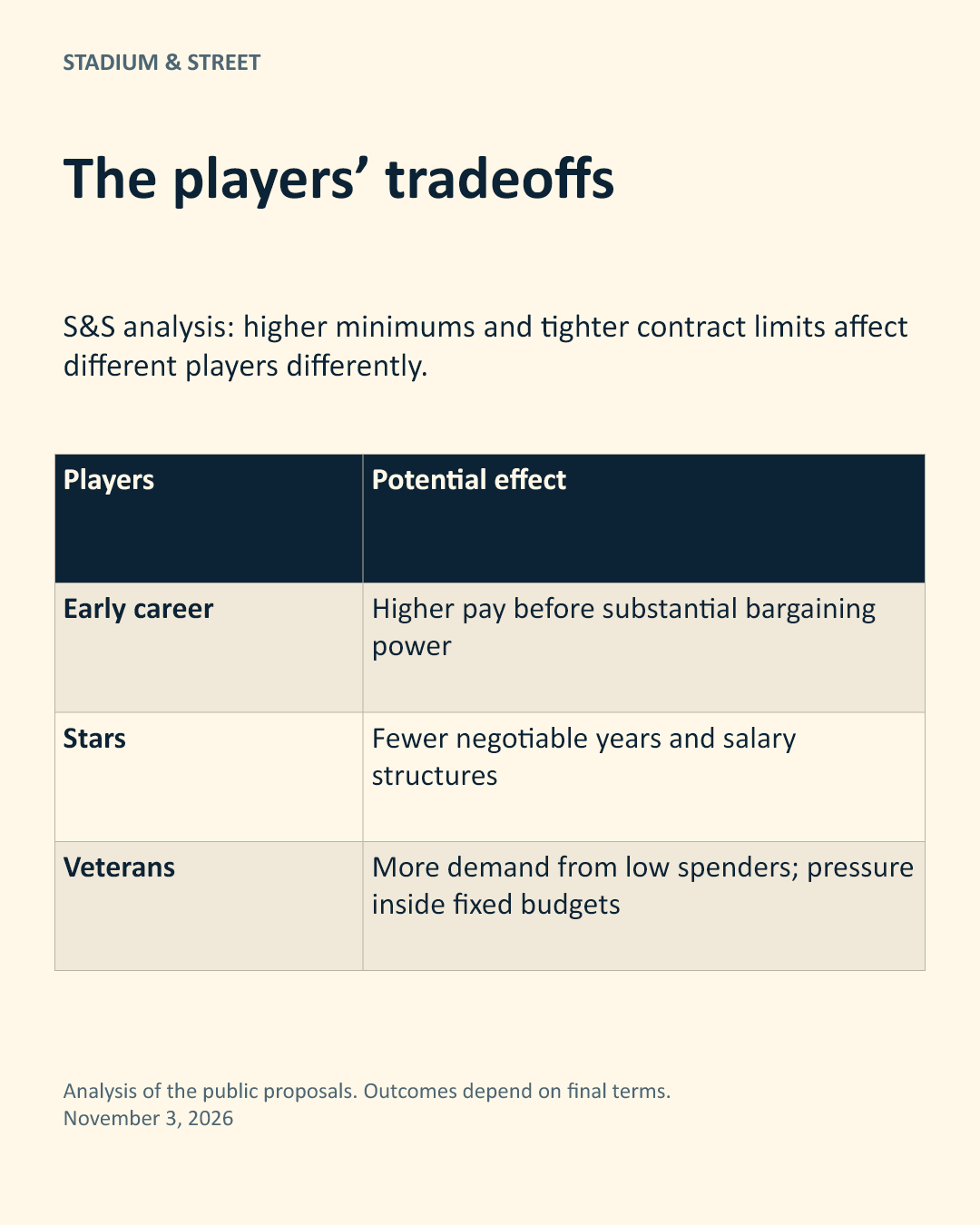
Who gains room, and who gives it up?
These are potential mechanisms, not forecasts of individual salaries or club profits.
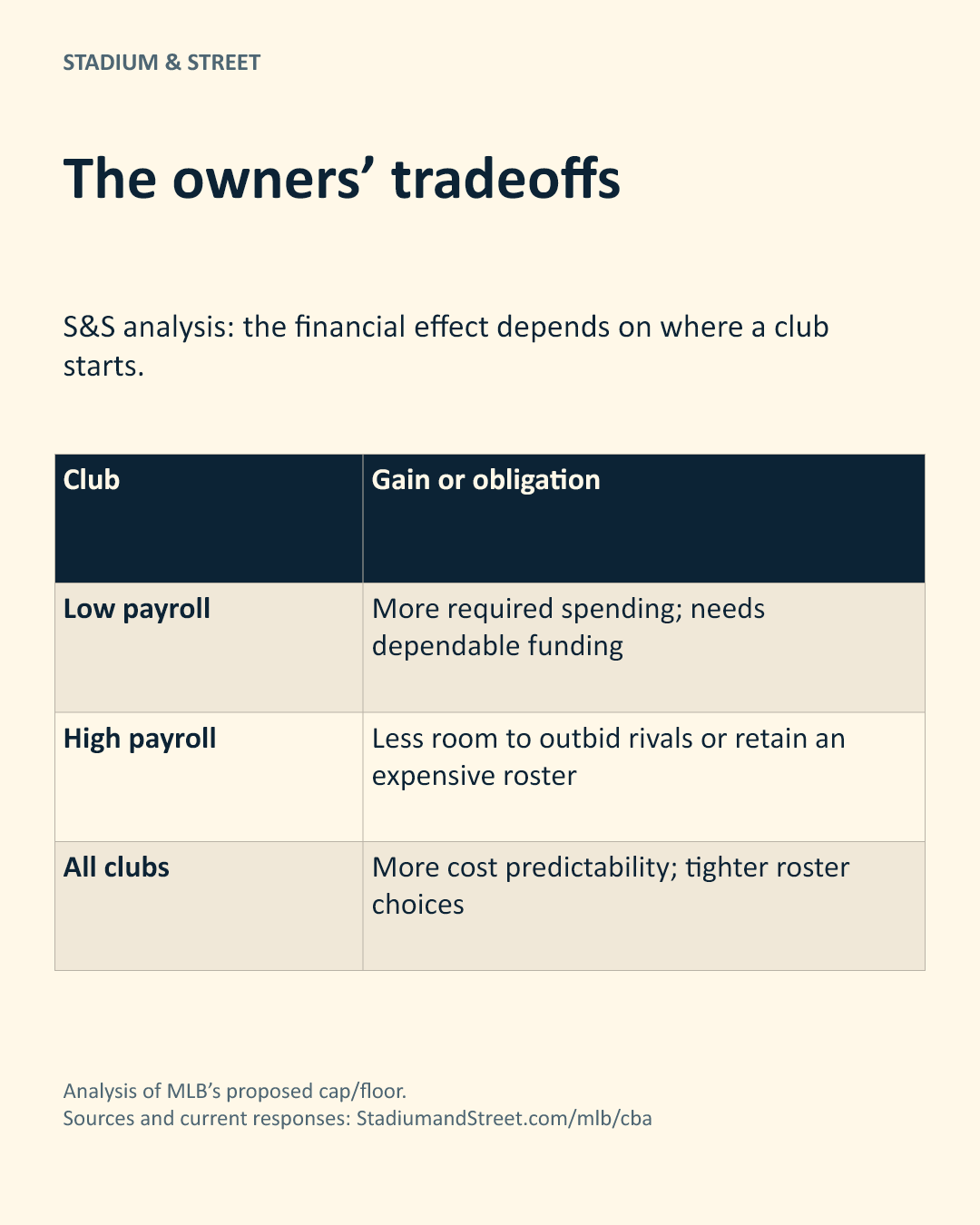
The same proposal affects different owners and players differently.
Owners of low-payroll clubs
- Potential benefit
- More predictable access to shared funding could support retention and free-agent bids.
- Obligation or risk
- A genuine floor requires additional spending even when an owner would prefer to retain cash.
Owners of high-payroll clubs
- Potential benefit
- A ceiling can restrain bidding costs across the league.
- Obligation or risk
- Less flexibility to retain a costly core or absorb a disappointing contract without another roster sacrifice.
Players early in their careers
- Potential benefit
- Higher minimums move compensation into years when individual negotiating power is limited.
- Obligation or risk
- A larger headline benefit may depend on service time, health-related eligibility and the way the bonus pool is allocated.
Established stars
- Potential benefit
- An incumbent advantage could strengthen the route to remaining with a club.
- Obligation or risk
- Limits on salary, years and deferrals narrow the choices a player can negotiate.
Middle-tier veterans
- Potential benefit
- Clubs below a firm floor would need additional payroll.
- Obligation or risk
- A fixed team budget can leave less room after stars and cheaper replacements take their shares.
| Group | Potential benefit | Obligation or risk |
|---|---|---|
| Owners of low-payroll clubs | More predictable access to shared funding could support retention and free-agent bids. | A genuine floor requires additional spending even when an owner would prefer to retain cash. |
| Owners of high-payroll clubs | A ceiling can restrain bidding costs across the league. | Less flexibility to retain a costly core or absorb a disappointing contract without another roster sacrifice. |
| Players early in their careers | Higher minimums move compensation into years when individual negotiating power is limited. | A larger headline benefit may depend on service time, health-related eligibility and the way the bonus pool is allocated. |
| Established stars | An incumbent advantage could strengthen the route to remaining with a club. | Limits on salary, years and deferrals narrow the choices a player can negotiate. |
| Middle-tier veterans | Clubs below a firm floor would need additional payroll. | A fixed team budget can leave less room after stars and cheaper replacements take their shares. |
S&S analysis: an enforceable floor backed by reliable funding offers a concrete response to clubs that underinvest. The players’ strongest counterargument is that more sharing and mandatory spending can be negotiated without permanently limiting their market earnings. A snapshot showing today’s low-spending clubs adding more than high-spending clubs cut does not establish the result over a full agreement. Future revenues, compliance and the uncapped alternative matter.
Proposals and responses
Newest first. Official positions identify what each side says; they do not independently establish the economic outcome.
· Official response · MLB Players Association
Union says the delay leaves its central objections intact
The MLBPA maintains its opposition to the cap framework and identifies compensation, guarantees and amateur restrictions as unresolved. It says transition-year contract restrictions would still apply.
What changes: Timing changed. No announced agreement on the economic system.
MLBPA: response, November 3· Official proposal summary · Major League Baseball
Management moves the proposed start to 2028
MLB says a full offseason would give clubs time to adjust. Its published projection counts 12 clubs adding payroll and eight reducing it. Those are management’s estimates.
What changes: The new start date and cap/floor figures supersede the earlier 2027 headline numbers.
MLB: public proposal summary, November 3, 1:56 p.m. EST· Earlier proposal · Major League Baseball
Season and playoff changes enter the discussion
The schedule proposal remains part of the public record. No adoption is claimed here.
What changes: Calendar proposals and economic terms remain separate entries until a final agreement connects them.
MLB: season and postseason proposal, October 8· Opening proposal · MLB Players Association
Players propose earlier pay and stronger spending incentives
The union’s framework combines greater player compensation with revenue-sharing conditions aimed at rewarding competition.
What changes: Its alternative addresses low spending while preserving market bargaining.
MLBPA: opening economic proposal, May 27
The graphical edition
Download the eight-slide November 3 edition (PDF). The slides retain their original date as the tracker develops.
What the next response needs to clarify
- Which revenues and deductions enter the player-share calculation?
- How are existing guarantees and escrow shortfalls treated?
- What happens when a club misses its spending obligation?
- How much of an advertised benefit is new money rather than a reallocation?
- Which provisions actually change in the next complete offer?
This page records substantive, verified proposals and responses during S&S news checks. Official statements and firsthand remarks are labeled separately from named reporting. Repeated commentary does not become a new agreement. Dates remain attached to earlier offers, and corrections are recorded. Checks are periodic, not continuous.
Expiry of the current agreement does not itself establish that a work stoppage has begun. Any lockout, strike or settlement requires a separately verified event.
Source record
- MLBPA: signed 2022-2026 Basic Agreement
- MLB: public proposal summary, November 3, 1:56 p.m. EST
- MLBPA: response, November 3
- MLBPA: opening economic proposal, May 27
- MLBPA: transaction and roster proposals, July 1
- MLBPA: amateur draft proposals, July 21
- MLB: cap-and-floor explanation, July 31
- MLB: season and postseason proposal, October 8
- AP / Ronald Blum: revised offer, November 3
- AP / Ronald Blum: contract proposals, June 25
- AP / Ronald Blum: players’ economic offer, May 27
- AP: cap dispute and escrow, September 2026