Opinion · Football
Barry Sanders deserves a better argument than his ring count
November 16, 2026
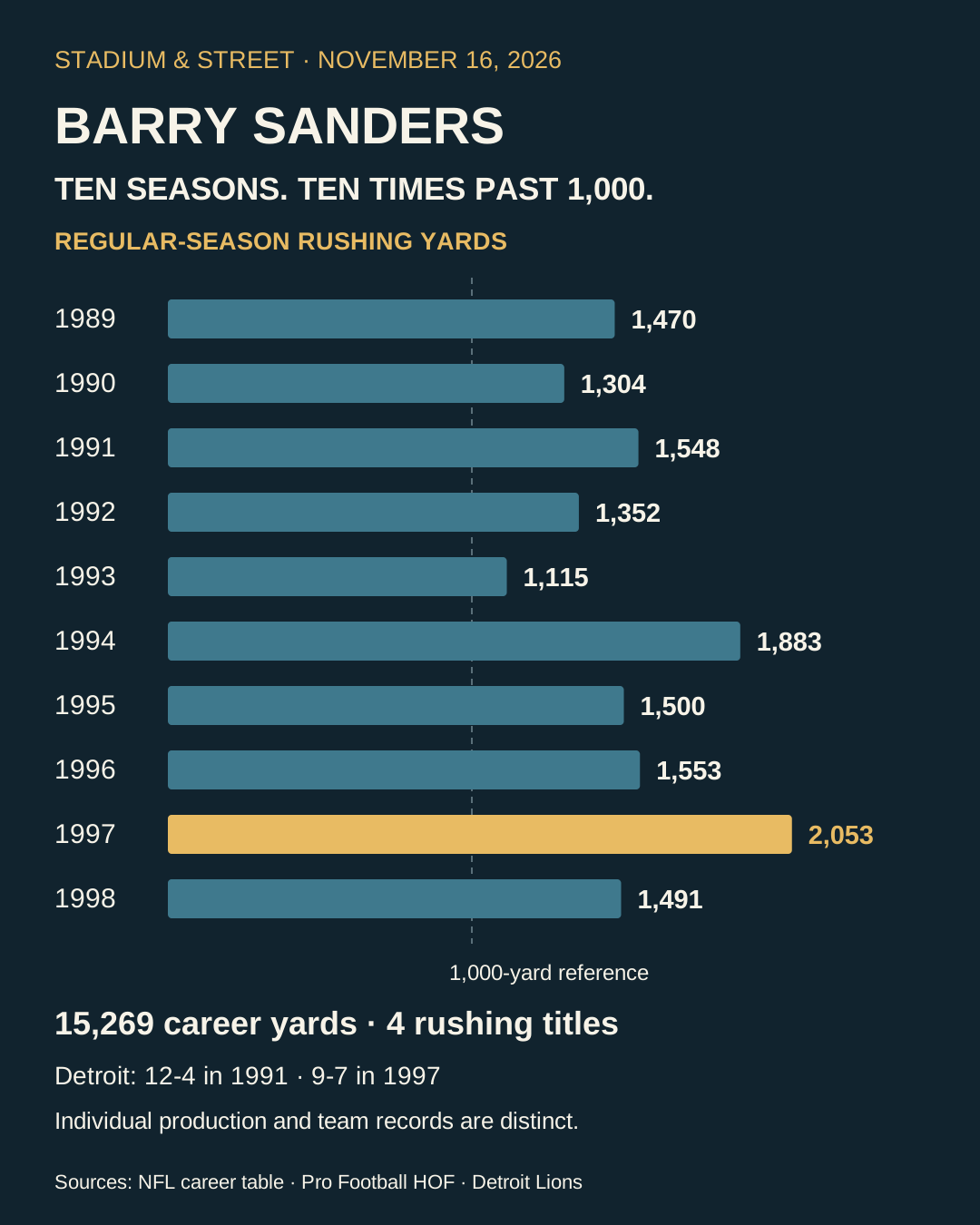
Barry Sanders ran for 2,053 yards in 1997. Detroit finished 9-7 and lost its first playoff game. His career forces a useful question: how much of a team’s ceiling should be charged to the player doing the most to raise it?
The NFL credits Sanders with 15,269 rushing yards on 3,062 carries in 153 regular-season games. The Pro Football Hall of Fame records a 1,000-yard rushing season and a Pro Bowl selection in each of his ten years. His four rushing titles came in 1990, 1994, 1996 and 1997. The achievement rests on a decade of production.
The absence of a Super Bowl championship belongs in the account of his career. Making it the decisive measure of his ability requires a further claim: that a running back can be held responsible for the whole chain of events that produces one. That claim asks one position to answer for much more than it controls.
A runner can create yards after a blocking plan breaks down. The next possession can still depend on a quarterback’s third-down throw, a cornerback’s coverage or a field-position exchange. A ring count compresses those different responsibilities into one grade and assigns it to every player.
Detroit deserves an accurate history, too
The counterargument begins with a necessary correction. Sanders did not spend ten seasons surrounded by uniformly hopeless teams. Detroit's own history identifies the 1991 club as a 12-4 division champion that reached the NFC Championship Game. The Lions went 10-6 in 1995. Their 1997 playoff berth was their fifth in seven years.
Calling every one of those teams bad erases good teammates and turns context into an excuse that cannot be tested. It also weakens the case for Sanders. His achievement is large enough to survive a fair description of the help he received.
Postseason performance should be examined. A player's decisions and execution in those games matter. What does not follow is that the final team result supplies a complete explanation of them. A fair comparison starts with what happened on the field, then asks how much responsibility the player actually carried. It does not begin with the trophy case and work backward toward a verdict.
A season that exposes the shortcut
In 1997, Sanders gained 2,053 yards on 335 carries, an official average of 6.1 yards. He added 305 receiving yards. Detroit still had to rally from 4-6 to reach the playoffs at 9-7, according to the team's retrospective by Mike O'Hara. The season ended with Tampa Bay winning 20-10.
That sequence allows two truths to stand. Sanders produced an extraordinary regular season. Detroit's postseason ended quickly. Neither fact cancels the other, and neither tells us what would have happened had he played behind a different line or alongside another quarterback. Imaginary championships are no more useful than automatic deductions for the ones he did not win.
The better standard is demanding and specific: production, efficiency, longevity, the work assigned to the player and his execution when the stakes rise. Team success adds evidence. It should not erase the rest of it.
Sanders does not need an invented alternate career to establish his place in football. The real one contains ten thousand-yard seasons, four rushing titles and a 2,000-yard year. If a comparison still turns chiefly on the missing ring, it is the comparison that needs more work.
Go to the sources
See something that needs attention? Read our corrections process.