Opinion · New York Knicks
The Knicks gave New York a championship. Ownership owes them a real chance at another
October 19, 2026 · Before opening night
When the Knicks raise their championship banner on October 20, they will be putting a year in the rafters that several generations of New Yorkers had stopped expecting to see.
The previous title came in 1973. Fifty-three years passed before the Knicks won another. That is a basketball drought long enough to become part of a family's history.
For an older fan, 2026 may sit beside memories of Willis Reed and Walt Frazier. For someone who grew up with Patrick Ewing, it may finally soften the ending of a story that always seemed to stop one round, one game or one shot too soon. For a child who discovered this team through Jalen Brunson, the Knicks will begin as champions. There is something lovely about that difference. The youngest fans will not have to inherit all the waiting before they inherit the joy.
The championship belongs to all of them. The responsibility for what comes next belongs to the people running the franchise.
That is why the question for James Dolan is larger than whether he enjoyed winning one. Of course the celebration mattered. The question is whether his rules for spending and the club's handling of its players will give this team a serious chance to win another.
What these Knicks earned
New York finished the regular season 53-29, third in the East, with the league's fourth-ranked offense and seventh-ranked defense. Good enough to contend. Nothing about those standings promised the spring that followed.
Mike Brown's team had already won the NBA Cup in December, beating San Antonio 124-113. The February addition of Brooklyn-born Jose Alvarado brought another guard into the effort. This was a season of building, testing and adjusting, not merely waiting for Brunson to rescue the ending.
The playoffs required another step. Atlanta took a 2-1 lead. New York won the next three.
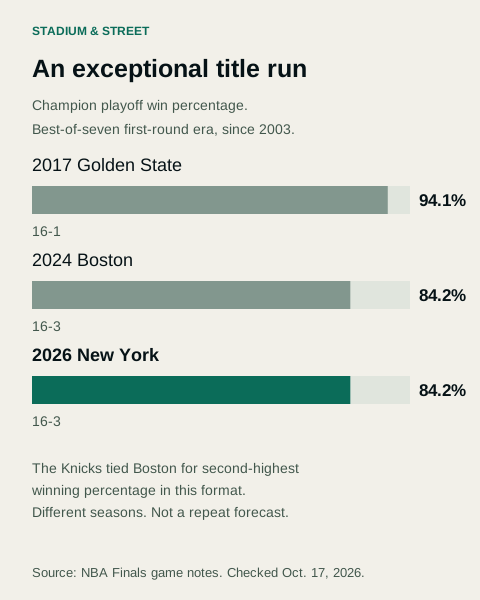
The series record: First round, Atlanta, Won 4-2; Conference semifinals, Philadelphia, Won 4-0; Conference finals, Cleveland, Won 4-0; NBA Finals, San Antonio, Won 4-1; Full postseason, 16 wins, 3 losses.
They could overwhelm an opponent and still have to survive a frightening night. Game 4 of the Finals required a 29-point comeback and ended with OG Anunoby's winning tip-in. In the clincher, Brunson scored 45 as New York won 94-90. The final postseason margin was plus-283 points, an NBA record. Those are the dimensions of an exceptional run, not a championship that needs to apologize for itself.
Brunson, Karl-Anthony Towns, Anunoby, Mikal Bridges, Josh Hart and the players around them have earned a permanent place in the franchise's story. That includes the less celebrated work of Miles McBride and the reserves. Another title would add to what they did. It would not make the first one count more.
Nor does their victory diminish the Knicks who could not finish the trip. Ewing's teams reached the Finals in 1994 and 1999 without winning them. Those seasons still meant something. A franchise's history contains more than the years it can print on a championship banner.
A city could share the moment
June's celebration reached beyond the Garden. The city organized a parade through lower Broadway and a City Hall ceremony. Fans filled the Canyon of Heroes, and players received keys to the city. This was a basketball achievement that became a public occasion.
It does not require a claim that New York has never come together like that before. This city has celebrated other champions, including the Liberty and NYCFC in recent years. The Knicks' particular gift was to let people carrying very different basketball memories share the same happy ending.
For one family, a championship can close a conversation that has lasted decades. For another, it can begin one. Sports cannot mend every division in a city. Sometimes they can give strangers something uncomplicated to smile about on the same train home.
That is worth protecting. It should also make ownership more accountable, not less.
The apron deserves an argument, not an alibi
Dolan's June appearance on WFAN set out the tension: he wanted the team back while avoiding the second apron. That is a defensible position to examine. It is not, by itself, proof that he is satisfied with one championship.
The second apron is a roster-building threshold under the NBA's collective bargaining agreement, not simply a second income-tax bracket. Crossing it can restrict the tools a front office uses to improve a team. Among the limits are salary aggregation in trades and access to the taxpayer mid-level exception. There are also future draft-pick consequences under specified conditions. Spending more does not remove those restrictions. Certain transactions can impose a hard cap for that cap year, too. The policy question is how New York plans successive seasons, not whether Dolan can undo a binding restriction by paying a tax.
That is the strongest case for restraint. A championship organization should consider how it will replace aging players, cover injuries and keep improving. Paying every requested price can make a good roster harder to repair.
But a blanket refusal to cross a line also has a basketball cost. Keeping flexibility is useful only if it helps preserve or improve the chance to win. Losing a difficult-to-replace player in order to remain flexible can defeat the purpose.
Fans deserve to hear which cost ownership believes is greater, and why. The answer should identify the basketball tradeoffs. It should not ask the word "apron" to end the conversation.
The 2026-27 league thresholds, in millions of dollars: Salary cap $164.961; Luxury-tax level $200.428; First apron $209.015; Second apron $221.686.
These are league thresholds for this season, not the Knicks' actual payroll or a projection of next year's limits. An extension's future salary belongs in the appropriate future season.
Contract talks involve people
On October 9, the Knicks postponed extension negotiations until "later in the season." That wording matters. The club did not announce a season-long refusal to talk. Towns, Hart and McBride are among the players affected.
There is another distinction worth making. A pause in discussions and a deadline for signing are different things. The CBA limits when certain veteran extensions can be completed, and option years matter. "Later" is not a promise that every player's existing deal can simply be extended on any convenient winter afternoon.
The club can reasonably want its attention on basketball. A player can reasonably want clarity about where he fits after helping deliver a championship. Neither desire is an insult to the other.
The risk is that a public promise of focus leaves a private question unanswered. If a player feels the organization sees his future differently from the way he does, that can complicate a working relationship. It does not establish that he will defend less, miss more shots or stop trusting a teammate.
Hart has publicly said he is not stressed about the pause. His stated view belongs in the discussion, particularly when the temptation is to diagnose a locker room from outside it.
A poor shooting week will not prove that contracts damaged the team. A good one will not prove the questions disappeared. Health, opponents, roles, lineup combinations and ordinary shooting variation will still matter. Anyone who wants to blame negotiations for a losing streak owes readers more than a theory that fits the score.
Ownership nevertheless has a responsibility to communicate honestly and privately with the people carrying its ambitions. A respectful explanation is not a concession of every negotiating point. It is part of running a team.
Gratitude and expectation can coexist
New York can be impatient. But Yankees fans, Mets fans and Knicks fans are not one person with one breaking point. Their frustration is not a laboratory test that tells us exactly how this season will feel.
The danger for the Knicks is more specific. If ownership makes avoidable choices that weaken a genuine contender, fans will have reason to object. The championship will remain precious. It will not make every subsequent decision wise.
Dolan does not owe the city an agreement at any price. He owes it a convincing effort to keep a championship window open, and a basketball explanation when he chooses a financial boundary that narrows the options.
On Tuesday, the players should have their evening. So should the coaches, the former Knicks who carried the story and the fans who stayed with it. Let them look up and take in a year that will never have to be explained away.
Then the next season begins.
The banner will be there for good. The opportunity to win with this group will not.
Go to the sources
See something that needs attention? Read our corrections process.