NBA · News & analysis
The NBA's prediction-market deals come with safeguards, not a safety guarantee
October 26, 2026 · League announcement
The NBA brought prediction markets further inside its commercial business on Monday, naming Kalshi and Polymarket preferred exchanges while announcing an information-sharing agreement with the Commodity Futures Trading Commission. The league is presenting the arrangements as a way to improve oversight. They also give the companies new ways to market themselves alongside basketball.
Those two purposes deserve to be examined separately. Access to league branding can make an operator more visible to fans. A requirement to share suspicious-trading information can help the league investigate a problem. Neither establishes that a particular trade is safe, or that the announced protections have already proved effective.
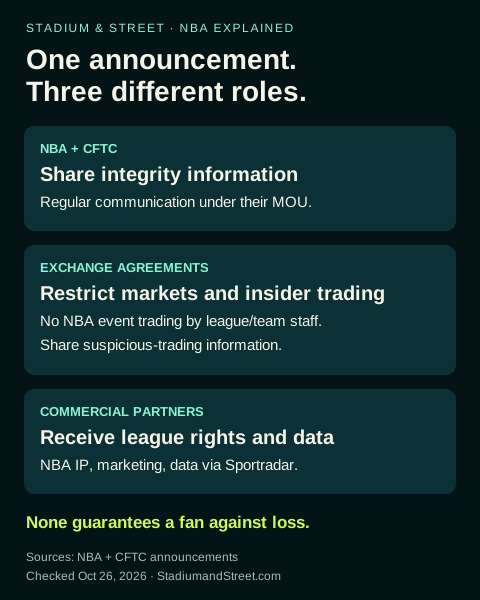
The league says its exchange agreements restrict the markets that can be offered, prohibit league and team personnel from trading NBA event contracts, and require information sharing about investigations and suspicious activity. These are concrete obligations to watch, rather than a reason to assume the integrity question has been settled.
What each agreement does
The CFTC separately confirmed that it signed a memorandum of understanding with the NBA. Its October 26 release describes regular communication and information sharing concerning basketball integrity and fair, transparent prediction markets. That regulatory cooperation is distinct from the league's commercial relationships with individual operators.
Under those commercial relationships, Kalshi and Polymarket receive rights to NBA intellectual property, U.S. marketing and promotional activity, and official league data supplied through Sportradar to operate and settle authorized markets. The NBA also says it has expanded its DraftKings agreement to cover prediction markets. Further operator agreements are planned, not yet established by that announcement.
The announcement says authorized operators' restrictions will align with the NBA's latest sports-betting restrictions. It does not publish a complete market-by-market list, a detailed enforcement timetable or the full contracts. Readers should not mistake the partnership label for a description of every permitted product or a ruling about access in every jurisdiction.
The test is what happens when something looks wrong
There is a serious argument for cooperation: an exchange that must provide information can give investigators a better view of unusual activity than one outside that relationship. The practical test will be whether those obligations produce timely alerts, useful investigations and meaningful responses. A press release cannot establish that record in advance.
There is also a tension the league should not hide behind the language of fan engagement. It is helping promote products while promising to police risks connected to its games. Fans should be able to understand both sides of that arrangement, including the limits of what has been disclosed.
The NBA and WNBA's October 13 announcement of a responsible-gaming campaign supplies an important qualification. It warns that both sports betting and prediction markets put money at risk and should not be treated as a way to generate income. That earlier warning remains relevant after Monday's deal. League affiliation does not remove the possibility of financial loss.
For basketball fans, the distinction is straightforward: official data, commercial endorsement and effective safeguards are different things. The new agreements describe how the first two will work and promise obligations for the third. Their performance still has to be demonstrated.
Go to the sources
See something that needs attention? Read our corrections process.