Opinion · Cooperstown Court
Pettitte belongs. Posada and Williams fall short. Three Yankees, three Hall cases.
November 2, 2026
Andy Pettitte would get my Hall of Fame vote. Jorge Posada and Bernie Williams would not. Those are three judgments about three careers, even if the memories tend to arrive together.
The strongest argument for this Yankees trio begins with the work each man did. Pettitte supplied years of rotation stability. Posada put a middle-of-the-order bat behind the plate. Williams gave New York an exceptionally productive hitter in center field. A fair hearing has to identify what each contribution was worth, then compare it with substantial elected peers.
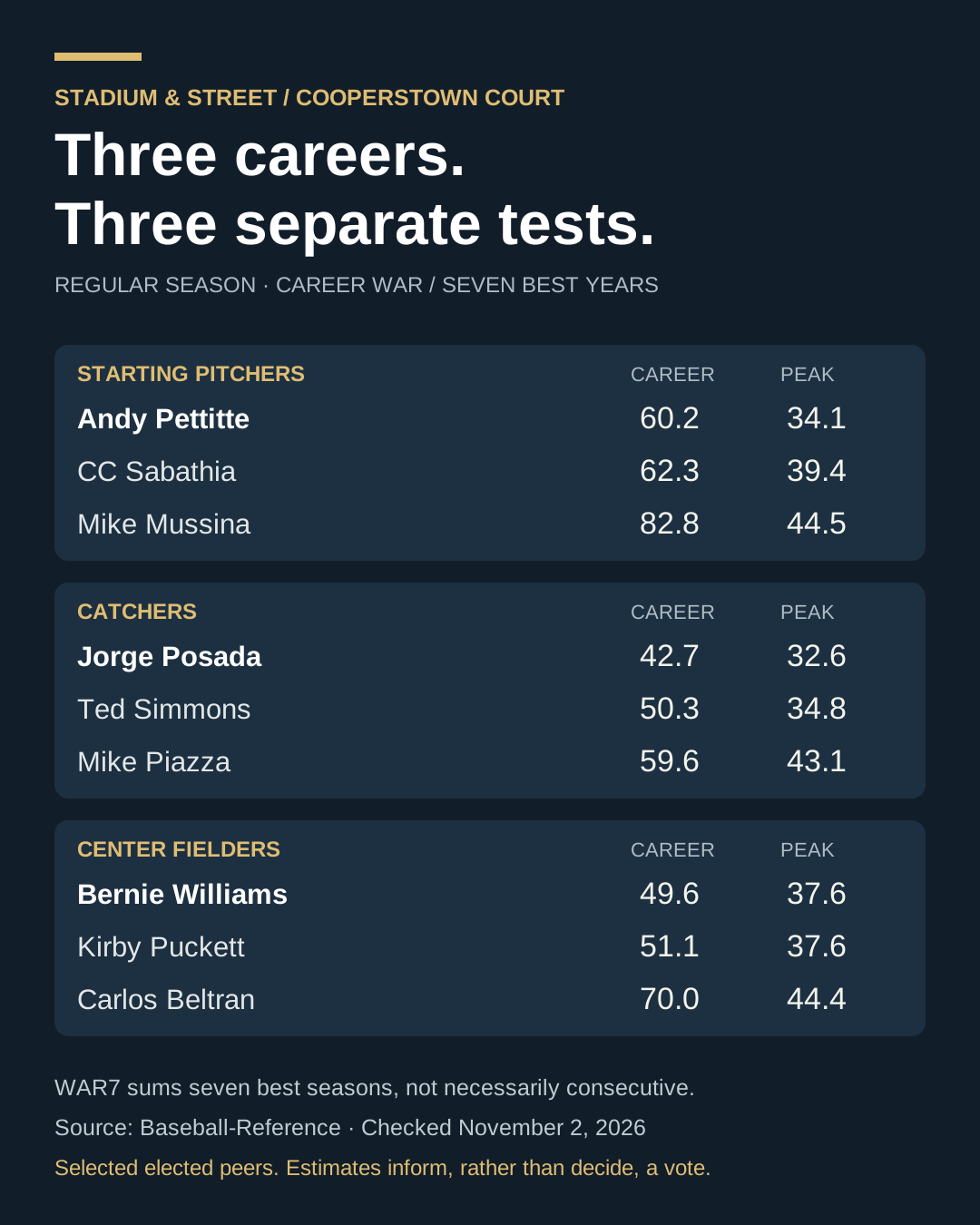
For that comparison, Baseball-Reference’s WAR estimates career value above a replacement-level player. WAR7 adds a player’s seven best seasons, which need not be consecutive. The figures here cover regular seasons. They are useful estimates, not an election formula. Postseason performance and the Hall’s character criterion require separate judgments.
Pettitte: a narrow yes, with the admission in the record
Pettitte’s 60.2 career WAR and 34.1 WAR7 describe sustained excellence more clearly than overwhelming peak dominance. Mike Mussina, at 82.8 and 44.5, supplies an important upper comparison. CC Sabathia, at 62.3 and 39.4, is closer in career value and still stronger at his peak. A Pettitte vote should acknowledge those differences rather than pretend that all long, successful careers are interchangeable.
Pettitte’s additional case is the scale of his postseason contribution: 44 starts, 276 2/3 innings and a 3.81 ERA. That workload belongs in the evaluation. It is a substantial body of performance outside the regular-season totals in the chart.
The opportunity objection is powerful. Teams create playoff appearances, and the expanded postseason gives recent pitchers more chances than their predecessors had. Nineteen playoff wins cannot be treated as nineteen isolated demonstrations of greatness. My vote rests on the innings and the quality of the work, added to an already strong regular-season career. I would not manufacture an extra WAR total or pretend that every October inning was equally difficult.
There is also a fact that must stay in the argument. The congressional hearing record describes Pettitte’s acknowledgment of HGH use in 2002 and 2004. The Hall’s voting rules explicitly include integrity, sportsmanship and character. An admission makes the conduct part of the established record; it does not erase it.
My position is that acknowledged use should weigh against a candidate without creating an automatic exclusion for every player with documented use. That standard must apply beyond Pettitte. His disclosure cannot become a special exemption for a familiar Yankee, and this record cannot tell us how many runs or wins the drug changed. I would vote for him after weighing the conduct, not by declaring it irrelevant.
The strongest no vote therefore has two coherent grounds: a peak below stronger elected contemporaries, and a character standard that treats his admitted use as disqualifying. I respect the first objection and reject an automatic version of the second. His regular-season foundation and unusually large, effective postseason workload bring him across my line, narrowly.
Posada: the position strengthens the case, but does not finish it
Posada’s 121 OPS+ means his adjusted on-base-plus-slugging performance was 21 percent above the league baseline. That is a valuable bat anywhere and an especially useful one at catcher. Comparing him with first basemen would obscure the position’s demands. Comparing him only with the weakest elected catcher would obscure the Hall’s demands.
Ted Simmons is the serious favorable comparison. Posada’s 42.7 career WAR and 32.6 WAR7 trail Simmons’ 50.3 and 34.8. Their peaks are much closer than their career totals. Mike Piazza, at 59.6 and 43.1, shows how much further an exceptional offensive catcher can move the overall case.
The Simmons comparison gives Posada’s supporters a real argument: a relatively small peak gap, a scarce offensive skill at a demanding position and a role that helped a team build strong lineups. The countercase is that the shorter accumulation of value remains meaningful. I do not find a sufficiently large peak advantage elsewhere to offset it.
Historical catcher defense also deserves humility. Receiving and game-calling are not completely captured by a single career number. But uncertainty does not entitle us to invent the missing value necessary to reach a preferred verdict. Posada’s case merits more consideration than a quick dismissal of his totals. I still land on no, because the elected comparisons offer either substantially more career value or a stronger peak.
Williams: the Puckett comparison deserves an answer
Williams’ supporters have an unusually direct comparison in Kirby Puckett. Williams finished with 49.6 career WAR and 37.6 WAR7; Puckett had 51.1 and the same 37.6 peak total. A claim that Williams simply lacked a Hall-level peak has to confront that resemblance.
Williams also had a 125 OPS+, slightly above Puckett’s 124. His offense was the foundation of his candidacy. The favorable comparison is close enough that a yes vote can be reasoned rather than sentimental. It is the strongest challenge to my verdict on him.
The wider center-field comparison leads me the other way. Carlos Beltran’s career and peak totals are 70.0 and 44.4. Andruw Jones’ are 62.7 and 46.4. Both were elected this year. Williams’ bat keeps him in the discussion; his overall career does not supply their combination of sustained value and peak strength.
That distinction matters because center field includes more than hitting. I would not use an offensive rate alone to put Williams ahead of players whose value was distributed differently across batting, baserunning and defense. Nor would I make Puckett’s election a rule requiring every statistically nearby player to follow him. An elected comparison can establish plausibility without establishing a universal floor.
My no is consequently less comfortable than a simple ranking makes it appear. Puckett is a substantial counterexample, not an inconvenient name to omit. Williams has a defensible Hall case. I favor a higher combination of career and peak value for this election judgment, and the broader set of center-field peers leaves him short.
The paths from here
Pettitte received 206 of 425 votes, or 48.5 percent, in his eighth BBWAA election in 2026. Election requires 75 percent. Posada and Williams are no longer on the writers’ ballot. Their potential route is the Contemporary Baseball Era player process, whose next election is scheduled for December 2028 for the Class of 2029. Consideration is not a guaranteed place on that ballot.
The dynasty gives these careers a shared setting. Cooperstown still requires an individual decision. Pettitte’s extra body of October work moves a substantial career across a narrow line for me. Posada’s positional case and Williams’ Puckett comparison make their hearings worthwhile, but do not change my votes. All three deserve arguments that explain the choice.
Go to the sources
See something that needs attention? Read our corrections process.