Opinion · Golf
The PGA Tour should publish a return path that applies beyond its biggest names
November 9, 2026
LIV Golf’s announced wind-down gives the PGA Tour a decision it should make in public: what must a player do to return, and what can he expect if he meets those terms?
The answer should be a published route with consistent requirements, an application deadline and a clear distinction between permission to compete and a place in a tournament. A famous name can help sell an event. It should not be the explanation for the rules governing that event.
On November 5, LIV said its proposed BC Partners recapitalization would not proceed after the restructuring agreement was terminated. It intends to wind down operations while continuing to consider alternatives. The players’ return applications would be a separate decision for the PGA Tour.
The Tour has already shown how a return can carry a defined cost. Its 2026 handbook describes a Returning Member category for a narrow group of recent major or Players champions, with an application window that ended February 2. The category applies to the 2026 season. It permits prize money but excludes specified bonus, earnings-assurance and recurring-equity benefits for five years. It also adds returning members above the normal field size when they qualify through that exemption.
An Associated Press report published by Golf Channel on November 8 describes the broader return route as unresolved, including the effect of existing restrictions and players’ contracts.
Those provisions are a dated precedent. A wider policy now would require a new decision. The useful lesson is that membership, tournament entry and financial benefits can be addressed separately.
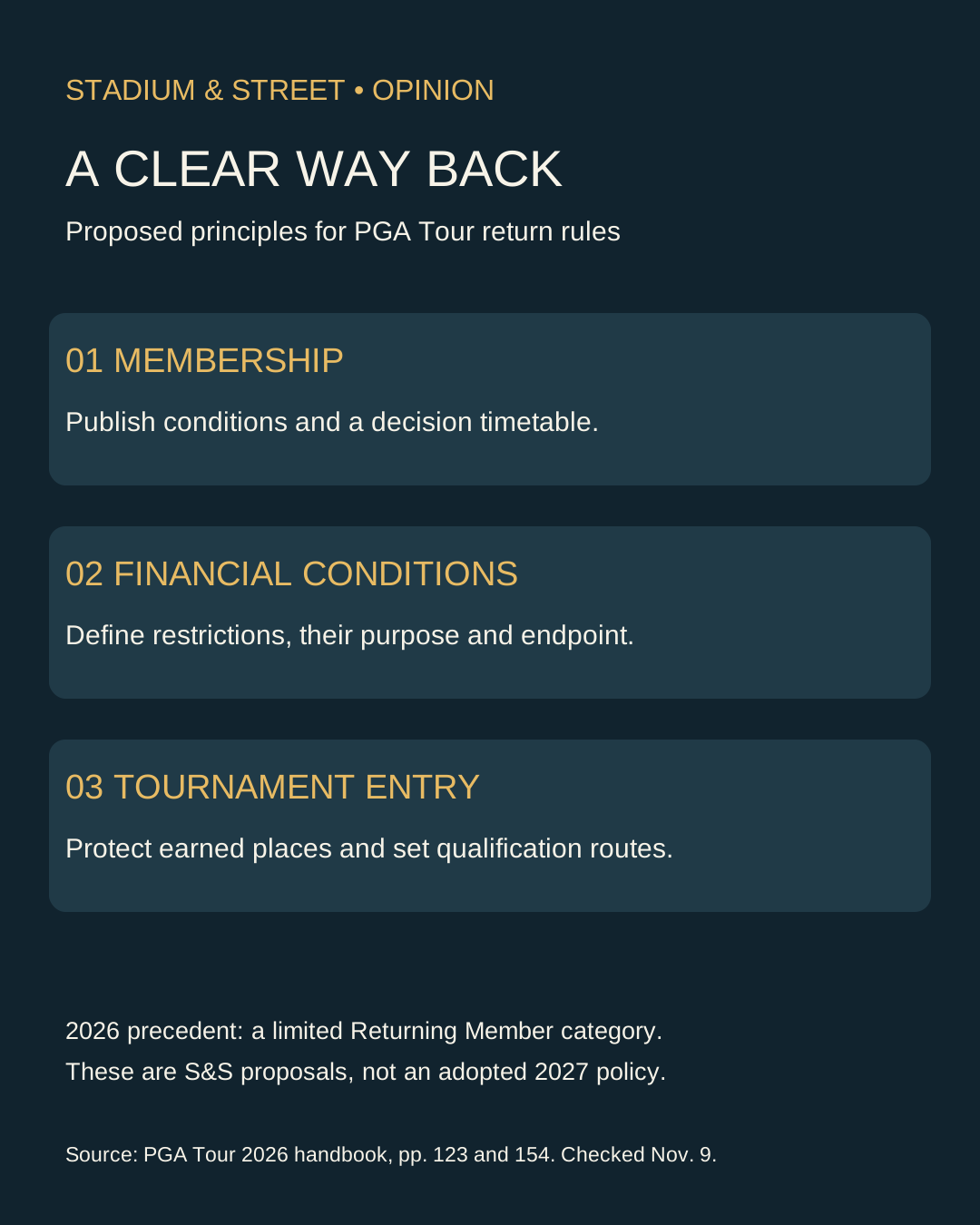
Three decisions, made in public
Start with membership. The Tour should state the conditions for an application, the consequences of a player’s particular status and the timetable for a decision. A published route need not erase a suspension, revive an expired exemption or settle a private contract. It should let similarly situated players understand why the same rule produces the same result.
Then address the money. Members who stayed have a serious claim to fair treatment. A return policy that lets a departing player collect outside guarantees and immediately receive every benefit built by the remaining membership would invite an obvious objection. The Tour should identify any financial restrictions in advance, explain their purpose and set an endpoint. A consequence is easier to defend when it can be completed, rather than renegotiated whenever a popular player becomes available.
Finally, protect the competition for places. Eligibility to seek a start should not automatically confer an exemption. A player with no valid entry category should have to qualify through an announced route. If the Tour chooses temporary additional places, it should publish how many, for how long and which events can accommodate them. Field expansion has practical costs, including daylight and pace of play. It cannot become an unlimited promise.
The strongest objection deserves an answer
The strongest case against reopening a path is about incentives. Players made choices under known restrictions. Making a return easier after the alternative business falters could teach the next generation that the safest financial strategy is to leave, then ask for an exception.
That concern deserves more than a ceremonial penalty. It supports meaningful conditions, protection for earned exemptions and a rule against repeated exits and returns. It also argues for deciding the policy before negotiating individual applications. Quiet exceptions for the most marketable players would weaken the deterrent while making equal treatment harder to defend.
Fans have an interest too. A tournament’s meaning comes partly from who can enter and how that opportunity was earned. Keeping a strong player out indefinitely can diminish the field; admitting him by a special arrangement can diminish trust in the route everyone else followed. A transparent, finite process lets the Tour explain its choice in competitive terms.
The PGA Tour can protect the people who stayed and still define a way back. It should publish the conditions, apply them consistently and let the resulting golf determine who belongs in the field.
Go to the sources
See something that needs attention? Read our corrections process.