Soccer · Hall of Fame
Altidore, Ertz and Rapinoe lead a Hall class that reaches beyond the national teams
November 13, 2026
Jozy Altidore’s first MLS goal came as a 16-year-old Red Bull, struck from 28 yards against Columbus. David Beckham’s first MLS start came against the same New York club, in a nine-goal match before 66,237 at Giants Stadium. Their American soccer stories intersected in the region long before Thursday’s Hall of Fame announcement put them in the same class.
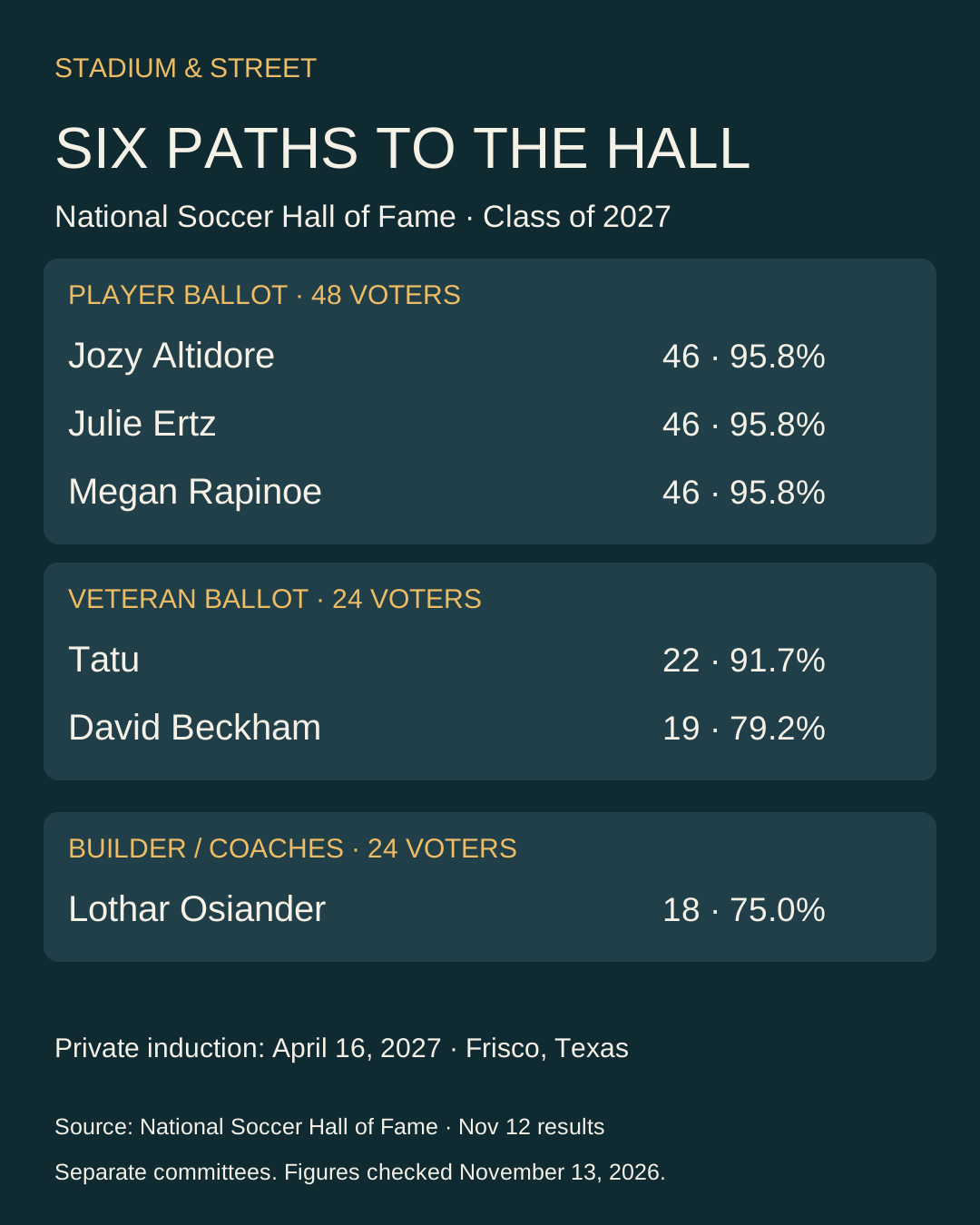
Altidore, Julie Ertz and Megan Rapinoe were elected in their first year on the Player ballot. Beckham and indoor star Tatu enter through the Veteran category, while coach Lothar Osiander takes the Builder place. The National Soccer Hall of Fame will induct the six on April 16, 2027, in a private ceremony at Toyota Stadium in Frisco, Texas.
Three first-ballot players, each with 46 votes
Altidore, Ertz and Rapinoe each appeared on 46 of 48 Player ballots, or 95.8 percent. The category elected three players. Their identical totals describe the vote; their careers supply three different reasons for it.
Altidore scored 42 goals in 115 U.S. appearances, third on the men’s national team’s career list. His opening goal against Spain in the 2009 Confederations Cup semifinal helped produce a 2-0 upset. At club level, his winning goal in the 2017 MLS Cup final earned the game’s MVP award and completed Toronto’s treble. The early Red Bulls promise developed into important goals for both club and country.
Ertz helped win two World Cups from different positions. She played center back in 2015, when the United States conceded three goals in seven matches, then operated in defensive midfield during the 2019 title run. Her 123 caps and 20 goals were accompanied by U.S. Soccer’s player-of-the-year awards in 2017 and 2019. Moving forward in the formation gave her a different way to control danger before it reached the defense.
Rapinoe finished with 203 caps, 63 goals and 73 assists. The 2019 World Cup supplied both the Golden Ball and Golden Boot, alongside her second world title. She also won Olympic gold in 2012. Her production explains the football case: she created chances, finished them and repeatedly supplied decisive contributions on the largest stage.
Beckham and Tatu represent different American stages
Tatu received 22 of 24 Veteran votes, 91.7 percent; Beckham received 19, or 79.2 percent. Keeping those denominators beside the totals matters. Their vote counts came from a smaller committee than the Player ballot.
Beckham’s Galaxy years helped establish the Designated Player era. He recorded 18 goals and 38 assists in 98 regular-season MLS appearances and won the 2011 and 2012 championships. The Giants Stadium debut was an early demonstration of the attention he could attract: New York won 5-4, and Beckham had two assists. The eventual titles gave his American playing chapter a competitive conclusion.
Tatu’s career preserves a part of the sport that a national-team-centered history can overlook. Across 21 years, he scored 857 regular-season indoor goals and helped the Dallas Sidekicks win four championships. He was the Major Indoor Soccer League’s MVP in 1987 and 1990. Recognizing that career gives the indoor game its place in the broader American record.
A coach completes the class
Osiander received 18 of 24 Builder votes, 75 percent, in the coaches’ rotation. He led the U.S. men from 1986 to 1988 and coached the Olympic teams in 1988 and 1992. His domestic work included U.S. Open Cup titles with the San Francisco Greek-Americans in 1985 and 1994 and taking the Galaxy to the first MLS Cup final in 1996.
Together, the six careers connect World Cups, Olympic teams, the early years of MLS, indoor arenas and the club game that preceded the league. That range makes the class more revealing than a list of famous names. It shows how many different settings have contributed to American soccer’s history.
Go to the sources
See something that needs attention? Read our corrections process.