MLB · Reported agreement
Cubs’ reported six-year Sato deal is a $120 million bet on power translating
November 24, 2026 · Club announcement pending
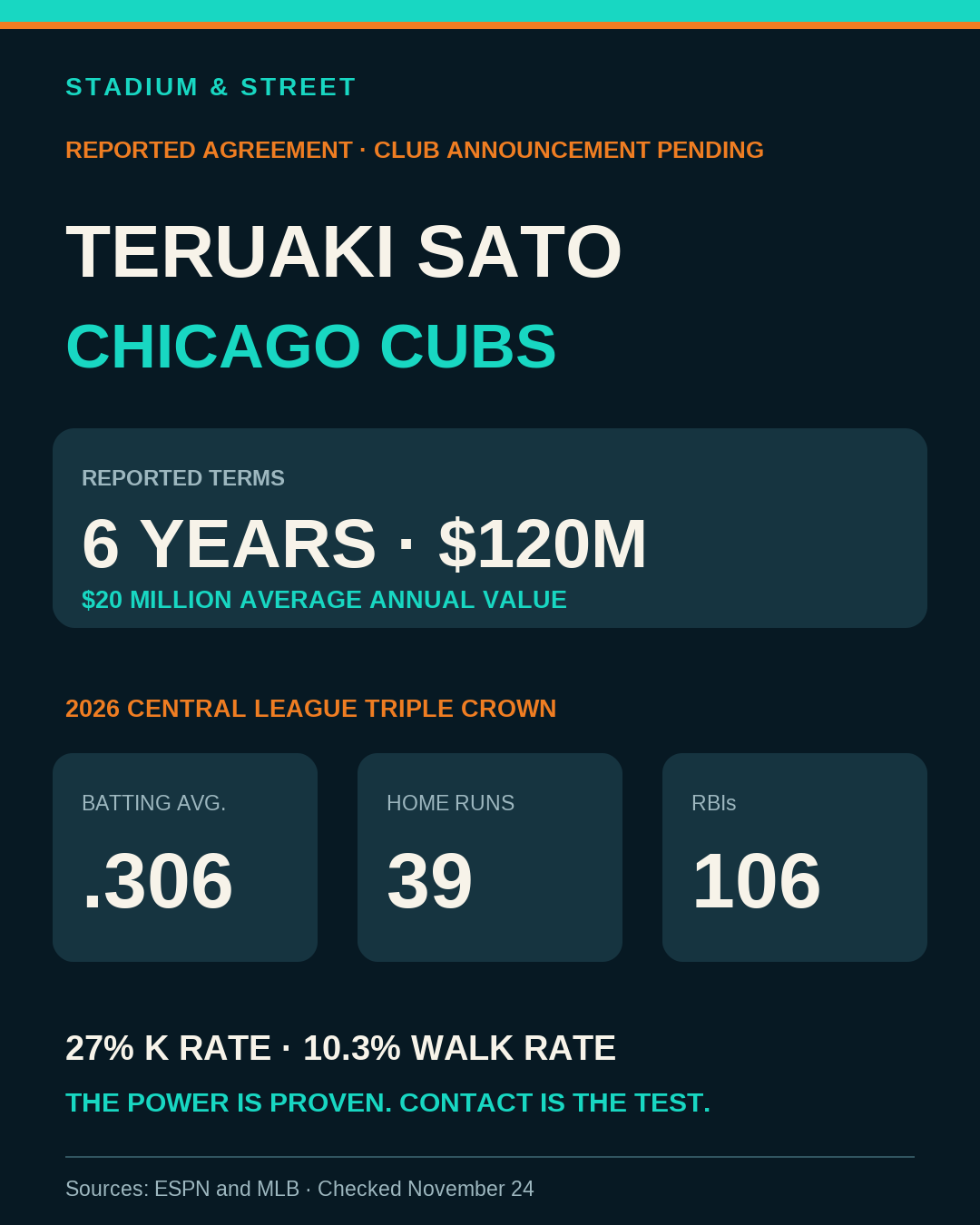
Teruaki Sato and the Chicago Cubs are in agreement on a six-year, $120 million contract, sources told ESPN’s Jeff Passan on Tuesday. Passan reported that the 27-year-old is expected to play corner outfield in Chicago. The $20 million average annual value pays for a left-handed bat that has already conquered Japan’s Central League.
The Cubs had not announced the move at the publication check, and their November transaction register did not yet list Sato. That makes this a reported agreement rather than an official club transaction. A physical and the final contract filing can still separate an agreement from a completed signing.
The attraction is not subtle. Sato won the 2026 Central League Triple Crown for the Hanshin Tigers by batting .306 with 39 home runs and 106 RBIs. He also hit 40 home runs with a .924 OPS in 2025, when he won his first league MVP award. Two seasons of top-end power make this more than a bet on one hot year.
Power is not the projection
Chicago is also buying a different lineup shape. Sato has been a third baseman by trade, but MLB noted that he has played 262 games in the outfield in Japan. Passan’s expected corner-outfield assignment would move the bat away from Alex Bregman’s position and into an area the Cubs entered the offseason needing to address.
The reported terms are aggressive without asking Sato to be the most expensive hitter on the market. Six years give Chicago his age-28 through age-33 seasons. The $20 million annual rate leaves room for considerable value if the home-run production survives the move, but the length makes a failed transition costly.
Contact is the dividing line. MLB’s posting analysis put Sato’s strikeout rate at 27 percent over the last two NPB seasons, alongside a 10.3 percent walk rate. Major League pitchers will challenge him with greater velocity and sharper breaking pitches. If the strikeouts climb while the walks hold, the power can still carry the profile. If both parts move the wrong way, the contract becomes harder to support.
The contact test comes next
There is also a defensive question. A corner-outfield role lowers the pressure on Sato’s infield throwing, but it raises the offensive standard. Chicago does not need him to win a Gold Glove there. It does need enough range and reliability to keep the bat in the lineup without turning him into a permanent designated hitter.
The Cubs are paying for established force and accepting that force is not the same thing as certainty. Sato has already produced consecutive seasons that few hitters in Japan can match. The next test is whether his swing decisions and contact survive a league built to attack them. First, the reported agreement still has to become an official Cubs transaction.
Go to the sources
See something that needs attention? Read our corrections process.