Team analysis · 2027 roster planning
The Blue Jays need power, then innings: the full 2027 review
October 30, 2026 edition · Acquisition amendment November 1
The complete review
October 30, 2026 edition. Completed 2026 regular-season performance; current roster and market checks October 30. Acquisition prices and playing-time plans are the author’s proposed limits and scenarios. November 1 acquisition amendment now precedes the preserved original analysis in this download. This amendment controls conflicting acquisition priorities; the original roster-check date remains unchanged.
Read the Blue Jays review with amendment (PDF, 26 pages) → · 234 KB
Preserved original edition (before the November 1 acquisition revision)
Updated
November 1 acquisition amendment
Toronto's case for Suzuki remains coherent: the report describes the league's lowest-scoring offense despite very few strikeouts, with a need for more productive contact and power. Kwan's contact, on-base skill and defense answer a different question. He should not be substituted into a Suzuki budget while leaving the original power expectation unchanged.
The report's Plans A and B both depend on the same batting acquisition. They are alternatives for allocating pitching money, not independent solutions if Suzuki signs elsewhere. If that bat cannot be obtained within the $20-24 million annual allocation, hold the batting money, reopen the impact-bat search and use the existing no-acquisition playing-time case without crediting a purchased offensive gain.
Decision: retain the Suzuki inquiry and the separate conditional Michael King pitching case. Preserve prospect capital. Do not promote Kwan to the centerpiece merely because another club acquires Suzuki, or describe the internal fallback as an equivalent contender.
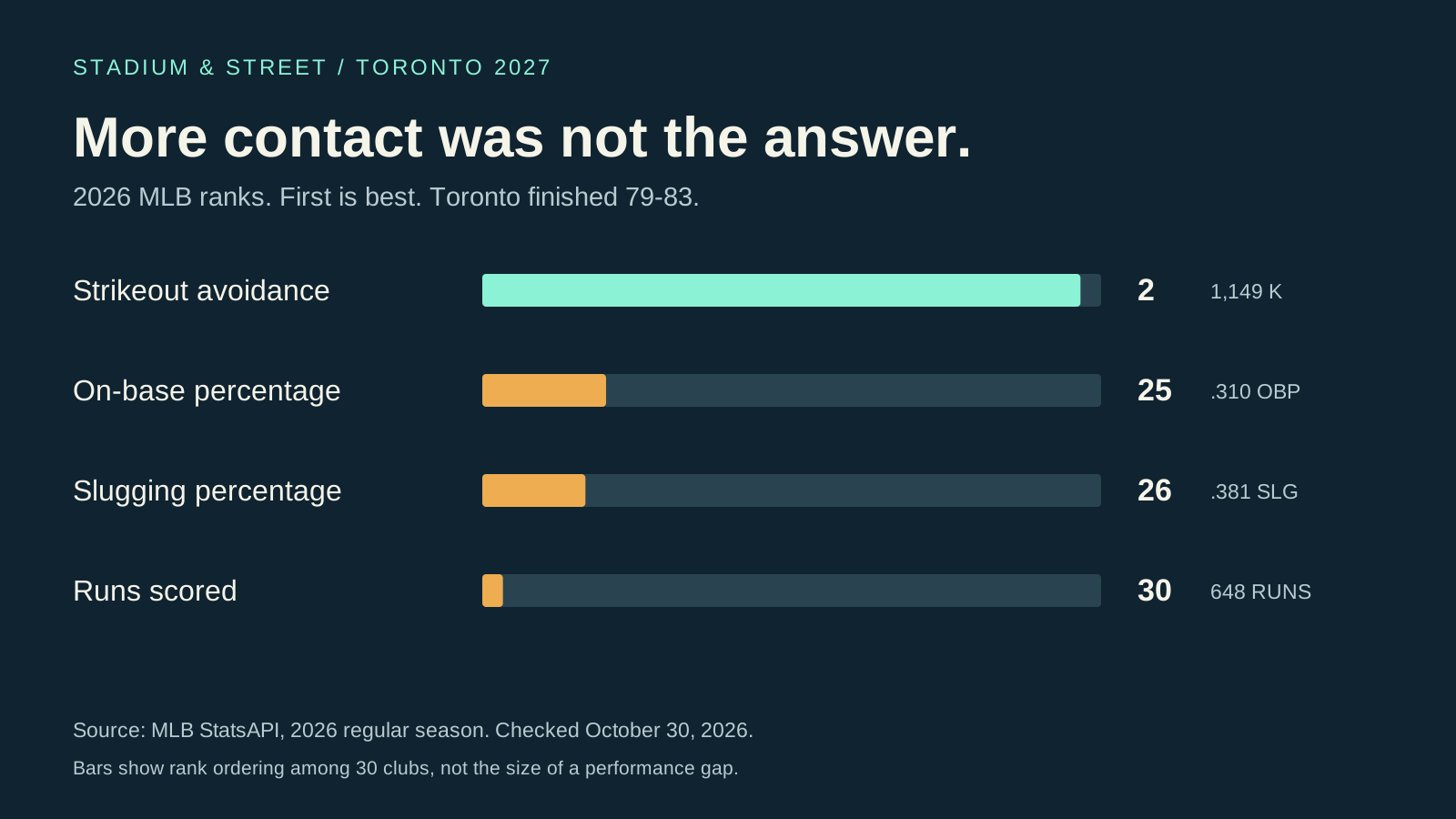
Toronto struck out less often than 28 other major-league clubs in 2026. It still finished last in runs and home runs. That is the starting point for a useful Blue Jays offseason: contact was already there. Too much of it produced too little.
The recommendation in this independent review is a targeted retool. Buy a substantial corner-outfield bat, add credible starting innings and preserve the young players who could make the roster less expensive and more adaptable over time. The full dossier above contains the current player register, lineup, range defense, catching, farm depth, contracts, workload allocation and three financial alternatives.
The 79-83 finish left Toronto five games behind the final wild-card place. Its minus-46 run differential offers a less forgiving view. Scoring 648 runs while allowing 694 is a real deficit to repair. A useful signing can be swallowed by regression elsewhere, especially when the bullpen has already done so much of the work.
The missing skill is damage
Toronto’s .310 on-base percentage ranked 25th and its .381 slugging percentage ranked 26th. Its 152 home runs ranked last. The lineup drew only 459 walks. Adding another contact hitter without improving the quality of the contact would leave the main weakness intact.
Seiya Suzuki is the preferred hitting target. His official October 29 free-agent election separates him from a merely speculative name. He hit .270/.368/.473 with 26 home runs and 81 walks in 634 plate appearances. That combination directly addresses Toronto’s shortage of power and free passes. His 2026 expected slugging was .427, below the actual .473, so the price should allow for regression.
Steven Kwan is a secondary trade inquiry. He remains with Cleveland. His .382 on-base percentage and plus-six outs above average would help, but three home runs and a .349 slugging percentage would leave a separate power purchase to make. Toronto should not spend both a premium prospect package and its remaining flexibility to solve only part of the problem.
A rebound cannot carry the whole plan
Vladimir Guerrero Jr. hit nine home runs and slugged .356 over 609 plate appearances. His .400 expected slugging supports some recovery, but his barrel rate fell from 13.7% in 2024 to 12.2% in 2025 and 6.9% in 2026. The evidence does not say that his best season will return on demand.
The pitch-type results give that recovery project substance. Guerrero’s actual wOBA against sliders and cutters was well below his expected output in those categories. The club should examine his decisions and contact against that movement while preserving what worked against fastballs. Those numbers identify an area for review; they do not establish a mechanical flaw or a private health explanation.
Kazuma Okamoto supplies a firmer power base after 33 home runs. His .452 slugging percentage was close to his .446 expected mark. He also struck out 183 times in 636 plate appearances. The objective is to improve the weak parts of those at-bats without coaching away the damage that made him valuable.
Protect the gloves and the catching
Andres Gimenez’s plus-19 outs above average and 14 range runs prevented make a strong case for preserving his middle-infield role despite the offensive cost. Ernie Clement’s .285 on-base percentage and minus-five OAA call for a fair second-base competition, with Josh Smith and younger alternatives involved. Low strikeout totals alone should not guarantee another 600-plus plate appearances.
The catching tandem is a better place to preserve continuity. Alejandro Kirk and Brandon Valenzuela combined useful offense with positive framing estimates. The full review models a 95/67 split of catching starts, subject to actual availability, and keeps a third-catcher depth path. That is a workload allocation, not a medical guarantee.
Brett Bateman should lead the center-field competition, but his .402 OBP came in only 181 plate appearances. His expected wOBA was .312 against an actual .368. Give him a real opportunity and a capable alternative. Sean Keys and Charles McAdoo also deserve evaluation, with minor-league production kept separate from their much smaller major-league samples.
Build the rotation with real innings
Toronto’s starters supplied 749.1 innings, only 4.63 per team start. Relievers handled 686.2 innings, or 47.8% of the total. A good bullpen can survive that burden for a season. Building the next season around the same burden leaves little room for an injury or a tired middle-relief group.
Dylan Cease’s 169 innings, 239 strikeouts and 2.40 ERA establish the lead role. Trey Yesavage has a credible development case after 97.2 innings. Jose Soriano’s 177.1 combined innings support a rotation job, though his Toronto segment was less effective. Spencer Arrighetti needs a command and fastball improvement plan, not an automatic assignment based on the fact that he is already on the roster.
Michael King is a conditional acquisition path. MLB.com reports his opt-out; the club has not confirmed it. His 185 innings in 2026 would address volume, but a 4.42 expected ERA against a 3.21 actual ERA is a reason to price him as dependable rotation help rather than another Cease. His 2025 workload was only 73.1 innings.
The dossier’s central workload allocation totals 1,440 innings, with no inning promised twice. An acquired starter displaces work from the depth pools. Berrios, Francis, Ponce and Bloss remain on the current 60-day injured-list snapshot; their potential returns belong inside the contingency plan. Louis Varland and Tyler Rogers remain valuable late-inning options, with room allowed for less favorable results than their exceptional 2026 ERAs.
Put a price on the preferred path
The proposed Suzuki limit is three guaranteed years and $60-72 million. The conditional King limit is three years and $66-78 million. These are this review’s negotiating ceilings, not reported offers, agent demands or predictions of the market. If the necessary term or price exceeds them, Toronto should change paths.
RosterResource’s current 2027 estimate is $249 million on its salary-plus-prorated-bonus basis. That is not cash flow or ownership’s budget. This review favors declining Myles Straw’s $8 million option with its $1.75 million buyout, provided a less expensive center-field alternative can be secured. The nominal difference is $6.25 million before other offsets.
From the resulting approximate $242.75 million planning base, Plan A adds $46-58 million annually for the primary hitter, starter and depth, producing an illustrative $288.75-300.75 million total. Plan B keeps the batting allocation but substitutes shorter-term pitching, adding $32-42 million. Plan C adds $8-14 million in depth and gives the young players a larger opportunity. All use the same starting assumptions, including Berrios remaining under contract.
The preferred plan protects the leading prospect group. JoJo Parker, Nolan Perry and Johnny King are development investments, not a collection of names to surrender because the winter feels urgent. Their current levels and actual upper-minors samples matter more than an attractive arrival date on a prospect list.
The countercase, and the fallback
The strongest objection is that Toronto could spend toward $300 million on this accounting basis and still have an ordinary offense and fragile rotation. Suzuki and King each carry regression risk. Guerrero may improve without returning to his peak. The roster has expensive commitments and unresolved workloads.
That objection sets the limits. Buy the missing skill first, put a price on the innings insurance and preserve a fallback that does not require an invented bargain. If the preferred deals are unavailable, the lower-cost plan should acknowledge the competitive risk it leaves. Toronto’s better path is specific enough to test and disciplined enough to abandon when the evidence changes.
Go to the sources
See something that needs attention? Read our corrections process.