Team analysis · 2027 roster planning
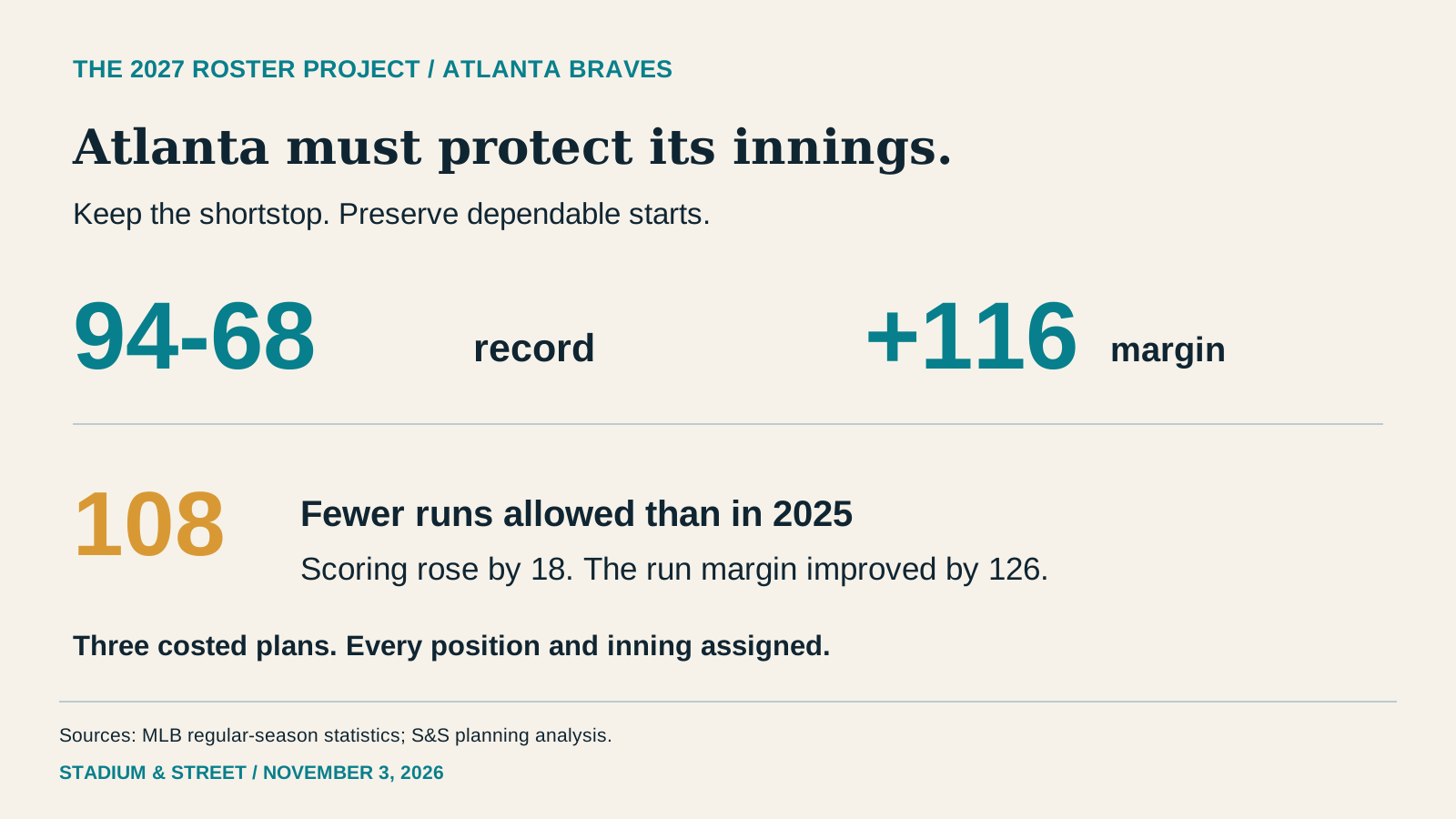
Atlanta must protect the innings behind 94 wins
November 3, 2026 edition
The complete review
November 3, 2026 edition. Completed 2026 regular-season performance with November 3 roster, transaction and market checks. The full website analysis includes 23 evidence and planning tables; the 28-page PDF is suitable for forwarding. Proposed prices and workloads are scenarios.
The decision
Atlanta should spend first on keeping a credible shortstop and a dependable rotation together. The preferred plan retains Mauricio Dubón and Tyler Mahle, adds Taylor Clarke for a defined relief workload and purchases a modest Randal Grichuk corner-outfield role. It preserves the existing core without making another successful season depend on multiple injured pitchers returning together.
That recommendation follows the shape of the improvement. The Braves went from 76 wins to 94 while scoring only 18 additional runs. They allowed 108 fewer. An offseason centered entirely on the lineup would miss the largest source of their success and the largest risk to repeating it.
The proposed annual additions total $42-52 million, including a $6-8 million depth reserve. With the existing salary, arbitration and roster-pool bridge, the preferred allocation is $254.45-268.45 million. These are editorial negotiating limits, not reported offers or an ownership budget. Every purchase has a specific job, a displaced workload and an alternative if the agreement does not happen.
What changed in 2026
Atlanta finished 94-68 with 742 runs scored and 626 allowed, a plus-116 margin. The prior season's margin was minus-10. The resulting 126-run improvement was overwhelmingly a prevention story. Team OPS scarcely moved, from .719 to .718, while ERA fell from 4.36 to 3.63.
The three-year view is useful. The 2024 Braves also prevented runs well, allowing 607, but scored only 704. This roster has demonstrated more than one way to contend. It has not established that every part of the latest pitching performance is repeatable. Distinguishing stable skills from a strong one-year result is more useful than asking the same players simply to reproduce 94 wins.
The official completed-game log produces a 27-21 record in one-run games and an 8-6 extra-inning record. A simple squared-run-ratio calculation gives 94.6 wins from the season's scoring totals. The actual record was therefore broadly consistent with the run margin. There is no need to explain the season primarily through close-game luck.
Separate the roster from last season's contributors
| Season | Record | Runs for / against | Margin | OPS / ERA |
|---|---|---|---|---|
| 2024 | 89-73 | 704 / 607 | +97 | .724 / 3.49 |
| 2025 | 76-86 | 724 / 734 | -10 | .719 / 4.36 |
| 2026 | 94-68 | 742 / 626 | +116 | .718 / 3.63 |
The dated 40-man response contains 35 players. Mitchell Parker is a current Brave after the November 2 waiver claim from Washington. Dubón, Mahle, Martín Pérez, Raisel Iglesias and Ha-Seong Kim are free agents. A familiar name in the 2026 statistics is not an existing 2027 roster slot.
One source discrepancy matters. The API still labels Spencer Strider as being on the 60-day injured list. Atlanta's October 29 announcement explicitly reinstated him. This analysis uses the club announcement for that administrative status and retains the separate medical uncertainty. A roster reinstatement is not a statement that he can supply a full season of starts.
Jurickson Profar requires a separate category. He is absent from the dated 40-man response, has a winter-league assignment in the player feed and remains listed with a $15 million 2027 obligation in the contract source. MLB announced a 162-game unpaid suspension in March. His eligibility and roster return must be confirmed before using the conditional workload below. The budget retains his cost even in the no-return branch.
The lineup has a strong middle and several distinct problems
| Player / MLB ID | Position | Snapshot treatment |
|---|---|---|
| AJ Smith-Shawver / 700363 | P | Current 40-man; readiness separate |
| Austin Riley / 663586 | 3B | Current 40-man; readiness separate |
| Blake Burkhalter / 686628 | P | Current 40-man; readiness separate |
| Brett Wisely / 689172 | 2B | Current 40-man; readiness separate |
| Brewer Hicklen / 676551 | RF | Current 40-man; readiness separate |
| Bryce Elder / 693821 | P | Current 40-man; readiness separate |
| Chris Sale / 519242 | P | Current 40-man; readiness separate |
| Danny Young / 664849 | P | Current 40-man; readiness separate |
| Didier Fuentes / 800311 | P | Current 40-man; readiness separate |
| Drake Baldwin / 686948 | C | Current 40-man; readiness separate |
| Dylan Dodd / 689266 | P | Current 40-man; readiness separate |
| Dylan Lee / 669276 | P | Current 40-man; readiness separate |
| Grant Holmes / 656550 | P | Current 40-man; readiness separate |
| Hurston Waldrep / 694462 | P | Current 40-man; readiness separate |
| JR Ritchie / 702275 | P | Current 40-man; readiness separate |
| James Karinchak / 675916 | P | Current 40-man; readiness separate |
| Jim Jarvis / 805347 | SS | Current 40-man; readiness separate |
| Joey Wentz / 666214 | P | Current 40-man; readiness separate |
| Matt Olson / 621566 | 1B | Current 40-man; readiness separate |
| Michael Grove / 675627 | P | Current 40-man; readiness separate |
| Michael Harris II / 671739 | CF | Current 40-man; readiness separate |
| Mike Yastrzemski / 573262 | LF | Current 40-man; readiness separate |
| Mitchell Parker / 680730 | P | Current 40-man; readiness separate |
| Owen Murphy / 702566 | P | Current 40-man; readiness separate |
| Ozzie Albies / 645277 | 2B | Current 40-man; readiness separate |
| Ray Kerr / 678061 | P | Current 40-man; readiness separate |
| Reynaldo López / 625643 | P | Current 40-man; readiness separate |
| Robert Suarez / 663158 | P | Current 40-man; readiness separate |
| Rolddy Muñoz / 691548 | P | Current 40-man; readiness separate |
| Ronald Acuña Jr. / 660670 | RF | Current 40-man; readiness separate |
| Sean Murphy / 669221 | C | Current 40-man; readiness separate |
| Spencer Schwellenbach / 680885 | P | Current 40-man; readiness separate |
| Spencer Strider / 675911 | P | Oct.29 club reinstatement overrides stale D60 |
| Tyler Uberstine / 700413 | P | Current 40-man; readiness separate |
| Victor Mederos / 682989 | P | Current 40-man; readiness separate |
| Player / MLB ID | Latest relevant transaction | 2027 treatment |
|---|---|---|
| Mauricio Dubón / 643289 | 2026-10-29: 2B Mauricio Dubón elected free agency. | Proposed retention |
| Tyler Mahle / 641816 | 2026-10-29: RHP Tyler Mahle elected free agency. | Proposed retention |
| Martín Pérez / 527048 | 2026-10-29: LHP Martín Pérez elected free agency. | No retained main-plan workload |
| Raisel Iglesias / 628452 | 2026-10-29: RHP Raisel Iglesias elected free agency. | No retained main-plan workload |
| Ha-Seong Kim / 673490 | 2026-10-29: SS Ha-Seong Kim elected free agency. | No retained main-plan workload |
| Lane Thomas / 657041 | 2026-10-29: RF Lane Thomas elected free agency. | No retained main-plan workload |
| Brent Suter / 608718 | 2026-10-29: LHP Brent Suter elected free agency. | No retained main-plan workload |
| Anthony Molina / 683627 | 2026-08-24: San Francisco Giants recalled RHP Anthony Molina from Sacramento River Cats. | No retained main-plan workload |
| Luke Williams / 663897 | 2026-10-15: SS Luke Williams elected free agency. | No retained main-plan workload |
| Jurickson Profar / 595777 | 2026-10-20: LF Jurickson Profar assigned to Tiburones de La Guaira. | Contract reserve; conditional return, not a free agent |
Matt Olson's 41 homers and .823 OPS supplied dependable power across 698 plate appearances. Michael Harris II added 26 homers and an .812 OPS. Drake Baldwin produced 25 homers and an .817 OPS. Those are three substantial offensive pieces at first base, center field and catcher, positions that create very different replacement costs.
The weak spots should not be bundled together. Austin Riley's .654 OPS over 630 plate appearances is a large-sample production problem. Ozzie Albies' .685 OPS came with 22 homers and full-season availability, but not an accompanying strong on-base profile. Sean Murphy's .556 OPS came in only 121 plate appearances after injuries. The first two call for a serious performance review; the third also requires a workload and recovery assessment.
Ronald Acuña Jr. remained productive with a .796 OPS in 469 plate appearances. His absence for part of the year creates a different planning problem from Riley's full-season decline. Atlanta needs a credible way to cover Acuña's missed games and use designated-hitter days without assuming that 650 healthy plate appearances will arrive automatically.
Use the contract core without making the contracts the argument
| Player / MLB ID | ATL PA | AVG / OBP / SLG | HR | BB / K |
|---|---|---|---|---|
| Matt Olson / 621566 | 698 | .251 / .321 / .502 | 41 | 64 / 171 |
| Ozzie Albies / 645277 | 683 | .237 / .293 / .392 | 22 | 46 / 105 |
| Austin Riley / 663586 | 630 | .219 / .290 / .364 | 19 | 48 / 201 |
| Michael Harris II / 671739 | 621 | .294 / .321 / .491 | 26 | 23 / 119 |
| Drake Baldwin / 686948 | 615 | .284 / .358 / .459 | 25 | 55 / 132 |
| Ronald Acuña Jr. / 660670 | 469 | .255 / .345 / .451 | 20 | 53 / 103 |
| Mike Yastrzemski / 573262 | 408 | .224 / .309 / .380 | 12 | 41 / 98 |
| Sean Murphy / 669221 | 121 | .182 / .256 / .300 | 3 | 11 / 37 |
| Jim Jarvis / 805347 | 124 | .207 / .267 / .297 | 1 | 8 / 23 |
| Mauricio Dubón / 643289 | 619 | .276 / .321 / .399 | 12 | 35 / 73 |
| Ha-Seong Kim / 673490 | 147 | .116 / .219 / .140 | 0 | 16 / 38 |
| Dominic Smith / 642086 | 300 | .253 / .311 / .383 | 9 | 23 / 48 |
Olson, Riley, Harris, Acuña and Albies will occupy important jobs because of their skills and the structure of this roster. Their contracts do not require identical workloads. Olson's everyday role is supported by current production and defense. Riley should still receive a substantial chance to recover, but the club needs a usable third-base reserve rather than a ceremonial backup.
Baldwin's two MLB seasons create a stronger offensive foundation than a single hot month. His 2025 expected and observed production were close, and the 2026 expected line improved further. Harris recovered from a weaker 2025 hitting season while retaining meaningful defensive value. Those trajectories support maintaining their jobs rather than purchasing replacements at positions already occupied by capable players.
Riley's three-year progression is less reassuring. His expected weighted on-base average fell from .367 in 2024 to .330 in 2025 and .299 in 2026. A plan built on a return to his earlier peak would be paying twice for improvement that has not happened: once through the existing contract and again through optimistic lineup projections.
Contact quality changes the rebound argument
| Hitter | 2024 MLB PA / OPS | 2025 MLB PA / OPS | 2026 MLB PA / OPS |
|---|---|---|---|
| Matt Olson | 685 / .790 | 724 / .850 | 698 / .823 |
| Ozzie Albies | 435 / .707 | 667 / .671 | 683 / .685 |
| Austin Riley | 469 / .783 | 447 / .737 | 630 / .654 |
| Michael Harris II | 470 / .722 | 641 / .677 | 621 / .812 |
| Drake Baldwin | No MLB season | 446 / .810 | 615 / .817 |
| Ronald Acuña Jr. | 222 / .716 | 412 / .935 | 469 / .796 |
| Mike Yastrzemski | 474 / .739 | 558 / .736 | 408 / .689 |
| Sean Murphy | 264 / .636 | 337 / .709 | 121 / .556 |
| Jim Jarvis | No MLB season | No MLB season | 124 / .564 |
| Mauricio Dubón | 428 / .657 | 398 / .644 | 619 / .720 |
| Ha-Seong Kim | 470 / .700 | 191 / .649 | 147 / .359 |
| Dominic Smith | 307 / .691 | 225 / .750 | 300 / .694 |
Olson's .351 wOBA and .351 xwOBA agree almost exactly. Baldwin's .358 wOBA trails his .370 expected mark, while Acuña's .348 trails .366. Those comparisons support the quality of the contact and outcomes that remain in the lineup. They do not guarantee that the difference will become future production.
Albies presents the opposite warning. His .298 wOBA exceeded a .273 expected mark. The low expected production makes it difficult to argue that his results merely concealed a much stronger offensive season. His $7 million exercised option can still be useful value, especially with his availability and position, but the lineup should not rely on him supplying a major offensive surge.
Riley's .290 wOBA and .299 expected mark offer a modest gap, not a concealed star season. Harris' .349 and .342 are close enough to support a more balanced reading of his improvement. Expected statistics describe contact, walks and strikeouts under the model's assumptions. They are not medical evidence, a defensive evaluation or a 2027 projection.
Platoon work should solve a real weakness
| Batter / full MLB year | wOBA | xwOBA | SLG / xSLG |
|---|---|---|---|
| Matt Olson | 0.351 | 0.351 | 0.502 / 0.503 |
| Ozzie Albies | 0.298 | 0.273 | 0.392 / 0.337 |
| Austin Riley | 0.290 | 0.299 | 0.364 / 0.396 |
| Michael Harris II | 0.349 | 0.342 | 0.491 / 0.477 |
| Drake Baldwin | 0.358 | 0.370 | 0.459 / 0.505 |
| Ronald Acuña Jr. | 0.348 | 0.366 | 0.451 / 0.495 |
| Mike Yastrzemski | 0.306 | 0.309 | 0.380 / 0.368 |
| Sean Murphy | 0.252 | 0.273 | 0.300 / 0.332 |
| Jim Jarvis | 0.254 | 0.268 | 0.297 / 0.304 |
| Mauricio Dubón | 0.317 | 0.304 | 0.399 / 0.375 |
| Ha-Seong Kim | 0.180 | 0.222 | 0.140 / 0.206 |
| Dominic Smith | 0.304 | 0.301 | 0.383 / 0.378 |
Olson's OPS was .824 against left-handers and .823 against right-handers. Harris produced .780 and .830. Neither needs an automatic platoon. Diverting meaningful plate appearances from them to a generic opposite-handed bat would weaken the value of having complete everyday players.
Baldwin's split, .695 against left-handers and .888 against right-handers, supports selective rest against difficult lefties. It does not justify removing a productive young catcher from every such matchup. Murphy's 34 plate appearances against left-handers are far too few, particularly within an interrupted season, to treat his .370 OPS as an established platoon talent level.
The corner-outfield case is more direct. Yastrzemski had just 40 plate appearances against left-handers and a .697 OPS in 368 against right-handers. Grichuk can cover a defined right-handed role, but the purchase should remain modest. Atlanta would be buying a useful complement and injury cover, not an everyday solution to every corner-outfield problem.
Protect the fielding strengths and acknowledge the costs
| Batter / full MLB season | LHP PA / OPS | RHP PA / OPS |
|---|---|---|
| Matt Olson | 280 / .824 | 418 / .823 |
| Ozzie Albies | 261 / .727 | 422 / .657 |
| Austin Riley | 184 / .663 | 446 / .651 |
| Michael Harris II | 224 / .780 | 397 / .830 |
| Drake Baldwin | 224 / .695 | 391 / .888 |
| Ronald Acuña Jr. | 145 / .749 | 324 / .817 |
| Mike Yastrzemski | 40 / .614 | 368 / .697 |
| Sean Murphy | 34 / .370 | 87 / .629 |
| Jim Jarvis | 23 / .567 | 101 / .562 |
| Mauricio Dubón | 210 / .675 | 409 / .743 |
| Ha-Seong Kim | 66 / .249 | 81 / .452 |
| Dominic Smith | 39 / .413 | 261 / .735 |
Harris' OAA sequence of plus-7, plus-8 and plus-13 supports keeping him in center field. Olson's plus-4, plus-9 and plus-12 provides a similarly consistent positive record at first base. These are strengths around which to arrange the rest of the defense, not reasons to move either player merely to accommodate another purchase.
Acuña's corresponding sequence is minus-3, minus-11 and minus-10. The proposed plan gives him 110 right-field starts and 30 at designated hitter. That is a workload decision intended to reduce defensive exposure and preserve flexibility. It does not diagnose his legs or predict how his range will respond to another offseason.
Dubón's three-year OAA record is plus-10, plus-19 and plus-6 across multiple positions. The versatility is valuable, but those totals are not all shortstop defense. The proposed 130-start shortstop assignment requires specific review of his performance there. Jarvis' zero OAA in 135 opportunities is a small neutral sample, not proof that he can replace a veteran over 150 starts. Crawford's consecutive minus-13 seasons make that alternative particularly expensive in defensive terms.
Baldwin and Murphy can share a real catching plan
| Fielder | 2024 OAA | 2025 OAA | 2026 OAA | 2026 opportunities |
|---|---|---|---|---|
| Matt Olson | +4 | +9 | +12 | 399 |
| Ozzie Albies | -2 | -5 | +1 | 577 |
| Austin Riley | -3 | -1 | +2 | 497 |
| Michael Harris II | +7 | +8 | +13 | 407 |
| Ronald Acuña Jr. | -3 | -11 | -10 | 248 |
| Mike Yastrzemski | +0 | -3 | -2 | 233 |
| Jim Jarvis | No row | No row | +0 | 135 |
| Brett Wisely | +5 | +0 | No row | No row |
| Mauricio Dubón | +10 | +19 | +6 | 449 |
| Ha-Seong Kim | +4 | -3 | -2 | 169 |
| J.P. Crawford | +1 | -13 | -13 | 383 |
| Randal Grichuk | -1 | -2 | +0 | 86 |
| Jurickson Profar | -6 | -6 | No row | No row |
The proposed catching allocation gives Baldwin 115 starts and Murphy 47. Baldwin also receives 25 designated-hitter starts, preserving access to his bat while managing catching workload. Murphy receives seven DH starts. These are season totals rather than a fixed weekly schedule, and they require continuing review of both catchers' recovery and performance.
Baldwin's framing value was approximately plus-2 runs, but his overall catching value was about minus-1.3. Those measures are not interchangeable. The latter also incorporates other catching contributions. Murphy has a negative framing figure in the saved data but no corresponding full catching-value row. That missing row is unknown, not zero.
If Murphy cannot provide the proposed 300 plate appearances, the contingency assigns Jair Camargo 250 after roster selection, with 47 catching starts, and McCabe another 50 plate appearances with seven DH starts. That is a materially weaker alternative and should trigger a search for a verified available catcher within the reserve. No unnamed replacement is credited with production in advance.
Sale's value includes preserving the conditions around him
| Catcher | 2026 ATL catching IP | Full MLB framing | Full MLB catching value |
|---|---|---|---|
| Drake Baldwin | 690.2 | +2.01 | -1.33 |
| Sean Murphy | 278.2 | -1.30 | Unknown |
| Jair Camargo | 2.0 | -0.02 | Unknown |
Chris Sale supplied a 2.16 ERA across 162.2 innings and 27 starts. The preferred 2027 allocation keeps him at 27 starts and 165 innings. Increasing his expected workload because other starters are uncertain would undermine the structure that makes retaining him useful. The $27 million 2027 extension belongs in the budget, but its price is not a reason to demand 200 innings.
Holmes and Elder supplied 151.2 and 149 innings. Their underlying evidence differs. Elder's 4.11 ERA and 4.15 xERA are close. Holmes' 3.44 ERA sits well below a 5.05 xERA. Holmes still merits a rotation role, but Atlanta should carry enough depth to respond if his results move toward the contact-quality warning.
Mahle's Atlanta-only 1.99 ERA in 54.1 innings is not the proper basis for pricing him. His full 149-inning MLB season produced a 3.99 ERA and 3.95 xERA. That is the version of the pitcher the preferred plan buys: a useful middle-rotation workload, not an ace inferred from a nine-start stretch.
Rehabilitation cannot fill an innings spreadsheet by itself
| Pitcher / MLB ID | GS / ATL IP | ERA / full MLB xERA | K / BB / HR | Planning treatment |
|---|---|---|---|---|
| Chris Sale / 519242 | 27 / 162.2 | 2.16 / 2.97 | 200 / 31 / 10 | 27 starts / 165 IP; preserve rest |
| Grant Holmes / 656550 | 29 / 151.2 | 3.44 / 5.05 | 115 / 62 / 22 | 28 / 155; contact-quality caution |
| Bryce Elder / 693821 | 26 / 149.0 | 4.11 / 4.15 | 121 / 49 / 24 | 27 / 150 |
| Reynaldo López / 625643 | 13 / 79.1 | 4.54 / 4.82 | 73 / 34 / 11 | 12 / 60 after shoulder readiness |
| JR Ritchie / 702275 | 11 / 73.1 | 4.91 / 5.16 | 68 / 43 / 13 | 20 / 100; development |
| AJ Smith-Shawver / 700363 | 5 / 31.1 | 6.61 / 4.82 | 27 / 16 / 7 | 10 / 50; post-surgery progression |
| Didier Fuentes / 800311 | 1 / 73.1 | 2.45 / 3.15 | 92 / 21 / 6 | 10 / 50 plus 35 relief IP |
| Spencer Strider / 675911 | 8 / 39.0 | 5.31 / 3.52 | 46 / 20 / 9 | No main-plan IP; elbow recovery |
| Spencer Schwellenbach / 680885 | 0 / 0 | No ATL sample / No row | 0 / 0 / 0 | No main-plan IP; elbow recovery |
| Hurston Waldrep / 694462 | 2 / 10.2 | 8.44 / 5.65 | 9 / 10 / 3 | No main-plan IP after Sept. surgery |
| Tyler Mahle / 641816 | 9 / 54.1 | 1.99 / 3.95 | 48 / 9 / 6 | Free agent; proposed 28 / 155 |
| Martín Pérez / 527048 | 26 / 142.0 | 3.04 / 4.51 | 102 / 62 / 14 | Free agent; alternative only |
Strider and Schwellenbach receive no main-plan innings. Waldrep also receives none after his September Tommy John surgery, and Wentz is outside the principal workload after missing the season with an ACL injury. Their eventual contributions would permit Atlanta to reduce exposure elsewhere. They should not be necessary to make the initial plan add up.
López receives only 12 starts and 60 innings, conditional on shoulder readiness. Ritchie receives 20 starts and 100 innings; Smith-Shawver receives ten and 50. Those allocations leave substantial work for healthy established starters while allowing the younger pitchers to develop. They are workload proposals, not promises that any pitcher can safely reach a particular total.
Fuentes is especially easy to misuse on paper. His 73.1 MLB innings were valuable, with a 2.45 ERA in the official club statistics and a 3.15 expected ERA in Savant. The plan assigns ten starts and 50 innings plus 35 relief innings, for 85 total. It does not count a full starter season and a full relief season from the same arm.
The bullpen needs depth more than a second expensive label
Atlanta's relievers threw 598.2 innings with a 3.44 ERA. The preferred plan raises starter coverage from the previous 839.1 innings to 885 and budgets 555 in relief. A lower relief burden is an important part of the acquisition case for Mahle. Buying a closer while leaving the rotation exposed would address the most visible inning rather than the full workload.
Robert Suarez is under contract at $16 million for 2027. His 1.06 ERA came in 34 innings, with a 3.35 xERA and a season interrupted by right-elbow inflammation. He receives 50 proposed innings after a medical review. Lee's 3.09 ERA and 2.64 xERA offer stronger expected support. Dodd and Mederos have useful multi-inning roles, but their workloads still need to be earned.
Clarke is the modest outside addition. His 73 innings are relevant to the workload problem, though a 2.96 ERA against a 4.42 xERA limits the price. A one-year $4-6 million ceiling buys depth without assigning elite results. Iglesias remains a credible alternative, but a $10-12 million ceiling for him would require a different allocation. The preferred plan does not pay for two closers and quietly leave other innings unfilled.
The minors can provide specific help
| Pitcher | ATL IP | ERA / full MLB xERA | K / BB | Treatment |
|---|---|---|---|---|
| Robert Suarez | 34.0 | 1.06 / 3.35 | 26 / 6 | 50 IP after elbow check |
| Dylan Lee | 67.0 | 3.09 / 2.64 | 77 / 17 | 60 IP; stronger expected evidence |
| Dylan Dodd | 49.2 | 2.54 / 3.10 | 53 / 14 | 65 IP; bulk left-hander |
| Didier Fuentes | 73.1 | 2.45 / 3.15 | 92 / 21 | 35 relief IP; 85 total |
| Ray Kerr | 18.1 | 1.47 / 3.30 | 11 / 2 | 45 IP; small MLB sample |
| Victor Mederos | 34.1 | 3.41 / 3.50 | 34 / 14 | 65 IP; multi-inning depth |
| James Karinchak | 9.2 | 1.86 / 2.99 | 8 / 5 | 35 IP; walks/availability review |
| Michael Grove | 0 | No ATL sample / 8.47 | 0 / 0 | 20 IP; weak tiny sample |
| Rolddy Muñoz | 2.0 | 13.50 / 8.62 | 3 / 1 | 25 IP; AAA evidence |
| Blake Burkhalter | 1.0 | 9.00 / 7.12 | 1 / 1 | 40 IP; AAA evidence |
| Mitchell Parker | 0 | No ATL sample / 5.23 | 0 / 0 | No main-plan IP; July 29 elbow surgery |
| Tyler Uberstine | 0 | No ATL sample / 6.39 | 0 / 0 | 25 IP; development |
| Owen Murphy | 12.0 | 6.00 / 7.48 | 9 / 3 | 25 relief IP; AAA context |
| Raisel Iglesias | 60.0 | 2.55 / 3.50 | 64 / 17 | Free agent; no main-plan allocation |
Jarvis' Triple-A season included 62 walks against 75 strikeouts in 460 plate appearances, with an .823 OPS. His .564 MLB OPS in 124 plate appearances remains a reminder that the transition is unfinished. He receives 170 plate appearances in the preferred plan and becomes the central shortstop alternative if Dubón leaves. That is a meaningful development role, not a claim that he has already established himself.
Wisely's 517 Triple-A plate appearances produced an .835 OPS. Hicklen hit 18 homers with an .893 OPS in 402. McCabe's separate Double-A and Triple-A records show power, with 16 and four homers respectively. McCabe's proposed 80 plate appearances include first-base coverage supported by actual minor-league defensive work. He still needs a major-roster selection.
Ritchie, Owen Murphy, Burkhalter and Rolddy Muñoz offer useful pitching depth. The plan distinguishes their minor-league evidence from their brief MLB results. Caminiti's 31.1 Double-A innings and Gil's 161 Double-A plate appearances are development evidence. Neither is assigned an immediate MLB quota to make the offseason look cheaper. Clohisy is an outfield reserve to evaluate, not an automatic 2027 starter.
Buy the job, then compare the candidates
| Player / MLB ID | 2026 level and sample | Readiness decision |
|---|---|---|
| Jim Jarvis / 805347 | AAA: 460 PA, .823 OPS, 6 HR; 62 BB / 75 K | 170 main-plan PA; larger internal SS route |
| Brett Wisely / 689172 | AAA: 517 PA, .835 OPS, 11 HR; 77 BB / 104 K | 150 utility PA |
| Brewer Hicklen / 676551 | AAA: 402 PA, .893 OPS, 18 HR; 37 BB / 93 K | 30 PA; reserve corner/CF work |
| David McCabe / 678173 | AAA: 105 PA, .867 OPS, 4 HR; 8 BB / 28 K | 80 PA after selection; 1B depth |
| David McCabe / 678173 | AA: 220 PA, .962 OPS, 16 HR; 29 BB / 54 K | Separate AA sample |
| Patrick Clohisy / 802117 | AAA: 170 PA, .903 OPS, 3 HR; 21 BB / 38 K | Outfield reserve; no main-plan quota |
| Owen Murphy / 702566 | AAA: 96.2 IP, 3.07 ERA; 94 K / 34 BB | 25 MLB relief IP; alternate starter |
| JR Ritchie / 702275 | AAA: 82.1 IP, 3.17 ERA; 89 K / 37 BB | 100 MLB starter IP |
| Blake Burkhalter / 686628 | AAA: 29.2 IP, 2.43 ERA; 33 K / 12 BB | 40 MLB relief IP |
| Rolddy Muñoz / 691548 | AAA: 51.2 IP, 3.31 ERA; 71 K / 27 BB | 25 MLB relief IP |
| Cam Caminiti / 807284 | AA: 31.1 IP, 2.01 ERA; 32 K / 16 BB | Development only; no 2027 MLB quota |
| John Gil / 808535 | AA: 161 PA, .812 OPS, 2 HR; 15 BB / 27 K | Do not rush as immediate SS answer |
Dubón is the priority because shortstop is the clearest everyday opening. A three-year $36-42 million ceiling values a 600-plate-appearance role and 130 shortstop starts. It replaces Jarvis' larger fallback assignment and reduces pressure on Bruján and Wisely. The case is for a dependable job with defensive flexibility, not a prediction that Dubón will repeat every part of his .720 OPS.
Mahle's two-year $28-32 million ceiling supports 28 starts and 155 innings. Martinez is the direct alternative at two years and $26-30 million. His 180 innings, 3.10 ERA and 26 walks provide a different kind of dependability, although a 3.98 xERA and 109 strikeouts discourage paying for top-of-rotation dominance. Pérez is a lower-cost inquiry, with a recent back issue and a 4.51 xERA that matters more than his 3.04 ERA alone.
Kim's 147 plate appearances and .359 OPS make him a reclamation alternative rather than the funded everyday answer. Eflin's 3.2 MLB innings cannot support a principal rotation workload. Seager is a contracted Ranger, with no verified availability or agreed price. The analysis does not invent an outgoing package or treat Atlanta's young pitchers as someone else's accepted trade return.
Suzuki is the materially different offensive route. A four-year $80-92 million editorial ceiling would buy an everyday corner job, reducing Yastrzemski and Profar exposure and eliminating the Grichuk purchase. That commitment would compete with the shortstop and pitching budget. The preferred plan rejects it because solving those two needs first creates a more complete roster within a comparable overall allocation.
Shared names have different consequences across clubs
| Candidate / MLB ID | Full 2026 MLB evidence | S&S ceiling / decision |
|---|---|---|
| Mauricio Dubón / 643289 | 619 PA, .720 OPS, 12 HR; 0.317/0.304 wOBA/xwOBA | A/B retention: 3 years / $36-42M; 600 PA, 130 SS starts |
| Tyler Mahle / 641816 | 149.0 IP, 3.99 ERA, 3.95 xERA; 137 K / 46 BB | A retention: 2 years / $28-32M; 28 starts / 155 IP |
| Nick Martinez / 607259 | 180.0 IP, 3.10 ERA, 3.98 xERA; 109 K / 26 BB | B alternative: 2 years / $26-30M; 30 starts / 165 IP |
| Taylor Clarke / 664199 | 73.0 IP, 2.96 ERA, 4.42 xERA; 45 K / 14 BB | A/B: 1 year / $4-6M; 65 relief IP |
| Randal Grichuk / 545341 | 280 PA, .880 OPS, 15 HR; 0.370/0.335 wOBA/xwOBA | A/B: 1 year / $6-8M; 300 PA; 54 corner starts / 20 DH |
| Martín Pérez / 527048 | 142.0 IP, 3.04 ERA, 4.51 xERA; 102 K / 62 BB | Fallback inquiry: 1 year / $5-7M; not funded; back/readiness gate |
| Ha-Seong Kim / 673490 | 147 PA, .359 OPS, 0 HR; 0.180/0.222 wOBA/xwOBA | Reclamation alternative only; 1 year / $5-7M ceiling; not funded |
| J.P. Crawford / 641487 | 489 PA, .687 OPS, 14 HR; 0.312/0.319 wOBA/xwOBA | Alternative SS, not funded; persistent range cost |
| Seiya Suzuki / 673548 | 634 PA, .841 OPS, 26 HR; 0.366/0.340 wOBA/xwOBA | Different everyday corner route; 4 years / $80-92M ceiling, not funded |
| Corey Seager / 608369 | 436 PA, .736 OPS, 20 HR; 0.320/0.350 wOBA/xwOBA | Contracted Ranger; no price or availability assumed; no funded trade |
| Zach Eflin / 621107 | 3.2 IP, 2.45 ERA, 3.98 xERA; 7 K / 2 BB | 3.2 MLB IP in 2026; no main-plan workload |
| Raisel Iglesias / 628452 | 60.0 IP, 2.55 ERA, 3.50 xERA; 64 K / 17 BB | Closer retention alternative; 1 year / $10-12M ceiling, not funded |
The Angels preparation also evaluates Mahle at two years and $28-32 million, for 150 innings. Atlanta uses the same price range for 155. The difference is role and opportunity cost: Atlanta is preserving Sale's rest and limiting exposure to uncertain returning starters, while the Angels are buying innings for a different development roster. Neither club's plan establishes that Mahle will accept the offer or remain available for the other.
Martinez appears in the published Brewers analysis and the private Rays and Royals work at two years and $26-30 million. Atlanta preserves that ceiling. Its alternative assigns 165 innings and reduces Ritchie's workload by ten, rather than adding Martinez on top of a fully occupied rotation. If Martinez signs elsewhere, the named internal branch becomes the operative comparison.
Clarke's one-year $4-6 million range matches the Angels and Royals preparations. Atlanta assigns him 65 relief innings and explicitly acknowledges the gap between ERA and xERA. Grichuk's $6-8 million range matches Seattle's smaller corner role. Philadelphia's published fallback range is $7-9 million; Atlanta's lower ceiling reflects the narrower job and the existing Yastrzemski/Profar commitments. These are club-specific limits, not separate market quotations.
No prospect cost is assigned to the preferred free-agent purchases. Any qualifying-offer compensation or future contractual condition must be checked at release. No trade proceeds are credited, and no candidate's unsigned production appears in the internal plan. The comparison rejects both repetition without reasoning and novelty for its own sake.
Reconcile the money before describing flexibility
The twelve guaranteed, exercised-option and contract-reserve rows total $190 million for 2027. That includes Acuña's $17 million and Albies' $7 million exercised options, Sale's $27 million extension and the full $15 million Profar reserve. It does not deduct Profar's cost merely because his workload is conditional.
Five current-roster arbitration estimates total $11.2 million. Williams elected free agency on October 15, so the model excludes his prospective $0.9 million arbitration salary. The model carries the $1.25 million buyout identified in Kinley's January contract announcement. His later release and Detroit signing do not establish payment, a waiver or an offset, so none is assumed. A $10-14 million pool covers pre-arbitration salaries, minor-roster allocations and callups. The resulting base is $212.45-216.45 million.
RosterResource's $189.55 million 2027 headline uses a different treatment. Replacing the listed $10 million potential Acuña buyout with his $17 million salary adds seven. Adding Albies' exercised salary adds seven more. Replacing the source's $12.3 million arbitration total with $11.2 million for the five retained cases subtracts $1.1 million. The roster pool then produces this analysis's base. Without that bridge, apparent spending room would be overstated.
These figures are player-allocation estimates, not audited cash outflows or competitive-balance-tax payroll. Signing-bonus timing, benefits, tax treatment and the eventual 2027 rules require separate treatment. The 2026 source estimate of $258.596 million is useful context for the preferred plan's scale; it is not evidence that ownership has approved the 2027 amount.
Three plans with funded differences
| Player / MLB ID | 2027 allocation | Basis |
|---|---|---|
| Austin Riley / 663586 | $22.00M | Guaranteed through 2032; later club option |
| Matt Olson / 621566 | $22.00M | Guaranteed through 2029; later club option |
| Chris Sale / 519242 | $27.00M | 2027 extension; 2028 club option unexercised |
| Robert Suarez / 663158 | $16.00M | Guaranteed through 2028 |
| Ronald Acuña Jr. / 660670 | $17.00M | 2027 option exercised; 2028 option separate |
| Spencer Strider / 675911 | $22.00M | Guaranteed through 2028; rehabilitation risk |
| Sean Murphy / 669221 | $15.00M | Guaranteed through 2028; later option |
| Mike Yastrzemski / 573262 | $10.00M | 2027 salary; 2028 option separate |
| Reynaldo López / 625643 | $8.00M | 2027 salary; shoulder readiness separate |
| Michael Harris II / 671739 | $9.00M | Long-term extension through 2030 |
| Ozzie Albies / 645277 | $7.00M | 2027 option exercised |
| Jurickson Profar / 595777 | $15.00M | Contract reserve; absent dated 40-man, return/eligibility must clear |
| TOTAL | $190.00M | Includes $15M Profar reserve; not CBT/cash schedule |
| Player | Estimate, $M | Treatment |
|---|---|---|
| Dylan Lee | 4.20 | Unsigned current-roster estimate |
| James Karinchak | 1.10 | Unsigned current-roster estimate |
| Joey Wentz | 0.90 | Unsigned current-roster estimate |
| Michael Grove | 1.00 | Unsigned current-roster estimate |
| Bryce Elder | 4.00 | Unsigned current-roster estimate |
| TOTAL | 11.20 | Five current-roster players; departed Williams excluded |
| Component | Annual allocation | Definition |
|---|---|---|
| 12 guaranteed/option reserves | $190.00M | Includes exercised options and Profar contract |
| Five arbitration estimates | $11.20M | No non-tender savings assumed |
| Kinley buyout reserve | $1.25M | Carried $1.25M contractual buyout; no settlement or offset assumed |
| Pre-arb, minors and callups | $10-14M | Planning pool; no assumed 2027 minimum |
| Existing-roster envelope | $212.45-216.45M | S&S allocation bridge |
| RosterResource 2027 headline | $189.55M | Replace $10M Acuña potential buyout with $17M salary; add Albies $7M; adjust $12.3M arb to $11.2M excluding departed Williams; add pool |
| RosterResource 2026 estimate | $258.596332M | Historical allocation, not ownership-approved 2027 budget |
Plan A allocates $12-14 million annually to Dubón, $14-16 million to Mahle, $4-6 million to Clarke, $6-8 million to Grichuk and $6-8 million to the depth reserve. Annual additions total $42-52 million. New multiyear commitments plus the one-year reserve total $80-96 million. The full annual allocation is $254.45-268.45 million.
Plan B substitutes Martinez for Mahle. Its annual additions are $41-51 million and new commitments $78-94 million, with a total allocation of $253.45-267.45 million. The small financial difference should not dominate the decision. The meaningful choice is the form of innings, current medical evidence, contract terms and which pitcher remains obtainable at the stated ceiling.
Plan C makes none of those four acquisitions. It retains the $6-8 million reserve and assigns the larger internal jobs explicitly. The total allocation falls to $218.45-224.45 million. That savings comes with a much heavier burden on Jarvis, Bruján and the developing pitchers. A lower budget is not credited with the same expected roster quality as the preferred route.
Assign the plate appearances
| Plan | Annual additions | Total allocation | New commitment |
|---|---|---|---|
| A: Dubón / Mahle / Clarke / Grichuk | $42-52M | $254.45-268.45M | $80-96M |
| B: Martinez replaces Mahle | $41-51M | $253.45-267.45M | $78-94M |
| C: Internal roster | $6-8M | $218.45-224.45M | $6-8M |
The preferred allocation totals 6,200 plate appearances. Olson receives 650; Harris and Acuña 625 each; Albies, Riley and Dubón 600 each. Baldwin receives 550, Yastrzemski 450, Profar 400 and Murphy and Grichuk 300 apiece. The remaining 500 are divided among Jarvis, Wisely, Bruján, Hicklen and McCabe.
These assignments make the crowded corner and DH picture visible. Profar is not assumed to reclaim an everyday outfield job. Acuña gets designated-hitter access, Baldwin's bat stays available on selected days out of the catching gear, and Grichuk has a finite role. McCabe's 17 first-base starts provide Olson with actual coverage rather than an unfilled rest promise.
The plan's principal thirteen position players and thirteen pitchers cannot include every name in the seasonal table simultaneously. Bruján, McCabe and other depth players move through the roster only after selection, option and availability checks. With 35 players in the current 40-man snapshot, four acquisitions and a Profar return could consume the apparent room before those later selections. No unannounced release or injury-list move is assumed to clear a place.
Assign all 162 starts and the relief behind them
| Hitter | PA | Condition |
|---|---|---|
| Matt Olson | 650 | Health and performance gate |
| Michael Harris II | 625 | Health and performance gate |
| Ozzie Albies | 600 | Health and performance gate |
| Austin Riley | 600 | Health and performance gate |
| Ronald Acuña Jr. | 625 | Health and performance gate |
| Mauricio Dubón | 600 | New agreement required |
| Drake Baldwin | 550 | Health and performance gate |
| Sean Murphy | 300 | Health and performance gate |
| Mike Yastrzemski | 450 | Health and performance gate |
| Randal Grichuk | 300 | New agreement required |
| Jurickson Profar | 400 | Eligibility and roster return required; branch assigns all 400 PA if absent |
| Jim Jarvis | 170 | Health and performance gate |
| Brett Wisely | 150 | Health and performance gate |
| Vidal Bruján | 70 | Major-roster selection required |
| Brewer Hicklen | 30 | Health and performance gate |
| David McCabe | 80 | Major-roster selection required |
| TOTAL | 6200 | Season allocation, not simultaneous active roster |
| Pos. | 162-start allocation | Condition |
|---|---|---|
| C | Baldwin 115; Murphy 47 | Season allocation; readiness and roster selection required |
| 1B | Olson 145; McCabe 17 | Season allocation; readiness and roster selection required |
| 2B | Albies 145; Wisely 12; Bruján 5 | Season allocation; readiness and roster selection required |
| 3B | Riley 140; Wisely 12; Jarvis 10 | Season allocation; readiness and roster selection required |
| SS | Dubón 130; Jarvis 27; Bruján 5 | Season allocation; readiness and roster selection required |
| LF | Yastrzemski 100; Profar 40; Grichuk 22 | Season allocation; readiness and roster selection required |
| CF | Harris 145; Hicklen 12; Yastrzemski 5 | Season allocation; readiness and roster selection required |
| RF | Acuña 110; Yastrzemski 20; Grichuk 32 | Season allocation; readiness and roster selection required |
| DH | Profar 60; Acuña 30; Baldwin 25; Riley 10; Olson 10; Grichuk 20; Murphy 7 | Season allocation; readiness and roster selection required |
| C: C | Baldwin 115; Murphy 47 | Season allocation; readiness and roster selection required |
| C: 1B | Olson 145; McCabe 17 | Season allocation; readiness and roster selection required |
| C: 2B | Albies 145; Wisely 12; Bruján 5 | Season allocation; readiness and roster selection required |
| C: 3B | Riley 140; Wisely 12; Jarvis 10 | Season allocation; readiness and roster selection required |
| C: SS | Jarvis 125; Bruján 37 | Season allocation; readiness and roster selection required |
| C: LF | Yastrzemski 100; Profar 62 | Season allocation; readiness and roster selection required |
| C: CF | Harris 145; Hicklen 12; Yastrzemski 5 | Season allocation; readiness and roster selection required |
| C: RF | Acuña 110; Yastrzemski 42; Hicklen 10 | Season allocation; readiness and roster selection required |
| C: DH | Profar 60; Acuña 30; Baldwin 25; Riley 10; Olson 10; Murphy 7; McCabe 20 | Season allocation; readiness and roster selection required |
The proposed starters account for 162 games and 885 innings. Sale has 27 starts, Holmes 28, Elder 27 and Mahle 28. López, Ritchie, Smith-Shawver and Fuentes supply the remaining 52. No scheduled start depends on Strider, Schwellenbach, Waldrep or Wentz becoming available.
The 555 relief innings complete a 1,440-inning planning model. Dodd and Mederos receive 65 apiece, Burkhalter 40 and Uberstine 25; their depth allocations absorb work that cannot be assigned to Parker. Fuentes appears in both groups but totals only 85 innings. Parker receives no main-plan innings following his July 29 elbow surgery. Owen Murphy is initially relief depth with an explicit alternate starting role. Moving him to the rotation removes innings from the bullpen rather than creating new innings out of nothing.
The total is an allocation tool, not a forecast of exact team innings. Road losses, extra innings, shortened games and pitcher usage change the real requirement. The purpose is to expose dependencies and make adjustments accountable. It prevents a roster from appearing deep merely because the same capable arm has been listed in two places.
The fallback has to name the work
| Pitcher | GS / IP | Condition |
|---|---|---|
| Chris Sale | 27 / 165 | Health, workload and performance gate |
| Grant Holmes | 28 / 155 | Health, workload and performance gate |
| Bryce Elder | 27 / 150 | Health, workload and performance gate |
| Tyler Mahle | 28 / 155 | Proposed agreement and medical review |
| Reynaldo López | 12 / 60 | Health, workload and performance gate |
| JR Ritchie | 20 / 100 | Health, workload and performance gate |
| AJ Smith-Shawver | 10 / 50 | Health, workload and performance gate |
| Didier Fuentes | 10 / 50 | Health, workload and performance gate |
| TOTAL | 162 / 885 | No dependency on Strider, Schwellenbach, Waldrep or Wentz return |
| Pitcher | IP | Condition |
|---|---|---|
| Robert Suarez | 50 | Health, roster and performance gate |
| Dylan Lee | 60 | Health, roster and performance gate |
| Dylan Dodd | 65 | Health, roster and performance gate |
| Didier Fuentes | 35 | Combined starter/relief total 85 IP |
| Taylor Clarke | 65 | Proposed agreement |
| Ray Kerr | 45 | Health, roster and performance gate |
| Victor Mederos | 65 | Health, roster and performance gate |
| James Karinchak | 35 | Health, roster and performance gate |
| Michael Grove | 20 | Health, roster and performance gate |
| Rolddy Muñoz | 25 | Health, roster and performance gate |
| Blake Burkhalter | 40 | Health, roster and performance gate |
| Tyler Uberstine | 25 | Health, roster and performance gate |
| Owen Murphy | 25 | Health, roster and performance gate |
| TOTAL | 555 | 885 starter innings plus relief = 1,440 |
Without Dubón and Grichuk, Plan C removes 900 plate appearances. Jarvis gains 350, Wisely 150, Bruján 200, Hicklen 100 and McCabe 100. Shortstop becomes Jarvis for 125 starts and Bruján for 37. Profar, Yastrzemski and Hicklen take the vacated corner starts, while McCabe takes Grichuk's 20 DH starts. The result is a different roster, with weaker certainty at shortstop and more pressure on the depth bats.
Without Mahle, Ritchie adds eight starts and 45 innings, Smith-Shawver eight and 40, Owen Murphy eight and 45, and Fuentes four and 25. Owen Murphy's 25 relief innings move to Kerr, Muñoz and Uberstine in increments of ten, ten and five. Fuentes reaches 110 combined innings rather than being counted twice. Removing Clarke requires a second explicit 65-inning redistribution. Those two bullpen changes are both necessary to make the internal plan complete.
If Profar is unavailable, his 400 plate appearances go to McCabe, Yastrzemski, Grichuk and Hicklen in increments of 150, 100, 75 and 75. His 40 left-field starts become 20 for Yastrzemski and 20 for Hicklen. The 60 DH starts become 30 for McCabe, 15 for Grichuk and 15 for Murphy. Yastrzemski reaches 145 total starts under that branch, preserving a workable individual limit.
If López is unavailable, Ritchie, Smith-Shawver and Owen Murphy each supply four starts and 20 innings, with Owen Murphy's 25 relief innings reassigned as above. If Suarez cannot provide his 50 innings, six named relievers absorb the workload. These are isolated stress tests. Multiple simultaneous failures require a combined roster, workload and medical review, not the addition of every fallback without checking conflicts.
How much prevention can Atlanta afford to lose?
| Change from A | Removed workload | Named replacement |
|---|---|---|
| B: Martinez for Mahle | 28 GS / 155 IP | Martinez 30 / 165; Ritchie minus 2 / 10 |
| C: no Dubón or Grichuk | 900 PA | Jarvis +350, Wisely +150, Bruján +200, Hicklen +100, McCabe +100 |
| C: no Mahle | 28 GS / 155 IP | Ritchie +8 / 45, Smith-Shawver +8 / 40, Owen Murphy 8 / 45, Fuentes +4 / 25 |
| C: starter conversions | Owen Murphy 25 relief IP | Kerr +10, Muñoz +10, Uberstine +5 |
| C: no Clarke | 65 relief IP | Kerr +10, Karinchak +10, Grove +10, Muñoz +10, Burkhalter +10, Uberstine +15 |
| No Profar | 400 PA; 40 LF / 60 DH starts | McCabe +150, Yastrzemski +100, Grichuk +75, Hicklen +75; named position reassignment below |
| No López | 12 GS / 60 IP | Ritchie +4 / 20, Smith-Shawver +4 / 20, Owen Murphy 4 / 20; his 25 relief IP reassigned as above |
| No Suarez | 50 relief IP | Clarke +10, Lee +5, Dodd +10, Kerr +10, Mederos +10, Karinchak +5 |
| No Sean Murphy | 300 PA; 47 C / 7 DH starts | Camargo 250 PA / 47 C after selection; McCabe +50 PA / 7 DH |
| Multiple failures | Combined recalculation required | Individual branches are not automatically additive. Reserves supply no unnamed production. |
The run-ratio exercise is a sensitivity test, not a player projection or betting estimate. At 742 runs scored and 626 allowed, the squared-ratio model produces 94.6 wins over 162 games. Holding the same plus-116 margin while increasing both scoring and runs allowed by 25 produces a slightly different result because run environment matters.
Adding 40 runs of offense while allowing 50 more drops the illustrative total to 92.7 wins. Scoring 20 fewer and allowing 60 more produces 85.1. Those scenarios show why modest offensive improvement cannot automatically compensate for a large loss of pitching performance.
The preferred plan therefore buys innings without presenting the purchases as a guaranteed win total. A healthy productive core and a strong pitching year can create a high ceiling. The practical offseason task is to reduce the chance that a few unavailable starters force the club into prolonged replacement-level coverage.
Decisions that should change the plan
| Illustrative change from 2026 | RS / RA | Margin | 162-game simple run-ratio wins |
|---|---|---|---|
| Unchanged runs | 742 / 626 | +116 | 94.6 |
| Score 25 more; allow 25 more | 767 / 651 | +116 | 94.2 |
| Score 40 more; same prevention | 782 / 626 | +156 | 98.7 |
| Score 40 more; allow 50 more | 782 / 676 | +106 | 92.7 |
| Score 20 fewer; allow 60 more | 722 / 686 | +36 | 85.1 |
Dubón's market price is the first decision point. If it moves beyond the stated ceiling, Atlanta should compare the actual cost of alternatives with the complete Jarvis/Bruján route. It should not promise a Seager trade, count Kim as his earlier peak or buy Crawford without acknowledging the range cost. The shortstop decision affects both defense and how much utility coverage remains elsewhere.
The next decision is the actual health and price of the available starters. A fresh medical report can change the order between Mahle and Martinez. It can also change whether López belongs in the initial rotation allocation. Useful returns by Strider or Schwellenbach would reduce pressure on other pitchers; they should trigger workload revisions, not an automatic expansion of the total.
Profar's status, Murphy's readiness and Suarez's elbow are separate decisions. The first changes a conditional hitting role, the second affects catching coverage and the third affects late-inning depth. None justifies treating all three as either healthy or unavailable. Recheck each on its own evidence and preserve the corresponding financial obligations.
The verdict
Atlanta has enough established talent to pursue another strong season without a sweeping teardown. It also has enough unresolved pitching and availability questions that an unchanged roster would be a deliberate gamble. The best spending order is shortstop, dependable starts, a useful corner complement and affordable relief depth.
Dubón and Mahle are the preferred retentions because their jobs are concrete and the internal replacements are materially less certain. Clarke and Grichuk stay within narrow roles and price limits. Martinez provides a distinct starting-pitching alternative. The internal plan remains complete so the recommendation can be judged against what happens if negotiations fail.
The central judgment is straightforward: preserve the conditions that made 94 wins possible before asking the offense to cover for their disappearance. Atlanta's core can carry a contender. A careful offseason should make that core less dependent on perfect rehabilitation outcomes and another exceptional year from every arm around Sale.
Go to the sources
See something that needs attention? Read our corrections process.