Team analysis · 2027 roster planning
Keep the Brewers' advantage
November 3, 2026 edition
The complete review
November 3, 2026 edition. Completed 2026 regular-season performance with same-day roster and candidate checks. The full website analysis includes 23 evidence and planning tables; the 30-page PDF is suitable for forwarding.
The decision: pay for continuity where it is hardest to replace
Milwaukee should enter this winter prepared to pay Jake Bauers for one more season, keep William Contreras and Trevor Megill, and preserve the young rotation's opportunities. The largest internal change should come on the left side of the infield: give Cooper Pratt a real shortstop audition and make Joey Ortiz the primary third baseman with shortstop coverage. That is a more specific response to this roster than another broad search for veteran names.
The champions scored 832 runs and allowed 618 in a 103-win regular season. Their advantage was broad enough to withstand imperfection. They finished second in runs and second in ERA across MLB, despite hitting only 154 home runs. The case for continuity rests on that full-season foundation, the quality of the returning players and the cost of replacing their jobs.
Bauers' free agency is the immediate fork. His 578 plate appearances produced a .389 on-base percentage, 26 home runs and an .873 OPS. His .371 expected weighted on-base average supports treating the improvement as more than a favorable run of outcomes. Andrew Vaughn offers an internal alternative, but his .368 actual wOBA compared with a .329 expected figure makes him a less certain replacement than his .834 OPS suggests.
The club has already made Bauers a one-year, $23.15 million qualifying offer, with a November 17 decision deadline. Budget for acceptance. Do not commit that same money elsewhere while the offer is open. If he declines, investigate a two-year agreement at an S&S ceiling of $36-40 million, then move to the internal first-base plan if the price or term runs beyond it. The ceiling expresses this report's tolerance for age and performance risk. It is not an estimate of his demands.
Plan A reserves the full qualifying offer plus $6-8 million for depth. That is $29.15-31.15 million beyond the existing-roster planning base, producing an annual allocation of approximately $147.96-153.96 million before benefits, tax and other excluded costs. It retains Vaughn's arbitration allowance and assumes no savings from trading a player. Ownership's actual spending limit is not public evidence in this report.
If Bauers leaves, Plan B investigates Nick Martinez at two years and $26-30 million while expanding Vaughn's work. Plan C makes no major outside purchase and retains only the depth allowance. Neither alternative receives Bauers' offensive production on paper. The missing plate appearances, the greater reliance on internal development and the different pitching opportunities are shown explicitly below.
The strongest reason to reject Plan A is also plain. A large one-year first-base commitment, alongside a retained Vaughn and Christian Yelich, concentrates money and plate appearances in a crowded part of the roster. The answer is disciplined playing time, a short commitment and a willingness to use Plan C. It is not to pretend that a championship has removed the risk of regression.
How Milwaukee built a 214-run margin
| Season | RS / RA | Margin / HR | OPS | ERA / MLB rank |
|---|---|---|---|---|
| 2024 | 777 / 641 | +136 / 177 | .729 | 3.65 / 5 |
| 2025 | 806 / 634 | +172 / 166 | .735 | 3.58 / 2 |
| 2026 | 832 / 618 | +214 / 154 | .744 | 3.51 / 2 |
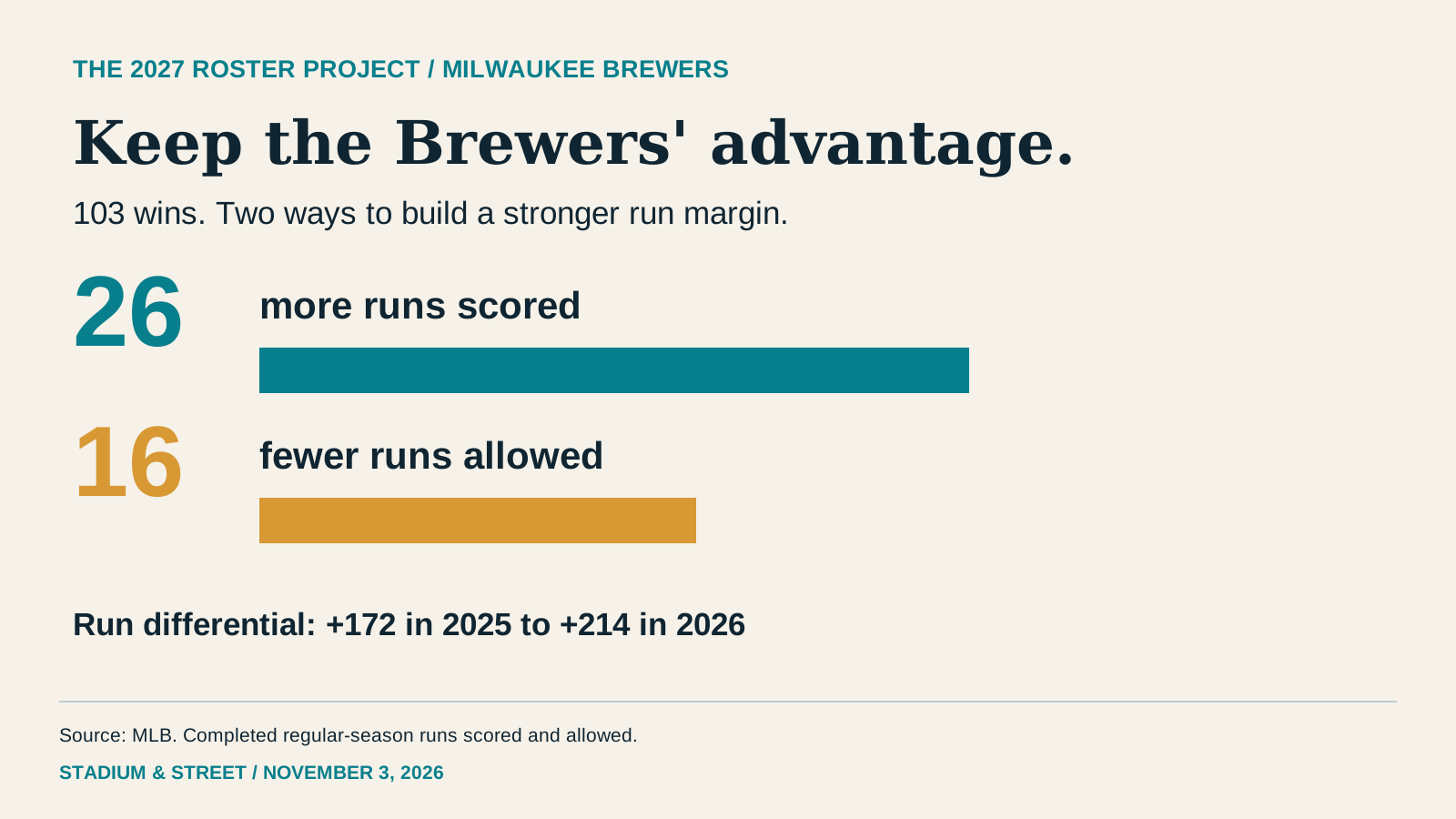
Milwaukee's run differential improved from plus-136 in 2024 to plus-172 in 2025 and plus-214 in 2026. The latest 42-run gain came from scoring 26 more runs and allowing 16 fewer. Both sides contributed. This was not a team whose record depended on one exceptional offensive season compensating for a weak staff.
The offense's shape matters. Its 668 walks helped produce a .341 team OBP and gave the lineup another way to score when a ball did not leave the park. Home runs declined from 177 to 166 to 154 across the three seasons while total scoring rose. The club should protect its ability to reach base and its defensive coverage before paying for a power total that does not fit an actual position.
There are limits to that interpretation. Team OBP and run totals reflect the sequence of events, opposing pitching and the contributions of players who may leave. They do not establish that this exact offensive formula will repeat. Bauers alone supplied 94 walks, and losing those opportunities cannot be repaired by retaining a slogan about patient hitting.
Milwaukee stole 162 bases and was caught 54 times, a 75% success rate. That is a description of its activity, not a calculated net run value. A proposed running-game improvement should use the base-out situation and the individual runner, rather than assuming every additional attempt helps. The first objective remains to put the right hitters on base.
The staff's 3.51 ERA also needs its proper denominator: 1,446 2/3 innings, 1,544 strikeouts and 518 walks. The ERA excludes unearned runs; the 618 runs allowed do not. Defensive innings summed across positions are a different measure and cannot be substituted for staff innings. That distinction matters when comparing how much work the team must replace.
October confirms the ceiling, not every winter choice
The Brewers went 11-2 in the postseason. They beat San Diego in four Division Series games, swept Los Angeles in the NLCS and beat Tampa Bay in five World Series games. The title-clinching final was Milwaukee 4, Tampa Bay 1 on October 28. Those outcomes belong in the club's record, separately from its regular-season totals.
That run provides evidence that the roster could solve several different opponents over a concentrated stretch. It does not tell us that every player should keep the same job or that every free agent should return. A winter decision must consider how a player reaches his next 400 plate appearances or 150 innings, not just how his last important appearance felt.
The most useful lesson from October is the value of having choices. A roster with multiple credible starters, flexible relief and defenders who cover difficult positions lets a manager respond to the game in front of him. Preserving those choices is a reason to avoid using a limited budget on redundant hitters or treating young starting candidates as disposable because they did not occupy the same role all year.
There is also a case for retaining established contributors through a final year of control. A trade can improve a farm system and still weaken the next season if the incoming value cannot cover the outgoing job. This report recommends keeping Contreras and Megill unless an actual offer supplies enough present value and future control to justify the loss. No proposed return is invented to make that trade sound painless.
The roster after the option decisions
| Player / MLB ID | 2026 MIL contribution | November 3 classification |
|---|---|---|
| Jake Bauers / 641343 | 578 PA / .873 OPS | Free agent; $23.15M QO pending |
| Gary Sánchez / 596142 | 275 PA / .771 OPS | Free agent after declined mutual option |
| Brandon Woodruff / 605540 | 45.1 IP / 2.98 ERA | Free agent |
| Dustin May / 669160 | 36.2 IP / 5.65 ERA | Free agent after declined mutual option |
| JoJo Romero / 668941 | 13.1 IP / 3.38 ERA | Free agent |
| Antonio Senzatela / 622608 | 21.0 IP / 5.14 ERA | Free agent after declined club option |
| Jared Koenig / 657649 | 7.0 IP / 9.00 ERA | Outrighted, then elected MLB free agency |
| Bryse Wilson / 669060 | 25.2 IP / 3.51 ERA | Outrighted, then minor-league free agent |
| Akil Baddoo / 668731 | No MIL MLB workload in collected season row | Claimed by Pittsburgh |
The current official administrative roster lists 33 players, including three on the 60-day injured list. That is a list of affiliations and statuses, not a count of occupied offseason roster slots or a projected Opening Day team. The later option announcements and transactions control where older player cards or cached feeds still show the last club.
Bauers, Gary Sanchez, Brandon Woodruff, Dustin May, JoJo Romero and Antonio Senzatela are separated from the returning roster. Jared Koenig and Bryse Wilson have also reached free agency after outright assignments. Akil Baddoo was claimed by Pittsburgh. A previous organizational association is not a retained player.
The listed departing pitchers supplied 149 Milwaukee innings in 2026. That figure uses their Brewers-only pitching rows and excludes position players' pitching work. It is the loss represented by this table, not a census of every player who left Milwaukee at some point during the year. The roster can cover that amount internally, but the allocation must show which pitchers receive the work.
The three current IL60 pitchers, Angel Zerpa, Brian Fitzpatrick and Quinn Priester, remain part of the organization in the checked roster. The central workload plan assigns none of them guaranteed innings. Their return would improve the depth choices; it should not be required to make the plan's arithmetic work. Roster status alone does not establish a recovery date.
Woodruff illustrates why the sequence of medical reporting matters. MLB reported in August that his previously planned shoulder operation was no longer needed. His later roster activation and free-agent election do not establish a healthy 2027 workload. A reunion can be considered after a current evaluation, but it is not the volume foundation of this report.
The returning lineup and its real workload
| Player / MLB ID | PA | AVG / OBP / SLG | HR | BB / K |
|---|---|---|---|---|
| Brice Turang / 668930 | 680 | .268 / .366 / .450 | 21 | 90 / 171 |
| William Contreras / 661388 | 640 | .270 / .341 / .417 | 18 | 61 / 94 |
| Jackson Chourio / 694192 | 573 | .291 / .351 / .487 | 25 | 47 / 134 |
| Garrett Mitchell / 669003 | 531 | .262 / .354 / .416 | 11 | 60 / 167 |
| Christian Yelich / 592885 | 500 | .235 / .315 / .378 | 12 | 49 / 135 |
| Joey Ortiz / 687401 | 415 | .270 / .328 / .402 | 9 | 35 / 82 |
| David Hamilton / 666152 | 387 | .245 / .314 / .336 | 4 | 32 / 86 |
| Sal Frelick / 686217 | 384 | .230 / .295 / .319 | 4 | 31 / 38 |
| Andrew Vaughn / 683734 | 331 | .306 / .390 / .444 | 6 | 35 / 53 |
| Cooper Pratt / 806198 | 266 | .281 / .350 / .368 | 3 | 26 / 48 |
| Luis Lara / 800325 | 212 | .246 / .311 / .325 | 1 | 18 / 46 |
| Brandon Lockridge / 663604 | 113 | .277 / .348 / .327 | 0 | 11 / 33 |
| Tyler Black / 672012 | 28 | .333 / .357 / .481 | 0 | 1 / 7 |
| Bo Naylor / 666310 | 8 | .286 / .375 / .714 | 1 | 1 / 3 |
| Jeferson Quero / 691620 | 2 | .000 / .500 / .000 | 0 | 1 / 0 |
The lineup still has three clear anchors in Brice Turang, Jackson Chourio and Contreras. Their combined value is not limited to the batting order. Turang covers second base, Chourio supplies a productive everyday outfielder and Contreras handles the largest catching workload. Replacing any of those jobs would require more than matching a single offensive statistic.
Turang's 680 plate appearances, 90 walks and 21 home runs made him a major source of both opportunities and damage. Chourio hit 25 home runs in 573 plate appearances. Contreras' 640 plate appearances and .758 OPS came from a position where the club also needed him to catch 1,085 2/3 innings. The next roster should protect that combination rather than force one of those players to compensate for every weakness.
The uncertainty is concentrated in the remaining work. Yelich had a .693 OPS in 500 plate appearances, Frelick a .614 OPS in 384, and Hamilton a .650 OPS in 387. Those are meaningful samples. The answer is not to remove all three at once, because their contracts, defensive roles and replacement choices differ. It is to make their next opportunities conditional on the job being filled.
Pratt's 266 plate appearances and .718 OPS are enough to justify an extended look, but not enough to declare him a finished everyday hitter. Lara's .636 OPS in 212 plate appearances leaves a larger offensive question. Both can receive development opportunities while the club remains competitive if the surrounding roster supplies credible alternatives. An eight-figure contract is not itself proof of readiness.
The contact-quality test
| Player | wOBA | xwOBA | SLG / xSLG | Reading |
|---|---|---|---|---|
| Jake Bauers | 0.381 | 0.371 | 0.484 / 0.467 | Free agent; strongest contact case among first-base choices |
| Andrew Vaughn | 0.368 | 0.329 | 0.444 / 0.380 | Actual results ahead of contact model |
| Christian Yelich | 0.305 | 0.308 | 0.378 / 0.385 | Little expected-stat rebound is visible |
| Brice Turang | 0.358 | 0.344 | 0.450 / 0.428 | Productive year; some expected-stat regression |
| William Contreras | 0.330 | 0.334 | 0.417 / 0.441 | Underlying offense broadly supports actual output |
| Jackson Chourio | 0.361 | 0.344 | 0.487 / 0.475 | Strong actual year; avoid automatic growth forecast |
| Garrett Mitchell | 0.340 | 0.353 | 0.416 / 0.447 | Expected power offers room, strikeouts remain |
| Joey Ortiz | 0.321 | 0.297 | 0.402 / 0.346 | Glove helps carry weaker contact model |
| Cooper Pratt | 0.320 | 0.315 | 0.368 / 0.362 | Small sample supports an audition |
| Sal Frelick | 0.275 | 0.281 | 0.319 / 0.324 | Weak damage on contact, not a strikeout problem |
Expected statistics help separate some parts of performance from the final outcome. They are models of the observed season, not forecasts of next year's health, mechanics or playing time. A gap should prompt a closer look, not a mechanical replacement of the actual line with the expected one. All figures here cover the completed 2026 MLB regular season.
Bauers' .381 wOBA and .371 xwOBA are close enough to support the central point: his best offensive year came with unusually strong underlying contact results for this group. Vaughn's .368 and .329 are farther apart. Vaughn remains useful, especially in selected matchups, but the club should not multiply his .834 OPS by a full season and call the Bauers vacancy solved.
Yelich's .305 wOBA and .308 xwOBA offer little evidence of a large rebound hidden beneath the results. His .385 expected slugging was also close to the actual .378. A comeback would therefore need a change in performance, rather than simply more favorable outcomes on substantially similar contact. That is a reasonable possibility to test, not an assumption to place in the middle of the order.
Mitchell presents a more encouraging gap. His .353 xwOBA and .447 expected slugging exceeded his .340 and .416 actual marks. Yet 167 strikeouts in 531 plate appearances remain part of the offensive cost. The opportunity is to preserve the quality of his contact while reducing the empty trips, not to promise that both improvements arrive together.
Ortiz and Hamilton also finished ahead of their expected offensive marks. That makes the defensive distinction between them more important. If both bats encounter more difficult outcomes, Ortiz has a stronger demonstrated range foundation to support an everyday role. Hamilton needs to contribute in a narrower reserve job and cannot be treated as the default answer to the third-base question.
Bauers, Vaughn and the price of the first-base decision
| Player | 2024 OPS / PA | 2025 OPS / PA | 2026 OPS / PA |
|---|---|---|---|
| Jake Bauers | .662 / 346 | .752 / 218 | .873 / 578 |
| Andrew Vaughn | .699 / 619 | .718 / 447 | .834 / 331 |
| Christian Yelich | .910 / 315 | .795 / 644 | .693 / 500 |
| Brice Turang | .665 / 619 | .794 / 659 | .816 / 680 |
| William Contreras | .831 / 679 | .754 / 659 | .758 / 640 |
| Jackson Chourio | .791 / 573 | .771 / 589 | .838 / 573 |
| Garrett Mitchell | .811 / 224 | .580 / 78 | .770 / 531 |
| Sal Frelick | .655 / 524 | .756 / 594 | .614 / 384 |
Bauers improved from a .662 OPS in 2024 to .752 in a smaller 2025 sample and .873 in 2026. His latest season was both his largest recent workload and his strongest production. That makes the case more persuasive than a breakout confined to a few weeks, while the size of the improvement still argues against a long guarantee.
The proposed two-year ceiling of $36-40 million, if the qualifying offer is declined, would lower the annual allocation to $18-20 million while adding a second guaranteed season. The decision is a trade between annual room and exposure to another year of decline. A third guaranteed season would require a stronger case than this evidence establishes. The outstanding qualifying offer remains the binding contingency until its outcome is known.
| Player | vs LHP: PA / OPS | vs RHP: PA / OPS |
|---|---|---|
| Jake Bauers | 160 / .901 | 418 / .863 |
| Andrew Vaughn | 133 / .938 | 198 / .764 |
| Christian Yelich | 130 / .610 | 370 / .722 |
| Garrett Mitchell | 129 / .668 | 402 / .802 |
| Sal Frelick | 98 / .541 | 286 / .640 |
| Joey Ortiz | 150 / .664 | 265 / .768 |
| Cooper Pratt | 70 / .572 | 196 / .768 |
Vaughn's .938 OPS against left-handed pitching in 133 plate appearances and .764 against righties in 198 create a useful lineup option. Bauers, however, produced a .901 OPS against lefties and .863 against righties. The first-base plan should not automatically bench Bauers against every left-hander merely because Vaughn bats right-handed. The samples support matchup judgment, not an inflexible platoon rule.
The more natural source of selected Vaughn opportunities is DH. Yelich's 2026 split was .610 against lefties and .722 against righties. Resting Yelich or moving the better current hitter into the lineup does not require inventing a new defensive position for either player. Vaughn's 58 third-base innings do not establish an everyday solution there.
Retaining both first basemen carries an opportunity cost. Vaughn's proposed $8.5 million arbitration allowance is fully retained in all three budgets. If an actual trade offer later clears, the payroll and playing-time plan can be rebuilt around the return. No savings or acquired talent is credited here. A plan that needs an unidentified trade partner before its numbers work is not fully funded.
The outfield: keep the center, demand more from the corners
Chourio's .838 OPS and plus-seven OAA support keeping him in the everyday core. His .344 xwOBA was lower than his .361 actual wOBA, so the budget should not depend on another immediate leap in offense. His value already comes from combining a productive bat with useful defensive range.
Mitchell played 1,105 center-field innings and recorded plus-seven OAA. That is a substantial position-specific workload behind the center-field assignment. The arm component in Savant's broader fielding measure was less favorable, which is one reason range and total defensive value should not be treated as identical statistics. His offensive and defensive evidence still make him the first choice in center.
Frelick's weak offensive season requires a different response from a player who simply struck out too often. He struck out only 38 times in 384 plate appearances, but hit four home runs and slugged .319. The low strikeout rate kept balls in play; it did not create enough damaging contact. His .324 expected slugging offers little reason to assume the problem disappears without a change in the quality of that contact.
Frelick still has a defensive role, but the full account is mixed. His plus-three OAA measures range, while his overall fielding run value was approximately minus-2.2 with a negative throwing component. The next evaluation should examine the specific throws, positioning and opportunities behind that result. Calling him either an automatic defensive star or a liability from one number would lose the useful detail.
Lara should compete for meaningful outfield work rather than inherit it solely because of his long-term deal. The central plan assigns 280 plate appearances, enough for an audition without assuming he replaces a full season of proven production. Lockridge remains a depth option. Neither a brief favorable stretch nor a prospect ranking should close the competition before the current performance is evaluated.
Put the infield defense in the right positions
| Player | 2024 OAA | 2025 OAA | 2026 OAA | 2026 opportunities |
|---|---|---|---|---|
| Brice Turang | +6 | -1 | +19 | 574 |
| Joey Ortiz | +11 | +13 | +15 | 395 |
| Jackson Chourio | +5 | +3 | +7 | 260 |
| Garrett Mitchell | +3 | +5 | +7 | 366 |
| Sal Frelick | +6 | +7 | +3 | 226 |
| Cooper Pratt | NA | NA | +1 | 275 |
| David Hamilton | -1 | +1 | -11 | 339 |
| Jake Bauers | -1 | -1 | -7 | 336 |
| Andrew Vaughn | -9 | +2 | -4 | 154 |
| Luis Lara | NA | NA | +1 | 134 |
Turang's plus-19 OAA and Ortiz's plus-15 give Milwaukee a strong middle-infield foundation. The three-year table also shows why a single season should not be treated as a fixed talent rating. Turang moved from plus-six to minus-one to plus-19, while Ortiz remained positive in all three years. The club should preserve the skill while planning for a range of outcomes.
| Player | 2026 MLB defensive work | Proposed use |
|---|---|---|
| Cooper Pratt | SS: 607.0 IP | Primary SS audition, not presumed 3B conversion |
| Joey Ortiz | 1B: 2.0 IP; 2B: 2.0 IP; 3B: 388.1 IP; SS: 580.2 IP | 3B with SS coverage; both supported by experience |
| David Hamilton | 2B: 85.0 IP; 3B: 577.1 IP; SS: 247.0 IP | Utility reserve, not automatic everyday 3B |
| Andrew Vaughn | 1B: 547.0 IP; 3B: 58.0 IP | 1B/DH; 58 third-base innings do not establish a solution |
| Jake Bauers | LF: 87.0 IP; 1B: 836.1 IP; RF: 199.0 IP | 1B first if retained; corner OF selectively |
| William Contreras | C: 1085.2 IP | Primary catcher with reduced load |
| Jeferson Quero | C: 6.0 IP | Backup audition; AAA evidence is more useful than six MLB innings |
| Bo Naylor | 1B: 2.0 IP; C: 16.0 IP | Catching alternative; MIL sample is limited |
Pratt played 607 innings at shortstop in 2026. Ortiz handled 580 2/3 at shortstop and 388 1/3 at third. The proposed alignment therefore keeps Pratt at his demonstrated position and shifts more of Ortiz's work toward a position he has already played extensively. It does not move Pratt to third on the assumption that every shortstop can immediately provide equivalent defense there.
Ortiz's aggregate OAA includes more than one position. His plus-15 cannot be assigned wholesale to third base, and Pratt's plus-one cannot be projected linearly from 607 innings to a full season. The argument is about a credible alignment and an internal alternative, not a claimed number of extra defensive runs.
Hamilton's minus-11 OAA over 339 tracked opportunities strengthens the case for reducing his everyday exposure. His ability to appear at multiple positions is useful, but versatility is not the same as above-average performance at each position. The plan retains him as a reserve and gives the club a specific improvement question: can it cover third base when Ortiz must return to shortstop?
That is one purpose of the depth reserve. If Pratt struggles, Ortiz can take more shortstop work and a portion of the $3-4 million infield allowance can address the resulting coverage gap. The money does not create a named third baseman or a performance improvement by itself. Hamilton, an earned internal promotion or a verified outside fit must actually supply the innings.
Keep Contreras, improve the catching support
Contreras' option was exercised at $15.5 million, according to MLB's latest report. The budget uses that current amount. The recommendation is to retain him through 2027 unless a concrete trade return covers the immediate catching loss and supplies enough durable value to justify changing course.
His offensive record is relatively stable across the last two seasons: .754 OPS in 659 plate appearances in 2025 and .758 in 640 in 2026. The larger concern is how much work the club asks him to absorb. Assigning another 640 plate appearances and more than 1,000 catching innings would leave little room for rest or for evaluating the next catcher.
| Component | Contreras, 2026 runs | Interpretation |
|---|---|---|
| Framing | -6.5 | Savant component; do not add framing again to total |
| Throwing | +3.1 | Savant component; do not add framing again to total |
| Blocking | -1.7 | Savant component; do not add framing again to total |
| ABS | +1.9 | Savant component; do not add framing again to total |
| Total catching | -3.2 | Savant component; do not add framing again to total |
Savant's catching components are a useful corrective to a reputation-only evaluation. Contreras' framing was approximately minus-6.5 runs, with throwing near plus-3.1, blocking near minus-1.7 and the ABS component near plus-1.9. The combined catching result was about minus-3.2. Those components are already incorporated in the total and must not be added a second time.
The plan reduces his allocation to 570 plate appearances and creates a real backup competition. Quero produced a .712 OPS with 15 home runs in 490 Nashville plate appearances. His six MLB catching innings tell us almost nothing about a full-season defensive workload. Naylor's Brewers catching sample was also small. Their assignment should be earned through current receiving, throwing, blocking and offensive evidence, not awarded on prospect status alone.
A catcher trade should be assessed against that actual alternative. Removing Contreras would require substantially more than a promising backup audition. It would move unproven players into the center of the roster's run-prevention plan and ask them to cover more offensive work at the same time. The present evidence does not make that the preferred route.
Misiorowski is an anchor, not the entire rotation
| Player / MLB ID | 2026 IP | GS / ERA | K / BB | xERA |
|---|---|---|---|---|
| Jacob Misiorowski / 694819 | 174.2 | 30 / 1.80 | 252 / 44 | 2.13 |
| Logan Henderson / 701656 | 98.1 | 18 / 2.47 | 110 / 19 | 2.74 |
| Kyle Harrison / 690986 | 115.2 | 24 / 4.20 | 141 / 36 | 4.01 |
| Robert Gasser / 688107 | 109.1 | 20 / 3.87 | 103 / 35 | 4.27 |
| Shane Drohan / 675660 | 124.2 | 19 / 4.19 | 125 / 44 | 3.81 |
| Chad Patrick / 694477 | 106.0 | 6 / 3.40 | 93 / 47 | 4.30 |
| Brandon Sproat / 687075 | 97.0 | 19 / 5.57 | 101 / 52 | 5.02 |
Misiorowski's 1.80 ERA, 252 strikeouts and 44 walks in 174 2/3 innings supply the strongest foundation on the staff. His 2.13 xERA remains excellent while allowing for less favorable results than the actual season. There is no need to project another 1.80 ERA to justify building around him.
Henderson is the next pitcher to protect from being reduced to a depth label. He struck out 110 and walked 19 in 98 1/3 innings, with a 2.47 ERA and 2.74 xERA. That combination supports a larger role, provided he can sustain the workload. The proposed 135 starter innings are an allocation to test, not a medical assessment or a guarantee that a young pitcher can add that much work.
Harrison's 141 strikeouts against 36 walks are useful, but 20 home runs in 115 2/3 innings narrowed his margin. Gasser had a 3.87 ERA and 4.27 xERA, while Drohan's 4.19 ERA compared with a 3.81 xERA. These are different cases. Treating all three as interchangeable back-end pitchers would ignore the distinct questions of contact damage, command and workload.
The rotation's central task is to supply more innings without assuming every young arm improves at once. That requires both competition and a workable fallback. The staff has enough candidates to begin with an internal plan, but the next section shows why the number of names on a depth chart is not the same as covered starts.
The innings behind the first five
Patrick's 106 innings included only six starts. Moving him to 18 proposed starts changes his role as well as his volume. His 93 strikeouts and 47 walks, together with a 4.30 xERA against a 3.40 actual ERA, argue for retaining flexibility rather than penciling him in as a finished full-season starter.
Sproat's 97 innings and 19 starts came with a 5.57 ERA, 101 strikeouts and 52 walks. His 5.02 xERA leaves a meaningful performance problem even after allowing for some improvement in results. The central plan gives him opportunities, but it does not assume that simply keeping him in the rotation solves the fifth or sixth starter job.
Crow, Stallings and Gordon provide additional organizational options. Their minor-league records are useful for evaluating readiness, but their MLB samples are too small to support confident full-season projections. The club should carry enough depth to move a struggling pitcher out of a role without asking the remaining starters to absorb every missing inning.
This is where Martinez becomes a legitimate alternative if the batting plan changes. His 180 innings and 31 starts would bring a different workload history from the internal candidates. The price must account for his age, low strikeout total and expected-stat regression, and the acquisition must take starts from specific incumbents. It cannot be added to a rotation already allocated 162 starts.
The bullpen is worth preserving
| Player | IP | ERA / xERA | K / BB | Role caution |
|---|---|---|---|---|
| Aaron Ashby | 89.1 | 3.12 / 2.99 | 116 / 41 | 89.1 all-role IP is a substantial workload |
| Trevor Megill | 61.2 | 2.63 / 2.64 | 69 / 15 | Retain primary leverage |
| DL Hall | 61.1 | 1.91 / 3.42 | 64 / 35 | Walks narrow the margin |
| Abner Uribe | 59.1 | 1.97 / 2.81 | 62 / 19 | Retain leverage |
| Grant Anderson | 59.0 | 3.36 / 3.15 | 52 / 23 | Useful middle/leverage bridge |
| Coleman Crow | 18.2 | 5.30 / 4.99 | 10 / 6 | Small MLB sample, AAA starter depth |
| Garrett Stallings | 14.0 | 0.00 / 1.24 | 17 / 5 | Small MLB sample, no automatic 1.24 xERA repeat |
| Colton Gordon | 5.0 | 3.60 / 6.11 | 1 / 1 | Developmental depth |
| Angel Zerpa | 12.2 | 6.39 / 7.58 | 8 / 6 | IL60; no guaranteed workload |
| Brian Fitzpatrick | 6.2 | 1.35 / 2.74 | 5 / 3 | IL60; no guaranteed workload |
Megill, Uribe, Ashby, Hall and Anderson give Milwaukee a useful returning bullpen core. Their roles should be distinguished. Megill's 2.63 ERA and 2.64 xERA are closely aligned. Uribe's 1.97 ERA was better than his 2.81 xERA but both support a meaningful leverage role. Ashby's 116 strikeouts in 89 1/3 innings supplied both outs and flexibility.
Hall's 1.91 ERA deserves more caution because it came with 35 walks in 61 1/3 innings and a 3.42 xERA. The next season should not assume that the same number of free passes will keep producing the same run prevention. His workload can remain valuable while the highest-leverage assignments depend on current command.
The bullpen handled 640 2/3 innings in 2026. A proposed 590-inning relief budget therefore asks the rotation to cover more of the season. That shift is intentional, but it is also a risk. If the starters fall short, the club needs additional usable arms rather than simply extending the same five relievers.
Keeping Megill at the projected arbitration allowance is preferable to trading him for an unspecified future return and then shopping for a replacement closer. The existing staff already has enough performance uncertainty without voluntarily removing one of its clearest leverage choices. A trade could still make sense at the right return, but the return must be real and the lost innings must be covered.
The farm system: preserve paths, not promises
| Player / MLB ID | 2026 level evidence | 2027 role and limit |
|---|---|---|
| Jeferson Quero / 691620 | AAA: 490 PA, .712 OPS, 15 HR, 39 BB / 104 K | Backup catcher audition |
| Tyler Black / 672012 | AAA: 430 PA, .755 OPS, 7 HR, 64 BB / 95 K | 1B/DH depth, not proven power replacement |
| Jesús Made / 815908 | AA: 558 PA, .774 OPS, 14 HR, 57 BB / 80 K | SS prospect; no central MLB PA assumed |
| Luis Peña / 821270 | AA: 61 PA, .667 OPS, 1 HR, 4 BB / 11 K | Short AA sample; development first |
| Josh Adamczewski / 815304 | AA: 283 PA, .847 OPS, 9 HR, 37 BB / 55 K | OF alternative after upper-level progress |
| Andrew Fischer / 702652 | AA: 314 PA, 1.026 OPS, 28 HR, 57 BB / 103 K | Power candidate; strikeouts and position must clear |
| Coleman Crow / 689441 | AAA: 105.1 IP, 3.59 ERA, 102 K / 35 BB | Depth competition, not guaranteed rotation |
| Garrett Stallings / 668831 | AAA: 82.0 IP, 3.95 ERA, 78 K / 28 BB | Starter/relief depth |
| Colton Gordon / 676467 | AAA: 54.0 IP, 4.67 ERA, 48 K / 14 BB | Depth; separate Nashville sample |
Milwaukee's internal options extend beyond the players already on the MLB roster. Made, Pena, Adamczewski and Fischer give the club several different development paths. Their current minor-league evidence should determine the next assignment; an estimated arrival year on a prospect list is not a guaranteed major-league contribution.
Made's Double-A season included 558 plate appearances, 57 walks and 80 strikeouts. That is a useful contact-and-zone-control foundation for a 19-year-old, but his .774 OPS does not make him an automatic replacement for an established MLB hitter. The central plan assigns him no MLB plate appearances. His development can proceed without requiring him to rescue the roster.
Fischer's power is harder to ignore. He hit 28 home runs in 314 Double-A plate appearances after 20 in 246 at High-A. The corresponding strikeout totals, 103 and 82, make the next challenge equally clear. His power may eventually address first base or third, but the report does not assign him a ready-made MLB position or assume that minor-league damage transfers immediately.
Adamczewski's .847 OPS in 283 Double-A plate appearances provides an outfield alternative worth developing. Pena's Double-A sample was only 61 plate appearances. Their situations should not be compressed into a generic statement that the farm will replace any departing veteran. Level, sample, defensive position and the next development task all matter.
The no-Bauers scenario includes a 100-plate-appearance pool that Fischer could earn. If he is not ready, that pool remains an organizational replacement problem. It is not credited with his minor-league slugging. The same standard applies to Quero's catching audition and to the innings reserved for Crow, Stallings and Gordon.
The money: rebuild the baseline before adding names
| Player | 2027 allocation, $M | Basis |
|---|---|---|
| Christian Yelich | 26.000 | RosterResource allocation, not immediate cash |
| Jackson Chourio | 8.250 | RosterResource annual allocation |
| Cooper Pratt | 3.875 | RosterResource annual allocation |
| Luis Lara | 2.286 | RosterResource annual allocation |
| Aaron Ashby | 7.700 | RosterResource annual allocation |
| William Contreras | 15.500 | Latest November 2 MLB option report; replaces old $14.5M figure |
| Contract subtotal | 63.611 | Six contracts; annual allocation basis |
The six-contract subtotal is $63.61 million on an annual allocation basis. It is not an immediate cash-disbursement schedule. Prorated bonuses, deferred payments and competitive-balance-tax accounting can produce different numbers for the same contract. The report uses one consistent planning bridge and keeps benefits and tax outside that bridge.
| Player | Allowance, $M | Status |
|---|---|---|
| Andrew Vaughn | 8.50 | Published estimate; not agreed salary |
| Trevor Megill | 8.00 | Published estimate; not agreed salary |
| Angel Zerpa | 1.30 | Published estimate; not agreed salary |
| Garrett Mitchell | 2.70 | Published estimate; not agreed salary |
| Brice Turang | 9.50 | Published estimate; not agreed salary |
| DL Hall | 1.00 | Published estimate; not agreed salary |
| Sal Frelick | 2.40 | Published estimate; not agreed salary |
| Joey Ortiz | 2.40 | Published estimate; not agreed salary |
| Bo Naylor | 1.50 | Published estimate; not agreed salary |
| David Hamilton | 1.60 | Published estimate; not agreed salary |
| Grant Anderson | 1.00 | Published estimate; not agreed salary |
| Quinn Priester | 1.30 | Published estimate; not agreed salary |
| TOTAL | 41.20 | Retains all 12 cases; no speculative savings |
The $41.2 million arbitration pool retains all 12 listed cases. These are published estimates, not agreed salaries or tender decisions. Vaughn and Megill are included at $8.5 million and $8 million, respectively; no trade or non-tender savings are assumed. The omitted departed players are not quietly left in the returning salary pool.
| Component | Annual allocation | Definition |
|---|---|---|
| Six contracts | $63.61M | Includes current $15.5M Contreras option |
| Arbitration pool | $41.20M | 12 estimates, not signed contracts |
| Listed 2027 buyouts | $2.00M | Rengifo $1.5M and May $0.5M, conservatively retained |
| Pre-arb, minors, call-up pool | $12-16M | S&S allowance including 40-man minor salaries |
| Existing-roster envelope | $118.81-122.81M | Before Bauers, other additions, benefits and tax |
The $12-16 million pre-arbitration, minors and call-up allowance is an S&S season budget. It includes a provision for 40-man players in the minors and the extra salaries that come with replacement usage. It is not a forecast of a future minimum salary or a count of 26 simultaneous major-league contracts.
The retained $2 million buyout line consists of the listed 2027 Rengifo and May amounts. It remains in the conservative planning base rather than being removed on an unverified assumption about payment timing. The resulting $118.81-122.81 million envelope precedes Bauers, other additions, benefits, any applicable tax, incentives and unlisted obligations.
Do not describe the gap between this base and a prior year's headline payroll as available cash. Published payroll totals use different definitions and may include different dates, benefits or acquired salary offsets. The baseball recommendation can specify its cost without claiming knowledge of the club's cash balance, profitability or ownership authorization.
The alternatives and the shared market
| Candidate / MLB ID | 2026 MLB record | S&S decision / proposed limit |
|---|---|---|
| Nick Martinez / 607259 | 180.0 IP; 3.10 ERA; 109 K / 26 BB | Conditional B: 2 years / $26-30M; no prospect cost |
| Chris Bassitt / 605135 | 102.0 IP; 4.41 ERA; 74 K / 38 BB | Pass as primary volume purchase; 102 IP |
| Michael Lorenzen / 547179 | 127.1 IP; 7.21 ERA; 90 K / 54 BB | Minor-league recovery inquiry only; no central IP |
| Kevin Gausman / 592332 | 177.2 IP; 4.51 ERA; 184 K / 47 BB | Mets comparison: $16-20M annual; pass for MIL at that cost |
| Freddy Peralta / 642547 | 169.0 IP; 4.42 ERA; 156 K / 63 BB | Mets alternative: $20-24M annual; no reunion premium |
| Ty France / 664034 | 500 PA; .865 OPS; 21 HR; 37 BB / 108 K | Alternative only: 2 years / $24-28M ceiling; replaces first-base role |
| Rhys Hoskins / 656555 | 317 PA; .682 OPS; 13 HR; 47 BB / 100 K | Pass as everyday solution |
| Ryan O'Hearn / 656811 | 451 PA; .770 OPS; 18 HR; 35 BB / 99 K | Pittsburgh-controlled; no trade price or outgoing package assumed |
Martinez is a free agent after the Rays' option decision. The proposed two-year, $26-30 million ceiling purchases an innings candidate, not a forecast that he will repeat his 3.10 ERA. He struck out 109 and walked 26 in 180 innings, while Savant estimated a 3.98 ERA. The age-36 workload history is valuable; the modest strikeout rate and the difference between actual and expected results limit the term and price.
Plan B gives Martinez 28 starts and 150 innings. He takes the 22 starts and 110 innings assigned to Drohan plus six starts and 30 innings from Sproat. The resulting starter budget rises by ten innings to 860. Drohan becomes a bulk-relief and rotation-backup option rather than disappearing from the organization. Those changes are essential to evaluating the purchase.
France offers a different first-base alternative. His .865 OPS in 500 plate appearances and plus-eight OAA are attractive, but his .327 xwOBA was well below the actual .373. A two-year, $24-28 million S&S ceiling recognizes both the defensive value and the risk of buying the peak offensive outcome. He would replace the first-base job, not join Bauers, Vaughn and Yelich without a playing-time consequence.
Hoskins does not clear the everyday-upgrade test on a .682 OPS, 100 strikeouts in 317 plate appearances and minus-seven OAA. Bassitt's 102 innings do not establish the larger volume sought from Martinez. Lorenzen's combined 7.21 ERA and 6.15 xERA make him a recovery inquiry, not a funded central rotation answer. Familiarity and a lower price are not enough to solve the required job.
The Mets report used Gausman as its preferred outside starter at $16-20 million annually, with Peralta a more expensive alternative. Those players would displace weaker or uncovered work in that roster. Milwaukee already has Misiorowski, Henderson and several controlled alternatives. Here, the additional salary would compete directly with the Bauers decision and with retaining existing contributors. The report therefore passes at those prices rather than assigning a different unsupported bargain price to the same target.
O'Hearn remains a Pittsburgh-controlled alternative in the checked record. No availability, asking price or outgoing prospect package is established. A hypothetical trade cannot be inserted into the cheaper plan with a zero acquisition cost. The alternative is retained for comparison, not promoted to an obtainable solution.
The earlier Yankees and Marlins reviews prioritized contact or catching support and relief. Toronto and Philadelphia needed a playable impact bat, and the Dodgers review addressed usable pitching depth. Milwaukee's preferred new commitment is retention at first base. Those differences explain the shortlist. They also keep this report from treating six clubs as though each has a separate supply of the same free agents.
Three funded plans, three different risks
| Plan | Annual additions | Total allocation | New commitment* |
|---|---|---|---|
| A: Bauers QO + depth | $29.15-31.15M | $147.96-153.96M | $29.15-31.15M |
| B: Martinez + depth | $19.00-23.00M | $137.81-145.81M | $32.00-38.00M |
| C: Internal + depth | $6.00-8.00M | $124.81-130.81M | $6.00-8.00M |
New commitment includes proposed contract guarantees and the full one-year depth reserve. The reserve is cash capacity, not a signed player. Benefits, tax, incentives, transaction costs and other excluded obligations remain separate. No speculative trade savings are credited.
Plan A is the preferred allocation if ownership supports the full envelope. It funds the outstanding Bauers offer and $6-8 million of depth. Split that reserve into $3-4 million for infield or bench coverage and $3-4 million for pitching depth. The club should spend each portion only when an actual player solves the uncovered job. Until then, the related work remains an internal or unfilled assignment.
If Bauers declines and accepts the proposed two-year arrangement instead, his annual line becomes $18-20 million. Including depth, additions would be $24-28 million and the total allocation approximately $142.81-150.81 million. New guarantees, including the one-year reserve, would be $42-48 million. That is a separate contract branch, not a claim that the lower annual cost is already secured.
Plan B is available only if Bauers leaves and Martinez can be signed within the stated limit. Annual additions are $19-23 million, with $32-38 million in new commitments including depth. It buys a more established innings option while accepting a weaker and less certain first-base offense. Martinez is not a financial substitute for Bauers until the qualifying-offer obligation is resolved.
Plan C adds only the $6-8 million depth reserve. It leaves the full arbitration pool intact and asks Vaughn, Black and the development system to cover more offense. Its advantage is flexibility and lower commitment. Its cost is greater dependence on players whose recent underlying evidence does not establish a Bauers-equivalent bat.
If Martinez signs elsewhere, Plan B does not automatically become a Bassitt or Lorenzen plan at the same workload. Return to Plan C, retain the money and show the missing coverage. If a third-base purchase becomes necessary, use the dedicated reserve or explicitly revise the total budget. Do not spend the same depth dollar twice.
A 6,200-plate-appearance plan
| Player / role | PA | Opportunity |
|---|---|---|
| Turang | 640 | 2B |
| Chourio | 620 | LF |
| Contreras | 570 | C / selective DH |
| Bauers | 540 | 1B; only if retained |
| Mitchell | 540 | CF |
| Pratt | 500 | SS audition |
| Ortiz | 490 | 3B / SS |
| Yelich | 420 | DH, with merit-based rest |
| Frelick | 400 | RF / defense |
| Vaughn | 290 | 1B / DH, favor useful matchups |
| Lara | 280 | OF competition |
| Quero | 170 | Backup C audition |
| Naylor | 110 | C coverage across season |
| Hamilton | 170 | IF reserve |
| Black | 120 | 1B / DH depth |
| Lockridge | 100 | OF reserve |
| Other coverage | 240 | Injury replacements, not bought production |
| TOTAL | 6200 | Season allocation, not simultaneous roster slots |
This allocation represents a full season of opportunities, including injuries and replacement usage. It is not a list of 17 players carried on one active roster. A possible 13-player position group begins with Contreras and one backup catcher; Bauers, Vaughn, Turang, Ortiz, Pratt and Hamilton; Chourio, Mitchell, Frelick and Lara; and Yelich. Naylor, Quero, Black and Lockridge require role, option and availability decisions as the season develops.
The core changes are deliberate. Yelich receives 420 plate appearances rather than an unconditional everyday DH assignment. Pratt receives 500 at his demonstrated position. Contreras' reduced total creates room to evaluate the backup and protect the primary catcher. Vaughn retains enough work to contribute in favorable matchups and cover first base or DH without being assumed to duplicate Bauers' full season.
| Change from Plan A | PA change | Resulting assignment |
|---|---|---|
| Bauers | -540 | 0 PA, no retained production credited |
| Vaughn | +220 | 510 PA at 1B/DH |
| Black | +180 | 300 PA at 1B/DH |
| Yelich | +40 | 460 PA, only if form supports work |
| Fischer or unfilled replacement | +100 | Readiness-dependent pool; no assumed MLB production |
| NET | 0 | Same 6,200-PA season |
The no-Bauers allocation raises Vaughn to 510 plate appearances and Black to 300. Yelich gains only 40, and those depend on his current form. The remaining 100 go to Fischer if he earns them or stay in an unresolved replacement pool. The arithmetic preserves 6,200 plate appearances while exposing the offensive risk instead of hiding it in a generic depth line.
If Pratt fails to hold shortstop, Ortiz's work shifts back there and the third-base job reopens. That should trigger a position-specific review of the internal options and the reserved money. It should not trigger an automatic claim that Hamilton's versatility or Vaughn's brief third-base experience makes the problem disappear.
Cover 162 starts without promising health
| Pitcher / coverage | Starts / IP | Condition |
|---|---|---|
| Misiorowski | 30 / 175 | Anchor, below automatic ace-repeat expectation |
| Henderson | 25 / 135 | Workload increase from 98.1 MLB IP |
| Harrison | 24 / 125 | Home-run prevention must improve |
| Gasser | 23 / 115 | Healthy availability and command |
| Drohan | 22 / 110 | Rotation competition |
| Patrick | 18 / 90 | Rotation and separate bulk-relief work |
| Sproat | 15 / 75 | Command must earn starts |
| Crow / Gordon / other depth | 5 / 25 | Unproven coverage pool |
| TOTAL | 162 / 850 | Plan A/C workload accounting, not a forecast |
The Plan A and Plan C rotation budgets total 162 starts and 850 innings. They ask for more starter work than Milwaukee received in 2026, especially from Henderson and Patrick. That is an important condition, not a hidden assumption. The club needs current availability, stamina and pitch-quality checks before treating those assignments as earned.
| Pitcher / coverage | IP | Condition |
|---|---|---|
| Ashby | 75 | Flexible bridge; below 2026 total |
| Megill | 60 | Primary leverage |
| Uribe | 60 | Primary leverage |
| Hall | 65 | Leverage by command and matchup |
| Anderson | 60 | Middle innings and bridge |
| Patrick | 35 | Additional to 90 starter innings |
| Sproat | 30 | Additional to 75 starter innings |
| Crow | 45 | Depth workload subject to readiness |
| Stallings | 50 | Depth and flexible length |
| Gordon / other organizational relief | 110 | Unproven coverage; no guaranteed reserve purchase |
| TOTAL | 590 | 850 starter IP + 590 relief IP = 1,440 |
The 590 relief innings bring the total to 1,440. That is a convenient planning denominator, not a prediction of exact team innings after walk-offs, extra innings and other game outcomes. Patrick's and Sproat's relief assignments are additional to their listed starter innings. Their combined seasonal loads must be assessed as a whole.
The least certain portion is the organizational relief pool. The central budget has 110 innings assigned to Gordon or other organizational coverage, plus developmental work for Crow and Stallings. A small cash reserve does not turn those assignments into verified major-league production. If two starting candidates fail at once, the bullpen demand rises and the club must reallocate or acquire actual coverage.
Under Plan B, Martinez's 150 starter innings replace 140 from Drohan and Sproat. The rotation totals 860 and relief falls to 580. Assign Drohan 80 relief innings and reduce the Gordon/other pool from 110 to 20, leaving the other relief assignments unchanged. That makes the combined staff total 1,440 again. Drohan's changed role requires evaluation; his original starter innings are removed before his relief work is added.
Zerpa, Fitzpatrick and Priester remain outside all central innings totals. A successful return would allow the club to replace some of the least certain assignments. Their absence would not invalidate the numerical plan, though the quality of the replacement work would still be unresolved.
What could break the recommendation
| Illustrative change from 2026 | RS change | RA change | Run margin |
|---|---|---|---|
| Mostly retained level | 0 | 0 | +214 |
| Offense -25; prevention slips 25 | -25 | +25 | +164 |
| Offense -50; prevention slips 50 | -50 | +50 | +114 |
| Offense +10; prevention slips 10 | +10 | +10 | +214 |
These cases are arithmetic stress tests, not forecasts or assigned probabilities. Losing 25 runs of offense and allowing 25 more would reduce the 2026 differential from plus-214 to plus-164. A larger 50-run decline on each side would leave plus-114. The exercise shows the size of the existing margin and the cumulative cost of several regressions. It does not convert that margin into a guaranteed win total.
The most direct threat to Plan A is concentration. Bauers, Vaughn and Yelich occupy overlapping offensive space while Pratt, Lara and the backup catcher remain developmental questions. If Bauers regresses and Yelich does not rebound, the club could spend heavily on the first-base/DH group without getting the intended production. The limited term and the willingness to change playing time are therefore central protections.
The strongest case for Plan B is that innings may prove harder to obtain during the season than an acceptable first-base platoon. The strongest case against it is that Martinez's age and low strikeout total make a two-year commitment risky, and the club already has internal pitchers whose development would be displaced. The purchase should follow an actual assessment of those alternatives, not a reflex preference for a veteran.
There is a serious argument for Plan C. Milwaukee's controlled talent and existing margin may justify keeping the winter short and waiting for a clearer in-season need. The cost is that the offense loses its best 2026 contact-quality case at first base and relies more heavily on Vaughn, Black and a possible promotion. It is a defensible lower-commitment choice, but it should be described as such.
The decisions to make in order
First, preserve the full Bauers qualifying-offer contingency until the decision is known. Continue evaluating the two-year retention ceiling and the internal first-base route without committing the same money twice. The club should know in advance which outcome it prefers at each price.
Second, retain Contreras and Megill in the central roster. Consider an actual trade only after evaluating the incoming players, the immediate lost workload and the full salary effect. A prospect return with no near-term catching or leverage answer carries a different cost for a defending champion than for a rebuilding club.
Third, test Pratt at shortstop, Ortiz at third, the backup catcher competition and Frelick's offensive adjustments. Use current performance over a meaningful sample, defensive position evidence and the quality of the alternatives. Do not turn a short spring streak into a permanent conclusion, but do not preserve an everyday job solely because it existed last year.
Fourth, evaluate starter readiness before spending the pitching reserve. Henderson's increase, Patrick's role change and Sproat's command are the clearest checkpoints. Martinez remains the larger conditional alternative if the batting commitment falls away and the internal assessment supports the purchase.
Finally, keep enough flexibility to act on the first real failure. The club does not need to win the winter by collecting recognizable names. It needs a roster in which a failed audition, an injury or a free-agent departure has an identified next step, a funded limit and an honest account of the production still missing.
Player register and definitions
| Player / MLB ID | Listed position | November 3 status |
|---|---|---|
| Aaron Ashby / 676879 | P | Active |
| Abner Uribe / 682842 | P | Active |
| Andrew Vaughn / 683734 | 1B | Active |
| Angel Zerpa / 672582 | P | Injured 60-Day |
| Bo Naylor / 666310 | C | Forty Man |
| Brandon Lockridge / 663604 | LF | Forty Man |
| Brandon Sproat / 687075 | P | Forty Man |
| Brian Fitzpatrick / 702153 | P | Injured 60-Day |
| Brice Turang / 668930 | 2B | Active |
| Chad Patrick / 694477 | P | Forty Man |
| Christian Yelich / 592885 | DH | Active |
| Coleman Crow / 689441 | P | Forty Man |
| Colton Gordon / 676467 | P | Forty Man |
| Cooper Pratt / 806198 | SS | Active |
| DL Hall / 669084 | P | Active |
| David Hamilton / 666152 | 3B | Active |
| Garrett Mitchell / 669003 | CF | Active |
| Garrett Stallings / 668831 | P | Forty Man |
| Grant Anderson / 681982 | P | Forty Man |
| Jackson Chourio / 694192 | LF | Active |
| Jacob Misiorowski / 694819 | P | Active |
| Jeferson Quero / 691620 | C | Forty Man |
| Joey Ortiz / 687401 | SS | Active |
| Kyle Harrison / 690986 | P | Active |
| Logan Henderson / 701656 | P | Active |
| Luis Lara / 800325 | RF | Active |
| Quinn Priester / 682990 | P | Injured 60-Day |
| Robert Gasser / 688107 | P | Active |
| Sal Frelick / 686217 | RF | Active |
| Shane Drohan / 675660 | P | Active |
| Trevor Megill / 656730 | P | Active |
| Tyler Black / 672012 | DH | Forty Man |
| William Contreras / 661388 | C | Active |
The roster table records official administrative status checked November 3, 2026. Active, forty-man and injured-list labels are reproduced as categories, not promises of 2027 availability. Historical 2026 contributors, pending retention cases and outside candidates are identified separately in the relevant tables. Player IDs distinguish players with similar names and preserve the link to the underlying records.
All major-league team totals and Milwaukee player rows refer to the completed 2026 regular season unless another year is specified. Multi-team candidate records and three-year player trends use full MLB seasons. Minor-league rows retain their exact affiliate and sample. Postseason results are discussed separately and are not added to regular-season rates or workloads.
Innings notation is baseball notation: .1 means one out and .2 means two outs. Calculations use outs before converting back to innings. OPS is on-base percentage plus slugging. OAA measures outs above average over tracked defensive opportunities; it is not the same unit as fielding runs. Catcher components and expected statistics are model estimates with their own definitions and uncertainty.
Proposed plate appearances, innings, salaries and contract ceilings are S&S planning scenarios. They are not club plans, player commitments, private medical findings or projections supplied by an agent. No trade return, signing probability, future labor agreement, payroll authorization or attendance-driven spending capacity is assumed. The report's choices can be revised when those facts become available without rewriting what the completed season showed.
Go to the sources
See something that needs attention? Read our corrections process.