Second Act · Buster Douglas
Buster Douglas's second act brings the story back to a Columbus gym
Where Are They Now? · Weekly feature
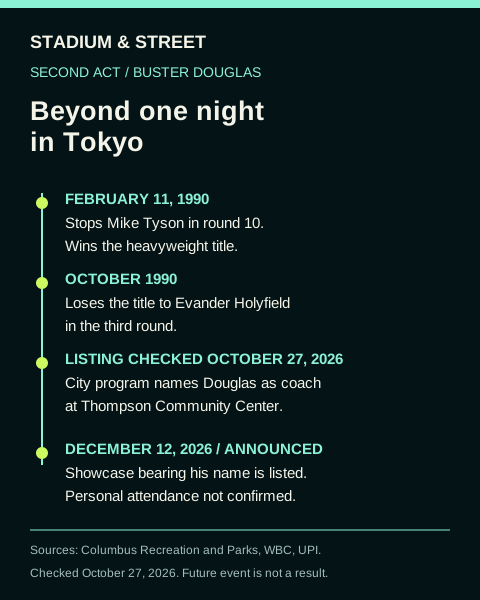
Buster Douglas is listed as a boxing coach at Thompson Community Center in Columbus. For a fighter whose name became shorthand for one astonishing night against Mike Tyson, that present-day connection is worth a look of its own. The sport continued after the championship.
Columbus Recreation and Parks describes a program for young people and adults, ranging from fundamentals to advanced instruction. Its current public listing names Douglas as the coach at Thompson. The setting brings the scale of the story down from a world title to a community gym, where learning to box is an achievement in itself.
The department's history records that Douglas learned boxing at Windsor Recreation Center. Thompson is a different building, and coaching is a different role. The municipal recreation system connects the two. Long before the Tokyo Dome, there was a place in Columbus where he could learn the sport.
Tokyo belongs in the story, not at its end
On February 11, 1990, Douglas stopped the previously unbeaten Tyson in the tenth round at the Tokyo Dome. The World Boxing Council's anniversary account recalls his jab, his recovery from an eighth-round knockdown and the combination that put Tyson down in the tenth. Calling it an upset describes the expectation he overcame. It should not obscure the boxing that made the result possible.
The reign was brief. Evander Holyfield defeated Douglas in the third round in Las Vegas that October, a result documented in UPI's contemporaneous reporting. A fair account has room for both fights. Douglas won the heavyweight title with a remarkable performance and lost it in his first defense. Neither result needs to be erased to make sense of the other.
Those two nights have a powerful claim on how Douglas is remembered. They also invite an overly tidy ending: the improbable triumph followed by the disappointing defense. They establish the course of a championship reign, but leave much of his later relationship with boxing outside the frame.
Another way to remain in boxing
The coaching listing supplies a concrete part of that later story. A city program names a former champion in a teaching role within the system where he began. The demands are different from those of a title defense. Explaining a movement to a beginner calls for a different contribution than performing it against an opponent.
The department's 2026 calendar also lists a James “Buster” Douglas Boxing Holiday Showcase for December 12 at Lou Berliner Athletic Complex. The event bears his name; the listing does not confirm his personal attendance. For local participants, the scheduled showcase is another opportunity within the same recreation program.
A famous athlete's second act is often judged by whether it can approach the scale of the first. That would make a community gym seem small beside a heavyweight championship. It is a poor measure of what a local program can mean to someone encountering the sport for the first time. The public record here supports a more modest, useful conclusion: Douglas remains connected to the institutions that helped introduce him to boxing.
Tokyo secured his place in sports history. Columbus gives the story somewhere else to go.
Go to the sources
See something that needs attention? Read our corrections process.