Team analysis · 2027 roster planning
Turn the Cardinals' auditions into a roster
November 3, 2026 edition
The complete review
November 3, 2026 edition. Completed 2026 regular-season performance with November 3 roster, transaction and market checks. The full website analysis includes 25 evidence and planning tables; the 30-page PDF is suitable for forwarding. Proposed prices and workloads are scenarios.
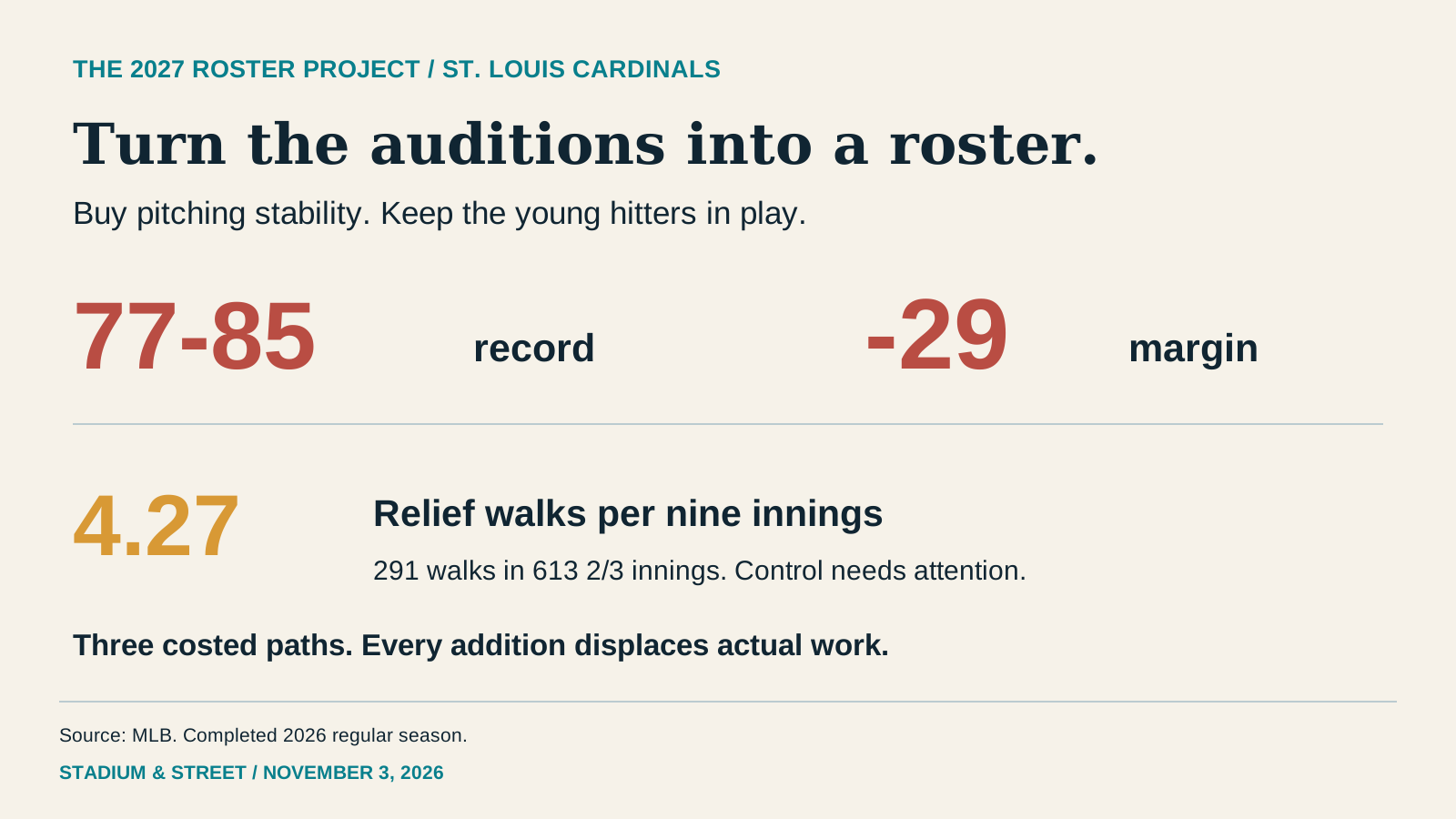
The recommendation: buy time without taking it away
The Cardinals have two kinds of uncertainty. Young hitters need enough major-league work to show what they can become. A pitching staff that allowed 749 runs needs help before those auditions can add up to a winning season. Spending the entire winter budget on a familiar middle-of-the-order name would address only part of that problem.
Our preferred plan purchases three defined jobs: Edmundo Sosa for a share of third base and middle-infield coverage, Tyler Mahle for 26 starts and 140 innings, and Taylor Clarke for 60 relief innings. The proposed annual prices are $6-8 million, $14-16 million and $4-6 million, respectively. Add a $6-8 million depth reserve. Total annual additions are $30-38 million, inside an estimated $100.05-112.05 million player-allocation envelope. These are S&S negotiating ceilings, not reported offers or a verified ownership budget.
Mahle receives a proposed two-year, $28-32 million contract. Sosa and Clarke receive one-year offers. Including both Mahle years and the first-year reserve, the proposed new commitment is $44-54 million. The reserve is money available for needs that emerge; it earns no invented hits, innings or wins in the analysis.
Sosa's 350 plate appearances leave 350 for Blaze Jordan, 450 for Joshua Baez and meaningful catching opportunities for Leo Bernal and Jimmy Crooks. A more expensive alternative substitutes Eugenio Suarez for Sosa, buying power while reducing Jordan's and Nolan Gorman's auditions. The internal-only alternative spends $6-8 million on depth and accepts substantially greater pitching and developmental risk.
None of these plans assumes a trade return, a prospect sale or the disappearance of an existing salary. The Cardinals can improve without dealing from their farm system, but the preferred plan must remain conditional on price, contract status and public availability checks. If Mahle cannot supply the proposed workload or his price rises beyond the ceiling, the club must revisit the rotation allocation rather than award his innings to an unnamed replacement.
The argument for restraint is substantial: St. Louis won 77 games, and several of its most interesting hitters have fewer than 200 major-league plate appearances. The answer is a measured investment in stability, with explicit opportunities for those hitters, rather than a claim that three signings make the Cardinals a finished contender.
Three seasons show how little the baseline has moved
St. Louis went from 83 wins in 2024 to 78 in 2025 and 77 in 2026. The run margin improved in the most recent season, from minus-65 to minus-29, because the offense scored 31 more runs while the staff allowed five fewer. That is progress. It still leaves a team that was outscored over a full season.
The 2026 Cardinals scored 720 runs, 16th in MLB, and produced a .691 OPS. Their 4.26 ERA ranked 20th. The gap between 684 earned runs and 749 total runs allowed also matters: preventing runs includes defense, positioning, receiving and avoiding the sequences that extend innings. Earned-run accounting cannot isolate responsibility for all 65 unearned runs.
| Season | Record | Runs for / against | Margin | OPS / ERA |
|---|---|---|---|---|
| 2024 | 83-79 | 672 / 719 | -47 | .704 / 4.04 |
| 2025 | 78-84 | 689 / 754 | -65 | .693 / 4.29 |
| 2026 | 77-85 | 720 / 749 | -29 | .691 / 4.26 |
The offense's 167 home runs, 511 walks and 1,306 strikeouts describe a club with useful pieces but no overwhelming scoring advantage. The pitching staff walked 564 batters. Building a more reliable roster requires attention to both the quality of contact allowed and the free baserunners that turn ordinary contact into expensive innings.
A 77-win record is an outcome, not a direct estimate of next year's talent. The completed season is the starting evidence. The remainder of this report separates retained production from departures, young-player samples from established workloads, and proposed improvements from results that have already happened.
Burleson, Walker and Herrera are the offensive foundation
Alec Burleson hit .279/.343/.473 with 26 home runs in 670 plate appearances. His .374 expected wOBA exceeded his .353 actual wOBA, and his expected slugging percentage was .522. Those figures support keeping him in the primary first-base role. They do not promise a particular batting average or another 30 points of production next year.
Jordan Walker supplied 29 home runs and a .466 slugging percentage in 667 plate appearances. His .344 actual wOBA and .340 expected wOBA were close. His offensive improvement therefore deserves more weight than a short hot stretch would. The separate question is how to limit the cost of his right-field defense without losing the bat.
Ivan Herrera's .353 on-base percentage gave him value even with a .382 slugging percentage. His 76 walks in 717 plate appearances supplied a skill the younger lineup cannot assume it will reproduce immediately. The proposed 620 plate appearances lower his total burden while preserving a central C/DH role.
| Player / MLB ID | STL PA | AVG / OBP / SLG | HR | BB / K; role |
|---|---|---|---|---|
| Iván Herrera / 671056 | 717 | .241 / .353 / .382 | 19 | 76 / 138; C/DH |
| Alec Burleson / 676475 | 670 | .279 / .343 / .473 | 26 | 55 / 121; 1B |
| Jordan Walker / 691023 | 667 | .269 / .327 / .466 | 29 | 50 / 174; RF |
| JJ Wetherholt / 802139 | 619 | .242 / .339 / .365 | 17 | 64 / 104; 2B/SS |
| Masyn Winn / 691026 | 532 | .232 / .308 / .317 | 5 | 48 / 116; SS |
| Nathan Church / 701675 | 470 | .247 / .290 / .364 | 10 | 25 / 81; CF/LF |
| José Fermín / 665877 | 370 | .248 / .309 / .355 | 6 | 30 / 50; Utility |
| Nolan Gorman / 669357 | 302 | .184 / .272 / .308 | 9 | 33 / 98; 3B/DH competition |
| Pedro Pagés / 686780 | 211 | .217 / .275 / .312 | 4 | 14 / 56; C |
| Blaze Jordan / 691458 | 199 | .247 / .276 / .382 | 3 | 7 / 30; 3B/1B audition |
| Victor Scott II / 687363 | 195 | .193 / .270 / .253 | 2 | 16 / 46; CF |
| Bryan Torres / 663494 | 189 | .229 / .309 / .331 | 4 | 18 / 39; OF/IF depth |
| Thomas Saggese / 695336 | 180 | .235 / .294 / .352 | 4 | 13 / 49; IF |
| Jimmy Crooks / 699625 | 149 | .179 / .255 / .336 | 5 | 9 / 48; C |
| Joshua Báez / 695491 | 108 | .230 / .278 / .510 | 7 | 4 / 33; LF; 108-PA sample |
| Leo Bernal / 699024 | 102 | .284 / .333 / .474 | 5 | 7 / 25; C; 102-PA sample |
| Lars Nootbaar / 663457 | 183 | .234 / .333 / .354 | 3 | 24 / 40; Departed; STL stint only |
This table uses Cardinals-only statistics. Lars Nootbaar's 183 plate appearances belong to the historical 2026 lineup, not to a retained 2027 depth chart. The same separation applies throughout the pitching analysis. A player who helped create last year's total cannot be counted again after leaving the organization.
The preferred lineup needs more from its supporting cast, but it does not need to displace its three established run producers merely to make an acquisition look consequential. A third baseman fits because that position still contains an unresolved audition. Another first baseman or a full-time DH would compete with jobs that already have credible occupants.
Wetherholt and Winn make defense part of the plan
JJ Wetherholt hit .242/.339/.365 in 619 plate appearances. His .347 expected wOBA and .435 expected slugging percentage were stronger than his .318 actual wOBA and .365 actual slugging. More important to the current roster structure, his tracked defensive season produced 25 Outs Above Average across 552 opportunities.
Masyn Winn's offense was much thinner: a .232 average, .308 on-base percentage and .317 slugging percentage in 532 plate appearances. He also produced 19 OAA, following 21 in 2025. The Cardinals have an unusually valuable range foundation in the middle of the infield. They should preserve it while seeking offensive growth, rather than treat Winn's weak slugging percentage as the whole player.
| Batter | wOBA | xwOBA | SLG / xSLG | Interpretation |
|---|---|---|---|---|
| Alec Burleson | 0.353 | 0.374 | 0.473 / 0.522 | Contact quality supports primary first-base role |
| JJ Wetherholt | 0.318 | 0.347 | 0.365 / 0.435 | Expected power exceeds actual; no automatic rebound |
| Jordan Walker | 0.344 | 0.340 | 0.466 / 0.462 | Power growth supported; defensive cost remains |
| Iván Herrera | 0.329 | 0.336 | 0.382 / 0.390 | On-base skill supports C/DH workload |
| Masyn Winn | 0.283 | 0.297 | 0.317 / 0.329 | Defense carries a limited offensive baseline |
| Blaze Jordan | 0.284 | 0.317 | 0.382 / 0.425 | Positive contact signal in a small MLB sample |
| Joshua Báez | 0.335 | 0.303 | 0.510 / 0.446 | Seven-HR burst ahead of contact estimate |
| Leo Bernal | 0.351 | 0.347 | 0.474 / 0.487 | Promising 102-PA sample; large uncertainty |
| Jimmy Crooks | 0.264 | 0.294 | 0.336 / 0.397 | MLB transition remains unresolved |
| Nolan Gorman | 0.260 | 0.278 | 0.308 / 0.351 | Expected offense still weak |
| Nathan Church | 0.288 | 0.283 | 0.364 / 0.354 | Useful range; modest bat |
Wetherholt's extension through 2034 gives the club a longer planning horizon, but it does not eliminate the need to test his offensive development. His 2027 allocation is discussed separately from the contract's average annual value. A long agreement and a promising expected-statistics line answer different questions.
The sensible expectation is not another exact 25-OAA season. Defensive measurements vary with opportunities, positioning and execution. A roster plan should survive a smaller positive contribution while retaining the advantage of two capable middle infielders. That is especially relevant for a staff relying on balls in play rather than overwhelming strikeout rates.
The platoon evidence argues for selective help
The Cardinals' overall OPS was .697 against left-handed pitching and .688 against right-handed pitching. That is not evidence of a universal left-handed-pitching crisis. The useful question is which individual matchups constrain the lineup and whether a specific addition improves those choices.
Burleson's .549 OPS in 206 plate appearances against left-handers contrasted sharply with .939 in 464 against right-handers. Walker moved in the opposite direction, with .863 against left-handers and .769 against right-handers. Herrera also did more damage against left-handers. Those differences argue for selective rest and substitutions, not for replacing the entire lineup against a particular starter.
| Batter / full MLB season | LHP: PA / OPS | RHP: PA / OPS |
|---|---|---|
| Iván Herrera | 220 / .823 | 497 / .697 |
| Alec Burleson | 206 / .549 | 464 / .939 |
| Jordan Walker | 175 / .863 | 492 / .769 |
| JJ Wetherholt | 220 / .654 | 399 / .732 |
| Masyn Winn | 141 / .714 | 391 / .594 |
| Nathan Church | 106 / .596 | 364 / .671 |
| José Fermín | 166 / .735 | 204 / .605 |
| Nolan Gorman | 49 / .491 | 253 / .598 |
| Blaze Jordan | 76 / .823 | 123 / .556 |
| Joshua Báez | 43 / 1.051 | 65 / .613 |
| Jimmy Crooks | 21 / .730 | 128 / .569 |
| Edmundo Sosa | 138 / .835 | 112 / .564 |
| Alec Bohm | 192 / .816 | 437 / .644 |
| Luis Rengifo | 134 / .570 | 220 / .677 |
| Eugenio Suárez | 129 / .714 | 369 / .748 |
Sosa's .835 OPS against left-handers in 138 plate appearances is a useful fit signal. His .564 against right-handers and only seven walks in 250 total plate appearances limit the case for an everyday offensive role. The preferred plan buys flexibility and a share of third base, with the right to adjust his role if the small-sample advantage does not persist.
Blaze Jordan and Joshua Baez also hit left-handers well in small samples. Their splits are reasons to keep testing, not proof that the problem is permanently solved. Allocating a veteran's work carefully leaves those tests available. Single-season platoon splits should guide an initial lineup experiment, then yield to a larger body of performance and current health.
Keep the range; stop giving it back at the corners
The Cardinals' middle-infield advantage coexists with substantial corner concerns. Walker posted minus-8 OAA in 2026 after minus-4 in each of the prior two seasons. Burleson improved to zero at first base after negative earlier years. Preserving Burleson's primary first-base assignment is therefore preferable to creating new outfield exposure just to fit another bat.
Victor Scott's 17 OAA in 2025 and four in 2026 support a role as a center-field and late-game option, but his .253 slugging percentage limits how much offense can be assumed. Nathan Church offered two OAA in 2026 with a .364 slugging percentage. The proposed arrangement gives Church most of the center-field starts and retains Scott's range without treating either as a complete offensive solution.
| Fielder | 2024 OAA | 2025 OAA | 2026 OAA | 2026 opportunities |
|---|---|---|---|---|
| JJ Wetherholt | No row | No row | +25 | 552 |
| Masyn Winn | +3 | +21 | +19 | 492 |
| Alec Burleson | -8 | -4 | 0 | 378 |
| Jordan Walker | -4 | -4 | -8 | 341 |
| Nathan Church | No row | +4 | +2 | 319 |
| Victor Scott II | +3 | +17 | +4 | 160 |
| Blaze Jordan | No row | No row | +2 | 178 |
| Nolan Gorman | -6 | -8 | 0 | 170 |
| José Fermín | -3 | +2 | -1 | 257 |
| Thomas Saggese | 0 | 0 | 0 | 156 |
| Joshua Báez | No row | No row | -3 | 50 |
| Edmundo Sosa | +4 | +5 | +4 | 210 |
| Alec Bohm | +5 | -2 | -11 | 435 |
| Luis Rengifo | -7 | -4 | -2 | 193 |
| Eugenio Suárez | +3 | -6 | -7 | 127 |
| Player | 2026 STL defensive innings | 2027 allocation |
|---|---|---|
| JJ Wetherholt | SS 96.2; 2B 1101.1 | Keep primary 2B; cover SS sparingly |
| Masyn Winn | SS 1141.1 | Retain primary SS |
| Alec Burleson | 1B 1324.2 | Keep at 1B; do not recreate outfield exposure |
| Jordan Walker | RF 1306.1 | RF with late-game coverage |
| Nathan Church | LF 253.0; RF 23.0; CF 809.0 | Primary CF, selective corners |
| Victor Scott II | LF 26.1; RF 7.0; CF 477.2 | CF range option; bat must earn more |
| Joshua Báez | RF 28.0; LF 171.1 | LF audition; not a CF projection |
| Blaze Jordan | 1B 58.0; 3B 399.0 | 3B/1B; share rather than guarantee full-time role |
| Iván Herrera | 1B 2.0; C 447.0 | C/DH, not an assumed everyday receiver |
| Leo Bernal | 1B 28.0; C 140.2 | Larger catching audition |
| Jimmy Crooks | C 311.1 | Preserve second catching development path |
Sosa's OAA sequence of plus-4, plus-5 and plus-4 is a reason to prefer his flexible role over a larger power-first commitment. Suarez's sequence of plus-3, minus-6 and minus-7 identifies the price of the alternative. Alec Bohm's minus-11 in 2026 also matters when comparing a familiar third-base name with the actual defensive problem.
These are full-season OAA observations across the positions in each underlying row, not position-specific forecasts. The opportunity counts preserve scale: Joshua Baez's minus-3 came in only 50 tracked opportunities, while Winn's plus-19 came in 492. The Cardinals should seek improvement at the corners while allowing for uncertainty in every young player's estimate.
Catching is an allocation problem, not a single vacancy
Pedro Pages, Jimmy Crooks, Herrera and Bernal provide four different combinations of receiving evidence and offensive uncertainty. Pages caught 532.1 Cardinals innings and produced approximately 3.2 total catching runs in the inspected Statcast table. Crooks had positive framing evidence but hit .179/.255/.336 in 149 major-league plate appearances. Bernal's 102-plate-appearance sample is too small to establish his offensive level.
| Catcher | 2026 STL catching IP | Framing runs | Receiving decision |
|---|---|---|---|
| Pedro Pagés | 532.1 | +3.3 | Keep veteran cover; full catching value +3.2 |
| Jimmy Crooks | 311.1 | +4.2 | Positive framing; MLB bat must catch up |
| Iván Herrera | 447.0 | -1.0 | Share C/DH workload; framing near neutral |
| Leo Bernal | 140.2 | +0.9 | Small receiving sample; larger audition conditional |
The preferred plan allocates 55 catching starts to Bernal, 45 to Crooks, 32 to Herrera and 30 to Pages across the season. That is a depth map, not a proposal to carry four catchers on the active roster at once. Options, health, performance and roster rules must determine the actual combinations available on any day.
Herrera receives most of the DH starts. That preserves his on-base contribution while testing whether Bernal and Crooks can carry more of the receiving work. Their strong Triple-A offensive seasons earn opportunity, not an automatic projection of their minor-league rates into the majors.
The table uses framing runs consistently for all four catchers. The inspected qualified total-value table included Pages, but not equivalent total-value rows for the other three. Missing total values are not zero. Framing is one part of receiving, and it must not be added to a total that already includes it.
The rotation has innings, but its best ERAs need testing
Michael McGreevy made 31 starts and supplied 168.2 innings with a 3.95 ERA. Andre Pallante contributed 162 innings and a 3.83 ERA. Kyle Leahy reached 140 innings and a 3.66 ERA. Those are meaningful workloads for a developing team. They do not remove the need for another starter.
McGreevy's 5.37 expected ERA and Leahy's 4.89 were materially higher than their actual ERAs. Pallante's 4.15 expected ERA was closer to his result. Expected ERA is not a forecast or a verdict that every favorable outcome must reverse, but it is a warning against budgeting the same run prevention without examining contact quality and defense.
| Pitcher / MLB ID | GS / STL IP | ERA / full MLB xERA | K / BB / HR | Treatment |
|---|---|---|---|---|
| Michael McGreevy / 700241 | 31 / 168.2 | 3.95 / 5.37 | 115 / 48 / 21 | Retain innings; contact-quality warning |
| Andre Pallante / 669467 | 29 / 162.0 | 3.83 / 4.15 | 110 / 50 / 12 | Ground-ball foundation; preserve infield range |
| Kyle Leahy / 681517 | 30 / 140.0 | 3.66 / 4.89 | 132 / 41 / 15 | Starter progress; expected ERA warns against ace pricing |
| Matthew Liberatore / 669461 | 31 / 155.0 | 5.23 / 5.02 | 154 / 55 / 28 | Compete for starter/bulk work |
| Quinn Mathews / 687273 | 9 / 49.1 | 3.83 / 3.84 | 46 / 20 / 5 | Larger MLB opportunity; monitor walks |
| Dustin May / 669160 | 21 / 109.0 | 4.38 / 4.45 | 106 / 35 / 7 | Departed; STL stint only |
| Hunter Dobbins / 690928 | 8 / 54.0 | 3.67 / 3.95 | 52 / 24 / 7 | Post-surgery; no opening workload |
| Max Rajcic / 691008 | 0 / 9.0 | 5.00 / 3.30 | 8 / 6 / 1 | UCL reconstruction; no opening workload |
Matthew Liberatore struck out 154 in 155 innings but allowed 28 home runs and finished with a 5.23 ERA. The plan gives him a starter/bulk role instead of treating all 31 of his previous starts as an entitlement. Quinn Mathews receives a larger opportunity, subject to command and workload checks after 99 Triple-A innings and 49.1 in the majors.
The starter group as a whole produced 829 innings with a 4.17 ERA, 706 strikeouts and 273 walks. The preferred plan purchases a moderate volume of outside work and redistributes the remaining starts. It does not require one prospect to become an immediate ace or count an injured pitcher as a healthy fifth starter.
Why Mahle is a better-defined purchase than a headline
Mahle's full 2026 season comprised 149 innings, 27 starts, a 3.99 ERA, 137 strikeouts and 46 walks. His 3.95 expected ERA broadly supported that full-season result. His 1.99 ERA in 54.1 Atlanta innings should not erase the 5.13 ERA in 94.2 San Francisco innings. Buying only the most attractive stint would produce a misleading valuation.
The proposed contract is two years and $28-32 million, with an annual allocation of $14-16 million. The workload budget is 26 starts and 140 innings, slightly below his most recent major-league workload. The offer is contingent on current availability and medical review the public cannot perform. No private health conclusion is implied.
Freddy Peralta is a different purchase. His full 2026 line was 169 innings and a 4.42 ERA, with a 3.84 expected ERA. The published Mets review tested a three-year, $60-72 million ceiling. Applying that same annual $20-24 million range here would require a separate resource decision, not an assumption that he can be acquired alongside Mahle within the current plan.
Michael King's 185 innings and 3.21 ERA warrant an inquiry, but his 4.42 expected ERA prevents a simple ace label. Nick Pivetta's 34.2 innings are too small a recent workload to substitute automatically for 140. Jakob Junis supplied only one start in 54.1 innings. A list of recognizable free agents is not a rotation budget.
The bullpen needs fewer free baserunners
The Cardinals' relievers worked 613.2 innings with a 4.40 ERA and 291 walks, approximately 4.27 per nine innings. The issue is not merely who pitches the ninth. Too many relief innings began or continued with runners reaching without contact.
Riley O'Brien saved 38 games, but his 64 innings included 29 walks and a 4.99 expected ERA against a 4.08 actual ERA. Gordon Graceffo's 2.67 ERA in 81 innings was accompanied by 36 walks and a 4.60 expected ERA. Both deserve roles. Neither should be treated as a guarantee of another favorable run-prevention season.
| Pitcher | STL IP | ERA / full MLB xERA | K / BB | Treatment |
|---|---|---|---|---|
| Riley O'Brien | 64.0 | 4.08 / 4.99 | 64 / 29 | Closer, but 29 walks require attention |
| Gordon Graceffo | 81.0 | 2.67 / 4.60 | 63 / 36 | Keep multi-inning role; do not project 2.67 ERA |
| Justin Bruihl | 77.2 | 3.59 / 4.48 | 53 / 28 | Left-handed coverage |
| George Soriano | 66.0 | 4.23 / 4.57 | 66 / 35 | Walk reduction needed |
| Luis Gastelum | 36.2 | 4.42 / 4.57 | 44 / 12 | Opportunity with controlled workload |
| Ryan Fernandez | 23.0 | 3.52 / 3.55 | 28 / 11 | Healthy competition for middle/setup work |
| Matt Svanson | 43.1 | 7.27 / 6.03 | 41 / 21 | Command/contact repair |
| Cade Winquest | 13.2 | 3.95 / 2.43 | 16 / 8 | Small MLB sample; conditional role |
| Cooper Hjerpe | 12.1 | 4.38 / 3.84 | 15 / 9 | Development workload |
| Ryne Stanek | 62.2 | 4.02 / 4.09 | 65 / 32 | Departed FA; option declined |
| JoJo Romero | 43.0 | 3.35 / 4.45 | 43 / 16 | Departed; STL stint only |
Clarke fits a modest control-oriented purchase. His 73 innings included 45 strikeouts and 14 walks, approximately 1.73 walks per nine. The countercase is strong: his 2.96 ERA was well below a 4.42 expected ERA, and his strikeout rate was only about 5.55 per nine. The proposed one-year, $4-6 million ceiling buys middle-relief volume, not a shutdown closer.
Andrew Kittredge is an alternative at a one-year, $5-7 million ceiling, with a different injury and workload assessment. He is not silently added beside Clarke. The internal group must still earn its assignments through better command and sustained effectiveness; a small outside signing cannot repair every middle inning.
The farm system should create options, not fictional certainty
Joshua Baez hit 34 home runs with a .901 OPS in 461 Triple-A plate appearances, then seven more in 108 major-league plate appearances. That earns a substantial left-field audition. His 136 Triple-A strikeouts and 33 major-league strikeouts remain part of the same record. The plan tests the power against a larger major-league sample rather than extending a seven-homer burst into a full-season forecast.
Blaze Jordan produced a .921 Triple-A OPS in 252 plate appearances, followed by a .382 major-league slugging percentage in 199. His contact-quality evidence was encouraging, but an everyday third-base job should still be earned. Sharing the position with Sosa gives the Cardinals a usable alternative if the bat or defense needs more work.
| Player / MLB ID | 2026 level and sample | Readiness decision |
|---|---|---|
| Joshua Báez / 695491 | AAA: 461 PA, .901 OPS, 34 HR; 37 BB / 136 K | LF opportunity; distinguish from Jesus Baez |
| Blaze Jordan / 691458 | AAA: 252 PA, .921 OPS, 11 HR; 19 BB / 29 K | Shared 3B/1B opportunity |
| Jimmy Crooks / 699625 | AAA: 236 PA, 1.006 OPS, 15 HR; 39 BB / 67 K | Receiving plus offensive transition |
| Leo Bernal / 699024 | AAA: 432 PA, .831 OPS, 16 HR; 51 BB / 86 K | Catching audition, not a guaranteed starter |
| César Prieto / 693409 | AAA: 360 PA, .865 OPS, 12 HR; 25 BB / 46 K | IF depth; needs better MLB translation |
| Thomas Saggese / 695336 | AAA: 249 PA, .786 OPS, 10 HR; 26 BB / 56 K | Utility competition |
| Colton Ledbetter / 807742 | AAA: 477 PA, .767 OPS, 13 HR; 42 BB / 131 K | Non-roster outfield development |
| Rainiel Rodriguez / 823787 | AA: 402 PA, .999 OPS, 23 HR; 41 BB / 77 K | 19-year-old AA bat; no April production credited |
| Jesús Báez / 800305 | AA: 257 PA, 1.033 OPS, 25 HR; 10 BB / 41 K | AA power; third-base conversion not assumed |
| Quinn Mathews / 687273 | AAA: 99.0 IP, 3.27 ERA; 120 K / 61 BB | Larger MLB workload; 61 AAA walks matter |
| Jurrangelo Cijntje / 701388 | AAA: 52.2 IP, 4.61 ERA; 62 K / 27 BB | Limited MLB audition; command test |
| Liam Doyle / 824604 | AA: 103.0 IP, 3.76 ERA; 130 K / 54 BB | Small late-season allocation only if ready |
| Tanner Franklin / 815119 | AA: 32.1 IP, 3.34 ERA; 42 K / 13 BB | 32.1 AA innings; no opening workload |
| Pete Hansen / 677337 | AAA: 101.1 IP, 4.53 ERA; 95 K / 35 BB | Non-roster depth; not a settled rotation answer |
| Brycen Mautz / 802408 | AAA: 85.2 IP, 3.78 ERA; 89 K / 65 BB | Starter/bulk work after command improvement |
| Hancel Rincon / 684516 | AAA: 77.2 IP, 3.82 ERA; 101 K / 32 BB | Relief depth; 77.2 AAA IP |
Rainiel Rodriguez's .999 OPS and 23 home runs in 402 Double-A plate appearances are significant development evidence for a 19-year-old. Jesus Baez hit 25 home runs in Double-A and 14 in High-A, 39 across the two levels. He is a different player from outfielder Joshua Baez. Neither his combined power total nor a possible position discussion justifies inventing an immediate major-league third-base role.
Liam Doyle's 103 Double-A innings included 130 strikeouts and 54 walks. Jurrangelo Cijntje worked 133 innings across Double-A and Triple-A, with command still part of the development question. The preferred plan gives them limited, conditional major-league starts. It does not require their arrival on Opening Day or assume their minor-league ERAs will transfer.
Injury uncertainty belongs outside the opening workload
Hunter Dobbins underwent right-elbow surgery involving his UCL and flexor tendon. Matt Rajcic underwent UCL reconstruction. Their public injury records justify excluding them from the opening workload rather than filling a rotation slot with a hopeful return date. No private medical prognosis is available to this analysis.
Richard Fitts' season included an extended minor-league injured-list period. Tekoah Roby's later administrative activity does not establish that he can carry a major-league pitching load. Fitts and Roby receive no opening innings in these scenarios.
An administrative active label after the season is not a medical clearance. Conversely, zero opening innings is not a declaration that a pitcher will miss every game in 2027. A verified return can improve the depth chart later, at which point the existing allocations should be revised rather than counted twice.
The internal-only plan increases the burden on healthy developing pitchers. That is its largest cost, even when its cash cost is lower. If several pitchers fail their readiness checks, the Cardinals will need more outside coverage than the nominal depth reserve can be assumed to purchase.
Test the alternatives by the job they would take
| Candidate / MLB ID | Full 2026 MLB evidence | S&S ceiling / decision |
|---|---|---|
| Edmundo Sosa / 624641 | 250 PA, .712 OPS, 9 HR; 0.307/0.328 wOBA/xwOBA | Preferred flexible 3B: 1 year / $6-8M |
| Tyler Mahle / 641816 | 149.0 IP, 3.99 ERA, 3.95 xERA; 137 K / 46 BB | Preferred starter: 2 years / $28-32M |
| Taylor Clarke / 664199 | 73.0 IP, 2.96 ERA, 4.42 xERA; 45 K / 14 BB | Middle relief: 1 year / $4-6M |
| Eugenio Suárez / 553993 | 498 PA, .740 OPS, 26 HR; 0.324/0.303 wOBA/xwOBA | Power alternative: 1 year / $12-14M |
| Alec Bohm / 664761 | 629 PA, .698 OPS, 15 HR; 0.309/0.327 wOBA/xwOBA | Pass as preferred 3B; price must reflect range cost |
| Luis Rengifo / 650859 | 354 PA, .636 OPS, 4 HR; 0.289/0.304 wOBA/xwOBA | Conditional depth only; knee and offensive gates |
| Michael King / 650633 | 185.0 IP, 3.21 ERA, 4.42 xERA; 159 K / 70 BB | Alternative inquiry; no assumed ace-level recovery |
| Nick Pivetta / 601713 | 34.2 IP, 2.86 ERA, 3.20 xERA; 42 K / 8 BB | 34.2-IP season; not a reliable volume substitute |
| Freddy Peralta / 642547 | 169.0 IP, 4.42 ERA, 3.84 xERA; 156 K / 63 BB | Alternative: prior S&S ceiling 3 years / $60-72M; not added |
| Andrew Kittredge / 552640 | 48.1 IP, 3.54 ERA, 4.01 xERA; 40 K / 11 BB | Alternative relief: 1 year / $5-7M |
| Jakob Junis / 596001 | 54.1 IP, 3.64 ERA, 4.42 xERA; 38 K / 18 BB | Do not purchase 150 starter innings from relief sample |
| Hoby Milner / 571948 | 42.0 IP, 3.64 ERA, 5.09 xERA; 25 K / 10 BB | Pass as main relief upgrade; weak strikeout/contact case |
Suarez supplies the clearest alternative power argument: 26 home runs in 498 plate appearances. He also struck out 169 times, and his .303 expected wOBA trailed his .324 actual mark. A one-year, $12-14 million offer would buy a larger everyday third-base role, with 500 plate appearances and an explicit defensive cost. It is a different roster choice from Sosa's 350-plate-appearance flexibility.
Bohm's .249/.315/.383 line and minus-11 OAA do not establish a superior answer at an unknown price. Luis Rengifo's full-season .636 OPS and late knee injury make him a conditional depth inquiry, not the preferred purchase. His .784 OPS with San Diego cannot erase the .534 Milwaukee stint that preceded it.
The cross-club comparison is deliberate. The Phillies review priced Sosa as a one-year, $6-8 million fallback. St. Louis uses the same ceiling for a larger but still limited job, with Jordan and Gorman as the displaced incumbents. The prepared Twins review considers Kittredge at $5-7 million; the Cardinals do not claim a different market price simply because the club changes.
The prepared Guardians analysis passes on Suarez because its 1B/DH opportunity is crowded. St. Louis has a more direct third-base opening, but the opportunity is not free: Jordan and Gorman lose work, and range can suffer. Prior published and prepared editions remain separately dated. No analysis assumes a shared target can sign for multiple clubs, and no proposed free-agent purchase includes outgoing prospects.
The payroll starts with obligations, not available cash
Wetherholt's eight-year, $112.5 million guarantee covers 2027-34. The 2027 allocation used here is $2.75 million: $2.5 million salary plus $0.25 million of allocated signing bonus. The deal's $14.0625 million average annual value is a different measure. Possible incentives and the timing of actual bonus payments must not be mixed into a single salary figure without explaining the basis.
| Obligation | 2027 allocation | Definition |
|---|---|---|
| JJ Wetherholt | $2.75M | $2.5M salary plus $0.25M allocated signing bonus |
| Eight-year term | $112.5M | 2027-34 guaranteed base deal; incentives separate |
| CBT average | $14.0625M | Different basis; not substituted for annual allocation |
| Player | Estimate, $M | Basis |
|---|---|---|
| Andre Pallante | 7.50 | Published projection; unsigned |
| Nolan Gorman | 3.40 | Published projection; unsigned |
| Alec Burleson | 8.30 | Published projection; unsigned |
| Matthew Liberatore | 3.60 | Published projection; unsigned |
| Masyn Winn | 3.30 | Published projection; unsigned |
| Jordan Walker | 5.10 | Published projection; unsigned |
| Ivan Herrera | 5.50 | Published projection; unsigned |
| Pedro Pages | 1.30 | Published projection; unsigned |
| Kyle Leahy | 2.80 | Published projection; unsigned |
| TOTAL | 40.80 | Nine cases retained; no assumed trade/non-tender savings |
The nine arbitration estimates total $40.8 million. They are published projections, not agreements. The analysis retains Gorman and every other listed case unless a verified transaction changes the roster. A hypothetical trade or non-tender cannot create automatic savings while leaving the player's work in the lineup.
Existing trade obligations add $13 million: $9 million associated with Nolan Arenado in Arizona and $4 million with Willson Contreras in Boston. Those payments consume resources even though neither player is in the Cardinals' lineup. The pre-arbitration, minor-league and callup allowance is an S&S range of $12-16 million, not a claim that every minimum-salary roster slot has already been filled.
Three plans with three actual prices
| Component | Annual allocation | Definition |
|---|---|---|
| Wetherholt contract | $2.75M | 2027 salary and allocated signing bonus |
| Arbitration pool | $40.80M | Nine estimates |
| Existing trade obligations | $13M | Arenado to Arizona $9M; Contreras to Boston $4M |
| Buyouts carried | $1.50M | Stanek $1M reported; Urias $0.5M listed |
| Pre-arb, minors and callups | $12-16M | S&S allowance; includes minor-league roster salaries |
| Existing-roster envelope | $70.05-74.05M | Before proposed additions; benefits/tax excluded |
The existing-roster envelope is $70.05-74.05 million before proposed additions. It includes $1.5 million in carried buyouts. The older payroll option rows require reconciliation: Ryne Stanek's declined option is treated as a reported $1 million buyout rather than a retained $6 million salary, and Ramon Urias' released status does not support retaining a $4 million option salary.
| Plan | Annual additions | Total allocation | New commitment* |
|---|---|---|---|
| A: Sosa + Mahle + Clarke | $30-38M | $100.05-112.05M | $44-54M |
| B: Suarez + Mahle + Clarke | $36-44M | $106.05-118.05M | $50-60M |
| C: Internal roster | $6-8M | $76.05-82.05M | $6-8M |
New commitment includes both years of Mahle's proposed contract in Plans A and B, the one-year hitter and reliever offers, and the first-year depth reserve. It is not identical to 2027 payroll. Plan C includes only the reserve. Existing obligations are already in the total annual allocation.
Plan A is the preferred balance: $30-38 million in annual additions and a $100.05-112.05 million total allocation. Plan B increases annual additions to $36-44 million and total allocation to $106.05-118.05 million. Plan C finishes at $76.05-82.05 million, with development and internal pitching carrying much more of the improvement burden.
These envelopes exclude benefits, tax and other club operating expenses. They are neither official cash-flow forecasts nor luxury-tax calculations. The full cost of ownership's operation is not known. The recommendation is therefore a conditional baseball resource plan, not a statement that an identified amount of cash is available.
Keep changing obligations visible
| Difference or contingency | Treatment | Reason |
|---|---|---|
| Stanek old option row | Use $1M reported buyout, not $6M option | Decline reported November 1; older payroll row lags |
| Urias old option row | Carry $0.5M buyout; no $4M salary | Released September 18; no retained roster slot |
| Wetherholt signing bonus | $0.25M allocated annually | Cash payment timing is separate; not a second $2M charge |
| Benefits, tax, other expenses | Excluded from allocation bridge | Not a full club budget or official CBT calculation |
| Arbitration settlement changes | Replace estimate once agreed | No double counting settlement and projection |
| Trade or non-tender | Recalculate return and replacement work | No invented salary dump or prospect proceeds |
Stanek illustrates why a static salary table is insufficient. The older option listing and the later decline report describe different states. The model carries the reported buyout and preserves the basis, rather than keeping the option salary or dropping the obligation entirely. The same discipline applies when arbitration estimates become settlements.
Wetherholt's allocated bonus is not a second cash payment. If actual payment timing is needed, a separate cash schedule is required. Allocating one eighth of the signing bonus across the guaranteed term is useful for comparison, but it must not be described as proof of when the money leaves the club.
The $6-8 million reserve remains available for depth, injury responses and roster competition. Its purchasing power is uncertain. No reserve line can stand in for an identified starter's 140 innings or a veteran's 350 plate appearances. If the club uses the money, the acquired player's role and displaced work need a new calculation.
Allocate the plate appearances before counting improvement
| Player | PA | Opportunity |
|---|---|---|
| Herrera | 620 | C/DH |
| Burleson | 620 | 1B/DH |
| Walker | 620 | RF/DH |
| Wetherholt | 600 | 2B/SS |
| Winn | 560 | SS |
| Church | 430 | CF/corner OF |
| Joshua Baez | 450 | LF/RF audition |
| Scott | 220 | CF |
| Sosa | 350 | 3B and middle-IF cover; only if signed |
| Blaze Jordan | 350 | 3B/1B audition |
| Bernal | 330 | C/1B/DH |
| Crooks | 240 | C/DH |
| Pages | 140 | C cover |
| Saggese | 210 | IF/DH |
| Gorman | 140 | 3B/DH; no assumed trade |
| Fermin | 140 | IF/LF |
| Pereira | 90 | OF depth |
| Prieto | 60 | IF depth |
| Torres | 30 | OF/IF depth |
| TOTAL | 6,200 | Season coverage, not 19 simultaneous active hitters |
The 6,200-plate-appearance budget is a season coverage exercise. It includes time in the minors, injuries, rest and roster changes. It does not propose a 19-hitter active roster. Each acquisition reduces some combination of incumbent work, and each young player's opportunity must exist in a plausible defensive or DH assignment.
| Change from A | PA adjustment | Consequence |
|---|---|---|
| B: Sosa to Suarez | -350 / +500 | More everyday power; reduced flexibility |
| B: Jordan / Gorman | -100 / -50 | 250 / 90 PA; reduced auditions |
| C: remove Sosa | -350 | No acquired production credited |
| C: Jordan / Gorman | +120 / +110 | 470 / 250 PA |
| C: Fermin / Saggese | +80 / +40 | 220 / 250 PA |
| TOTAL | 6,200 in every plan | Every acquisition displaces actual work |
Plan B replaces Sosa's 350 plate appearances with 500 for Suarez. Jordan falls from 350 to 250, and Gorman from 140 to 90. The additional power therefore comes with a real information cost: the club learns less about two internal alternatives while accepting a larger defensive risk at third base.
Plan C removes Sosa and returns 120 plate appearances to Jordan, 110 to Gorman, 80 to Jose Fermin and 40 to Thomas Saggese. That is a coherent internal experiment. Its outcome depends on improvement from hitters whose major-league evidence is limited or weak. It should be chosen for its price and development value, not presented as the same expected lineup at a discount.
The proposed core workloads are also bounded. Herrera, Burleson and Walker each receive 620 plate appearances rather than automatic career-high totals. Wetherholt receives 600 and Winn 560. Those allocations leave room for actual coverage instead of requiring the best players to appear every day.
Every defensive position needs 162 starts
| Pos. | 162-start allocation | Purpose |
|---|---|---|
| C | Bernal 55; Crooks 45; Herrera 32; Pages 30 | Season depth; not four simultaneous active catchers |
| 1B | Burleson 145; Jordan 10; Bernal 7 | Preserve best established bat |
| 2B | Wetherholt 140; Sosa 10; Fermin 8; Saggese 4 | Keep elite range foundation |
| 3B | Jordan 65; Sosa 75; Gorman 12; Saggese 10 | Defined veteran share plus real audition |
| SS | Winn 140; Wetherholt 10; Sosa 10; Saggese 2 | Retain range, cover rest/injuries |
| LF | Joshua Baez 110; Church 20; Pereira 15; Fermin 10; Torres 7 | Power opportunity with cover |
| CF | Church 90; Scott 65; Pereira 7 | Range before unsupported corner-to-CF conversion |
| RF | Walker 140; Joshua Baez 10; Pereira 5; Church 7 | Keep power, improve late-game protection |
| DH | Herrera 120; Burleson 8; Walker 8; Gorman 12; Crooks 5; Bernal 3; Saggese 6 | Protect Herrera bat while sharing receiving |
The defensive map exposes the tradeoffs that a generic depth chart can conceal. Herrera receives 120 DH starts and 32 behind the plate. Burleson owns first base. Wetherholt and Winn retain the middle infield. Joshua Baez gets most of the left-field work, while Church and Scott divide center field with limited additional coverage.
In Plan B, Suarez takes 110 third-base starts, Jordan 35 and Saggese 17. Sosa's ten second-base starts move to Fermin, and his ten shortstop starts move to Saggese. Suarez also takes Gorman's 12 DH starts. That preserves 162 at each position while making the loss of flexibility explicit.
In Plan C, Sosa's 75 third-base starts move to Jordan for 35, Gorman for 30 and Fermin for ten. His second-base and shortstop coverage again moves to Fermin and Saggese. The team retains a complete map, but more of it depends on internal performance.
These are coverage assignments rather than a day-by-day schedule. Actual lineups must satisfy active-roster, option, health and positional constraints. The map's purpose is to prevent the same job from being promised to several players or an attractive bat from being credited with playing time that does not exist.
A complete innings budget has to survive a failed signing
| Pitcher | Starts / IP | Workload condition |
|---|---|---|
| Mahle | 26 / 140 | Conditional signing and health; below 149 prior MLB IP |
| McGreevy | 29 / 160 | Below 168.2 prior MLB IP; effectiveness gate |
| Pallante | 29 / 160 | Near 162 prior MLB IP |
| Leahy | 27 / 145 | Modest increase from 140; track recovery |
| Mathews | 25 / 125 | Below 148.1 combined MLB/AAA innings; command gate |
| Liberatore | 15 / 75 | Plus 30 relief IP; 105 total |
| Cijntje | 7 / 35 | Limited audition after 133 combined AA/AAA IP |
| Doyle | 3 / 15 | Late-season readiness only; no guaranteed April job |
| Mautz | 1 / 5 | Plus 30 relief IP; command must improve |
| TOTAL | 162 / 860 | Coverage scenario, not a health forecast |
| Pitcher / coverage | IP | Condition |
|---|---|---|
| Clarke | 60 | Only if signed; below 73 prior all-role IP |
| OBrien | 60 | Reduce 64-IP closer burden; command gate |
| Bruihl | 55 | Below 77.2 prior IP |
| Soriano | 55 | Walk reduction required |
| Graceffo | 70 | Below 81 prior IP; expected ERA warning |
| Gastelum | 45 | Combined MLB/AAA preparation |
| Fernandez | 45 | Health and command checks |
| Svanson | 30 | Recovery from 7.27 MLB ERA |
| Hjerpe | 30 | Earn role beyond 12.1 MLB IP |
| Winquest | 30 | Small-sample translation |
| Mautz | 30 | Additional to five starter IP |
| Liberatore | 30 | Additional to 75 starter IP |
| Rincon | 25 | Minor-league evidence; no assumed ERA |
| Other healthy depth | 15 | Unfilled coverage with no assigned performance |
| TOTAL | 580 | 860 starter + 580 relief = 1,440 innings |
The preferred plan covers 162 starts with 860 starter innings and adds 580 relief innings, 1,440 total. It is an illustrative season volume, not a prediction of exactly how many innings the club will play. Liberatore's 75 starter and 30 relief innings are separate parts of a 105-inning allocation. Mautz similarly has five starter and 30 relief innings.
| Plan C change | Workload adjustment | Consequence |
|---|---|---|
| Remove Mahle | -26 GS / -140 IP | No outside starter credited |
| Liberatore | +10 GS / +55 IP | 25 GS / 130 starter IP, plus 30 relief |
| Cijntje | +8 GS / +40 IP | 15 GS / 75 starter IP |
| Doyle | +4 GS / +20 IP | 7 GS / 35 starter IP |
| Mautz | +4 GS / +25 IP | 5 GS / 30 starter IP, plus 30 relief |
| Remove Clarke | -60 relief IP | No outside relief credited |
| Graceffo, Fernandez, Gastelum, Winquest, Hjerpe, Rincon | +10 relief IP each | Higher internal workload and translation risk |
| NET | 162 GS / 1,440 IP | Equal volume budget; different risk and quality |
Without Mahle, Liberatore takes ten additional starts and 55 starter innings, Cijntje eight and 40, Doyle four and 20, and Mautz four and 25. That replaces all 26 starts and 140 innings on paper. It also concentrates more responsibility in pitchers with unresolved command, readiness or effectiveness questions.
Removing Clarke shifts ten relief innings each to Graceffo, Ryan Fernandez, Luis Gastelum, Cade Winquest, Cooper Hjerpe and Hancel Rincon. Those six pitchers collectively replace all 60 of Clarke's proposed innings, with greater internal development risk. No performance is assigned to the 15 innings of other healthy depth.
The internal-only path is structurally complete but less resilient. A workload table can show where innings must come from; it cannot make a pitcher ready to supply them. Release checks must reconcile current health, options and organizational status before these allocations can be described as an actionable roster plan.
What would have to improve for the standings to change
| Illustrative change from 2026 | RS / RA | Margin | Simple run-ratio wins* |
|---|---|---|---|
| Unchanged runs | 720 / 749 | -29 | 77.8 |
| Score 20 more; prevent 20 | 740 / 729 | +11 | 82.2 |
| Score 30 more; prevent 40 | 750 / 709 | +41 | 85.5 |
| Score 50 more; prevent 50 | 770 / 699 | +71 | 88.8 |
| Offense flat; allow 30 more | 720 / 779 | -59 | 74.6 |
The illustration uses 162 multiplied by runs scored squared, divided by runs scored squared plus runs allowed squared. It is a simple run-ratio comparison, not a player projection, schedule model or forecast.
At the unchanged 720 runs scored and 749 allowed, the simple ratio produces 77.8 wins. Scoring 20 more and preventing 20 moves it to 82.2. Scoring 30 more while preventing 40 moves it to 85.5. The size of those changes shows why a single power purchase is an incomplete solution.
The offense could improve through Wetherholt's contact quality translating more fully, Walker sustaining his progress, and one or more young hitters establishing themselves. Run prevention could improve through stronger command, better corner coverage and a healthier supply of competent innings. Those mechanisms are plausible, but their simultaneous success is not guaranteed.
The downside is equally concrete. If the offense stays flat and 30 more runs are allowed, the same illustration falls to 74.6 wins. That can happen if favorable pitching ERAs move toward weaker contact indicators and young depth cannot absorb the missing innings. The preferred plan purchases some protection against that outcome; it does not remove it.
The strongest countercase: let the young roster answer first
The best argument against Plan A is that a 77-win club should avoid paying for modest veteran improvements before its young hitters establish the next core. Sosa could take work from Jordan, Mahle could reduce opportunities for developing starters, and Clarke's low strikeout rate could make his control advantage less useful than it appears. None is a risk-free purchase.
Plan C answers that argument honestly. It keeps the internal auditions large, preserves cash and prospects, and leaves the club free to act after more evidence arrives. It also asks Liberatore, Cijntje, Doyle and Mautz to absorb the 140 innings that the preferred plan buys from Mahle. The value of that information must be weighed against the chance of spending another season without enough reliable pitching.
The recommended compromise is to keep the veteran commitments short and the jobs limited. Sosa does not receive 600 plate appearances. Clarke does not receive a closer guarantee. Mahle's proposed two-year term is the largest new obligation, justified by a defined rotation workload rather than a claim that he transforms the staff.
If the market does not permit those limits, the Cardinals should choose the internal path explicitly. A different name at a materially higher price is a different plan and deserves a new comparison. The most useful winter is one that improves the roster while making the next set of decisions clearer.
Current roster, departures and definitions
| Current major-roster player / MLB ID | Bats / throws | Administrative status |
|---|---|---|
| Alec Burleson / 676475 | L / L | Active |
| Andre Pallante / 669467 | R / R | Active |
| Blaze Jordan / 691458 | R / R | Active |
| Bryan Torres / 663494 | L / R | Active |
| Brycen Mautz / 802408 | L / L | Active |
| Cade Winquest / 685464 | R / R | Active |
| Cooper Hjerpe / 687309 | L / L | Active |
| César Prieto / 693409 | L / R | Active |
| Everson Pereira / 677592 | R / R | Active |
| George Soriano / 666277 | R / R | Active |
| Gordon Graceffo / 700669 | R / R | Active |
| Hancel Rincon / 684516 | R / R | Active |
| Hunter Dobbins / 690928 | R / R | Active; no opening workload |
| Iván Herrera / 671056 | R / R | Active |
| JJ Wetherholt / 802139 | L / R | Active |
| Jimmy Crooks / 699625 | L / R | Active |
| Jordan Walker / 691023 | R / R | Active |
| Joshua Báez / 695491 | R / R | Active |
| José Fermín / 665877 | R / R | Active |
| Justin Bruihl / 677865 | L / L | Active |
| Kyle Leahy / 681517 | S / R | Active |
| Leo Bernal / 699024 | S / R | Active |
| Luis Gastelum / 703725 | R / R | Active |
| Masyn Winn / 691026 | R / R | Active |
| Matt Svanson / 694335 | R / R | Active |
| Matthew Liberatore / 669461 | L / L | Active |
| Max Rajcic / 691008 | R / R | Active; no opening workload |
| Michael McGreevy / 700241 | L / R | Active |
| Nathan Church / 701675 | L / L | Active |
| Nolan Gorman / 669357 | L / R | Active |
| Pedro Pagés / 686780 | R / R | Active |
| Quinn Mathews / 687273 | L / L | Active |
| Richard Fitts / 690916 | R / R | Active; no opening workload |
| Riley O'Brien / 676617 | R / R | Active |
| Ryan Fernandez / 681676 | R / R | Active |
| Tekoah Roby / 694358 | R / R | Active; no opening workload |
| Thomas Saggese / 695336 | R / R | Active |
| Victor Scott II / 687363 | L / L | Active |
| Eduardo Rivera / 700842 | L / L | Acquired from Boston November 3; no principal innings assigned |
| Player / MLB ID | Classification | 2027 treatment |
|---|---|---|
| Dustin May / 669160 | Free Agent | No 2027 STL workload; past contributions retained separately |
| JoJo Romero / 668941 | Free Agent | No 2027 STL workload; past contributions retained separately |
| Lars Nootbaar / 663457 | External Or Historical | No 2027 STL workload; past contributions retained separately |
| Ryne Stanek / 592773 | Free Agent | No 2027 STL workload; past contributions retained separately |
| Ramón Urías / 602104 | Free Agent | No 2027 STL workload; past contributions retained separately |
| Caleb Ferguson / 657571 | External Or Historical | No 2027 STL workload; past contributions retained separately |
| Yohel Pozo / 650968 | External Or Historical | No 2027 STL workload; past contributions retained separately |
| Nelson Velázquez / 676369 | External Or Historical | No 2027 STL workload; past contributions retained separately |
| Chase Hampton / 694633 | Baltimore waiver claim November 2 | No 2027 STL workload; past contributions retained separately |
The November 3 major-league roster contains 39 names in both fresh official roster responses. Administrative active status is recorded separately from the medical workload judgments in this report. Organizational minor-league players and external candidates are retained in the research register with MLB IDs, current-team fields and transaction histories.
Baltimore's November 2 waiver claim of Chase Hampton is now confirmed by the transaction record and current Orioles roster. St. Louis acquired Eduardo Rivera from Boston on November 3, and he appears on both current Cardinals roster surfaces. Rivera adds depth but receives no principal innings in this plan. His inclusion in the pre-arbitration and minor-league pool does not create a new assumed salary or guaranteed rotation job.
PA means plate appearances. OPS is on-base percentage plus slugging percentage. wOBA weights offensive events; xwOBA estimates contact-based results with other relevant inputs. Expected ERA is a descriptive Statcast measure, not a promised future ERA. OAA measures tracked defensive range relative to average and is distinct from total defensive or catching run value.
Baseball innings use outs: .1 means one out and .2 means two, not decimal tenths. Rate calculations convert them accordingly. Full-season and team-stint statistics remain separate. Published prices, S&S ceilings, arbitration estimates, allocated salary and actual cash timing are different categories. The acquisition and workload tables are conditional scenarios, with no assumed signatures, private medical knowledge or prospect returns.
Sources and research record
The completed 2026 regular season supplies the performance baseline. Roster, transaction, market and contract checks are dated November 3, 2026. Statistical tables come from the cited league and Statcast records; the recommendations, workload allocations, cost ceilings and run-ratio illustrations are Stadium & Street analysis.
Go to the sources
See something that needs attention? Read our corrections process.