Team analysis · 2027 roster planning
Give the Cubs' offense a rotation
November 3, 2026 edition
The complete review
November 3, 2026 edition. Completed 2026 regular-season performance with November 3 roster, transaction and market checks. The full website analysis includes 26 evidence and planning tables; the 29-page PDF is suitable for forwarding. Proposed prices and workloads are scenarios.
Buy a foundation for an excellent offense
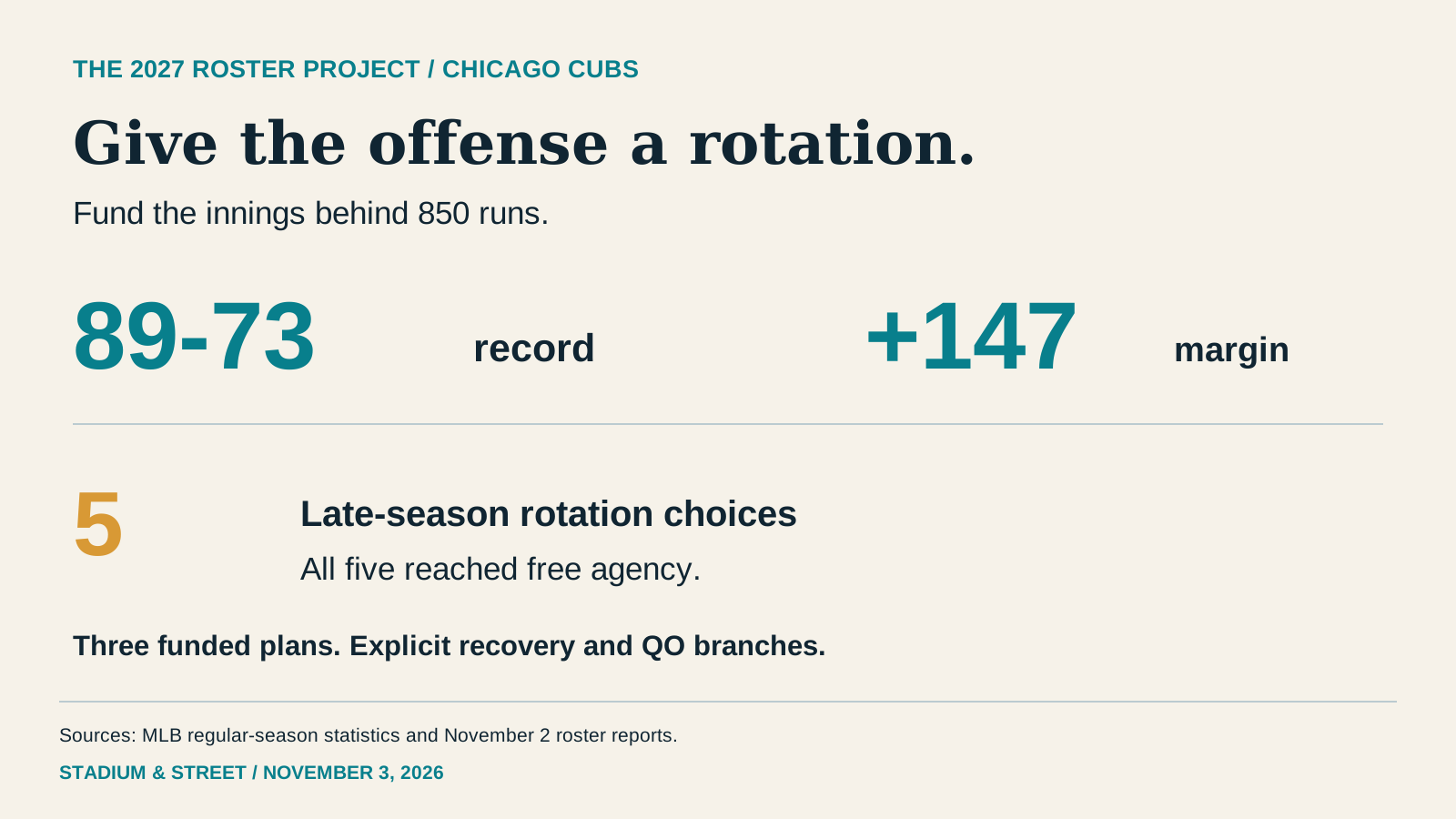
The Cubs scored 850 runs and still finished 14 games behind Milwaukee. Chicago's offense led the majors. Its pitching allowed 54 more runs than in 2025, and all five pitchers who finished the season in the rotation have reached free agency. The winter's central question is how much the Cubs will pay to put dependable innings behind a productive lineup.
Our preferred plan starts with Tarik Skubal, then retains Shota Imanaga and Clay Holmes. It also brings back Seiya Suzuki and Carson Kelly, adds Taylor Clarke for relief depth and reserves $8-10 million for needs that emerge. Those choices require $116-134 million in annual additions and a total player-allocation envelope of about $269.22-291.22 million. The commitment is substantial: $540-612 million across the proposed contracts and reserve. These are S&S negotiating limits, not reports of offers or Chicago's authorized budget.
The cost is the argument's hardest part. An eight-year ace contract carries considerable health and aging risk. But an internal rotation that assumes Justin Steele and Ben Brown will immediately resume full workloads would hide a different risk. This analysis prices a credible outside foundation and gives the returning pitchers conditional roles. A lower-cost Freddy Peralta alternative and a fully mapped internal plan show what changes if Chicago declines that commitment.
A better run margin did not produce a better finish
Chicago improved its run differential from plus-144 to plus-147 while falling from 92 wins to 89. The offense added 57 runs. Almost all of that gain was absorbed by the 54-run increase in runs allowed. The result is a roster with a strong underlying scoring advantage and a pitching problem that the win total alone understates.
| Season | Record | Runs for / against | Margin | OPS / ERA |
|---|---|---|---|---|
| 2024 | 83-79 | 736 / 669 | +67 | .710 / 3.78 |
| 2025 | 92-70 | 793 / 649 | +144 | .750 / 3.79 |
| 2026 | 89-73 | 850 / 703 | +147 | .767 / 4.12 |
The Padres swept Chicago in the Wild Card Series, winning 8-0 and 4-1. That is a verified October outcome, not a complete diagnosis from two games. The regular season supplies the stronger evidence for prioritizing pitching: a 4.27 starter ERA across 848.2 innings, followed by 598.1 relief innings with a 3.90 ERA. Chicago used its bullpen for a substantial share of the season, and injuries repeatedly changed the available choices.
A simple squared-run model turns 850 scored and 703 allowed into roughly 96.2 wins. Chicago actually won 89. That gap can reflect sequencing, close-game outcomes and other factors the formula leaves out. It does not entitle the Cubs to seven extra wins next season. It does show why dismantling a productive position-player group in response to a short October would be an unnecessarily broad reaction.
The roster after the first November decisions
The initial 40-man feed contains 38 names, including players whose departures were subsequently confirmed. Removing Caleb Thielbar, Clay Holmes, Colin Rea, Hunter Harvey and Tyler Austin, then adding the November 2 waiver claim of Eric Orze, produces 34 reconciled names in this research snapshot. Orze's claim is confirmed in MLB's report on Jacob Webb's new contract even though the roster feed still carries his Minnesota affiliation.
| Player / MLB ID | Feed status | Reconciled treatment |
|---|---|---|
| Alex Bregman / 608324 | Active | Controlled; medical clearance separate |
| BJ Murray Jr. / 681230 | Active | Controlled; medical clearance separate |
| Ben Brown / 676962 | Injured 60-Day | Controlled; medical clearance separate |
| Braxton Garrett / 666129 | Active | Controlled; medical clearance separate |
| Cade Horton / 690990 | Injured 60-Day | Controlled; medical clearance separate |
| Daniel Palencia / 694037 | Active | Controlled; medical clearance separate |
| Dansby Swanson / 621020 | Active | Controlled; medical clearance separate |
| Edward Cabrera / 665795 | Active | Controlled; medical clearance separate |
| Eric Orze / 679358 | Claim confirmed | Waiver claim; API lag |
| Ethan Roberts / 681799 | Active | Controlled; medical clearance separate |
| Gabriel Arias / 672356 | Active | Controlled; medical clearance separate |
| Gavin Hollowell / 668970 | Active | Controlled; medical clearance separate |
| Jacob Webb / 657097 | Active | Controlled; medical clearance separate |
| James Triantos / 701649 | Active | Controlled; medical clearance separate |
| Javier Assad / 665871 | Active | Controlled; medical clearance separate |
| Jayden Murray / 681151 | Active | Controlled; medical clearance separate |
| Jordan Wicks / 696136 | Active | Controlled; medical clearance separate |
| Julian Aguiar / 687924 | Active | Controlled; medical clearance separate |
| Justin Dean / 681909 | Active | Controlled; medical clearance separate |
| Justin Steele / 657006 | Injured 60-Day | Controlled; medical clearance separate |
| Kevin Alcántara / 682634 | Active | Controlled; medical clearance separate |
| Matt Shaw / 807713 | Active | Controlled; medical clearance separate |
| Michael Busch / 683737 | Active | Controlled; medical clearance separate |
| Miguel Amaya / 665804 | Active | Controlled; medical clearance separate |
| Nico Hoerner / 663538 | Active | Controlled; medical clearance separate |
| Pedro Ramírez / 699393 | Active | Controlled; medical clearance separate |
| Pete Crow-Armstrong / 691718 | Active | Controlled; medical clearance separate |
| Phil Maton / 664208 | Injured 60-Day | Controlled; medical clearance separate |
| Porter Hodge / 687863 | Injured 60-Day | Controlled; medical clearance separate |
| Riley Martin / 702303 | Injured 60-Day | Controlled; medical clearance separate |
| Ryan Rolison / 669020 | Active | Controlled; medical clearance separate |
| Ryan Zeferjahn / 666171 | Active | Controlled; medical clearance separate |
| Shelby Miller / 571946 | Injured 60-Day | Controlled; medical clearance separate |
| Tyler Ferguson / 621053 | Active | Controlled; medical clearance separate |
Injured-list labels are administrative information, not clearance to pitch. The raw feed still includes several 60-day listings. Brown's neck condition, Steele's elbow recovery, Cade Horton's elbow operation and the recoveries of Porter Hodge, Phil Maton, Tyson Miller and Riley Martin require individual treatment. A roster restoration would not by itself establish any of their workloads.
The proposed additions also require roster space and actual transactions. Six signings or retentions would take this reconciled group to 40 before additional prospect selections. Ayers, Wiggins, Noland, Sanders, Kipp, Caple and Netz represent season-long depth possibilities, not simultaneous opening-day roster appointments. Their selection, option and availability decisions must be made against the final roster rather than inferred from a list of names.
The productive bats already in place
Pete Crow-Armstrong supplied 45 home runs, 41 steals and a .942 OPS in 726 plate appearances. Alex Bregman added 28 home runs and a .819 OPS. Michael Busch produced 20 home runs and 92 walks. The core offers several ways to create runs, including power, patient at-bats and speed. It does not need an unrelated expensive first baseman or designated hitter simply because one reaches the market.
| Player / MLB ID | CHC PA | AVG / OBP / SLG | HR | BB / K; role |
|---|---|---|---|---|
| Pete Crow-Armstrong / 691718 | 726 | .280 / .372 / .570 | 45 | 83 / 187; CF centerpiece |
| Michael Busch / 683737 | 710 | .242 / .352 / .393 | 20 | 92 / 165; 1B |
| Alex Bregman / 608324 | 702 | .265 / .355 / .464 | 28 | 76 / 102; 3B |
| Nico Hoerner / 663538 | 689 | .263 / .316 / .350 | 8 | 43 / 58; 2B |
| Ian Happ / 664023 | 636 | .218 / .326 / .412 | 24 | 81 / 189; Free agent, LF |
| Seiya Suzuki / 673548 | 634 | .270 / .368 / .473 | 26 | 81 / 155; Free agent; QO pending |
| Dansby Swanson / 621020 | 486 | .213 / .297 / .397 | 19 | 51 / 115; SS |
| Carson Kelly / 608348 | 425 | .258 / .336 / .376 | 10 | 40 / 70; Free agent, C |
| Michael Conforto / 624424 | 314 | .240 / .331 / .469 | 15 | 35 / 80; Free agent, OF |
| Pedro Ramírez / 699393 | 266 | .261 / .321 / .402 | 6 | 20 / 49; Utility |
| Miguel Amaya / 665804 | 254 | .237 / .340 / .377 | 6 | 23 / 67; C |
| Matt Shaw / 807713 | 202 | .237 / .327 / .410 | 5 | 21 / 35; Utility / OF |
| Moisés Ballesteros / 694208 | 175 | .231 / .303 / .385 | 6 | 17 / 36; Traded to Angels |
| Tyrone Taylor / 621438 | 82 | .351 / .390 / .500 | 1 | 5 / 10; Free agent, OF |
| Kevin Alcántara / 682634 | 28 | .240 / .286 / .360 | 1 | 2 / 11; OF opportunity |
| James Triantos / 701649 | 9 | .125 / .222 / .125 | 0 | 1 / 2; Development opportunity |
| Justin Dean / 681909 | 10 | .375 / .500 / .625 | 0 | 2 / 4; OF depth |
The table deliberately includes departed contributors. Suzuki, Ian Happ, Kelly and Michael Conforto helped produce the 850-run season but are not guaranteed parts of the next one. Moises Ballesteros was traded to the Angels. Their historical output is useful for understanding 2026; it cannot be assigned to a retained 2027 lineup without paying for a return or naming a replacement.
Nico Hoerner's .666 OPS and Dansby Swanson's .694 OPS leave room for offensive improvement, but their defensive value matters. Hoerner struck out only 58 times in 689 plate appearances, while Swanson hit 19 home runs despite a shorter season. They offer different offensive profiles. The lineup plan preserves both regular jobs and provides rest through verified infield alternatives rather than treating one year's OPS as a complete player valuation.
Contact quality tempers the offensive expectations
Crow-Armstrong's .400 wOBA exceeded his .374 expected mark. The expected figure still describes excellent contact-based production. Suzuki's .366 wOBA and .340 xwOBA also support a valuable bat while warning against budgeting every bit of his actual outcome. Bregman's .357 and .327 measures point in the same direction.
| Batter | wOBA | xwOBA | SLG / xSLG | Reading |
|---|---|---|---|---|
| Pete Crow-Armstrong | 0.400 | 0.374 | 0.570 / 0.508 | Exceptional production; contact also strong |
| Alex Bregman | 0.357 | 0.327 | 0.464 / 0.391 | Above contact-based estimate |
| Seiya Suzuki | 0.366 | 0.340 | 0.473 / 0.427 | Above estimate, still valuable contact |
| Michael Busch | 0.333 | 0.331 | 0.393 / 0.402 | Actual and expected closely aligned |
| Nico Hoerner | 0.297 | 0.322 | 0.350 / 0.375 | Expected contact stronger than results |
| Dansby Swanson | 0.305 | 0.301 | 0.397 / 0.380 | Both measures modest |
| Ian Happ | 0.325 | 0.313 | 0.412 / 0.390 | Power and walks, many strikeouts |
| Carson Kelly | 0.320 | 0.311 | 0.376 / 0.372 | Catching value beyond offense |
| Miguel Amaya | 0.324 | 0.295 | 0.377 / 0.335 | Short sample; actual exceeds estimate |
| Pedro Ramírez | 0.315 | 0.284 | 0.402 / 0.342 | Small sample with weaker expected output |
| Matt Shaw | 0.325 | 0.303 | 0.410 / 0.353 | Limited opportunity; do not extrapolate |
| Randal Grichuk | 0.370 | 0.335 | 0.566 / 0.478 | Platoon alternative; not funded |
| Austin Hedges | 0.313 | 0.280 | 0.377 / 0.314 | Defense-first catching alternative |
Busch's .333 wOBA and .331 xwOBA are closely aligned. Hoerner's .297 actual mark was below his .322 expected measure, providing a different kind of opportunity. It would be reasonable to investigate the quality and placement of his contact. It would be unreasonable to add the entire difference to a team forecast as if improvement were guaranteed.
Expected statistics describe contact using observed ball characteristics and related inputs. They do not fully price baserunning, defense, lineup context, every park effect or future health. This report uses them to test the strength of the offensive foundation. They support keeping the best bats, giving younger hitters real opportunities and avoiding a plan that assumes the league-leading offense will automatically remain first after several departures.
Three seasons and the matchup choices
An offseason plan should distinguish an established contribution from a short opportunity. The three-year table gives the regulars' full MLB samples, rather than silently replacing a traded player's full season with only his Chicago segment. It also shows how little major-league evidence supports some of the younger alternatives.
| Hitter | 2024 MLB PA / OPS | 2025 MLB PA / OPS | 2026 MLB PA / OPS |
|---|---|---|---|
| Pete Crow-Armstrong | 410 / .670 | 647 / .768 | 726 / .942 |
| Alex Bregman | 634 / .768 | 495 / .822 | 702 / .819 |
| Seiya Suzuki | 585 / .848 | 651 / .804 | 634 / .841 |
| Michael Busch | 567 / .775 | 592 / .866 | 710 / .745 |
| Nico Hoerner | 641 / .708 | 649 / .739 | 689 / .666 |
| Dansby Swanson | 593 / .702 | 645 / .717 | 486 / .694 |
| Ian Happ | 657 / .782 | 663 / .762 | 636 / .738 |
| Carson Kelly | 313 / .687 | 421 / .761 | 425 / .712 |
| Miguel Amaya | 363 / .645 | 103 / .814 | 254 / .717 |
| Matt Shaw | No MLB season | 437 / .689 | 202 / .737 |
| Batter / full MLB season | LHP: PA / OPS | RHP: PA / OPS |
|---|---|---|
| Pete Crow-Armstrong | 230 / .879 | 496 / .973 |
| Alex Bregman | 179 / .875 | 523 / .799 |
| Seiya Suzuki | 168 / .966 | 466 / .797 |
| Michael Busch | 204 / .770 | 506 / .736 |
| Nico Hoerner | 173 / .674 | 516 / .665 |
| Dansby Swanson | 139 / .735 | 347 / .677 |
| Ian Happ | 144 / .484 | 492 / .816 |
| Carson Kelly | 136 / .871 | 289 / .638 |
| Miguel Amaya | 78 / .753 | 176 / .701 |
| Pedro Ramírez | 47 / 1.007 | 219 / .662 |
| Matt Shaw | 98 / .841 | 104 / .640 |
| Randal Grichuk | 178 / 1.026 | 102 / .636 |
| Austin Hedges | 130 / .747 | 117 / .654 |
The handedness table is a guide to deployment, not an invitation to build a different lineup around every small split. Crow-Armstrong, Bregman, Hoerner and Busch need regular work. Suzuki's return would preserve a right-handed power source without forcing a prospect to reproduce it immediately. Shaw and Pedro Ramirez should receive planned opportunities that extend beyond occasional pinch-hit appearances.
Randal Grichuk is an evaluated platoon alternative at $6-8 million for one year and about 260 plate appearances. He is not added to the preferred budget. His .880 full-season OPS in 280 plate appearances is useful evidence, but the small sample and narrower role do not make him a 600-PA Suzuki replacement. If Chicago chooses that route, it must also assign the remaining work and accept a different offensive ceiling.
Preserve the range that helps the pitchers
The Cubs' best defensive players change the kind of roster they can build. Crow-Armstrong recorded plus-26 Outs Above Average, Swanson plus-16, Hoerner plus-11 and Bregman plus-9 in 2026. Those are meaningful sources of run prevention. They also make it sensible to retain pitchers who can put the ball in play without surrendering too many free baserunners.
| Fielder | 2024 OAA | 2025 OAA | 2026 OAA | 2026 opportunities |
|---|---|---|---|---|
| Pete Crow-Armstrong | +13 | +24 | +26 | 413 |
| Nico Hoerner | +9 | +15 | +11 | 613 |
| Dansby Swanson | +17 | +4 | +16 | 475 |
| Alex Bregman | +8 | +3 | +9 | 431 |
| Seiya Suzuki | -3 | 0 | +5 | 263 |
| Michael Busch | +2 | -1 | +2 | 387 |
| Ian Happ | 0 | 0 | +1 | 331 |
| Pedro Ramírez | No row | No row | +2 | 194 |
| Matt Shaw | No row | -1 | +1 | 132 |
| Kevin Alcántara | 0 | 0 | 0 | 9 |
| Justin Dean | No row | +1 | +1 | 8 |
Suzuki's plus-5 OAA followed minus-3 in 2024 and zero in 2025. His improvement strengthens the retention case, but a contract should not assume that every future season repeats the best defensive result. The table includes opportunities because the same OAA total means something different over a full season than in limited work. Missing rows are not zeroes, and these estimates are not interchangeable with framing runs or offensive value.
| Player | 2026 CHC defensive innings | 2027 assignment |
|---|---|---|
| Pete Crow-Armstrong | CF 1370.0 | CF |
| Nico Hoerner | 2B 1019.2; SS 352.1 | 2B |
| Dansby Swanson | SS 1087.2 | SS |
| Alex Bregman | 3B 1248.0 | 3B |
| Seiya Suzuki | RF 972.2 | RF only if retained |
| Michael Busch | 1B 1399.0 | 1B |
| Pedro Ramírez | 1B 13.0; 2B 312.1; 3B 136.0; LF 1.0 | 2B/3B/DH |
| Matt Shaw | 1B 10.0; 3B 55.0; LF 16.1; CF 7.0; RF 209.2; 2B 87.0 | RF/LF and IF |
| Kevin Alcántara | LF 21.0; CF 6.0; RF 10.0 | LF/RF; AAA experience at all OF spots |
| Justin Dean | LF 2.0; CF 15.0; RF 16.0 | All OF; 290 AAA CF innings |
| James Triantos | 2B 12.0 | IF/OF depth; 110 AAA CF innings |
| BJ Murray Jr. | 1B 9.0 | 1B/3B depth |
Alcantara has actual minor-league experience at all three outfield positions, including 363.1 innings in right field at Iowa. Dean played 290 Triple-A innings in center. Triantos added 110 Triple-A center-field innings alongside extensive infield work. Those records support contingency assignments. They do not establish that all three will defend like Crow-Armstrong or hit well enough to justify everyday major-league roles.
Catching needs a bridge, not a vacancy disguised as depth
Kelly's mutual option was declined, leaving him a free agent. Retaining him for two years and $16-20 million would give Chicago a 350-PA bridge alongside Amaya and a measured Ayers introduction. The proposed annual cost is $8-10 million. Kelly's 425 plate appearances and .712 OPS in 2026 show a workable workload, while his defensive measures require a more restrained description than calling him an elite all-around catcher.
| Catcher | 2026 catching IP | Framing runs | Overall catching value |
|---|---|---|---|
| Carson Kelly | 848.1 | +1.0 | -1.0 runs |
| Miguel Amaya | 557.2 | +1.3 | +1.3 runs |
| Owen Ayers / 689196 | 287.1 AAA; 265 AA | No comparable MLB row | Development option, not established MLB defense |
Ayers caught 287.1 innings at Triple-A and 265 at Double-A. His bat was stronger at the lower level: a 1.008 OPS in 278 Double-A plate appearances, then .721 in 208 at Iowa. The plan gives him 100 MLB plate appearances and 12 starts behind the plate, with more development time available. It does not turn a promising minor-league season into a guaranteed major-league starter.
Austin Hedges is a separate defense-oriented option at $4-5 million for one year. He would receive only 180 plate appearances, with Amaya taking 100 more and Ayers 70 more than in the preferred plan. That saves money but changes both the offense and the workload. Ballesteros is not an alternative here because Chicago traded him to the Angels for Ryan Zeferjahn in August.
A rotation with five departing finishers
Imanaga, Matthew Boyd, Kevin Gausman, David Peterson and Holmes all finished the year as available rotation choices and are now free agents. The Cubs can retain some of them, but the 2026 innings do not remain on the roster simply because the pitchers were familiar. MLB's current offseason reporting identifies this as Chicago's central need.
| Pitcher / MLB ID | GS / CHC IP | ERA / full MLB xERA | K / BB / HR | Treatment |
|---|---|---|---|---|
| Shota Imanaga / 684007 | 32 / 174.1 | 3.77 / 3.81 | 174 / 37 / 35 | Free agent; proposed retention |
| Matthew Boyd / 571510 | 22 / 126.2 | 3.91 / 4.66 | 96 / 39 / 15 | Free agent; alternative |
| Kevin Gausman / 592332 | 9 / 50.1 | 4.83 / 4.03 | 57 / 11 / 11 | Free agent after trade |
| David Peterson / 656849 | 15 / 80.1 | 3.70 / 4.76 | 74 / 35 / 9 | Free agent after trade |
| Clay Holmes / 605280 | 9 / 48.2 | 4.25 / 3.87 | 33 / 24 / 3 | Free agent; proposed retention |
| Edward Cabrera / 665795 | 15 / 80.0 | 5.96 / 5.40 | 71 / 36 / 16 | Blister recovery; poor 2026 results |
| Ben Brown / 676962 | 8 / 68.0 | 1.85 / 3.25 | 65 / 19 / 2 | Neck recovery; no opening allocation |
| Javier Assad / 665871 | 11 / 94.1 | 3.63 / 4.48 | 63 / 27 / 16 | Option declined; arbitration control retained |
| Braxton Garrett / 666129 | 0 / 5.0 | 1.80 / 6.07 | 2 / 3 / 0 | Small post-recovery workload |
| Jordan Wicks / 696136 | 2 / 10.1 | 10.45 / 4.42 | 8 / 2 / 1 | Depth; performance must improve |
| Cade Horton / 690990 | 2 / 7.1 | 2.45 / 3.35 | 4 / 2 / 1 | Elbow surgery; no opening allocation |
Imanaga's 174.1 innings, 3.77 ERA and 37 walks provide a strong retention case. His 35 home runs allowed also create a real limitation. The proposal is three years and $54-60 million, with 165 innings assigned for 2027. That pays for strike throwing and an established workload without calling him the staff's ace or assuming the home-run problem disappears.
Holmes is a different purchase. His full season covered 101.1 innings with a 3.29 ERA, while his Chicago portion was 48.2 innings at 4.25. The proposal of three years and $42-48 million buys a 135-inning role, subject to health and workload review. His prior interruption was a fractured fibula, not evidence of an undisclosed arm condition. The increase from 101.1 to 135 innings remains an assumption that needs clearance, not a completed medical finding.
Skubal is a priority with a price limit
Skubal's 158.2 innings produced a 2.72 ERA, a 2.94 xERA, 186 strikeouts and 27 walks. That combination offers something Chicago's internal alternatives have not established: substantial strikeout production with few free passes. Our proposed limit is eight years and $320-360 million, or $40-45 million annually. The planned workload is 30 starts and 170 innings.
The medical history belongs in the valuation. Skubal had surgery to remove loose bodies from his elbow during 2026 and subsequently returned to pitch. His completed season supports considering him; it does not certify eight healthy years. A club with access to medical records could reach a different valuation. This report does not claim that access, and the contract remains conditional on an acceptable examination and negotiated terms.
The strongest counterargument is that an eight-year contract transfers too much future risk to solve an immediate need. That is why the plan has a lower-commitment alternative. The Cubs should pursue the ace only within the stated ceiling and with the rest of the staff funded. Signing Skubal while abandoning two other needed starters would leave too much of the original innings problem intact.
Price Peralta and the other alternatives by their jobs
Peralta is the principal alternative at five years and $125-140 million, an annual allocation of $25-28 million. His full 2026 season contained 169 innings, a 4.42 ERA, a 3.84 xERA, 156 strikeouts and 63 walks. The Rays segment was better than the Mets segment, but the full year governs the assessment. The lower expected ERA is a reason to investigate, not proof that his next season will match it.
| Candidate / MLB ID | Full 2026 MLB evidence | S&S ceiling / decision |
|---|---|---|
| Tarik Skubal / 669373 | 158.2 IP, 2.72 ERA, 2.94 xERA; 186 K / 27 BB | Preferred ace: 8 years / $320-360M |
| Freddy Peralta / 642547 | 169.0 IP, 4.42 ERA, 3.84 xERA; 156 K / 63 BB | Alternative ace: 5 years / $125-140M |
| Shota Imanaga / 684007 | 174.1 IP, 3.77 ERA, 3.81 xERA; 174 K / 37 BB | Retain: 3 years / $54-60M |
| Clay Holmes / 605280 | 101.1 IP, 3.29 ERA, 3.87 xERA; 78 K / 42 BB | Retain: 3 years / $42-48M |
| Seiya Suzuki / 673548 | 634 PA, .841 OPS, 26 HR; 0.366/0.340 wOBA/xwOBA | Retain: 4 years / $96-108M; QO pending |
| Carson Kelly / 608348 | 425 PA, .712 OPS, 10 HR; 0.320/0.311 wOBA/xwOBA | Retain: 2 years / $16-20M |
| Taylor Clarke / 664199 | 73.0 IP, 2.96 ERA, 4.42 xERA; 45 K / 14 BB | Relief: 1 year / $4-6M |
| Steven Okert / 595345 | 67.2 IP, 2.13 ERA, 3.13 xERA; 68 K / 14 BB | Alternative relief: 1 year / $8-10M |
| Nick Martinez / 607259 | 180.0 IP, 3.10 ERA, 3.98 xERA; 109 K / 26 BB | Alternative SP: 2 years / $26-30M |
| Michael King / 650633 | 185.0 IP, 3.21 ERA, 4.42 xERA; 159 K / 70 BB | Alternative SP: 3 years / $75-84M |
| Tyler Mahle / 641816 | 149.0 IP, 3.99 ERA, 3.95 xERA; 137 K / 46 BB | Alternative SP: 2 years / $28-32M |
| Shane Bieber / 669456 | 55.2 IP, 4.37 ERA, 5.99 xERA; 44 K / 24 BB | Recovery inquiry only; not funded |
| Randal Grichuk / 545341 | 280 PA, .880 OPS, 15 HR; 0.370/0.335 wOBA/xwOBA | Platoon alternative: 1 year / $6-8M |
| Austin Hedges / 595978 | 247 PA, .702 OPS, 6 HR; 0.313/0.280 wOBA/xwOBA | Limited catcher: 1 year / $4-5M |
| Ian Happ / 664023 | 636 PA, .738 OPS, 24 HR; 0.325/0.313 wOBA/xwOBA | Alternative retention: 2 years / $30-36M |
The Peralta plan retains Imanaga and Holmes and uses the same 30-start, 170-inning slot assigned to Skubal. Its annual additions fall to $101-117 million and its new commitments to $345-392 million. The saving is real within these assumptions, but so is the difference in command and recent performance. Peralta is an alternative route to a stronger staff, not the same pitcher at a discount.
Nick Martinez is a $26-30 million, two-year fallback for the Holmes role. His 180 innings and 26 walks support a larger workload, although 109 strikeouts describe a less dominant profile. Michael King and Tyler Mahle also receive explicit evidence checks. Shane Bieber's 55.2 innings, 4.37 ERA and 5.99 xERA do not justify treating a recovery purchase as a cheap substitute for the ace. No candidate's availability or willingness to accept our ceiling is assumed.
Rebuild relief around actual available arms
Webb's new contract is a useful first step: $2 million for 2027, followed by a $4 million club option with a $500,000 buyout for 2028. It replaces the old $2.5 million option. His 67 innings, 3.36 ERA, 73 strikeouts and 25 walks give the bullpen an established contribution at a modest current allocation. The contract does not solve the entire relief staff.
| Pitcher | 2026 CHC IP | ERA / full MLB xERA | K / BB | Treatment |
|---|---|---|---|---|
| Jacob Webb | 67.0 | 3.36 / 4.35 | 73 / 25 | Retained for $2M |
| Daniel Palencia | 29.2 | 3.64 / 3.76 | 30 / 11 | Health-dependent late innings |
| Ryan Zeferjahn | 18.0 | 4.50 / 3.10 | 19 / 8 | Late-inning opportunity |
| Phil Maton | 27.2 | 6.18 / 6.85 | 31 / 16 | Knee recovery; explicit fallback |
| Ryan Rolison | 63.0 | 3.14 / 4.03 | 55 / 28 | Left-handed depth |
| Ethan Roberts | 25.2 | 4.21 / 5.05 | 17 / 14 | Middle relief |
| Tyler Ferguson | 17.1 | 3.63 / 4.48 | 20 / 4 | Right-handed depth |
| Gavin Hollowell | 14.2 | 2.45 / 5.65 | 13 / 9 | Depth |
| Riley Martin | 8.1 | 2.16 / 2.60 | 10 / 2 | Recovery-dependent; no opening innings |
| Caleb Thielbar | 50.0 | 4.86 / 4.60 | 60 / 18 | Free agent |
| Hunter Harvey | 4.0 | 6.75 / 5.16 | 4 / 1 | Free agent |
Clarke is proposed for one year and $4-6 million, with 60 innings. His 73 innings, 2.96 ERA and 14 walks support a command-oriented addition. His 4.42 xERA and 45 strikeouts limit the claim: this is middle- and later-inning depth, not the purchase of a dominant closer. Steven Okert is the left-handed alternative at $8-10 million for the same 60-inning slot, adding $4 million at either end of the annual budget.
Palencia, Zeferjahn and Webb remain the leading established choices for important innings, subject to health and performance. Orze must earn his place after a 5.66 ERA with Minnesota. The report reserves work for recovering Maton but supplies a replacement branch. Hodge, Miller and Martin are not assigned opening workloads merely to make the bullpen look deeper.
Development after the trades
Chicago has already used meaningful prospect capital to acquire major-league help. Owen Caissie and Cristian Hernandez moved to Miami in the Cabrera deal. Jonathon Long moved in the Garrett transaction. Brett Bateman and Ty Southisene went to Toronto for Gausman. Ballesteros went to the Angels, and Jefferson Rojas is now in the Mets organization. Those players cannot appear again as Cubs depth or as assets available for a second proposed trade.
| Player / MLB ID | 2026 level and sample | Readiness decision |
|---|---|---|
| Owen Ayers / 689196 | AAA: 208 PA, .721 OPS, 3 HR; 32 BB / 45 K | Third catcher; AAA production weaker than AA |
| Kevin Alcántara / 682634 | AAA: 357 PA, .852 OPS, 20 HR; 43 BB / 109 K | Defined LF opportunity, not assumed stardom |
| James Triantos / 701649 | AAA: 484 PA, .787 OPS, 9 HR; 33 BB / 57 K | Contact and positional flexibility |
| BJ Murray Jr. / 681230 | AAA: 535 PA, .906 OPS, 17 HR; 74 BB / 113 K | Corner depth; no everyday vacancy |
| Justin Dean / 681909 | AAA: 352 PA, .623 OPS, 3 HR; 48 BB / 87 K | Defense and depth; weak AAA offense |
| Jaxon Wiggins / 694393 | AAA: 33.1 IP, 7.83 ERA; 41 K / 31 BB | Control must improve before sustained MLB role |
| Connor Noland / 690939 | AAA: 73.2 IP, 5.38 ERA; 52 K / 31 BB | Depth; 5.38 AAA ERA |
| Will Sanders / 691739 | AAA: 50.0 IP, 5.22 ERA; 54 K / 21 BB | Depth; no automatic league-average innings |
| Grant Kipp / 805990 | AAA: 40.2 IP, 5.09 ERA; 49 K / 24 BB | Conditional internal fallback |
| Brooks Caple / 699944 | AA: 86.0 IP, 3.24 ERA; 82 K / 25 BB | AA development before guaranteed MLB work |
| Dawson Netz / 683100 | AA: 85.2 IP, 2.94 ERA; 103 K / 35 BB | AA development; monitor walks |
| Josiah Hartshorn / 815824 | A+: 370 PA, .965 OPS, 18 HR; 54 BB / 79 K | A+ success; no 2027 MLB PA budget |
| Kane Kepley / 823807 | AA: 144 PA, .745 OPS, 3 HR; 24 BB / 23 K | AA progress; no immediate CF vacancy |
| Ethan Conrad / 828255 | A+: 8 PA, .125 OPS, 0 HR; 1 BB / 3 K | Development; no 2027 MLB PA assumed |
| Miguel Useche / 687766 | AA: 182 PA, .862 OPS, 6 HR; 20 BB / 36 K | Catching development, not current MLB solution |
Alcantara's 20 homers and .852 OPS in 357 Triple-A plate appearances earn a real opportunity. Triantos' .787 OPS with 57 strikeouts in 484 Triple-A plate appearances offers a different contact profile. Murray's .906 Triple-A OPS is useful corner depth, but Busch and Bregman already occupy those jobs. Ayers has a defined catching path. These distinctions are more useful than treating every prospect as an interchangeable inexpensive starter.
The pitching promotions require particular caution. Wiggins walked 31 in 33.1 Triple-A innings. Noland and Sanders had ERAs above five at Iowa. Caple and Netz produced stronger Double-A results but have not established major-league relief roles. Hartshorn, Kepley, Conrad, Townsend and Reid remain developmental assets; no 2027 MLB production is credited to them in the funded plan. The next wave matters without being forced to rescue the opening roster.
The existing financial obligations
Seven guaranteed contracts total about $106.917 million on the report's salary-plus-allocated-bonus basis. The figures include Bregman's $35 million, Swanson's $28 million, Hoerner's roughly $23.833 million, Crow-Armstrong's roughly $10.833 million, Maton's $6 million, Miller's $1.25 million and Webb's new $2 million. Actual cash timing differs where bonuses and deferrals apply.
| Player / MLB ID | 2027 allocation | Basis |
|---|---|---|
| Alex Bregman / 608324 | $35.000M | Salary plus allocated bonus; deferrals separate |
| Dansby Swanson / 621020 | $28.000M | Guaranteed 2027 allocation |
| Nico Hoerner / 663538 | $23.833M | $23M salary plus allocated bonus; deferrals separate |
| Phil Maton / 664208 | $6.000M | Future option/buyout separate |
| Shelby Miller / 571946 | $1.250M | Recovery does not erase guarantee |
| Pete Crow-Armstrong / 691718 | $10.833M | $10M salary plus allocated signing bonus |
| Jacob Webb / 657097 | $2.000M | November 2 replacement contract; 2028 option separate |
| TOTAL | $106.917M | Before Assad, arbitration, buyouts and depth |
| Player | Estimate, $M | Treatment |
|---|---|---|
| Justin Steele | 6.80 | Published estimate; unsigned salary |
| Edward Cabrera | 4.80 | Published estimate; unsigned salary |
| Braxton Garrett | 1.60 | Published estimate; unsigned salary |
| Miguel Amaya | 1.70 | Published estimate; unsigned salary |
| Gabriel Arias | 1.30 | Published estimate; unsigned salary |
| Ryan Rolison | 1.10 | Published estimate; unsigned salary |
| Ethan Roberts | 0.80 | Published estimate; unsigned salary |
| Michael Busch | 5.40 | Published estimate; unsigned salary |
| Ben Brown | 1.30 | Published estimate; unsigned salary |
| Daniel Palencia | 1.20 | Published estimate; unsigned salary |
| TOTAL | 26.00 | Ten cases; no automatic non-tender savings |
The ten other arbitration estimates total $26 million. The Cubs declined Assad's $3.3 million option while retaining arbitration control through 2028. The model includes his separate $2.3 million arbitration estimate once, reducing the existing-roster allocation by $1 million. His eventual settlement can differ from that estimate. Tyler Austin's estimated arbitration salary is removed because he is a free agent. Steele and Brown remain financial obligations even though their opening workloads are not assumed.
| Component | Annual allocation | Definition |
|---|---|---|
| Seven contracts | $106.917M | Allocated salary and bonus basis |
| Assad arbitration estimate | $2.30M | Unsigned estimate after $3.3M option declined |
| Arbitration | $26.00M | Ten cases; exclude free-agent Austin and separate Assad |
| Declined-option buyouts | $6.00M | Boyd 2; Kelly 1.5; Rea 1; Harvey 1; Thielbar 0.5 |
| Pre-arb, minors and callups | $12-16M | S&S planning allowance |
| Existing-roster envelope | $153.22-157.22M | Allocation, not cash or official CBT |
The $6 million buyout provision comprises Boyd at $2 million, Kelly at $1.5 million, Rea and Harvey at $1 million each and Thielbar at $500,000. The $12-16 million pre-arbitration, minor-league and callup allowance completes a $153.22-157.22 million existing-roster envelope. It is not an audited cash budget, a competitive-balance-tax calculation or the organization's full operating cost. No tax threshold beyond the current agreement is invented, and prior trade cash is not automatically carried into 2027.
Three funded paths and their contract exposure
Plan A purchases three starters, retains two important position players and adds one reliever. Skubal costs $40-45 million annually; Imanaga $18-20 million; Holmes $14-16 million; Suzuki $24-27 million; Kelly $8-10 million; and Clarke $4-6 million. The separate $8-10 million reserve has no player production attached. Together, those additions total $116-134 million annually.
| Plan | Annual additions | Total allocation | New commitment |
|---|---|---|---|
| A: Skubal-led, three SP / Suzuki / Kelly / Clarke | $116-134M | $269.22-291.22M | $540-612M |
| B: Peralta-led, same supporting additions | $101-117M | $254.22-274.22M | $345-392M |
| C: Internal roster | $8-10M | $161.22-167.22M | $8-10M |
Plan B substitutes Peralta's five-year, $125-140 million proposal for Skubal's eight-year contract. The other additions remain funded. Plan C makes no named acquisition and spends only the $8-10 million reserve, producing a $161.22-167.22 million total allocation. Its lower expense is accompanied by weaker catching, a thinner outfield and a rotation heavily dependent on internal improvement.
The new-commitment column includes the full face value of the proposed contracts and the reserve. It is separate from one year's allocation and from existing commitments. A club choosing Plan A would be accepting $540-612 million in new exposure. That number should be visible before calling the plan affordable. No verified owner budget has been supplied, so the recommendation is a roster judgment with an explicit cost, not a claim about willingness to spend.
Suzuki's decision changes the bill
Suzuki received the $23.15 million qualifying offer and has until November 17 at 3 p.m. Central to decide. A return on that one-year offer replaces the proposed $24-27 million annual allocation. With all other Plan A additions intact, the total becomes approximately $268.37-287.37 million. If the other additions fail, an internal roster with Suzuki on the offer costs about $184.37-190.37 million.
| Condition | Cost treatment | Workload consequence |
|---|---|---|
| Suzuki accepts QO | A becomes $268.37-287.37M total | Same 600 PA; $23.15M replaces proposed $24-27M |
| QO accepted, other additions fail | $184.37-190.37M total | Internal plan plus Suzuki; pitching gap persists |
| Assad arbitration settlement differs | $2.3M estimate already included; adjust by the actual difference | Option declined; retained control does not establish the final salary |
| Happ instead of Suzuki | Annual additions $107-125M; total $260.22-282.22M | Happ 550 PA, Shaw +50; Alcantara moves to RF |
| Okert instead of Clarke | Annual addition increases $4M at either bound | Same 60 RP IP; left-handed option |
| Martinez instead of Holmes | Annual addition decreases $1M at either bound | Martinez 30/165; internal SP decreases 4/30 |
| Webb new contract | $2M for 2027; do not carry old $2.5M option | 2028 $4M option / $0.5M buyout is future |
| No acquisition | Only $8-10M unassigned reserve | Do not credit production to unused reserve |
Imanaga accepted a qualifying offer the previous offseason and cannot receive a second one. Skubal and Peralta changed clubs during the season, so their cases differ from Suzuki's. Retaining Suzuki also differs from signing another club's qualified free agent. Compensation and forfeiture should be evaluated under the actual transaction rather than attached indiscriminately to every expensive player.
Happ is a legitimate alternative retention at two years and $30-36 million. Replacing Suzuki with that proposal lowers Plan A's annual additions to $107-125 million. It also moves Alcantara toward right field and keeps Happ in left, with a 550-PA Happ role and another 50 PA for Shaw. The .738 OPS and 189 strikeouts in Happ's 2026 season explain why we prefer Suzuki's stronger recent offense, even while recognizing Happ's walks, familiarity and lower commitment.
Assign the plate appearances before adding another bat
The preferred roster distributes 6,200 plate appearances across the season. Crow-Armstrong and Hoerner receive 650 each; Bregman, Busch and Suzuki receive 600; Swanson 550; and Shaw, Pedro Ramirez and Alcantara 450 each. Kelly, Amaya and Ayers divide the catching opportunities. The totals include depth and callups, not a claim that every listed player occupies the active roster at once.
| Player | PA | Opportunity |
|---|---|---|
| Crow-Armstrong | 650 | CF |
| Bregman | 600 | 3B |
| Busch | 600 | 1B |
| Hoerner | 650 | 2B |
| Swanson | 550 | SS |
| Suzuki | 600 | RF/DH only if retained |
| Kelly | 350 | C only if retained |
| Amaya | 300 | C |
| Shaw | 450 | OF/IF/DH |
| Pedro Ramirez | 450 | IF/DH |
| Alcantara | 450 | LF/RF development |
| Triantos | 150 | IF/OF depth |
| BJ Murray | 50 | Corner depth |
| Dean | 100 | OF depth |
| Ayers | 100 | C development |
| Arias | 150 | SS/IF depth |
| TOTAL | 6,200 | Season coverage, not 16 simultaneous active hitters |
| Change | PA adjustment | Consequence |
|---|---|---|
| C: no Suzuki | -600; Dean +250, Alcantara +150, Shaw +50, Pedro +50, Triantos +50, Murray +50 | Substantial offensive downgrade; more young OF time |
| C: no Kelly | -350; Amaya +100, Ayers +250 | Amaya 90 C starts, Ayers 72; development risk |
| Happ instead of Suzuki | Suzuki -600; Happ +550, Shaw +50 | Happ LF 130; Alcantara RF 125; Shaw RF 37 |
| Crow-Armstrong unavailable | -650; Alcantara +150, Dean +150, Shaw +150, Triantos +100, Pedro +100 | CF: Alcantara 90, Dean 50, Triantos 22; RF Suzuki130/Shaw32; LF Shaw60/Dean45/Triantos57 |
| TOTAL | 6,200 in each individual branch | Combined injuries require a fresh integrated roster map |
The no-acquisition branch removes Suzuki's 600 PA and Kelly's 350. Dean, Alcantara, Shaw, Pedro Ramirez, Triantos and Murray absorb the outfield and utility work; Amaya and Ayers absorb the catching work. That is a complete arithmetic solution, but the offensive evidence is much weaker. Dean's .623 Triple-A OPS and Ayers' limited Triple-A experience cannot be treated as equivalent replacements for established major-league production.
The Crow-Armstrong absence branch is a separate stress test. It uses verified center-field experience from Alcantara, Dean and Triantos and changes the corner assignments. It is not combined with every other failure at once. Multiple simultaneous absences would require another integrated roster map, including actual available depth, rather than repeatedly allocating the same player to several full-time jobs.
Every defensive position needs 162 starts
The position map preserves the strongest established defenders at their regular positions. It gives Alcantara 105 left-field starts, Shaw a combination of corner-outfield and infield work, and Pedro Ramirez a substantial designated-hitter role. That use of DH leaves room for development and rest without an additional expensive bat occupying the same plate appearances.
| Pos. | 162-start allocation | Purpose |
|---|---|---|
| C | Kelly 85; Amaya 65; Ayers 12 | C: Amaya 90, Ayers 72 |
| 1B | Busch 140; Murray 12; Shaw 10 | No outside first baseman |
| 2B | Hoerner 140; Pedro 22 | Retain defensive strength |
| 3B | Bregman 135; Shaw 20; Pedro 7 | Rest without removing regular role |
| SS | Swanson 130; Arias 32 | Hoerner emergency option, not double-counted |
| LF | Alcantara 105; Shaw 40; Dean 17 | C: Alcantara 85, Dean 77 |
| CF | Crow-Armstrong 145; Dean 17 | Preserve elite range |
| RF | Suzuki 130; Shaw 20; Alcantara 12 | C: Alcantara 60, Shaw 80, Dean 22 |
| DH | Shaw 40; Pedro 95; Suzuki 27 | C: Pedro 90, Shaw 30, Busch 20, Bregman 22 |
The named starts sum to 162 at each of the nine positions. No individual is assigned more than 162 starts in the main plan. This is a planning constraint, not a prediction of the batting order or a substitute for actual game availability. Plate appearances can also arise from substitutions, pinch hitting and games in which a player changes positions.
Under Plan C, Alcantara and Dean take most of left field, while Alcantara, Shaw and Dean cover right. The DH allocation changes to Pedro Ramirez, Shaw, Busch and Bregman. The shift keeps the defensive coverage complete while revealing a cost: more regular work goes to players with shorter or weaker major-league offensive records. The savings do not preserve the same lineup quality by definition.
Fund 162 starts without promising recoveries
The preferred starter plan allocates 860 innings across 162 starts. The three funded additions supply 86 starts and 470 innings: Skubal 170, Imanaga 165 and Holmes 135. Cabrera and Assad follow with 110 and 100 innings. Wicks, Garrett, Wiggins, Noland and Sanders cover the remaining starts.
| Pitcher | Starts / IP | Workload condition |
|---|---|---|
| Skubal | 30 / 170 | Only if signed; medical and workload review |
| Imanaga | 30 / 165 | Only if retained; below 174.1 prior IP |
| Holmes | 26 / 135 | Only if retained; meaningful increase from 101.1 prior IP |
| Cabrera | 22 / 110 | Blister clearance and performance review |
| Assad | 18 / 100 | Arbitration control retained; meaningful workload |
| Wicks | 10 / 50 | Depth, plus 30 relief IP |
| Garrett | 8 / 40 | Cautious allowance after 9.1 total MLB IP |
| Wiggins | 8 / 40 | AAA control gate; no guaranteed ready-made starter |
| Noland | 6 / 30 | AAA performance must improve |
| Sanders | 4 / 20 | Depth before a regular rotation claim |
| TOTAL | 162 / 860 | No opening Steele, Brown or Horton innings assumed |
Cabrera's 5.96 ERA and 5.40 xERA in 80 innings make improvement a condition of the role, not an established contribution. Garrett's full season was only 9.1 MLB innings. Wiggins' Triple-A walks, Noland's results and Sanders' limited upper-level workload all constrain how much confidence belongs in the depth allocation. The main plan limits their assignments rather than making one young pitcher carry a full vacancy.
Brown receives a separate 50-inning, ten-start branch only after medical clearance, replacing 30 innings from Wicks and 20 from Noland. Steele's separate 80-inning, 16-start branch replaces 10 from Noland, 20 from Sanders, 20 from Wiggins and 30 from Garrett. Those changes can coexist without double-counting the removed starts. Neither is needed to make the initial 162-start plan add up. Horton receives no opening allocation following his elbow operation.
Relief depth and the internal-only stress test
The relief plan assigns another 580 innings, bringing the season to 1,440. Webb, Zeferjahn and Clarke receive 60 each, Rolison 55 and Palencia 50. Maton receives 40 subject to recovery. Roberts, Ferguson, Hollowell and Orze supply further depth, with Wicks, Jayden Murray, Caple and Netz filling conditional bulk or development roles.
| Pitcher | IP | Condition |
|---|---|---|
| Palencia | 50 | Health, performance and workload review |
| Zeferjahn | 60 | Health, performance and workload review |
| Webb | 60 | Health, performance and workload review |
| Maton | 40 | Knee recovery; replacement listed |
| Rolison | 55 | Health, performance and workload review |
| Roberts | 35 | Health, performance and workload review |
| Ferguson | 35 | Health, performance and workload review |
| Hollowell | 40 | Health, performance and workload review |
| Orze | 35 | Waiver claim confirmed November 2; earn role |
| Clarke | 60 | Only if signed |
| Jayden Murray | 20 | Health, performance and workload review |
| Wicks | 30 | Health, performance and workload review |
| Brooks Caple | 30 | Health, performance and workload review |
| Dawson Netz | 30 | Health, performance and workload review |
| TOTAL | 580 | 860 starter + 580 relief = 1,440 IP |
| Change from A | IP / starts adjustment | Consequence |
|---|---|---|
| B: Peralta for Skubal | 30 starts / 170 IP exchanged | Same 860 starter innings; different upside and contract risk |
| C: no three SP purchases | -86 starts / -470 IP | Cabrera +4/20; Assad +10/50; Wicks +12/60; Garrett +16/80; Wiggins +14/80; Noland +12/70; Sanders +12/70; Kipp +6/40 |
| C: no Clarke | -60 RP IP | Roberts +15; Ferguson +15; Hollowell +15; Orze +15 |
| Brown medically cleared | Add 10 starts / 50 IP | Wicks -6/30; Noland -4/20 |
| Steele medically cleared | Add 16 starts / 80 IP | Noland -2/10; Sanders -4/20; Wiggins -4/20; Garrett -6/30 |
| Maton unavailable | -40 relief IP | Ferguson +15; Hollowell +15; Orze +10 |
| Martinez for Holmes | Holmes -26/135; Martinez +30/165 | Wicks -2/10; Noland -2/20 |
| TOTAL | 162 starts; 860 + 580 IP | C closes mathematically, but young workload is not cleared |
If Maton cannot provide his 40 innings, Ferguson and Hollowell each take 15 more and Orze takes ten. If Clarke is not signed, Roberts, Ferguson, Hollowell and Orze each take 15 more. Caple and Netz's proposed 30 relief innings apiece require promotion, roster space and a successful transition from their Double-A work. Those are readiness gates, not assumptions that every internal name is immediately available.
Plan C redistributes all 470 purchased starter innings to Cabrera, Assad, Wicks, Garrett, Wiggins, Noland, Sanders and Kipp. The starts and innings close, but the workload becomes aggressive, especially for pitchers recovering from injuries or struggling at Triple-A. That is why the internal-only plan is a downside case rather than our recommendation. An unspent reserve does not quietly become a league-average starter.
Repeated targets, different jobs
Skubal also appeared in the Dodgers analysis at eight years and $320-360 million, with a 170-inning, 30-start role. The price ceiling is deliberately consistent. The priority differs because Los Angeles had substantial established pitching commitments, while Chicago's five late-season rotation choices have become free agents. Chicago's marginal need is greater; that does not make Skubal obtainable by both clubs or justify inventing a lower market price for one.
Kelly's $8-10 million annual ceiling also appears in other prepared dossiers. Here he is a retention with 350 PA alongside Amaya and Ayers. In Cincinnati he was evaluated for a larger catching share. Clarke's $4-6 million price buys the same limited command-oriented relief job used elsewhere, not a newly invented closer role. Martinez is an alternative for Holmes, rather than an automatic preferred acquisition simply because his name has already been researched.
The different-candidate test is Peralta. The internal test gives Steele and Brown explicit conditional returns and maps an acquisition-free roster. The no-acquisition outcome remains visible even though it is unattractive. None of these free-agent proposals requires invented outgoing prospects. A future trade discussion would need verified control, an actual job vacancy and a justified talent cost. Previously traded Caissie, Ballesteros, Rojas, Long, Bateman and Southisene are unavailable as Cubs assets.
What different run outcomes would mean
The following cases apply a simple squared-run formula, 162 multiplied by runs scored squared divided by the sum of runs scored squared and runs allowed squared. They illustrate sensitivity to offensive loss and pitching improvement. They are not player projections, probabilities or promised win totals. The 2026 baseline's 96.2 model wins already differs materially from the actual 89.
| Illustrative change from 2026 | RS / RA | Margin | Simple run-ratio wins |
|---|---|---|---|
| Unchanged runs | 850 / 703 | +147 | 96.2 |
| Score 30 fewer; prevent 30 | 820 / 673 | +147 | 96.8 |
| Score 30 fewer; prevent 60 | 820 / 643 | +177 | 100.3 |
| Score 70 fewer; prevent 20 | 780 / 683 | +97 | 91.7 |
| Score 50 fewer; allow 40 more | 800 / 743 | +57 | 87.0 |
Losing 30 runs of offense while preventing 30 leaves the run margin at plus-147. Losing 70 runs while preventing only 20 cuts the margin to plus-97. Those examples explain why rebuilding the rotation and retaining useful bats should be considered together. A cheaper lineup can erase much of the value of better pitching, even when the individual pitcher additions work.
The opposite risk also matters. Retaining Suzuki and Kelly while making no credible rotation additions could preserve more offense but leave an injured and inexperienced staff carrying too much work. The preferred plan is expensive because it addresses both sides. If ownership selects a lower spending limit, the analysis should be revised around that actual limit rather than leaving unfunded names in the lineup and rotation.
The decision and the evidence
Chicago should pursue Skubal within a firm ceiling, retain Imanaga and Holmes as the supporting starters, and preserve Suzuki and Kelly at the stated limits. Clarke offers a modest relief addition, while the young outfielders and utility players receive defined opportunities. This approach gives a high-scoring team a stronger pitching foundation without making a full Steele or Brown recovery a prerequisite for assembling the rotation.
If the ace price exceeds the ceiling, the Peralta route preserves the three-starter structure with a shorter commitment. If a retention fails, the appropriate workload and cost branch must replace it before the plan is called funded. The $8-10 million reserve remains unassigned until an actual player and purpose are identified. Spending authority, medical clearance, qualifying-offer decisions and release-date roster changes remain genuine decision points.
| Player / MLB ID | Current reconciliation | Roster consequence |
|---|---|---|
| Moisés Ballesteros / 694208 | Angels; August 3 trade | Not a retained catching option |
| Owen Caissie / 683357 | Marlins; January Cabrera trade | Not a current Cubs prospect |
| Cristian Hernández / 694183 | Marlins organization | Not a current Cubs prospect |
| Jefferson Rojas / 800473 | Mets organization | Not a current Cubs prospect |
| Jonathon Long / 675085 | Marlins organization | Garrett trade; not a Cubs first-base option |
| Brett Bateman / 703520 | Blue Jays | Gausman trade; not Cubs OF depth |
| Ty Southisene / 807257 | Blue Jays organization | Gausman trade; not Cubs depth |
| Caleb Thielbar / 573204 | Free agent | Option declined |
| Colin Rea / 607067 | Free agent | Option declined |
| Hunter Harvey / 640451 | Free agent | Option declined |
| Tyler Austin / 592122 | Free agent | No arbitration allocation |
| Tyrone Taylor / 621438 | Free agent | No retained PA |
| Michael Conforto / 624424 | Free agent | No retained PA |
Research is dated November 3, 2026. Completed MLB regular-season samples are separated from postseason results, minor-league performance and current roster status. Expected statistics, OAA and framing are used within their own definitions. All prices, workloads, reserves and sensitivity cases are S&S analytical assumptions. The source directory identifies the underlying records and reports so the reader can distinguish evidence from judgment.
Go to the sources
See something that needs attention? Read our corrections process.