Team analysis · 2027 roster planning
The Dodgers need more usable innings
November 2, 2026 edition
The complete review
November 2, 2026 edition. Completed 2026 regular-season performance with same-day roster and candidate checks. The full website analysis includes 18 evidence and planning tables; the 28-page PDF is suitable for forwarding.
01. The decision
The Dodgers should spend this winter making their best players easier to use. That means protecting the pitching staff from another chain of short workloads, adding a dependable right-handed relief option and making room for a younger left-field alternative. It does not mean buying another everyday hitter before deciding where the existing hitters will play.
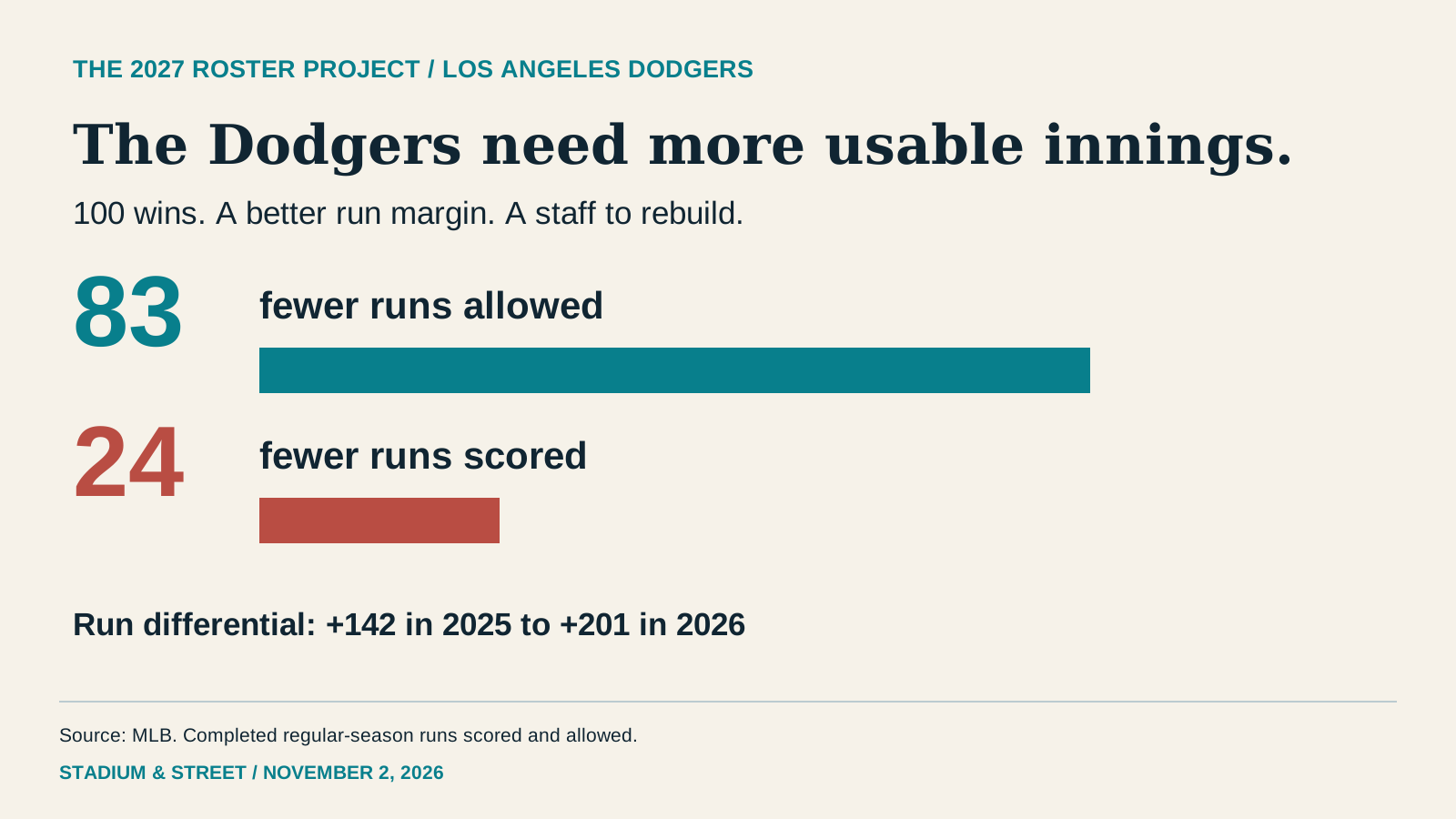
Los Angeles won 100 games, scored 801 runs and allowed 600. Its plus-201 differential was substantially better than the previous year's plus-142. Milwaukee nevertheless swept the Dodgers in the National League Championship Series, outscoring them 21-11. Both results belong in the analysis. A roster capable of dominating six months can still reach October with too few useful choices.
Our preferred Plan A is a two-year, $16-20 million offer range to retain Alex Vesia, a one-year, $9-12 million inquiry for Raisel Iglesias, and a $4-6 million first-year depth reserve. That is $21-28 million in annual additions, including the reserve. The reserve prioritizes catching insurance and usable pitching depth. These are Stadium & Street risk limits, not reported negotiations, market quotes or evidence that either pitcher will accept the role.
The strongest alternative is to retain Tarik Skubal. We would explore an eight-year, $320-360 million structure as the upper boundary of a premium plan, subject to medical review, contract terms and the complete ownership budget. That is a large commitment to one pitcher, even for this club. It is not our default because the Dodgers already carry extensive starting-pitching commitments and still need to repair the bullpen and catching coverage if he returns.
Keep Andy Pages in center, Mookie Betts at shortstop and Tommy Edman primarily at second. Give Josue De Paula a real left-field audition, with a defensive test before the job becomes permanent. Reduce Teoscar Hernández's projected plate appearances rather than pretend a new prospect can join the lineup without displacing anybody. Retain his salary in every financial scenario until an actual transaction changes it.
The standard for success is a staff with enough credible innings and a lineup whose rest days do not create another vacancy. A new star could help. Better allocation of the stars already here could help more than an indiscriminate shopping list.
02. What the 100 wins tell us
| Season | RS / RA | Margin / HR | OPS | ERA / MLB rank |
|---|---|---|---|---|
| 2024 | 842 / 686 | +156 / 233 | .781 | 3.90 / 13 |
| 2025 | 825 / 683 | +142 / 244 | .768 | 3.95 / 16 |
| 2026 | 801 / 600 | +201 / 204 | .762 | 3.55 / 4 |
The improvement in scoring margin came from prevention. From 2025 to 2026, the Dodgers allowed 83 fewer runs while scoring 24 fewer. The net gain was 59 runs. Their ERA ranking improved from 16th to fourth, while their offense remained fourth in runs. This was not a team that suddenly stopped producing enough to win.
The offensive trend still deserves attention. Home runs fell from 244 to 204. A .762 OPS remained strong, but it was generated by a different distribution of production and availability. Freeman, Tucker, Betts, Smith and Ohtani cannot all be treated as their best historical versions in the same projection. Their contracts buy actual future seasons, not a composite highlight reel.
On the other side, a 3.55 team ERA is not a renewable entitlement. Several pitchers who contributed to it have elected free agency. Others supplied good rates over short workloads. A useful offseason starts by distinguishing a pitcher who can cover a role from a pitcher who merely appears on the depth chart.
The appropriate baseline is therefore strong but conditional. Los Angeles can reasonably expect to contend with much of this roster intact. It cannot reasonably assume that a plus-201 differential will survive unchanged if innings disappear, corner defense deteriorates or the veteran lineup needs more rest.
03. October: evidence without overreaction
The Dodgers beat Atlanta three games to one in the Division Series. They then lost all four games to Milwaukee: Brewers 2-1, Brewers 7-4, Brewers 6-2 and Brewers 6-4. Eleven runs in four games is a specific offensive failure. Twenty-one runs allowed is a specific prevention failure. Neither is explained adequately by invoking bad luck or demanding more grit.
Four games are also too few to establish a new true talent level. The series should prompt a review of which options were actually available, which matchups the roster could answer and how much workload the club had asked its central players to carry. It should not erase 162 games of evidence or become a reason to trade a young player merely because his name can headline a deal.
The winter response should be structural. More credible relief choices allow a manager to act before a matchup becomes decisive. Catching coverage allows an injured or fatigued regular to sit without breaking the lineup. An outfield reserve who can defend allows a late lead to change the alignment. Those choices have value even when they never generate a famous postseason moment.
This is also why the Skubal question cannot stand alone. Retaining him would improve the rotation's front end. It would not automatically restore all the departed relief innings, make Rushing available to catch or resolve the crowded corner-outfield workload. A complete roster proposal must show the remaining jobs after its biggest purchase.
04. The lineup: a strong core with uneven trends
| Player / MLB ID | PA | AVG / OBP / SLG | HR | BB / K |
|---|---|---|---|---|
| Freddie Freeman / 518692 | 657 | .288 / .362 / .430 | 16 | 66 / 116 |
| Kyle Tucker / 663656 | 627 | .233 / .330 / .385 | 17 | 78 / 105 |
| Shohei Ohtani / 660271 | 618 | .275 / .377 / .512 | 30 | 81 / 152 |
| Andy Pages / 681624 | 574 | .274 / .343 / .468 | 23 | 49 / 113 |
| Max Muncy / 571970 | 561 | .252 / .348 / .490 | 29 | 65 / 140 |
| Mookie Betts / 605141 | 528 | .257 / .326 / .454 | 23 | 47 / 58 |
| Teoscar Hernández / 606192 | 491 | .267 / .334 / .425 | 16 | 42 / 135 |
| Tommy Edman / 669242 | 331 | .247 / .329 / .385 | 8 | 22 / 67 |
| Will Smith / 669257 | 276 | .260 / .355 / .426 | 10 | 34 / 45 |
| Alex Freeland / 690976 | 269 | .234 / .327 / .325 | 4 | 32 / 74 |
| Dalton Rushing / 687221 | 253 | .246 / .328 / .460 | 12 | 23 / 74 |
| Alex Call / 669743 | 195 | .233 / .349 / .307 | 1 | 23 / 35 |
| Hyeseong Kim / 808975 | 131 | .259 / .323 / .328 | 1 | 12 / 31 |
| Hunter Feduccia / 676439 | 91 | .197 / .322 / .263 | 1 | 14 / 16 |
| Josue De Paula / 800543 | 42 | .323 / .500 / .581 | 1 | 11 / 5 |
| Eliezer Alfonzo / 672613 | 28 | .179 / .179 / .250 | 0 | 0 / 3 |
The table records each current organizational hitter's Dodgers-only 2026 batting sample. Historical contributors who have departed are separated later. This matters especially for Hunter Feduccia, whose full-season major-league record includes another club. Adding his full-season total to a Dodgers lineup table would overstate what he supplied in Los Angeles.
| Player | 2024 OPS / PA | 2025 OPS / PA | 2026 OPS / PA |
|---|---|---|---|
| Shohei Ohtani | 1.036 / 731 | 1.014 / 727 | .889 / 618 |
| Kyle Tucker | .993 / 339 | .841 / 597 | .715 / 627 |
| Freddie Freeman | .854 / 638 | .869 / 627 | .792 / 657 |
| Mookie Betts | .863 / 516 | .732 / 663 | .780 / 528 |
| Andy Pages | .712 / 443 | .774 / 624 | .811 / 574 |
| Max Muncy | .852 / 293 | .846 / 388 | .838 / 561 |
| Teoscar Hernández | .840 / 652 | .738 / 546 | .759 / 491 |
| Will Smith | .760 / 544 | .901 / 436 | .781 / 276 |
Ohtani's .889 OPS was still the best among the regulars, but it followed seasons above 1.000. Freeman's .792 followed .854 and .869. Tucker's .715 followed a shorter .993 season and then .841. A planning exercise that restores every lost point at once has built a best case, not a baseline.
Pages is the important counterweight. His OPS climbed from .712 to .774 to .811, and his defensive record supports keeping him in the middle of the outfield. At 574 plate appearances, his 2026 contribution is large enough to be a meaningful starting point. That does not immunize him against regression, but it gives the club a younger regular whose value is not dependent on another expensive acquisition.
Betts' offensive rebound from .732 to .780 OPS came with valuable shortstop range. The combination matters more than either number alone. Moving him solely to accommodate an outside name would require a clear net improvement across two positions. Edman and Freeland already give the club ways to redistribute some infield work without creating a new long-term salary obligation.
The lineup's broad handedness split was not the obvious weakness: .756 OPS against left-handed pitching and .766 against right-handed pitching. That does not eliminate individual matchup problems. It does argue against declaring that the whole offense needs a specialist for one side before identifying whose plate appearances that specialist would take.
05. Contact quality and the limits of a rebound case
| Player | wOBA | xwOBA | SLG / xSLG | Reading |
|---|---|---|---|---|
| Shohei Ohtani | 0.377 | 0.397 | 0.512 / 0.552 | Strongest contact foundation; workload separate |
| Kyle Tucker | 0.318 | 0.331 | 0.385 / 0.393 | Some rebound room, modest power evidence |
| Freddie Freeman | 0.348 | 0.363 | 0.430 / 0.463 | Contact quality supports useful offense |
| Andy Pages | 0.352 | 0.343 | 0.468 / 0.442 | Actual production slightly ahead of contact model |
| Max Muncy | 0.361 | 0.349 | 0.490 / 0.470 | Power remains valuable; no automatic repeat |
| Mookie Betts | 0.338 | 0.339 | 0.454 / 0.435 | Actual and expected nearly align |
| Will Smith | 0.345 | 0.389 | 0.426 / 0.502 | Contact quality stronger than actual line |
| Teoscar Hernández | 0.332 | 0.332 | 0.425 / 0.437 | Expected results do not erase range cost |
Statcast expected statistics help separate the quality of contact from what happened after the ball was hit. They are diagnostic estimates, not forecasts that a player is owed a particular result. Here they describe full 2026 MLB seasons, which can differ from the team-only samples above.
Tucker presents the most important distinction. His .318 actual wOBA was below a .331 expected mark, but his .393 expected slugging percentage does not establish that an immediate return to elite power is waiting to happen. The Dodgers should investigate the mechanisms of the decline, including the quality of contact and the pitches he can damage, rather than budget a large rebound simply because the contract is large.
Smith's .389 expected wOBA against a .345 actual mark provides a more encouraging contact-quality signal. His actual workload was only 276 plate appearances. MLB reported that neck inflammation cost him nearly three months before his September 1 return. Better contact results would help; assuming a full season of catching on the strength of them would answer a different question.
Ohtani's expected contact remained exceptional. The .397 expected wOBA and .552 expected slugging support the importance of protecting his batting availability. There is no need to manufacture a choice in which every pitching inning necessarily damages his hitting. There is a need to make both workloads explicit and to change them when the evidence changes.
Pages and Muncy finished somewhat above their expected contact results. Their power still belongs in the lineup, but the preferred plan does not fund itself with an assumed improvement from every regular. Teoscar's actual and expected wOBA were essentially level. His roster decision turns more on defense, available positions and the competition for plate appearances than on a supposed statistical rebound that the contact data do not show.
06. The outfield decision has an incumbent
A De Paula promotion has a cost even when it has no free-agent price tag. Someone must lose work. In our preferred allocation, that player is primarily Teoscar Hernández, with additional opportunities coming from ordinary rest and the normal churn of a season. Ohtani remains the primary DH, so the club cannot solve every outfield problem by moving a veteran into that slot.
De Paula produced a .948 OPS with 27 home runs, 81 walks and 87 strikeouts in 588 Double-A plate appearances. His 42 major-league plate appearances were excellent, with eleven walks and five strikeouts. The larger sample establishes a serious offensive prospect. The smaller sample establishes an encouraging introduction, not a settled major-league projection.
Our central plan gives him a conditional 400 plate appearances. That is substantial enough to test whether he can help the club, but it is not an Opening Day guarantee or a prediction of 400 productive appearances. He must demonstrate playable left-field routes, throwing decisions and positioning. His major-league OAA record contains only one tracked range opportunity. It cannot establish defensive readiness.
Teoscar remains useful as a right-handed corner option, a pinch-hitter and a limited DH when that slot is genuinely open. The proposed 360 plate appearances are a reduction from 491, not a declaration that he has no value. If he materially outplays De Paula or another outfielder is unavailable, the allocation changes. The club should discuss the role honestly rather than hide the competition inside a list of eight everyday players for seven jobs.
A trade is an option, not a financial assumption. Any return must be evaluated after salary retention, the value of lost depth and the prospects requested. Our budgets retain Teoscar's full listed allocation and include no speculative trade proceeds. A deal that clears a position but requires the Dodgers to pay most of the contract is primarily a playing-time decision, not a large payroll saving.
07. Keep the infield's useful shape
Betts belongs at shortstop in the starting plan. His plus-nine OAA follows plus-six in 2025, providing a range-based reason to preserve the alignment. Edman supplies a defensively useful second-base option and emergency center-field coverage. Muncy's 29 homers and .838 OPS continue to earn substantial third-base work, even as his range requires attention.
Freeland is the first internal infield alternative. His .234/.327/.325 batting line does not yet establish an everyday offensive upgrade. It does provide a player who can take coverage work while the club tests his ability to do more damage. The distinction is consequential: a reserve can be valuable without receiving an unsupported projection as an above-average starter.
Kim's 131-plate-appearance sample is too small to settle his offensive ceiling. It also is not evidence that the Dodgers must buy a replacement immediately. The first question is how many credible innings Edman, Freeland and Kim can cover between them, and how much of that work comes at the position where each is actually most useful.
Freeman remains the first baseman. His 16 home runs were lower than the batting reputation associated with him, but his .362 on-base percentage still made outs more difficult to obtain. The club should provide rest without casually assigning first-base work to a catcher recovering from elbow surgery. Any new secondary position is a defensive job that must be practiced and evaluated.
An outside infielder becomes a priority if the internal coverage fails, a health development removes one of these players or a clearly superior player becomes obtainable at a defensible total cost. The current evidence does not require repeating the utility-player purchase considered in other teams' reviews. The Dodgers have a different incumbent structure and a different opportunity cost.
08. Catching is a coverage problem before it is a shopping problem
Rushing had elbow surgery October 21; MLB reported a nine-month catching recovery, with hitting expected sooner. That timetable makes an Opening Day catching allocation inappropriate. Administrative roster status is not medical clearance.
The immediate framework is Smith with Feduccia, supported by Eliezer Alfonzo and further organizational depth. Smith receives 430 plate appearances in our season allocation and Feduccia 260. Rushing receives 120 conditional late-season appearances, not a guaranteed return date. If he cannot catch, those opportunities must be reassigned without squeezing an extra DH into an already crowded lineup.
The evidence for Feduccia's glove is useful but narrow. Statcast credits his full 2026 MLB season with approximately 4.6 framing runs, compared with minus-1.3 for Smith and minus-2.7 for Rushing. Feduccia's framing sample covers 1,899 shadow-zone pitches across clubs. That is not a Dodgers-only total and it does not measure all receiving, blocking, throwing or game-calling value.
The depth reserve should buy a practical contingency if the organization cannot supply one. That means a catcher capable of handling actual major-league innings, with the contract and roster conditions specified. It does not mean naming a premium trade target and ignoring the prospects required or Smith's existing commitment.
If Smith misses substantial time, the plan changes sharply. Feduccia's .585 OPS in his 91 Dodgers plate appearances does not support assuming that a larger role would preserve the offense. A catching acquisition would then outrank a marginal bullpen upgrade. Until the health and depth picture is clearer, keep part of the reserve uncommitted and do not credit that cash with any batting or defensive production.
09. Defense: protect the middle, test the corners
| Player | 2024 OAA | 2025 OAA | 2026 OAA | 2026 opportunities |
|---|---|---|---|---|
| Mookie Betts | -3 | +6 | +9 | 410 |
| Tommy Edman | -2 | +10 | +5 | 222 |
| Freddie Freeman | +1 | -4 | 0 | 388 |
| Max Muncy | +1 | -5 | -2 | 437 |
| Andy Pages | +1 | +11 | +10 | 402 |
| Kyle Tucker | +2 | -2 | -8 | 325 |
| Teoscar Hernández | -9 | -9 | -6 | 225 |
| Alex Call | +1 | 0 | +2 | 102 |
| Alex Freeland | NA | +3 | +2 | 247 |
| Hyeseong Kim | NA | 0 | -1 | 105 |
| Josue De Paula | NA | NA | 0 | 1 |
OAA is a range measure relative to the difficulty of tracked opportunities. It is more useful here than fielding percentage, which can reward a player for failing to reach a difficult ball. The table uses full player seasons and may combine positions or clubs. It does not convert a shortstop's result directly into a left fielder's value.
The strongest repeatable pattern is in the middle. Betts and Pages each posted positive range results in both 2025 and 2026. Edman also remained positive. Those three create a reason to improve around the alignment before moving its strongest defenders to accommodate a new signing.
The corner-outfield concern is equally concrete. Tucker's minus-eight and Teoscar's minus-six OAA give the club fourteen outs below average across their tracked 2026 opportunities. That sum describes the observed results, not a projection or a conversion into fourteen runs. Pages' plus-ten does not make those losses irrelevant. A center fielder cannot repair every ball hit into a corner.
Tucker's three-year sequence, plus-two, minus-two and minus-eight, warrants a position-specific review of routes, jumps and the types of opportunities being missed. Teoscar's minus-nine, minus-nine and minus-six is a longer pattern. A small one-year improvement still leaves a meaningful range cost. Those records support testing a different allocation, while De Paula's limited sample prevents declaring the replacement an automatic upgrade.
Muncy's results also vary across years. The club should prepare late-game alternatives and rest-day alignments, not treat a single defensive estimate as an instruction to discard his bat. The broader point is to price the whole role: offense, range, innings, rest and the position another player must occupy as a result.
10. Rotation: one anchor and several conditions
| Player / MLB ID | 2026 IP | GS / ERA | K / BB | xERA |
|---|---|---|---|---|
| Yoshinobu Yamamoto / 808967 | 185.0 | 28 / 2.53 | 182 / 42 | 2.94 |
| Justin Wrobleski / 680736 | 140.0 | 22 / 3.66 | 118 / 31 | 4.54 |
| Roki Sasaki / 808963 | 122.1 | 23 / 4.49 | 123 / 48 | 4.30 |
| Emmet Sheehan / 686218 | 112.1 | 22 / 4.57 | 132 / 33 | 3.57 |
| Shohei Ohtani / 660271 | 85.2 | 14 / 1.79 | 95 / 26 | 2.74 |
| Tyler Glasnow / 607192 | 74.0 | 13 / 3.53 | 98 / 25 | 2.88 |
| Blake Snell / 605483 | 42.2 | 9 / 1.90 | 55 / 16 | 2.17 |
Yamamoto supplied 185 innings with a 2.53 ERA and 182 strikeouts against 42 walks. His 2.94 expected ERA supports the quality of the season while allowing for some difference between outcomes and contact-based estimates. He is the workload anchor in this plan. Even then, the proposal uses 180 innings, not an automatic increase.
Wrobleski's 140 innings were valuable. His 3.66 ERA and 4.54 xERA tell us not to treat all of that run prevention as secure. Twenty-one home runs and 118 strikeouts in that workload create a different risk from Sheehan's 132 strikeouts in 112.1 innings. The club should keep both in the development plan while distinguishing their improvement tasks.
Sheehan's 4.57 ERA against a 3.57 xERA provides a plausible case for better results without an acquisition. It is not a guarantee. Sasaki's 4.49 ERA, 48 walks and 22 home runs in 122.1 innings point to the importance of command and avoiding damaging counts. More innings are useful only if the pitcher can deliver them at an acceptable level.
Snell and Glasnow offered good rates over 42.2 and 74 innings respectively. Their contracts remain in the budget whether they provide 70 innings or 170. A roster forecast should not answer that uncertainty by quietly assigning both full-season workloads. Our central accounting asks for 95 innings from Snell and 110 from Glasnow, still increases that require evidence of readiness.
For Ohtani, Friedman said October 21 that surgery was unnecessary and a pitching return was expected; the two-way workload remained unsettled. Our 70-inning allocation is a scenario, not a medical recommendation or an April timetable. It allows the club to plan meaningful pitching value without assuming that his largest possible workload is also the best use of his season.
11. What actually left the staff
| Player / MLB ID | 2026 LAD contribution | November 2 classification |
|---|---|---|
| Brusdar Graterol / 660813 | No LAD MLB workload in collected season row | Free-agent election October 29; not retained |
| Blake Treinen / 595014 | 29.2 IP / 3.64 ERA | Free-agent election October 29; not retained |
| Alex Vesia / 681911 | 58.0 IP / 2.64 ERA | Free-agent election October 29; not retained |
| Tarik Skubal / 669373 | 62.0 IP / 2.61 ERA | Free-agent election October 29; not retained |
| Miguel Rojas / 500743 | 252 PA / .703 OPS | Free-agent election October 29; not retained |
| Evan Phillips / 623465 | 26.0 IP / 3.46 ERA | Free-agent election October 29; not retained |
| Kris Bubic / 663460 | 4.2 IP / 0.00 ERA | Free-agent election October 29; not retained |
| Eric Lauer / 641778 | 72.0 IP / 4.50 ERA | Free-agent election October 29; not retained |
| Enrique Hernández / 571771 | 96 PA / .671 OPS | Free-agent election October 29; not retained |
The departing pitchers supplied 252.1 Dodgers innings before the October 29 free-agent elections. Five additional emergency innings came from departing position players and are excluded from that staff total. Skubal supplied 62 Los Angeles innings after joining the club. His combined MLB total was 158.2. Using the latter figure as the Dodgers' workload loss would overstate the gap by 96.2 innings.
Vesia, Phillips and Treinen together supplied 113.2 innings. Lauer supplied 72, and Bubic 4.2. These are different jobs. A late-inning signing does not independently replace a starter's workload, and a bulk pitcher does not automatically replace the quality of a leverage reliever. Graterol's free-agent status must also be separated from any assumption that a familiar name is part of the returning staff.
The club has candidates for internal coverage. Knack, Miller, Hurt, Dreyer, Henriquez and Gervase offer different combinations of length and relief work. Their small or uneven major-league samples require genuine competition. A list of six names is not the same thing as six ready replacements.
Stone, Casparius, Cousins and Klein appear on the administrative roster with 60-day injured-list status in the collected record. Their contracts or organizational membership remain relevant, but our central plan does not require innings from them. MLB's October 30 injury page reported that Klein was expected for Spring Training after elbow surgery. That expectation is not a reason to spend his innings before he earns them.
If several starters fall below the proposed workloads, the fallback cannot simply be to ask the bullpen for the difference indefinitely. That is when a bulk acquisition, a different starter or a more expensive Skubal plan becomes a higher priority. The roster should be reassessed by uncovered innings, not by whether it still looks impressive on paper.
12. The bullpen: buy a second decision
| Player | IP | ERA / xERA | K / BB | HR / saves |
|---|---|---|---|---|
| Jack Dreyer | 64.2 | 3.20 / 3.52 | 73 / 23 | 7 / 2 |
| Tanner Scott | 63.2 | 2.69 / 3.03 | 82 / 15 | 4 / 25 |
| Edgardo Henriquez | 60.0 | 2.85 / 2.47 | 71 / 25 | 1 / 2 |
| Kyle Hurt | 45.2 | 4.14 / 3.76 | 58 / 23 | 5 / 1 |
| Will Klein | 41.2 | 3.67 / 3.50 | 49 / 21 | 3 / 2 |
| Brock Stewart | 26.2 | 2.70 / 2.55 | 25 / 10 | 3 / 1 |
| Edwin Díaz | 18.2 | 8.68 / 4.60 | 28 / 11 | 3 / 7 |
| Landon Knack | 11.2 | 3.86 / 4.09 | 8 / 2 | 4 / 1 |
| Seth Halvorsen | 10.0 | 8.10 / 6.27 | 6 / 2 | 3 / 0 |
| Paul Gervase | 7.2 | 2.35 / 3.95 | 8 / 5 | 0 / 0 |
| Bobby Miller | 7.1 | 3.68 / 6.19 | 8 / 4 | 1 / 0 |
| Ben Casparius | 4.2 | 9.64 / 6.68 | 4 / 4 | 1 / 0 |
Scott's 63.2 innings, 82 strikeouts and fifteen walks give the Dodgers a strong left-handed foundation. Henriquez's 2.47 xERA and 71 strikeouts in 60 innings are encouraging, but his 25 walks preserve meaningful command risk. Dreyer supplied 64.2 innings across roles. Those are assets to build around, not reasons to assume the staff is complete.
Díaz's 8.68 ERA came in only 18.2 innings. The same sample included 28 strikeouts, eleven walks and three home runs. His 4.60 xERA is less severe than the actual ERA and still does not describe the reliable elite relief performance the club needs. The proposed 45 innings are conditional capacity, with leverage earned through current performance rather than salary or prior saves.
Vesia is a retention decision, not an outside acquisition. His 2.68 xERA, 74 strikeouts and four home runs allowed in 58 innings support the case for keeping him. Thirty-two walks are the countercase. Paying for the strikeouts while overlooking the walks would miss the main risk. A two-year limit gives the Dodgers a useful left-handed option without turning a volatile relief role into a long commitment.
Iglesias is our preferred outside inquiry because the proposed job is specific: approximately 55 innings, a right-handed alternative in important situations and a short contractual horizon. His 2026 line was 60 innings, a 2.55 ERA, 64 strikeouts and seventeen walks. The 3.50 xERA argues for caution. The recommendation is not to purchase a repeat 2.55 ERA; it is to buy another credible choice at a price that leaves the rest of the roster funded.
The Dodgers' relief corps allowed 64 of 179 inherited runners to score, about 35.8 percent. That is a team result shaped by opportunities, situations and personnel, not a clean estimate of one pitcher's skill. It nevertheless gives the club a reason to evaluate who can enter with men on base, rather than assigning all the most valuable arms to clean ninth innings.
13. The farm: opportunities with gates
| Player / MLB ID | 2026 level evidence | 2027 job and limit |
|---|---|---|
| Josue De Paula / 800543 | AA: 588 PA, .948 OPS, 27 HR, 81 BB / 87 K | 400-PA audition only if LF readiness clears |
| Mike Sirota / 701527 | AA: 333 PA, .940 OPS, 10 HR, 65 BB / 75 K | Upper-level outfield depth; AAA sample only 9 PA |
| Eduardo Quintero / 808234 | High-A: 501 PA, .940 OPS, 12 HR, 88 BB / 102 K | Development, not central MLB playing time |
| Emil Morales / 815896 | High-A: 368 PA, .914 OPS, 20 HR, 48 BB / 93 K | Infield development, not a Betts replacement |
| Christian Zazueta / 800537 | AA: 55.0 IP, 3.44 ERA, 78 K / 8 BB | Starting-depth development, no central MLB IP |
De Paula is the nearest impact-bat opportunity in this plan. His offensive record earns the audition, while his defense determines how much of it can occur in left field. The Dodgers should not exchange him for a marginal veteran upgrade before testing whether their own player can fill the job. That is an opportunity-cost judgment, not an untouchable designation under every conceivable offer.
Sirota's 333 Double-A plate appearances produced a .940 OPS, ten home runs, 65 walks and 75 strikeouts. His Triple-A sample was only nine plate appearances. That makes him an upper-level development candidate, not a proven replacement for a major-league regular. The next useful evidence is sustained performance against advanced pitching and the ability to handle the actual defensive assignment.
Quintero and Morales have promising High-A offensive records. Those seasons do not belong in a 2027 major-league production budget simply because the club is interested in becoming younger. Zazueta's Double-A strikeout and walk record is worth following, but 55 innings at that level do not replace a major-league ace's workload.
The development plan should preserve different routes. De Paula can win a major-league role. Sirota can build upper-level readiness. Quintero and Morales can continue progressing without a forced calendar. Zazueta can develop as a starter without being rushed into a vacancy created by a free-agent departure. Each player needs a job suited to his evidence, not the same projected arrival date.
For a trade, the outgoing player is part of the price. A proposal that improves the 2027 bullpen by consuming a potential low-cost everyday player must compare those values over time. No named prospect package is assumed acceptable to another club here. The preferred plan uses free agency and retention precisely because it can address the immediate pitching jobs without inventing a cooperative trade partner.
14. Payroll: three different numbers
| Player | 2027 allocation, $M | Basis |
|---|---|---|
| Kyle Tucker | 87.000 | RosterResource annual column; not cash or CBT |
| Shohei Ohtani | 70.000 | RosterResource annual column; not cash or CBT |
| Blake Snell | 36.400 | RosterResource annual column; not cash or CBT |
| Tyler Glasnow | 30.000 | RosterResource annual column; not cash or CBT |
| Yoshinobu Yamamoto | 30.167 | RosterResource annual column; not cash or CBT |
| Mookie Betts | 30.417 | RosterResource annual column; not cash or CBT |
| Freddie Freeman | 27.000 | RosterResource annual column; not cash or CBT |
| Edwin Díaz | 26.000 | RosterResource annual column; not cash or CBT |
| Teoscar Hernández | 22.167 | RosterResource annual column; not cash or CBT |
| Tanner Scott | 20.000 | RosterResource annual column; not cash or CBT |
| Tommy Edman | 15.650 | RosterResource annual column; not cash or CBT |
| Will Smith | 16.000 | RosterResource annual column; not cash or CBT |
| Max Muncy | 7.000 | RosterResource annual column; not cash or CBT |
| Hyeseong Kim | 4.083 | RosterResource annual column; not cash or CBT |
| Muncy escalator adjustment | 3.750 | Add reported earned salary increase once |
| Adjusted core subtotal | 425.633 | 14 contracts; allocation basis only |
The table uses RosterResource's 2027 annual contract-allocation column and separately adds Muncy's reported $3.75 million earned escalator. The resulting $425.63 million core subtotal is an allocation measure. It is not 2027 cash paid, a certified club payroll or competitive-balance-tax payroll. Signing-bonus allocation, deferred salary and tax treatment can produce substantially different figures.
Tucker is the clearest warning against combining columns casually. RosterResource assigns $87 million to 2027. That does not mean the Dodgers will hand him $87 million of current-year cash. Ohtani's $70 million annual allocation likewise cannot be equated with current cash payment. Deferring money changes timing; it does not erase the obligation.
Muncy's escalator is included once. The base column shows $7 million, while Eric Stephen reports that his 2026 plate appearances raised the 2027 salary by $3.75 million. The planning bridge therefore adds that difference instead of silently relying on the lower base or adding the full adjusted salary a second time.
| Component | Annual allocation | Definition |
|---|---|---|
| Adjusted core | $425.63M | 14 listed contracts plus Muncy escalator |
| Arbitration pool | $16-20M | S&S allowance for six cases, not agreed salaries |
| Pre-arb / call-up pool | $12-16M | S&S season allowance, not one 26-man snapshot |
| Existing-roster envelope | $453.63-461.63M | Before new additions and excluded costs |
The arbitration allowance is our $16-20 million planning range for Stewart, Cousins, Call, Sheehan, Stone and Pages. It is not a claim that salaries have been agreed. The $12-16 million pre-arbitration and call-up pool covers organizational roster movement over a season. These broad allowances remain in each scenario, so the comparison does not depend on speculative non-tender or trade savings.
The existing-roster envelope is $453.63-461.63 million on this allocation basis. It excludes tax, benefits, incentives beyond the specified adjustment, transaction expenses, deferred-obligation funding and the separate cost of any draft or international compensation. Those exclusions prevent it from being described as the club's complete cash requirement. The current labor agreement expires December 1; a final 2027 tax bill cannot be established from these planning numbers.
15. Candidates we would pursue, and ones we would pass
| Candidate / MLB ID | 2026 MLB record | S&S decision / proposed price |
|---|---|---|
| Alex Vesia / 681911 | 58.0 IP; 2.64 ERA; 74 K / 32 BB; 4 HR | Retain: 2 years / $16-20M; walks are the risk |
| Raisel Iglesias / 628452 | 60.0 IP; 2.55 ERA; 64 K / 17 BB; 6 HR | Preferred outside inquiry: 1 year / $9-12M |
| Tarik Skubal / 669373 | 158.2 IP; 2.72 ERA; 186 K / 27 BB; 14 HR | Premium alternative: 8 years / $320-360M ceiling |
| David Bednar / 670280 | 69.1 IP; 2.47 ERA; 76 K / 20 BB; 4 HR | Countercase: 2 years / $24-28M, same ceiling as Phillies |
| Evan Phillips / 623465 | 26.0 IP; 3.46 ERA; 33 K / 6 BB; 5 HR | Conditional depth only; not central-case leverage |
| Jason Adam / 592094 | 34.1 IP; 2.62 ERA; 22 K / 10 BB; 5 HR | Pass as primary leverage purchase |
| Matt Strahm / 621381 | 35.2 IP; 7.32 ERA; 30 K / 14 BB; 12 HR | Pass as primary leverage purchase |
| Pete Fairbanks / 664126 | 41.1 IP; 6.31 ERA; 57 K / 21 BB; 8 HR | Rebound inquiry only, not funded in Plan A |
Iglesias is a short-term purchase with aging and regression risk. A second guaranteed year at the same annual price would materially change the comparison. If that is the required term, reconsider the market rather than stretching the original recommendation until it means something else.
Bednar is the strongest direct countercase. He recorded 69.1 innings, a 2.47 ERA and 76 strikeouts against twenty walks, with a 2.88 xERA. At two years and $24-28 million, the same proposed ceiling used in our Phillies review, he could be the better purchase if the Dodgers value the second year and his role preferences fit. The choice should turn on actual terms and marginal value, not a desire to avoid repeating a name.
Iglesias at $12 million for one year and Bednar at $12 million annually for two years are not dramatically different first-year costs. The additional guarantee and the expected quality of those future innings are the distinction. If both are available at the low end of these proposed ranges and medical review is comparable, Bednar deserves a fresh comparison before the Dodgers commit. Our preference for a shorter deal is a risk policy, not evidence that the older pitcher is inherently better.
Jason Adam's 2.62 ERA obscures only 22 strikeouts in 34.1 innings and a 3.78 xERA. Matt Strahm allowed twelve home runs in 35.2 innings and was released by Kansas City in August. Pete Fairbanks allowed eight home runs in 41.1 innings, with a 6.31 ERA and 4.42 xERA. These records do not justify treating any of them as the preferred dependable leverage addition without a new, specific rebound case.
Phillips is a separate conditional depth inquiry. His 33 strikeouts against six walks are attractive, but the sample was 26 innings and his xERA was 4.38. A modest agreement could become useful if health, role and price align. It cannot be used to claim that the high-leverage job is filled simply because he is familiar with the organization.
Free-agent elections establish status, not willingness to sign in Los Angeles. The candidate records and transactions were checked November 2. Any actual deal still requires current terms, medical evaluation, roster space and the applicable signing-compensation review. This report contains no reported offers and no invented trade package.
16. Why this is a different shopping list
Our earlier five-club acquisition review identified a real problem: several proposals depended on the same small group of players without adequately testing the incumbent or the no-acquisition outcome. The Dodgers review begins with those comparisons rather than adding another copy of the same preferred lineup.
Toronto's dated plan needs more impact from its contact. Philadelphia needs a corner bat that can remain in the field, plus late-inning support. The Mets need additional scoring and starting innings. Miami's amended priorities put catching and left-handed relief ahead of another utility commitment. The Yankees' dated plan puts contact and catching jobs ahead of an optional outside utility purchase. Those needs are not the Dodgers' needs simply because the clubs share a market.
There is still legitimate overlap. Vesia appeared as a fallback in the Yankees and Marlins reports. For Los Angeles he is a retention decision covering part of his own departed workload. Iglesias was a Yankees relief alternative; here he is a preferred one-year right-handed inquiry alongside Scott and a conditional Díaz recovery. Bednar was a Yankees retention priority and a Phillies outside target; here he is the direct alternative to Iglesias, at the same annual price range.
The displaced work is explicit. A signed Iglesias receives 55 relief innings that otherwise fall to internal right-handed coverage. A retained Vesia receives 55 that otherwise have to be covered by the remaining staff. Neither is counted twice as a closer and as a separate relief upgrade. No prospect is sent out in the proposed free-agent plans, and no sale of an incumbent is needed to make the arithmetic work.
The different-candidate test is Bednar. The internal test is Plan B. The no-acquisition test is to keep the existing roster and assign both missing relief blocks to organizational pitchers without claiming an expected improvement. If the preferred players sign elsewhere, the recommendation changes with the uncovered jobs. Their names do not remain penciled into a fictional Dodgers roster.
17. Three fully costed paths
| Plan | Annual additions | Total allocation | Proposed guarantees* |
|---|---|---|---|
| A: Vesia + Iglesias + depth | $21-28M | $474.63-489.63M | $29-38M |
| B: Vesia + depth | $12-16M | $465.63-477.63M | $20-26M |
| C: Skubal + A | $61-73M | $514.63-534.63M | $349-398M |
Proposed guarantees include the specified contracts and treat the $4-6 million depth reserve as a fully spent one-year commitment for conservative comparison. An unspent reserve is not a contract. Total allocation uses the same existing-roster envelope in every plan and excludes the costs defined in section 14.
Plan A adds Vesia at $8-10 million annually, Iglesias at $9-12 million and the $4-6 million reserve. The total annual addition is $21-28 million. The proposed contractual and fully spent reserve commitment is $29-38 million across the terms, not $21-28 million multiplied by an assumed common contract length. Its main virtue is that it buys distinct bullpen jobs while preserving the young outfield opportunity.
Plan B retains Vesia and the depth reserve but makes no Iglesias purchase. The annual addition is $12-16 million. Henriquez, Stewart, Hurt and the rest of the internal right-handed group compete for the 55 innings assigned to Iglesias in Plan A. The money saved is real in the scenario. The quality of the replacement is unresolved. This is an acceptable fallback if prices become excessive, but it carries more performance risk.
Plan C adds Skubal at $40-45 million annually to all of Plan A. Its $61-73 million annual addition produces a $514.63-534.63 million allocation envelope before the exclusions. The total proposed guarantee range is $349-398 million, including the eight-year starter commitment, the two-year Vesia contract, one year of Iglesias and the fully spent reserve. An ownership decision on that entire exposure must precede the headline signing.
The premium plan assigns Skubal 170 innings and thirty starts as a conditional target. It reduces the starting workloads assigned to Sasaki, Sheehan, Wrobleski and Ohtani and removes the fifty reserve starter innings. Section 19 reconciles all 162 starts and 1,440 total innings. Skubal displaces work; he does not create extra games.
The fully internal outcome adds no free-agent guarantees and retains the existing-roster envelope. It asks the remaining organization to cover Vesia's and Iglesias' proposed 110 innings as well as the normal depth assignments. That is a real decision, not a failure to make a decision. It should be chosen only with an honest acceptance of the increased variance and an identified way to respond if the internal arms do not perform.
18. Playing time: 6,200 plate appearances, one lineup
| Player / role | PA | Opportunity |
|---|---|---|
| Ohtani | 600 | Primary DH; workload management |
| Freeman | 610 | Primary 1B |
| Tucker | 610 | Primary RF |
| Betts | 580 | Primary SS |
| Muncy | 520 | Primary 3B |
| Pages | 600 | Primary CF |
| Edman | 460 | Primary 2B; selective CF coverage |
| Smith | 430 | Primary catcher |
| Teoscar Hernández | 360 | Corner OF / limited DH / pinch-hit |
| De Paula | 400 | Conditional LF audition |
| Freeland | 260 | 2B / 3B / SS relief |
| Feduccia | 260 | Catching coverage |
| Call | 100 | Outfield reserve |
| Kim | 130 | Infield / outfield reserve |
| Rushing | 120 | Conditional late-season catching / limited hitting |
| Other organizational coverage | 160 | Injury replacement; not an extra starter |
| TOTAL | 6200 | Season allocation, not 16 simultaneous roster slots |
The 6,200-plate-appearance budget is close to the club's 6,214 in 2026. It distributes a season, not an Opening Day roster. Players can move between the majors, injured list and minors, subject to the actual rules and their contract status. No proposed option assignment is assumed legal merely because it makes a spreadsheet convenient.
The initial position group is Smith and Feduccia catching; Freeman at first; Edman at second; Betts at shortstop; Muncy at third; De Paula, Pages and Tucker in the outfield; and Ohtani at DH. Teoscar, Freeland, Call and Kim compete for the remaining coverage roles. Those four cannot all be promised the same final bench spot. The season table explicitly allows more participants than an Opening Day roster.
If De Paula does not earn the defensive job, reassign his 400 appearances as 200 additional for Teoscar, 100 for Call, fifty for Edman and fifty for organizational coverage. That preserves the total. It also preserves the potential corner-defense problem. The fallback should not be described as the same improvement delivered by different names.
If Rushing is unavailable for the allocated work, assign sixty of his appearances to Feduccia and sixty to organizational catching coverage, subject to actual readiness. If Smith also misses time, that simple substitution is no longer enough. Use the depth reserve to investigate a real catcher and revise the offensive expectation. A catching shortage cannot be solved by increasing Ohtani's DH allocation.
The plan also preserves rest for the veteran core. Freeman at 610, Betts at 580 and Muncy at 520 leaves work for substitutes without declaring their bats expendable. Those rest opportunities have to be earned by capable coverage. They are not automatic gains in health or postseason performance.
19. Innings: 162 starts and a visible depth burden
| Pitcher / coverage | Starts / IP | Condition |
|---|---|---|
| Yamamoto | 29 / 180 | Main workload anchor |
| Snell | 18 / 95 | Increase from 42.2 IP remains conditional |
| Glasnow | 20 / 110 | Increase from 74 IP remains conditional |
| Sasaki | 24 / 125 | Command / home-run control |
| Sheehan | 23 / 120 | Convert contact indicators into results |
| Wrobleski | 24 / 130 | Regression exposure; do not project 2026 ERA blindly |
| Ohtani | 14 / 70 | No guaranteed April rotation or full-season two-way workload |
| Knack / Miller / other depth | 10 / 50 | Unproven coverage assignment, not purchased production |
| TOTAL | 162 / 880 | Conditional workload accounting |
| Pitcher / coverage | IP | Condition |
|---|---|---|
| Scott | 65 | Primary leverage left-hander |
| Díaz | 45 | Recovery and command must earn leverage |
| Vesia | 55 | Only if retained |
| Iglesias | 55 | Only if signed |
| Henriquez | 60 | Command risk remains |
| Dreyer | 65 | Relief and flexible length |
| Stewart | 35 | Availability and workload |
| Hurt | 50 | Walk reduction |
| Gervase | 35 | Small MLB sample; developmental |
| Knack / Miller bulk relief | 45 | Separate from 50 starting innings |
| Other organizational relief | 50 | Unproven depth; no assumed contribution from cash reserve |
| TOTAL | 560 | With 880 starter IP = 1,440 IP |
The 1,440-inning model is a round season-planning target, close to the Dodgers' actual 1,435.2. It allocates 880 starter innings and 560 relief innings. The two columns must remain separate: Knack or Miller can provide starting and relief work during a season, but the same inning cannot appear in both totals.
The starter plan assumes neither a full-season Ohtani rotation nor simultaneous 180-inning campaigns from Snell and Glasnow. It still asks the latter two to provide more than they did in 2026. That is an explicit vulnerability. If either fails to reach his allocation, the missing innings become a new coverage requirement, not an invisible debit to an unlimited bullpen.
The reserve burden is significant. Fifty starter innings, 45 Knack/Miller bulk-relief innings, 35 Gervase innings and fifty other organizational relief innings total 180 innings with substantial uncertainty. Hurt's fifty and Stewart's 35 bring their own risks. The depth allowance is a way to seek better coverage, not evidence that those innings have already been acquired.
For Plan C, use this reconciled starter allocation: Yamamoto 29 starts/180 innings; Skubal 30/170; Snell 18/95; Glasnow 20/110; Sasaki 20/105; Sheehan 20/105; Wrobleski 15/80; Ohtani 10/50. That totals 162 starts and 895 innings. Reduce the unassigned relief pool by fifteen, to 35, for 545 relief innings and the same 1,440 total. The premium purchase raises expected quality and reduces reliance on reserve starts; it does not eliminate all depth risk.
For Plan B, transfer Iglesias' 55 innings to 15 additional for Henriquez, ten for Stewart, ten for Hurt and twenty for organizational relief. Those resulting workloads are capacity questions that require scrutiny. For the no-acquisition case, another 55 Vesia innings remain uncovered by a named signing. Do not assign the same internal pitcher to both missing blocks without changing his total and evaluating whether it is plausible.
20. The countercase and what changes the verdict
The strongest case for spending less is simple: the Dodgers already won 100 games. Tucker could improve, Smith could provide more batting value, Sheehan's outcomes could move toward his contact indicators, and De Paula could supply useful offense at low salary. Adding another long commitment could block an internal solution and make future corrections harder.
That argument supports restraint on an everyday bat. It is less persuasive as a reason to ignore the pitching departures and catching risk. The preference for $21-28 million of annual additions is an attempt to buy the most clearly uncovered jobs without reconstructing the lineup or spending prospect capital to create the appearance of activity.
The strongest case for Skubal is that high-quality innings are difficult to replace piecemeal. His 2.72 combined MLB ERA, 186 strikeouts and 27 walks in 158.2 innings are a materially different foundation from a series of optimistic depth assumptions. If the club can afford the entire premium plan and the terms stay inside its risk limits, choosing the ace would be defensible. The objection is the size and duration of the commitment, not a claim that the pitcher would be unnecessary.
| Illustrative change from 2026 | RS change | RA change | Run margin |
|---|---|---|---|
| Mostly retained level | 0 | 0 | +201 |
| Lineup +20; prevention slips 30 | +20 | +30 | +191 |
| Lineup -30; prevention slips 50 | -30 | +50 | +121 |
| Lineup +25; prevention improves 10 | +25 | -10 | +236 |
These scenarios change the actual 2026 scoring totals to show how much room the roster has, not to forecast a win total. A thirty-run offensive decline plus fifty more runs allowed would reduce the differential to plus-121. That remains positive and still represents a large loss of competitive margin. A twenty-run offensive gain with thirty more allowed would yield plus-191. Improvement in one area can be absorbed by deterioration elsewhere.
Change the preferred plan if a new medical assessment removes a starter or catcher, if the internal right-handed relief group fails its role tests, if De Paula cannot handle left field, or if actual free-agent prices change the comparison. An Iglesias demand for a second year, a favorable Bednar offer or attainable Skubal terms could all alter the ranking. A useful plan names those conditions before the market makes the decision uncomfortable.
21. The first decisions, in order
First, reconcile the medical and workload plans for Smith, Rushing, Ohtani, Snell and Glasnow. These five cases determine how much genuine coverage the club needs behind expensive players. The public evidence supports conditional planning, not a private prognosis.
Second, establish the complete spending envelope on consistent definitions. Current-year cash, annual allocation and tax payroll are separate discussions. Ownership should approve both the preferred winter spending and the contingency for a substantial coverage failure, rather than discover after the first signing that the remaining jobs have no budget.
Third, pursue the Vesia retention and the right-handed relief comparison in parallel. Preserve the one-year Iglesias limit and compare Bednar on the same facts and price basis used elsewhere. If neither works, adopt the internal allocation explicitly and preserve funds for a better opportunity. Do not label an unfilled allowance an improved bullpen.
Fourth, give De Paula an organized left-field competition and define Teoscar's alternative role. Keep the prospect's offensive opportunity meaningful, while making fielding readiness a real gate. Do not announce a trade saving or a defensive upgrade that has not occurred.
Finally, revisit the plan as evidence arrives. The Dodgers' advantage is not only the ability to buy talent. It is the ability to keep strong players in useful roles while building enough depth to change course. This winter should turn that advantage into a staff and lineup that remain usable when the season becomes difficult.
22. Player register and statistical definitions
| Player / MLB ID | Listed position | November 2 status |
|---|---|---|
| Alex Call / 669743 | LF | Active |
| Alex Freeland / 690976 | 2B | Active |
| Andy Pages / 681624 | CF | Active |
| Ben Casparius / 676508 | P | Injured 60-Day |
| Blake Snell / 605483 | P | Active |
| Bobby Miller / 676272 | P | Active |
| Brock Stewart / 592779 | P | Active |
| Dalton Rushing / 687221 | C | Active |
| Edgardo Henriquez / 683618 | P | Active |
| Edwin Díaz / 621242 | P | Active |
| Eliezer Alfonzo / 672613 | C | Active |
| Emmet Sheehan / 686218 | P | Active |
| Freddie Freeman / 518692 | 1B | Active |
| Gavin Stone / 694813 | P | Injured 60-Day |
| Hunter Feduccia / 676439 | C | Active |
| Hyeseong Kim / 808975 | SS | Active |
| Jack Dreyer / 676263 | P | Active |
| Jake Cousins / 664776 | P | Injured 60-Day |
| Josue De Paula / 800543 | DH | Active |
| Justin Wrobleski / 680736 | P | Active |
| Kyle Hurt / 669165 | P | Active |
| Kyle Tucker / 663656 | RF | Active |
| Landon Knack / 689017 | P | Active |
| Max Muncy / 571970 | 3B | Active |
| Mookie Betts / 605141 | SS | Active |
| Paul Gervase / 801434 | P | Active |
| Roki Sasaki / 808963 | P | Active |
| Ronan Kopp / 691947 | P | Active |
| Seth Halvorsen / 678020 | P | Active |
| Shohei Ohtani / 660271 | TWP | Active |
| Tanner Scott / 656945 | P | Active |
| Teoscar Hernández / 606192 | LF | Active |
| Tommy Edman / 669242 | 2B | Active |
| Tyler Glasnow / 607192 | P | Active |
| Will Klein / 694361 | P | Injured 60-Day |
| Will Smith / 669257 | C | Active |
| Yoshinobu Yamamoto / 808967 | P | Active |
The official administrative roster returned 37 entries in the November 2 collection, including four with 60-day injured-list status. That is the dated source listing, not a declaration that 37 players occupy an ordinary in-season 40-man configuration or that every listed player is medically available. Rushing's published surgical timetable controls his proposed catching role despite an active administrative code.
Prospect identifiers: Josue De Paula 800543, Mike Sirota 701527, Eduardo Quintero 808234, Emil Morales 815896 and Christian Zazueta 800537. The selected prospect group was checked against official player and affiliate records. A winter-league or Arizona Fall League listing is an assignment, not evidence of a different MLB parent organization.
External and retention candidates are identified in section 15. The October 29 free-agent elections and Strahm's August release are separated from stale last-team fields. No current affiliation is inferred solely from the club attached to an old statistical season. The report makes no claim that an external candidate has agreed to join Los Angeles.
All batting and pitching season comparisons are regular-season records unless a postseason result is expressly named. Dodgers-only contribution tables remain separate from full-player MLB records. Expected statistics, OAA and framing can span multiple clubs or positions. Minor-league samples remain level-specific. A .1 innings suffix means one out and .2 means two outs; the financial and workload calculations use actual outs rather than decimal tenths.
OAA measures tracked range, framing runs measure one part of catching, and xERA is a contact-based expected statistic. None is a complete player valuation or medical assessment. Proposed workloads and prices are analytical choices. They are not forecasts, club budgets, reported asking prices or guarantees of availability. No projected win gain is obtained by subtracting historical WAR totals from different roles or workloads.
Go to the sources
See something that needs attention? Read our corrections process.