Opinion · Canton
Put Eli Manning in Canton. Just don't erase the ordinary Sundays.
October 12 · Hall of Fame argument
Updated
Eli Manning belongs in the Pro Football Hall of Fame. Put the bust in Canton and leave the complicated record intact. His career does not need a makeover to deserve recognition.
The easy version of the case begins and ends with two championships. That sells both Manning and the argument short. A ring belongs to a team. The individual case has to explain what the quarterback did, how long he did it and where he fell short.
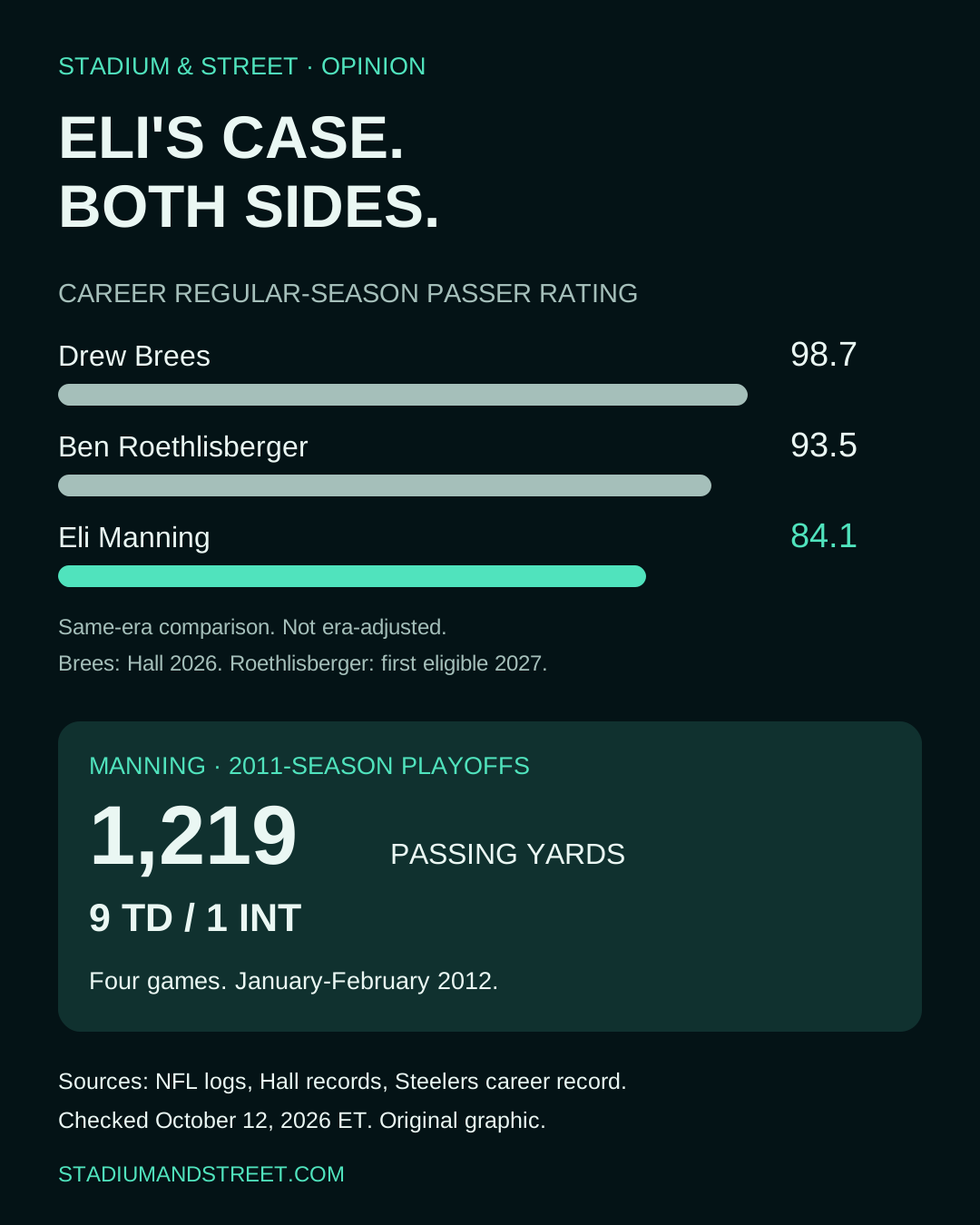
Manning finished 117-117 as a regular-season starter. He threw 244 interceptions and had an 84.1 passer rating. Those are substantial objections to calling him one of his generation's best quarterbacks. A famous last name cannot answer them.
The regular-season objection
The comparison gets harder when it stays inside his own era. Drew Brees, a member of the Hall's Class of 2026, finished with a 98.7 career passer rating. Ben Roethlisberger finished at 93.5 and becomes eligible for the Class of 2027. Both also surpassed Manning's 57,023 passing yards and 366 touchdowns. These are overlapping careers, not a misleading comparison with a quarterback from the leather-helmet years.
Passer rating is not a complete measure, and these figures are not era-adjusted. They nevertheless make an important point: Manning's regular-season résumé was not on Brees' level, nor does it match Roethlisberger's passing production. An honest yes vote has to survive that finding. It cannot explain it away with the word clutch.
Four games, not one famous catch
Manning's best postseason evidence is an entire run. In the four playoff games following the 2011 regular season, he passed for 1,219 yards, nine touchdowns and one interception. The Giants went through Atlanta, Green Bay, San Francisco and New England. Those games were played in January and February 2012; the record belongs to the 2011 season.
The range of those performances matters. Against Green Bay, Manning threw for 330 yards and three touchdowns. In San Francisco, he attempted 58 passes without an interception. In the Super Bowl, he completed 30 of 40 for 296 yards. The defense and the rest of the roster deserve their credit. Those numbers also belong to the quarterback who had to keep the offense moving.
The winning Super Bowl drives covered 83 yards in February 2008 and 88 yards four years later. Manning did not receive a championship simply because the Giants held New England down. He had to bring the offense back down the field. Two Super Bowl MVP awards recognize his contribution to two separate titles.
His best work was not confined to the playoffs, either. During the 2011 regular season, Manning threw for 4,933 yards with 29 touchdowns and 16 interceptions. Across his career he started 234 regular-season games, including 210 consecutively. Availability does not turn average football into great football, but keeping the position filled for that long has real value.
The standard and the verdict
The strongest no vote is straightforward: sustained regular-season superiority should matter more than two championship runs. That is a serious standard. Under it, Manning's uneven seasons and the passing gap to his peers can outweigh his best months. Giants fans should engage that argument rather than treat it as an insult.
Our standard gives extraordinary postseason execution meaningful weight alongside sufficient career production and durability. Manning clears that combined threshold. He need not be as good as Brees to belong in the same institution. Nor should every two-ring quarterback automatically receive the same verdict. The case rests on his actual performance, not a shortcut based on the trophy count.
Manning was a finalist but was not elected in 2026. The Hall's September rules revision puts eligible players into one pool and ends automatic finalist carryover. His case returns to a changed process, with no reserved place at the final meeting.
Canton can recognize a quarterback who was durable, productive, frequently frustrating and excellent through two championship runs. The ordinary Sundays remain part of the record. So do the games that made two titles possible. On the whole career, our vote is yes.
Go to the sources
See something that needs attention? Read our corrections process.