Team analysis · 2027 roster planning
Give Cleveland's young bats room
November 3, 2026 edition
The complete review
November 3, 2026 edition. Completed 2026 regular-season performance with November 3 roster, transaction and market checks. The full website analysis includes 25 evidence and planning tables; the 30-page PDF is suitable for forwarding. Proposed prices and workloads are scenarios.
The recommendation: improve the roster without blocking it
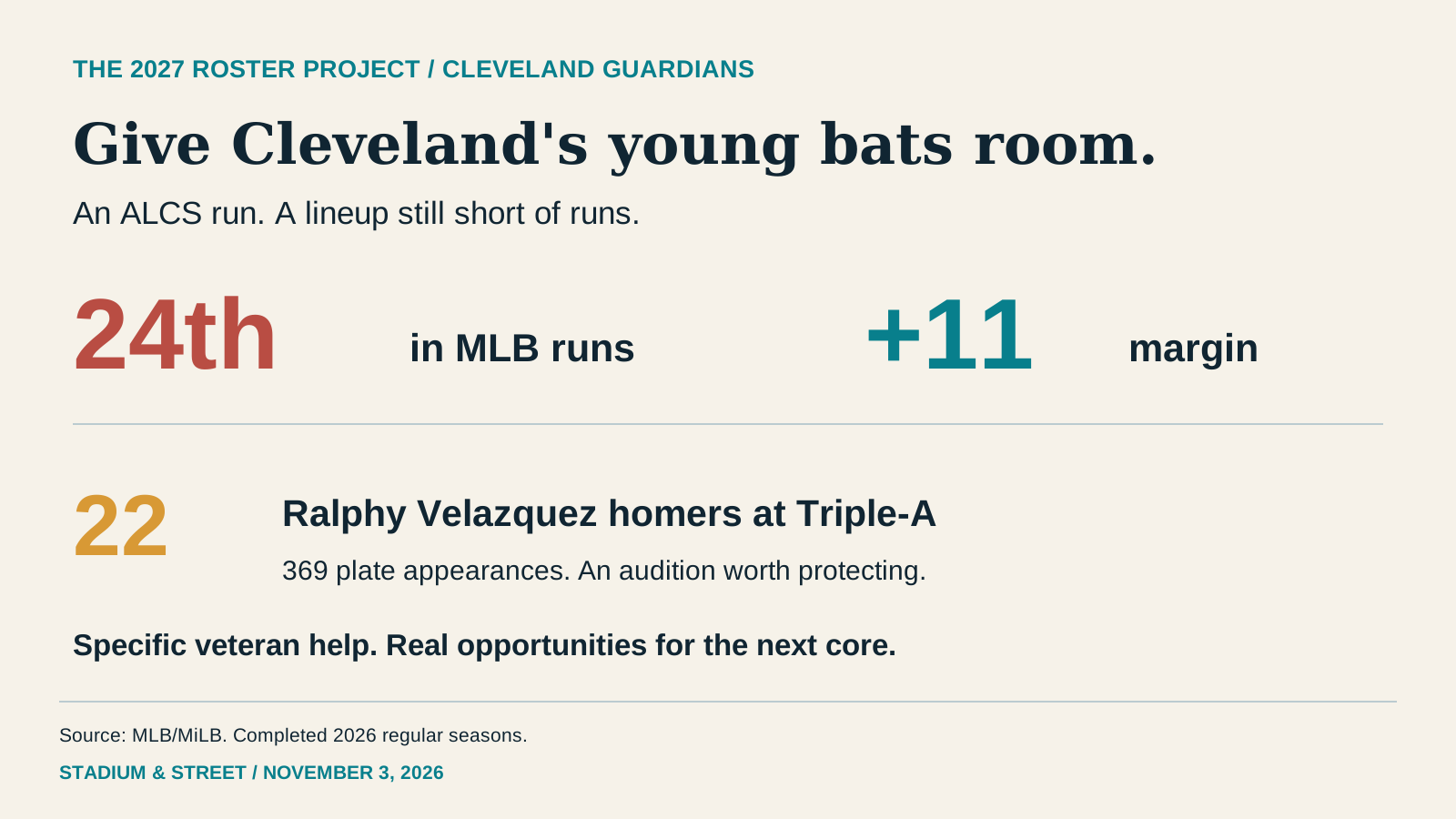
Cleveland reached the American League Championship Series with an offense that ranked 24th in runs. That combination creates a difficult winter. The Guardians have enough pitching and defense to remain dangerous, but too many ordinary nights still require the staff to protect a narrow margin. Their 85-77 record came with only 11 more runs scored than allowed.
The answer is not to buy a veteran for every unsettled position. Ralphy Velazquez produced a .904 OPS with 22 home runs at Triple-A. Cooper Ingle produced a .952 OPS with 20 homers and 86 walks at the same level. They have earned serious major-league opportunities. An offseason that fills first base and designated hitter with inflexible commitments could spend away two of Cleveland's most useful sources of improvement.
The preferred plan is more selective. Pursue Paul Goldschmidt for a limited, mostly favorable-matchup role at an S&S ceiling of one year and $5-7 million. Pursue Michael Soroka as a conditional rotation addition at one year and $8-10 million, subject to availability and the club's medical review. Keep another $5-7 million for depth and in-season needs. These are proposed price limits, not reported asking prices, negotiations or agreements.
Plan A adds $18-24 million to an existing-roster allocation of approximately $100.17-104.17 million. Its total is $118.17-128.17 million on the earned-salary basis used here. Goldschmidt receives 260 plate appearances, not an everyday guarantee. Soroka receives a 110-inning planning allocation, not a promise that his recent health history permits a full season. Every purchased inning and plate appearance displaces a named internal alternative.
Plan B tests a larger first-base commitment: Ty France at two years and $24-28 million, with the same Soroka inquiry and reserve. That raises the annual total to $125.17-135.17 million and reduces the opportunities for Velazquez and Kyle Manzardo. Plan C makes neither external purchase. It costs $105.17-111.17 million, including the reserve, and accepts more offensive and rotation uncertainty.
The recommendation is Plan A at those limits. It protects the two most credible prospect auditions while addressing a specific weakness against left-handed pitching and the fragility behind the rotation's strongest arms. If the prices or health conditions fail, Cleveland should use the explicit alternatives rather than pay an impact-player price for a complementary job.
October success and the regular-season baseline
| Season | Record | Runs for / against | Margin | OPS / ERA |
|---|---|---|---|---|
| 2024 | 92-69 | 708 / 621 | +87 | .702 / 3.61 |
| 2025 | 88-74 | 643 / 649 | -6 | .669 / 3.70 |
| 2026 | 85-77 | 678 / 667 | +11 | .696 / 3.77 |
Cleveland improved its scoring from 643 runs in 2025 to 678 in 2026. Runs allowed rose from 649 to 667. The net improvement was 17 runs, moving the differential from minus-six to plus-11. That is progress, but it is a smaller change than the postseason run might suggest.
The offense's shape matters. Walks increased from 494 to 574, and strikeouts fell from 1,344 to 1,271. Home runs declined from 168 to 162. The Guardians became better at creating and extending opportunities without developing enough reliable extra-base damage to turn those opportunities into a substantially stronger scoring attack.
The pitching staff's 3.77 ERA ranked eighth in the majors. It struck out 1,530 batters in 1,437 2/3 innings. That is a real strength. The staff also walked 530 and allowed 175 home runs. Its performance should be protected, not treated as an unlimited resource that can compensate for every offensive weakness.
Cleveland recovered from a two-game deficit to beat the White Sox in five Division Series games. The Guardians then won two of the first three ALCS games before Tampa Bay won the next three. The completed postseason record was 5-6. Those games demonstrate what this roster could do against good opponents; eleven games do not replace the much larger regular-season evidence.
The simple runs-squared calculation yields about 82.3 wins from 678 runs scored and 667 allowed, compared with the actual 85. That is not an official projection or a verdict on the manager. It is a useful reminder that the club's margin for error was narrow before October began.
Start with the current roster
The November 3 major-league roster contains 36 players. The departures include Foster Griffin, Austin Hedges, Rhys Hoskins and Nathaniel Lowe. Shawn Armstrong and Trevor Stephan also became free agents after their options were declined. Their previous contributions belong in the 2026 record, not in a fictional returning 2027 roster.
Milan Tolentino's contract was selected on October 30. He belongs in the current roster and the infield depth discussion. Velazquez and Kody Huff remain organizational minor leaguers outside that major-league roster. Promoting either requires an actual roster transaction; a strong Triple-A season does not itself create an Opening Day spot.
Bo Naylor is no longer a Cleveland catcher. The transaction history records the August trade to Milwaukee. Several other players who appeared for the Guardians in 2026 have also left the current major-league group. The historical batting and pitching tables retain their contributions, while the workload plan uses the players Cleveland currently controls and the separately identified acquisition scenarios.
Emmanuel Clase and Luis Ortiz are listed on the restricted roster and receive no innings in any plan. Their legal and contractual outcomes are not established here. The budget carries a conservative $2 million contingent Clase reserve based on the listed buyout exposure, with a separate adjustment if the verified obligation is different. It does not assume that an old salary disappears, that an option has been paid or that either pitcher returns.
Administrative activation is also not a medical clearance. Colin Holderman's public injury update reports October wrist surgery. He remains in the current roster, but the 40-inning allocation is conditional. If he cannot supply it, those innings must move to healthy depth or an actual acquisition.
The lineup has foundations worth preserving
| Player / MLB ID | CLE PA | AVG / OBP / SLG | HR | BB / K; context |
|---|---|---|---|---|
| Steven Kwan / 680757 | 637 | .282 / .382 / .349 | 3 | 85 / 62; CF and LF |
| Brayan Rocchio / 677587 | 592 | .253 / .313 / .391 | 15 | 38 / 85; Primary SS |
| Chase DeLauter / 800050 | 559 | .287 / .363 / .457 | 16 | 60 / 82; RF/DH |
| José Ramírez / 608070 | 544 | .235 / .320 / .368 | 12 | 60 / 69; 3B; 2026 hand injury |
| Travis Bazzana / 683953 | 517 | .245 / .335 / .408 | 15 | 56 / 107; 2B |
| Angel Martínez / 682657 | 416 | .254 / .290 / .465 | 18 | 13 / 91; LF/RF; occasional CF |
| Kyle Manzardo / 700932 | 356 | .215 / .306 / .378 | 13 | 36 / 114; 1B/DH competition |
| Jo Adell / 666176 | 204 | .244 / .324 / .417 | 7 | 18 / 49; CLE stint only |
| Patrick Bailey / 672275 | 256 | .228 / .292 / .390 | 9 | 21 / 70; CLE stint only |
| David Fry / 681807 | 214 | .201 / .313 / .364 | 8 | 28 / 59; Matchup/utility role |
| Daniel Schneemann / 682177 | 286 | .210 / .276 / .332 | 7 | 24 / 84; Utility and CF |
| Petey Halpin / 690984 | 195 | .225 / .268 / .326 | 4 | 9 / 35; CF coverage |
| Angel Genao / 694197 | 139 | .213 / .281 / .291 | 2 | 11 / 21; Young IF competition |
| Cooper Ingle / 694876 | 24 | .095 / .208 / .095 | 0 | 3 / 12; 24-PA MLB sample |
| Rhys Hoskins / 656555 | 317 | .179 / .306 / .376 | 13 | 47 / 100; Departed FA |
| Nathaniel Lowe / 663993 | 153 | .226 / .275 / .376 | 5 | 10 / 29; Departed FA |
| Austin Hedges / 595978 | 247 | .247 / .325 / .377 | 6 | 25 / 45; Departed FA |
Steven Kwan's .382 on-base percentage supplies the clearest offensive foundation. He walked 85 times and struck out only 62 in 637 plate appearances. Chase DeLauter added a .363 on-base percentage and .457 slugging percentage in 559 plate appearances. Those are two different strengths: Kwan repeatedly reaches base, while DeLauter offers a more substantial combination of contact and extra-base production.
José Ramírez's .235/.320/.368 season left a large gap in the middle of the order. The official transaction record includes a left hamate fracture and subsequent activation. That history is relevant, but it does not permit a medical explanation for every poor swing or a guarantee that his previous production returns. Cleveland should allow for improvement without making a full rebound the condition on which the entire winter works.
Travis Bazzana supplied 15 home runs and a .335 on-base percentage. Brayan Rocchio supplied 15 homers while sustaining a valuable defensive job. Angel Martínez hit 18 home runs, but his .290 on-base percentage and 13 walks in 416 plate appearances make him a different kind of offensive piece. His power should not conceal the frequency with which he used an out without reaching base.
Manzardo's .684 OPS and 114 strikeouts in 356 plate appearances are inadequate for an uncontested first-base or DH assignment. His 27-homer 2025 season remains part of his record. It earns him a chance to recover, not ownership of the position regardless of what Velazquez does. The proposed plan keeps the competition real.
Jo Adell's Cleveland-only .741 OPS was better than his full-season .701. A decision about his next role should use both scopes honestly. His stronger Cleveland stint is relevant evidence, but it should not erase the much larger full-season weakness against right-handed pitching.
What the contact-quality measures add
| Batter | wOBA | xwOBA | SLG / xSLG | Interpretation |
|---|---|---|---|---|
| Steven Kwan | 0.334 | 0.328 | 0.349 / 0.343 | On-base foundation; modest power |
| Chase DeLauter | 0.359 | 0.346 | 0.457 / 0.427 | Strongest young MLB bat; modest regression risk |
| José Ramírez | 0.301 | 0.325 | 0.368 / 0.391 | Some rebound support, not a restored star projection |
| Travis Bazzana | 0.328 | 0.299 | 0.408 / 0.347 | Actual result ahead of contact-quality estimate |
| Brayan Rocchio | 0.311 | 0.294 | 0.391 / 0.350 | Defense helps sustain a modest offensive role |
| Angel Martínez | 0.326 | 0.299 | 0.465 / 0.401 | Power result ahead of expected output |
| Kyle Manzardo | 0.305 | 0.307 | 0.378 / 0.380 | Expected result does not erase weak MLB production |
| Jo Adell | 0.307 | 0.329 | 0.401 / 0.444 | Full MLB season; larger platoon issue |
| Patrick Bailey | 0.271 | 0.307 | 0.335 / 0.398 | Expected output better; receiving remains central |
| David Fry | 0.304 | 0.271 | 0.364 / 0.294 | Low expected offense; do not assume old peak returns |
DeLauter's .359 weighted on-base average exceeded his .346 expected figure, but both were strong enough to support a substantial role. The expected statistic is a reason for modest restraint in projecting his next season, not a reason to diminish the value of a productive young hitter.
Ramírez's .325 expected wOBA was better than his .301 actual result. That offers some basis for a rebound case. It does not establish a return to an MVP-level season, particularly when age, health and future playing time remain outside this simple comparison.
Bazzana's .328 actual wOBA exceeded an expected .299. Angel Martínez's .326 exceeded an expected .299 as well. Cleveland can reasonably expect development from young players while still recognizing that their 2026 results were stronger than this particular contact-quality screen. A roster plan should not add automatic growth on top of every favorable result.
Manzardo's actual and expected wOBA were close, .305 and .307. The underlying screen does not reveal a clearly superior hitter hidden beneath the season's surface. His opportunity should come with a demand for better performance, supported by work on the particular pitches and locations that produced his failures.
Bailey's expected offense was stronger than his actual result. That matters because Cleveland already has a separate reason to keep him behind the plate. A modest offensive improvement would enhance a receiving-oriented role without requiring him to become one of the lineup's main run producers.
Expected statistics estimate outcomes from recorded contact and related inputs. They are not forecasts, park-neutral guarantees, medical findings or substitutes for watching how a hitter is being attacked. The useful application is to identify which assumptions deserve the most skepticism.
Handedness is a roster-design problem
| Batter / full MLB season | LHP: PA / OPS | RHP: PA / OPS |
|---|---|---|
| Steven Kwan | 205 / .609 | 432 / .787 |
| Chase DeLauter | 179 / .844 | 380 / .808 |
| José Ramírez | 164 / .835 | 380 / .625 |
| Travis Bazzana | 165 / .526 | 352 / .846 |
| Brayan Rocchio | 199 / .619 | 393 / .749 |
| Angel Martínez | 152 / .830 | 264 / .711 |
| Kyle Manzardo | 73 / .625 | 283 / .698 |
| Jo Adell | 191 / .971 | 469 / .592 |
| David Fry | 148 / .643 | 66 / .746 |
| Paul Goldschmidt | 183 / .966 | 197 / .590 |
| Ty France | 138 / .853 | 362 / .869 |
| Eugenio Suárez | 129 / .714 | 369 / .748 |
| Trent Grisham | 136 / .691 | 348 / .708 |
The Guardians posted a .675 OPS against left-handed pitching and .706 against right-handers. The proposed Goldschmidt role addresses the weaker side of that team split. He produced a .966 OPS in 183 plate appearances against lefties, compared with .590 in 197 against righties. The difference is large enough to shape his job, while the samples remain too small to promise identical results next year.
Goldschmidt would not be signed to replace every left-handed hitter whenever a lefty starts. The purpose is to give the manager one useful first-base option and a better bench choice without denying Velazquez and Manzardo the work needed to establish whether either can hold a larger role. Age and the narrowness of the assignment keep the proposed term to one year.
Adell's full-season split was similarly pronounced: .971 against lefties and .592 against righties. Cleveland already has one right-handed outfielder whose strongest case rests on favorable matchups. Adding Randal Grichuk simply because his own lefty split was excellent could duplicate that role while leaving the larger lineup problem unresolved.
Fry complicates the assumption that any right-handed bat will solve the problem. He had a .643 OPS against lefties in 148 plate appearances. His broader career may justify another opportunity, but the recent result does not support treating him as a dependable substitute for a purchased matchup bat.
Ramírez's .835 OPS against lefties and .625 against righties also show why the team split cannot be reduced to the number of left- and right-handed hitters on the roster. The players' actual strengths matter more than a tidy alternating batting order.
Defense: preserve range without freezing positions
| Fielder | 2024 OAA | 2025 OAA | 2026 OAA | 2026 tracked opportunities |
|---|---|---|---|---|
| Steven Kwan | +5 | +5 | +6 | 378 |
| Brayan Rocchio | +5 | -4 | +12 | 547 |
| José Ramírez | +3 | +8 | +2 | 334 |
| Chase DeLauter | No row | -1 | +2 | 152 |
| Travis Bazzana | No row | No row | +1 | 432 |
| Angel Martínez | -2 | -5 | -2 | 221 |
| Kyle Manzardo | 0 | -3 | -5 | 192 |
| Jo Adell | 0 | -12 | -6 | 270 |
| Daniel Schneemann | 0 | +8 | +7 | 215 |
| Petey Halpin | No row | 0 | -2 | 168 |
| Blake Perkins | +10 | +1 | -2 | 45 |
| Angel Genao | No row | No row | +1 | 113 |
| Paul Goldschmidt | 0 | -3 | +6 | 157 |
| Ty France | -11 | +10 | +8 | 330 |
| Trent Grisham | +2 | -2 | -6 | 280 |
Rocchio's plus-12 Outs Above Average provides a strong reason to retain him at shortstop while the offense develops. A .704 OPS is more workable at a demanding defensive position than at first base. Replacing him requires an improvement in total contribution, not merely a more attractive batting line.
Kwan recorded plus-six OAA across his defensive work. Cleveland used him for 637 innings in center field, so the roster should not be analyzed as though he can only play left. That actual experience gives the club a way to keep DeLauter in right and distribute corner opportunities among Adell and Angel Martínez.
The OAA figure is not a center-field-only grade. The table retains combined-position results and the number of tracked opportunities. It also shows multiple seasons because single-year defensive values can move substantially with opportunity, positioning and sampling variation.
Manzardo's minus-five OAA strengthens the case for reducing routine first-base exposure while the bat is still uncertain. France's plus-eight and Goldschmidt's plus-six were favorable 2026 results, but their prior years were not identical. Cleveland should buy an expected role and a reasonable range of outcomes rather than a promise to repeat the latest defensive total.
Grisham is another example of why reputation is not enough. His OAA moved from plus-two in 2024 to minus-two in 2025 and minus-six in 2026. He remains a possible center-field alternative, but signing him cannot be described as an automatically verified range upgrade.
Assign the positions the players actually cover
| Player | 2026 CLE defensive innings | 2027 allocation decision |
|---|---|---|
| Steven Kwan | CF 637.0; LF 626.2 | Continue meaningful CF plus LF; do not call OAA a CF-only figure |
| Chase DeLauter | RF 559.2 | Keep primary RF; avoid inventing everyday CF readiness |
| Jo Adell | LF 55.0; RF 224.0 | RF/LF/DH, emphasize favorable matchups |
| Angel Martínez | CF 28.0; RF 309.1; LF 522.0 | LF first; selective RF and 2B |
| Daniel Schneemann | 2B 94.0; 3B 253.2; SS 44.0; LF 1.0; RF 14.0; CF 217.0 | Preserve positional cover |
| Kyle Manzardo | 1B 612.1 | Reduce routine first-base exposure |
| David Fry | C 43.1; 1B 85.0; 3B 5.0; LF 113.0; RF 95.0 | Third catcher and corner cover; small catching workload |
| Patrick Bailey | C 589.2 | Primary receiving job |
| Cooper Ingle | LF 32.0 | Catching audition rests on minor-league work |
The preferred alignment keeps DeLauter in right, uses Kwan substantially in center and treats Adell as a corner/DH option. It does not invent an everyday center-field conversion for either DeLauter or Adell. Halpin, Perkins and Schneemann provide additional center-field coverage, with the offense limiting how much of the season can be assigned to that group.
Angel Martínez's 2026 work was concentrated in the corners, including 522 innings in left and 309 1/3 in right. His center-field exposure was only 28 innings. A depth chart that places him in center because he is listed broadly as an outfielder would overstate the demonstrated basis for that decision.
The infield also needs flexibility without forcing a young player to learn several jobs at once. Bazzana receives the primary second-base opportunity. Rocchio keeps most shortstop starts. Genao competes for meaningful work at short and third, with Schneemann covering the gaps. Tolentino's newly selected roster spot supplies another alternative, not an obligation to displace a better player.
These allocations are planning choices. Spring performance, health and actual defensive evaluations can change them. The important discipline is that every proposed bat has a place to stand, every position has coverage and the DH is not promised simultaneously to four everyday players.
Let receiving and offensive upside share the catching job
| Catcher / full MLB season | Catching run value | Framing / throwing / blocking / ABS |
|---|---|---|
| Patrick Bailey | +7.5 | +4.6 / +3.5 / -2.0 / +1.5 |
| Austin Hedges | -1.6 | +2.0 / -2.3 / -0.7 / -0.5 |
| Cooper Ingle | No qualifying MLB row | AAA offensive evidence is separate from receiving value |
Bailey's full-season catching run value was approximately plus-7.5, with positive framing, throwing and ABS components offset partly by blocking. Hedges' total was approximately minus-1.6. Those totals already include their component values; adding framing again would count the same contribution twice.
The recommendation is to keep Bailey as the primary receiver and give Ingle a substantial audition. Ingle's Triple-A record is more compelling than his 24 major-league plate appearances are discouraging. The larger sample justifies an opportunity, while the receiving standard determines how much catching work he can keep.
Ingle's offensive upside is not a measured major-league catching value. The available MLB fielding table records his brief 2026 outfield work, not a season of major-league receiving. His proposed 60 catching starts therefore depend on actual readiness, not an inference from his position label or batting average.
Fry receives only a small third-catcher allocation. Huff is the next organizational alternative worth evaluating: he had an .888 OPS with 23 homers and 69 walks in 497 Triple-A plate appearances. His non-roster status and receiving ability still need to be resolved before he can be treated as an available major-league replacement.
This is a different problem from Minnesota's potential loss of Ryan Jeffers or Miami's longer-term catching development. Cleveland already has an established receiver under control and a productive upper-level prospect. An expensive outside catcher would have to clear a much higher marginal-value test here.
The rotation is good, but the depth is not free
| Pitcher / MLB ID | GS / CLE IP | ERA / xERA* | K / BB / HR | Treatment |
|---|---|---|---|---|
| Parker Messick / 800048 | 32 / 186.1 | 2.56 / 3.15 | 193 / 49 / 17 | Retain; budget below 186.1 completed IP |
| Gavin Williams / 668909 | 32 / 184.1 | 3.76 / 3.84 | 248 / 61 / 28 | Retain strikeout foundation |
| Tanner Bibee / 676440 | 33 / 188.0 | 4.36 / 4.35 | 148 / 55 / 29 | Restore effectiveness, not just innings |
| Joey Cantillo / 676282 | 30 / 159.0 | 3.62 / 4.01 | 171 / 81 / 17 | Command test; 81 walks |
| Slade Cecconi / 677944 | 21 / 121.0 | 4.91 / 4.76 | 99 / 39 / 19 | Starter/bulk, not guaranteed fifth starter |
| Foster Griffin / 656492 | 9 / 43.1 | 5.19 / 4.35 | 42 / 15 / 4 | Departed FA; full MLB xERA |
| Logan Allen / 671106 | 2 / 16.2 | 5.94 / 4.21 | 16 / 6 / 3 | Depth competition |
| Daniel Espino / 682982 | 3 / 15.1 | 4.11 / 2.90 | 25 / 7 / 3 | Small sample; gradual workload |
Messick's 2.56 ERA in 186 1/3 innings was the staff's strongest combination of run prevention and workload. His 3.15 expected ERA still supports an effective pitcher while advising against making 2.56 the planning baseline. Williams supplied 248 strikeouts in 184 1/3 innings, a substantial source of missed bats.
Bibee supplied 188 innings but allowed 29 home runs and finished with a 4.36 ERA. His 4.35 expected ERA does not suggest that the results were primarily a contact-luck problem. Cleveland needs to improve the quality of those innings rather than celebrate the workload alone.
Cantillo's 171 strikeouts were accompanied by 81 walks in 159 innings, approximately 4.6 walks per nine. His 3.62 ERA was useful, but the command burden makes that result harder to sustain. Giving him another starting opportunity is reasonable. Assuming that he can simply absorb another 30 innings at the same effectiveness is not.
Cecconi's 4.91 ERA and 4.76 expected ERA make him a starter/bulk candidate rather than an unquestioned fifth starter. Allen and Espino provide additional possibilities, but their small 2026 MLB workloads and uneven development make them poor substitutes for a properly funded contingency.
Soroka is the preferred inquiry at the stated one-year ceiling. He delivered 116 innings with a 3.41 ERA and 114 strikeouts against 29 walks. His 4.12 expected ERA and recent injured-list history temper the case. This is a purchase of a chance at useful middle-rotation innings, not a bet that his healthiest or most effective season must repeat.
The bullpen already has a hierarchy
| Pitcher | CLE IP | ERA / full MLB xERA | K / BB | 2027 treatment |
|---|---|---|---|---|
| Cade Smith | 74.0 | 1.95 / 2.83 | 107 / 23 | Closer; reduce 74-IP workload |
| Hunter Gaddis | 60.1 | 2.98 / 4.09 | 57 / 22 | Setup; expected ERA less dominant |
| Erik Sabrowski | 48.1 | 2.61 / 2.62 | 76 / 31 | High strikeouts; walks remain a constraint |
| Tim Herrin | 56.2 | 3.02 / 3.89 | 54 / 28 | Left-handed coverage |
| Matt Festa | 66.2 | 3.78 / 3.92 | 69 / 21 | Middle/setup depth |
| Colin Holderman | 52.2 | 2.73 / 3.87 | 50 / 20 | Post-surgery availability gate |
| Franco Aleman | 22.1 | 4.43 / 4.48 | 28 / 10 | AAA success needs MLB translation |
| Craig Yoho | 18.1 | 6.87 / 4.30 | 23 / 10 | Command/contact repair |
| Shawn Armstrong | 35.1 | 4.58 / 4.21 | 34 / 19 | Departed FA; no retained innings |
Cade Smith saved 41 games while posting a 1.95 ERA and striking out 107 in 74 innings. The preferred plan reduces his allocation to 65 innings. A strong closer should not become the default answer to every problem created in the sixth and seventh.
Gaddis, Herrin, Festa and Sabrowski provide a substantial retained foundation. Sabrowski struck out 76 in 48 1/3 innings, but also walked 31. Gaddis' expected ERA was meaningfully higher than his actual ERA. The group is useful without being immune to regression or workload pressure.
Holderman's recovery is a separate question from his 2.73 ERA. The plan does not count his current roster status as evidence that the wrist is ready. Forty conditional innings leave room for caution, while the depth reserve exists partly because an internal recovery can fail without warning.
Aleman's 1.32 ERA with 50 strikeouts and nine walks in 34 Triple-A innings gives Cleveland a concrete relief-development case. His 22 1/3 major-league innings were less successful. Yoho's Cleveland ERA was 6.87. Neither should receive a high-leverage title merely because the organization has developed good relievers before.
The first external dollars therefore go toward the specific offensive role and rotation contingency. A premium reliever can help, but it is not the clearest first purchase for a club that already has Smith and several useful setup options while finishing near the bottom of the league in scoring.
The farm system offers choices, not guaranteed replacements
| Player / MLB ID | 2026 level and sample | Readiness decision |
|---|---|---|
| Ralphy Velazquez / 806252 | AAA: 369 PA, .904 OPS, 22 HR; 39 BB / 76 K | Real 1B/DH audition; no assumed MLB translation |
| Cooper Ingle / 694876 | AAA: 473 PA, .952 OPS, 20 HR; 86 BB / 108 K | Second catcher competition; receiving must hold |
| Angel Genao / 694197 | AAA: 309 PA, .889 OPS, 10 HR; 38 BB / 48 K | IF coverage and future larger role |
| Kody Huff / 687627 | AAA: 497 PA, .888 OPS, 23 HR; 69 BB / 97 K | Non-roster catching alternative |
| Milan Tolentino / 675455 | AAA: 497 PA, .781 OPS, 21 HR; 65 BB / 157 K | Selected October 30; contact test |
| CJ Kayfus / 692216 | AAA: 199 PA, .705 OPS, 3 HR; 24 BB / 54 K | Depth, not assumed middle-order solution |
| Jaison Chourio / 702693 | AA: 420 PA, .755 OPS, 7 HR; 56 BB / 89 K | AA development; no April production credited |
| Juneiker Caceres / 821181 | A+: 100 PA, .744 OPS, 1 HR; 12 BB / 23 K | 100 High-A PA; longer-term prospect |
| Welbyn Francisca / 806988 | A+: 289 PA, .894 OPS, 17 HR; 32 BB / 64 K | High-A strength; only 21 subsequent AA PA |
| Luke Hill / 702619 | AA: 150 PA, .699 OPS, 3 HR; 15 BB / 34 K | 150 AA PA; not a settled MLB role |
| Braylon Doughty / 815785 | AA: 50.0 IP, 5.40 ERA; 49 K / 14 BB | 50 AA innings; no 2027 opening workload |
| Austin Peterson / 804926 | AAA: 102.0 IP, 4.41 ERA; 107 K / 38 BB | Starter/bulk depth |
| Daniel Espino / 682982 | AAA: 36.2 IP, 3.68 ERA; 49 K / 22 BB | Gradual combined workload |
| Franco Aleman / 680916 | AAA: 34.0 IP, 1.32 ERA; 50 K / 9 BB | Relief audition |
| Andrew Walters / 689958 | AAA: 12.1 IP, 7.30 ERA; 23 K / 11 BB | Small return sample; cautious build |
| Rorik Maltrud / 702045 | AAA: 129.1 IP, 3.90 ERA; 113 K / 47 BB | Non-roster starter depth |
| Trenton Denholm / 671143 | AAA: 129.1 IP, 4.59 ERA; 126 K / 33 BB | Non-roster starter depth |
Velazquez's Triple-A record provides the strongest argument against an inflexible first-base signing. His 22 homers came in 369 plate appearances, with 39 walks and 76 strikeouts. He also hit seven homers at Double-A. That combination is strong enough to earn an extended audition, but the league change still requires a substantial adjustment.
Ingle's 473 Triple-A plate appearances provide a larger offensive sample than many prospects bring to their first meaningful major-league opportunity. His 86 walks matter as much as the 20 homers because Cleveland needs more hitters who can create a productive plate appearance when they do not drive the ball.
Genao's .889 Triple-A OPS and 38 walks against 48 strikeouts support a patient approach to his weaker first major-league sample. Rocchio's defense means Cleveland can develop Genao without immediately demanding that he become the everyday shortstop. The competition can be real without making either player disposable.
The younger prospects belong on a different timetable. Chourio has a meaningful Double-A sample. Caceres had only 100 High-A plate appearances. Francisca's strong High-A work was followed by only 21 at Double-A. Doughty threw 50 Double-A innings. None receives automatic Opening Day production in this plan.
The same restraint applies to pitching depth. Peterson, Espino, Walters and Aleman receive limited, identifiable opportunities. Maltrud and Denholm remain non-roster alternatives whose contract and roster status must be checked before use. Their minor-league innings are evidence of preparation, not major-league innings already purchased.
Test the other purchases before choosing the small one
| Candidate / MLB ID | Full 2026 MLB evidence | S&S ceiling / decision |
|---|---|---|
| Paul Goldschmidt / 502671 | 380 PA, .765 OPS, 18 HR; 0.330/0.311 wOBA/xwOBA | Preferred limited role: 1 year / $5-7M |
| Ty France / 664034 | 500 PA, .865 OPS, 21 HR; 0.373/0.327 wOBA/xwOBA | Broader alternative: 2 years / $24-28M |
| Michael Soroka / 647336 | 116.0 IP, 3.41 ERA, 4.12 xERA; 114 K / 29 BB | Conditional starter inquiry: 1 year / $8-10M |
| Nick Martinez / 607259 | 180.0 IP, 3.10 ERA, 3.98 xERA; 109 K / 26 BB | Alternative: 2 years / $26-30M; not in preferred budget |
| Foster Griffin / 656492 | 172.2 IP, 3.60 ERA, 4.35 xERA; 158 K / 45 BB | Retention alternative: 1 year / $7-9M |
| Eugenio Suárez / 553993 | 498 PA, .740 OPS, 26 HR; 0.324/0.303 wOBA/xwOBA | Pass as preferred DH; contact decline and overlap |
| Taylor Ward / 621493 | 607 PA, .670 OPS, 7 HR; 0.312/0.334 wOBA/xwOBA | Pass as principal power purchase |
| Trent Grisham / 663757 | 484 PA, .703 OPS, 18 HR; 0.311/0.337 wOBA/xwOBA | CF alternative only; not a proven range upgrade |
| Daulton Varsho / 662139 | 526 PA, .636 OPS, 12 HR; 0.281/0.283 wOBA/xwOBA | Range alternative; offensive cost remains |
| Cedric Mullins / 656775 | 502 PA, .628 OPS, 15 HR; 0.281/0.264 wOBA/xwOBA | Not preferred offensive repair |
| Jake Meyers / 676694 | 153 PA, .594 OPS, 3 HR; 0.265/0.256 wOBA/xwOBA | Officially announced free-agent election; no purchased role |
| Randal Grichuk / 545341 | 280 PA, .880 OPS, 15 HR; 0.370/0.335 wOBA/xwOBA | Platoon alternative; duplicates Adell/Angel roles |
France is the strongest broader first-base alternative in this comparison. His .865 OPS, 21 homers and favorable defensive result would raise the position's immediate floor if repeated. The caution is substantial: his .373 actual wOBA exceeded an expected .327, and his .502 slugging exceeded an expected .421. The proposed two-year ceiling prices useful coverage, not a guaranteed repeat of the career-best-looking surface line.
Goldschmidt is cheaper in this plan because the job is smaller and the age risk is greater. The club would be buying roughly 260 plate appearances, primarily in favorable matchups, while preserving Velazquez's chance to become the larger solution. A demand for an everyday role or a multi-year guarantee would undermine the reason for choosing him.
Suárez's 26 homers are tempting, but his .303 expected wOBA, 169 strikeouts in 498 plate appearances and declining defensive result make an everyday DH commitment difficult to justify here. Cleveland needs the DH to rotate among developing bats, matchup hitters and Ramírez. Paying for a narrow power outcome would reduce that flexibility.
Ward's 99 walks were valuable, but seven home runs and a .311 slugging percentage do not establish the missing power solution. Grichuk's strong platoon production overlaps the jobs already held by Adell and Angel Martínez. Grisham and Varsho can be considered for center field, but neither is an automatic offensive improvement large enough to make Kwan's demonstrated flexibility irrelevant.
Martinez is a sound command-oriented pitching alternative, with only 26 walks in 180 innings. His acquisition would cost more and could require two years. Griffin is a retention alternative, but his Cleveland ERA and full-season expected ERA argue against treating his October contribution as the only evidence that matters. Soroka's shorter proposed commitment fits the preferred plan, provided his health and market actually permit it.
Houston's official announcement identifies Meyers' free-agent election following his outright. He receives no purchased role or assumed price in these scenarios; the release check resolves his status without changing Cleveland's preferred acquisitions.
Build the payroll from obligations
| Player | 2027 allocation, $M | Basis |
|---|---|---|
| Jose Ramirez | 25 | Annual earned salary; $10M deferred, not forgiven |
| Tanner Bibee | 7.4 | 2027 salary column |
| TOTAL | 32.4 | Earned salary basis; not present value or near-term cash |
| Player | Estimate, $M | Basis |
|---|---|---|
| Jo Adell | 9.60 | Published projection; unsigned |
| Steven Kwan | 11.30 | Published projection; unsigned |
| Colin Holderman | 2.30 | Published projection; unsigned |
| David Fry | 1.90 | Published projection; unsigned |
| Matt Festa | 1.50 | Published projection; unsigned |
| Patrick Bailey | 2.30 | Published projection; unsigned |
| Gavin Williams | 4.80 | Published projection; unsigned |
| Blake Perkins | 0.90 | Published projection; unsigned |
| Hunter Gaddis | 2.20 | Published projection; unsigned |
| Tim Herrin | 1.30 | Published projection; unsigned |
| Brayan Rocchio | 3.10 | Published projection; unsigned |
| Cade Smith | 5.50 | Published projection; unsigned |
| Slade Cecconi | 2.00 | Published projection; unsigned |
| TOTAL | 48.70 | 13 retained cases; no assumed non-tender savings |
The two listed guaranteed salaries total $32.4 million. The 13 arbitration estimates total $48.7 million. Those estimates are unsigned projections, not finalized salaries. Retaining Kwan and Adell therefore requires acknowledging their projected raises, rather than carrying forward their previous pay or quietly assuming a non-tender.
Ramírez's annual salary includes $10 million deferred to later years. The analysis keeps the full $25 million earned allocation in the baseline. A cash-flow comparison can subtract the known deferral for the relevant year, but that does not erase the future obligation or turn the contract into a $15 million annual commitment.
| Component | Annual allocation | Definition |
|---|---|---|
| Two guaranteed contracts | $32.40M | Ramirez $25M and Bibee $7.4M |
| Arbitration pool | $48.70M | 13 estimates |
| Existing other obligations | $2.321429M | Straw $1.75M; Gimenez signing bonus $0.571429M |
| Declined-option buyouts | $2.75M | Armstrong $1.5M; Stephan $1.25M |
| Clase contingent reserve | $2M | Listed buyout exposure; actual resolution unverified |
| Pre-arb, minors and callups | $12-16M | S&S allowance includes minor-league roster salaries |
| Existing-roster envelope | $100.17-104.17M | Earned allocation before proposed additions |
The remaining base includes the listed Straw and Giménez obligations, the Armstrong and Stephan buyouts, the contingent Clase reserve and a $12-16 million allowance for pre-arbitration players, minor-league roster salaries and callups. That yields $100.17-104.17 million before proposed acquisitions and the separate depth reserve.
This is a roster-allocation model, not an official payroll forecast or a full club operating budget. It excludes benefits, taxes, facilities, scouting and other organizational costs. It also does not claim that Cleveland has approved this spending level. The purpose is to expose what the baseball recommendation actually requires.
A non-tender, trade or revised contract could change the baseline. None is assumed merely to make the arithmetic more comfortable. If Cleveland chooses to move an arbitration player, the replacement cost, lost workload and actual return must be added to the same calculation.
Three plans and the conditions that change them
| Plan | Annual additions | Total allocation | New commitment* |
|---|---|---|---|
| A: Goldschmidt + Soroka | $18-24M | $118.17-128.17M | $18-24M |
| B: France + Soroka | $25-31M | $125.17-135.17M | $37-45M |
| C: Internal roster | $5-7M | $105.17-111.17M | $5-7M |
Every plan includes a $5-7 million reserve. The reserve is money available for actual needs, not a player who already supplies an ERA, an OPS or a fixed number of wins. Plan A's two proposed one-year purchases account for $13-17 million; the reserve brings the annual additions to $18-24 million.
The commitment column includes the full proposed contract terms plus the first-year reserve. For Plan B, that means France's two years, Soroka's one year and the reserve. These are planning commitments, not signed liabilities. The reserve has not already been spent.
Plan B increases the first-base commitment and moves 190 plate appearances toward France relative to Goldschmidt. Those opportunities come from Velazquez and Manzardo. Its higher price buys broader immediate coverage at the expense of development time and a second guaranteed year. The report does not count both France and Goldschmidt as simultaneous additions.
Plan C retains the internal group and the reserve. It is a legitimate choice if the club cannot secure worthwhile terms, but it is not the same roster at a discount. The lefty-matchup problem becomes more dependent on Fry, the young first basemen and the existing outfielders. The rotation also asks more of Cecconi, Allen, Espino and Peterson.
| Difference or contingency | Treatment | Reason |
|---|---|---|
| Ramirez deferral | $10M earned annually, paid later | Subtract only when comparing a near-term cash proxy; liability survives |
| Clase actual obligation differs | Replace the $2M reserve with verified amount | No claim of waiver, termination, paid option or legal outcome |
| Illustrative $10M Clase liability | Add $8M to every plan | Stress test only; not a finding that this sum is payable |
| Benefits, taxes and other costs | Excluded from these roster allocations | Not full club operating cost or an official CBT calculation |
| Soroka unavailable | Remove $8-10M and reassign 110 starter IP | No imaginary innings from an unfilled allowance |
The Clase branch is deliberately unresolved. A verified obligation different from the $2 million reserve changes every scenario. For example, a hypothetical $10 million obligation would add $8 million, not $10 million, because $2 million is already carried. That is a stress test, not a legal or contractual conclusion.
If Soroka cannot be acquired at the ceiling or cannot clear the club's evaluation, remove his cost and his innings together. Martinez or Griffin would require a new costed choice. An unspent starter allowance cannot be credited with preventing runs.
Make the plate appearances add up
| Player / role | PA | Opportunity |
|---|---|---|
| Kwan | 620 | CF/LF |
| DeLauter | 580 | RF/DH |
| Ramirez | 590 | 3B/DH; return to stronger offense is conditional |
| Rocchio | 540 | SS |
| Bazzana | 530 | 2B |
| Adell | 430 | Corner OF/DH, favor LHP |
| Angel Martinez | 420 | LF/RF/2B |
| Velazquez | 360 | 1B/DH audition; needs 40-man selection |
| Manzardo | 340 | 1B/DH competition |
| Goldschmidt | 260 | Mostly favorable matchups; only if signed |
| Bailey | 350 | C |
| Ingle | 270 | C/DH audition |
| Schneemann | 250 | CF/IF cover |
| Halpin | 180 | CF |
| Perkins | 100 | CF depth |
| Genao | 140 | SS/3B |
| Fry | 100 | C/corner/DH cover |
| Kayfus | 60 | 1B/RF depth |
| Tolentino | 40 | IF depth |
| Watson | 40 | OF depth |
| TOTAL | 6,200 | Season coverage, not 20 simultaneous active hitters |
The 6,200-plate-appearance budget is season coverage across starters, bench players, injuries, options and callups. It is not a proposal to carry 20 hitters on the active roster. The main jobs belong to the established core, while Velazquez and Ingle receive substantial but conditional opportunities.
The largest deliberate reduction is at the intersection of first base and DH. Manzardo retains 340 plate appearances, but no longer controls the entire role. Goldschmidt's 260 create a matchup alternative. Velazquez's 360 create a real test of the prospect's ability to improve the lineup.
| Change from A | PA adjustment | Consequence |
|---|---|---|
| B: replace Goldschmidt with France | -260 / +450 | France receives 450 PA and broader first-base duty |
| B: Velazquez / Manzardo | -110 / -80 | 250 / 260 PA; fewer young-player opportunities |
| C: remove Goldschmidt | -260 | No acquired production credited |
| C: Velazquez / Manzardo | +80 / +80 | 440 / 420 PA; larger translation bet |
| C: Fry / Kayfus | +60 / +40 | 160 / 100 PA; matchup safety net weaker |
| TOTAL | 6,200 in all plans | Acquisitions displace actual incumbents |
Plan B removes Goldschmidt, adds France and reduces both younger first-base candidates. Plan C removes Goldschmidt and explicitly restores those opportunities internally. Neither alternative can claim the preferred plan's production while deleting the purchase price.
Adell's 430 plate appearances are also a choice. His arbitration estimate is substantial for a player whose recent performance was so split-dependent. The club should evaluate whether the role produces enough total value at that salary. The base retains him, so the report does not assume savings from a transaction that has not happened.
Cover all nine positions
| Pos. | Proposed 162-start allocation | Purpose |
|---|---|---|
| C | Bailey 94; Ingle 60; Fry 8 | Test Ingle receiving; Huff is a non-roster alternative |
| 1B | Velazquez 80; Manzardo 35; Goldschmidt 47 | A: preserve the prospect audition and RH matchups |
| 2B | Bazzana 125; Angel Martinez 17; Schneemann 20 | Growth opportunity with actual cover |
| 3B | Ramirez 132; Genao 15; Schneemann 15 | Scheduled DH/rest coverage |
| SS | Rocchio 130; Genao 17; Schneemann 8; Tolentino 7 | Keep range; let Genao earn more work |
| LF | Angel Martinez 85; Adell 35; Kwan 30; Watson 8; Schneemann 4 | Use Kwan CF flexibility |
| CF | Kwan 100; Halpin 36; Perkins 20; Schneemann 6 | No assumed DeLauter or Adell conversion |
| RF | DeLauter 120; Adell 30; Kayfus 12 | Preserve strongest young bat |
| DH | Manzardo 40; Adell 30; Ramirez 18; Velazquez 15; Goldschmidt 12; DeLauter 12; Fry 10; Ingle 10; Schneemann 15 | Shared work; no inflexible everyday DH purchase |
The primary alignment gives Kwan 100 center-field starts and 30 in left. That is an expansion of a role he actually performed, not a conversion invented to make the spreadsheet work. Halpin, Perkins and Schneemann cover the remaining center-field starts.
At first base, Plan A gives Velazquez 80 starts, Manzardo 35 and Goldschmidt 47. Plan B changes that to France 110, Velazquez 40 and Manzardo 12. Goldschmidt's 12 DH starts are reassigned equally to Velazquez and Ingle. Plan C reallocates Goldschmidt's first-base starts to Velazquez 20, Manzardo 20 and Fry seven, with Fry taking the 12 DH starts as well. Every version preserves 162 starts at the position.
The catching allocation assumes Ingle can handle a meaningful receiving job. If he cannot, the club must revise the workload rather than leave the same offensive assumptions in place under another name. Huff's evaluation and the small Fry allocation provide alternatives, but neither is an established equivalent.
Defensive starts and plate appearances are different units. Batting order, substitutions, pinch-hitting and game length change the relationship. The two tables make the broad role distribution visible; they are not claims that every player will receive exactly four plate appearances each time he starts.
Budget the pitching workload before projecting improvement
| Pitcher / coverage | Starts / IP | Workload test |
|---|---|---|
| Messick | 29 / 165 | Below 186.1 completed MLB IP |
| Williams | 29 / 165 | Below 184.1 completed MLB IP |
| Bibee | 30 / 165 | Below 188 completed MLB IP |
| Cantillo | 25 / 130 | Command gate; below 159 completed IP |
| Soroka | 22 / 110 | Only if signed and cleared; below 116 prior IP |
| Cecconi | 15 / 75 | Additional 35 relief IP; 110 total |
| Allen | 5 / 25 | Additional 30 relief IP; 55 total |
| Espino | 4 / 20 | Additional 25 relief IP; 45 total |
| Peterson | 3 / 15 | Additional 15 relief IP; 30 total |
| TOTAL | 162 / 870 | Eight internal pitchers plus conditional Soroka |
The starter allocation totals 162 starts and 870 innings. Messick, Williams and Bibee are each budgeted below their completed 2026 workloads. Cantillo receives fewer innings while his command is addressed. Soroka's 110-inning role is below his 116-inning season and remains conditional on an actual signing and availability.
| Pitcher / coverage | IP | Workload test |
|---|---|---|
| Cade Smith | 65 | Below 74-IP season |
| Gaddis | 60 | Near 60.1 prior IP |
| Herrin | 55 | Near 56.2 prior IP |
| Sabrowski | 55 | Above 48.1; command must hold |
| Festa | 60 | Below 66.2 prior IP |
| Holderman | 40 | Post-surgery availability required |
| Aleman | 50 | Combined minor/major track record, not guaranteed MLB translation |
| Yoho | 35 | Recovery in command/contact needed |
| Walters | 25 | Small return workload; conditional |
| Cecconi | 35 | Additional to 75 starter IP |
| Allen | 30 | Additional to 25 starter IP |
| Espino | 25 | Additional to 20 starter IP |
| Peterson | 15 | Additional to 15 starter IP |
| Other healthy depth | 20 | Unfilled coverage; no assigned ERA |
| TOTAL | 570 | 870 starter + 570 relief = 1,440 innings |
The relief allocation totals 570 innings. Together, the two tables cover 1,440 innings. Actual games will not produce precisely that number because of extra innings, shortened games and home teams that do not bat in the ninth. This is a workload planning standard, not a schedule prediction.
Cecconi, Allen, Espino and Peterson have starter and relief work shown separately. Their combined totals matter. Assigning a pitcher 75 starter innings and 35 relief innings means budgeting 110 innings, not treating the two roles as independent players.
| Change from A/B | Starts / starter IP change | Result |
|---|---|---|
| Remove Soroka | -22 / -110 | No external starter credited |
| Cecconi | +8 / +40 | 23 starts / 115 starter IP, plus 35 relief |
| Allen | +7 / +35 | 12 starts / 60 starter IP, plus 30 relief |
| Espino | +2 / +10 | 6 starts / 30 starter IP, plus 25 relief |
| Peterson | +5 / +25 | 8 starts / 40 starter IP, plus 15 relief |
| NET | 0 / 0 | Same innings budget, higher internal depth risk |
The no-purchase branch redistributes Soroka's 22 starts and 110 innings exactly. It does not assign a favorable ERA to those extra internal innings. The likely effectiveness of that replacement work is one of the central reasons to consider the external starter in the first place.
Compare the repeated names by their actual jobs
France is a broader first-base alternative in the prepared Milwaukee analysis, where the existing retention question centers on Jake Bauers. In Cleveland, France competes with an upper-level prospect audition and Manzardo's recovery attempt. The same $24-28 million two-year ceiling reflects a similar proposed everyday skill package, while the reason to decline it is different: Cleveland has more development value at risk.
The prepared Tampa Bay analysis rejects France because first base and DH already have clearer incumbents. That is a role decision, not an attempt to vary names. A useful player can be a reasonable alternative for one club and an inefficient purchase for another.
Grichuk's role is particularly revealing. Tampa Bay's prepared plan uses him for a defined right-handed corner matchup job. Cleveland already has Adell and Angel Martínez competing for many of those plate appearances. Adding him here without subtracting their work would manufacture an extra role that the lineup does not contain.
Martinez appears in other dossiers because a pitcher who limits walks and covers innings can help several clubs. Cleveland's preferred plan instead tests Soroka's shorter commitment and a smaller workload. That is a financial and roster constraint, not a claim that Soroka is more durable or that Martinez will be available independently to every team mentioned in the series.
The earlier Yankees review treats Kwan as a conditional trade inquiry. Cleveland's analysis treats him as a central retained player with substantial center-field work and a projected arbitration salary. Both perspectives can coexist only if a trade is evaluated as a real exchange. This plan assigns no outgoing prospects and assumes no Kwan trade. An offer would have to replace his on-base value, defensive coverage and playing time, as well as justify the loss of the remaining control year.
Goldschmidt's limited Cleveland role is different from an everyday first-base assignment. The lower proposed price follows from fewer plate appearances, advanced age and a narrow matchup purpose. If he wants an everyday job elsewhere, the alternative is a different plan, not an invented willingness to accept Cleveland's terms.
The strongest countercase
The strongest objection is that this plan may be too cautious for a club that just reached the ALCS. Goldschmidt is an aging complementary hitter. Soroka has health and performance uncertainty. Velazquez and Ingle have not proved they can provide a full season of major-league production. A more expensive established bat might give Cleveland a better chance to capitalize on the pitching it already has.
That objection deserves weight. Plan A is preferable only if the organization genuinely believes the two prospect auditions are ready and if the veteran purchases remain within their limited price and role definitions. If either prospect is clearly unready, the playing-time advantage of the smaller purchase weakens. France then becomes more attractive, or the club must evaluate a different impact bat with an honest account of the positions and money displaced.
There is also a case for making no purchase and preserving flexibility. The farm system could supply the needed improvement, Ramírez could rebound, and a rotation of Messick, Williams, Bibee, Cantillo and Cecconi could remain competitive. That is Plan C. It saves money while concentrating more of the outcome in internal development and health.
The problem with relying entirely on that case is the number of things that must go right at once. Cleveland needs more offense, not merely a different explanation for why 678 runs should have been enough. The limited acquisitions are intended to reduce two specific dependencies without closing the development paths that could produce the largest gains.
The decision should therefore be revisited when the club has better information about readiness, medical evaluations and prices. The report recommends a conditional course of action, not a shopping list that becomes correct simply because each name is familiar.
Define the improvement in runs
| Illustrative change from 2026 | RS / RA | Run margin | Simple run-ratio wins* |
|---|---|---|---|
| Unchanged runs | 678 / 667 | +11 | 82.3 |
| Score 30 more; prevention unchanged | 708 / 667 | +41 | 85.8 |
| Score 30 more; prevent 20 | 708 / 647 | +61 | 88.3 |
| Score 50 more; prevent 30 | 728 / 637 | +91 | 91.8 |
| Offense flat; allow 30 more | 678 / 697 | -19 | 78.8 |
Adding 30 runs while holding prevention steady moves the simple run-ratio illustration from 82.3 wins to 85.8. Adding those 30 runs and preventing another 20 produces 88.3. A stronger combination, 50 more scored and 30 fewer allowed, produces 91.8. These are transparent arithmetic scenarios, not forecasts of what the proposed signings will deliver.
The adverse case matters just as much. If the offense stays flat and runs allowed increase by 30, the same illustration falls to 78.8 wins. A club can preserve most of a successful October roster and still move backward if the pitching regresses before the lineup improves.
Cleveland should evaluate the season through concrete questions: Are the young hitters reaching base and doing enough damage? Is the lefty-matchup allocation producing useful plate appearances? Is Ramírez's offense recovering? Are Bibee's and Cantillo's innings becoming more effective? Is the bullpen retaining its strikeout strength without requiring excessive work from Smith?
Those questions should be answered with current performance, contact quality, defensive opportunity and health information. A predetermined date or a few difficult games should not decide a prospect's future, but neither should the organization leave an underperforming role untouched because the winter plan looked balanced on paper.
Current-player register and departures
| Current major-roster player / MLB ID | Bats / throws | Administrative status |
|---|---|---|
| Andrew Walters / 689958 | R / R | Active |
| Angel Genao / 694197 | S / R | Active |
| Angel Martínez / 682657 | S / R | Active |
| Austin Peterson / 804926 | R / R | Active |
| Blake Perkins / 663368 | S / R | Active |
| Brayan Rocchio / 677587 | S / R | Active |
| CJ Kayfus / 692216 | L / L | Active |
| Cade Smith / 671922 | R / R | Active |
| Chase DeLauter / 800050 | L / L | Active |
| Colin Holderman / 670059 | R / R | Active |
| Cooper Ingle / 694876 | L / R | Active |
| Craig Yoho / 684974 | R / R | Active |
| Daniel Espino / 682982 | R / R | Active |
| Daniel Schneemann / 682177 | L / R | Active |
| David Fry / 681807 | R / R | Active |
| Erik Sabrowski / 681870 | R / L | Active |
| Franco Aleman / 680916 | R / R | Active |
| Gavin Williams / 668909 | L / R | Active |
| Hunter Gaddis / 683769 | R / R | Active |
| Jo Adell / 666176 | R / R | Active |
| Joey Cantillo / 676282 | L / L | Active |
| José Ramírez / 608070 | S / R | Active |
| Kahlil Watson / 696135 | L / R | Active |
| Kyle Manzardo / 700932 | L / R | Active |
| Logan Allen / 671106 | R / L | Active |
| Matt Festa / 670036 | R / R | Active |
| Milan Tolentino / 675455 | L / R | Active |
| Parker Messick / 800048 | L / L | Active |
| Patrick Bailey / 672275 | S / R | Active |
| Petey Halpin / 690984 | L / R | Active |
| Slade Cecconi / 677944 | R / R | Active |
| Steven Kwan / 680757 | L / L | Active |
| Tanner Bibee / 676440 | R / R | Active |
| Tim Herrin / 682120 | L / L | Active |
| Travis Bazzana / 683953 | L / R | Active |
| Yorman Gómez / 691414 | R / R | Active |
The roster is a November 3 administrative snapshot, distinct from the 2026 statistical record. Every listed current player has a corresponding MLB identifier. Active status indicates a roster classification; it does not certify health, future availability or an Opening Day assignment.
| Name / MLB ID | Reconciled classification | Treatment |
|---|---|---|
| Foster Griffin / 656492 | Free Agent | No retained 2027 workload |
| Shawn Armstrong / 542888 | Free Agent | No retained 2027 workload |
| Trevor Stephan / 663986 | Free Agent | No retained 2027 workload |
| Austin Hedges / 595978 | Free Agent | No retained 2027 workload |
| Rhys Hoskins / 656555 | Free Agent | No retained 2027 workload |
| Nathaniel Lowe / 663993 | Free Agent | No retained 2027 workload |
| Bo Naylor / 666310 | External Or Historical | No retained 2027 workload |
| Gabriel Arias / 672356 | External Or Historical | No retained 2027 workload |
| Juan Brito / 682877 | External Or Historical | No retained 2027 workload |
| George Valera / 671655 | Current Organizational Minor | No retained 2027 workload |
| Emmanuel Clase / 661403 | Restricted No Workload | No retained 2027 workload |
| Luis Ortiz / 682847 | Restricted No Workload | No retained 2027 workload |
The external acquisition candidates remain outside Cleveland's roster. Their free-agent or other status is checked separately from the team labels that individual feeds may retain after a season ends. Meyers' free-agent election is now supported by Houston's official announcement. Clase and Ortiz remain outside the pitching workload because of their restricted status.
This register should change when the facts change. A waiver claim, signing, option decision, non-tender or newly documented injury must be reflected before a later release or substantive update uses the same roster plan.
Definitions and sources
The statistical baseline is the completed 2026 regular season, with 2024 and 2025 comparisons. Cleveland-only batting and pitching tables are labeled accordingly. Expected-statistic, handedness and acquisition tables use full MLB season scope unless a different scope is explicitly stated. Minor-league statistics retain their level and sample.
Innings notation follows baseball convention: .1 means one out and .2 means two outs. ERA includes earned runs; the team run differential uses all runs scored and allowed. Outs Above Average measures fielding outcomes relative to modeled opportunity and is shown across combined positions. Catching run value is a separate measure whose component values are already included in its total.
The run-ratio illustration is 162 multiplied by runs scored squared, divided by the sum of runs scored squared and runs allowed squared. It does not incorporate schedule, age, park changes, injuries or player-level projections. No proposed acquisition is assigned a guaranteed win value.
Financial figures distinguish contracted obligations, published arbitration estimates and S&S planning allowances. Deferrals remain obligations. Proposed acquisition prices are independent ceilings, not market quotations. No trade return, willingness to sign or private medical conclusion is assumed.
Go to the sources
See something that needs attention? Read our corrections process.