Team analysis · 2027 roster planning
Seattle needs more than a rebound
November 3, 2026 edition
The complete review
November 3, 2026 edition. Completed 2026 regular-season performance with November 3 roster, transaction and market checks. The full website analysis includes 23 evidence and planning tables; the 29-page PDF is suitable for forwarding. Proposed prices and workloads are scenarios.
The decision
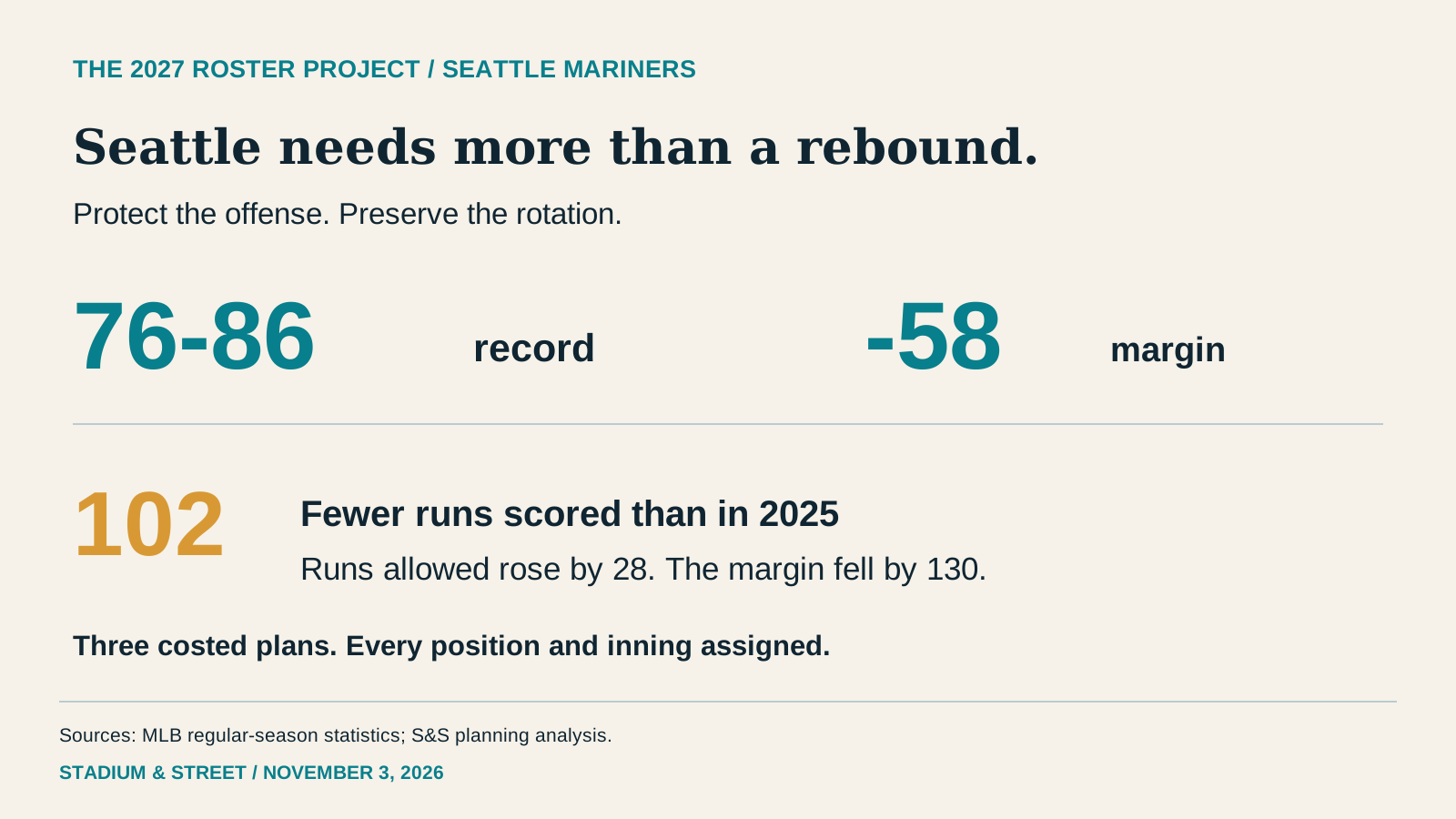
Seattle scored 102 fewer runs in 2026 than it did in 2025. Cal Raleigh, Josh Naylor and Julio Rodríguez remained central to the lineup, but their combined production no longer carried the same force. The Mariners finished 76-86 with a minus-58 run margin. A team built around a credible rotation now has to decide how much offense it is prepared to buy and how much recovery it is prepared to assume.
The preferred plan retains Randy Arozarena, adds Randal Grichuk for a defined right-handed corner role and pursues Steven Okert for 60 relief innings. The S&S negotiating ceilings are four years and $88-100 million for Arozarena, one year and $6-8 million for Grichuk, and two years and $16-20 million for Okert. A separate $6-8 million depth reserve brings annual additions to $42-51 million. These are proposed limits, not reported player demands.
That is a substantial recommendation. The existing-roster allocation bridge is $143.37-147.37 million, including arbitration estimates, a contingent Wisdom reserve and a pre-arbitration/callup pool. Plan A reaches $185.37-198.37 million, above the $166.94 million estimated 2026 payroll. There is no verified ownership commitment to fund that increase. If the club will not fund it, the alternative must change the baseball expectations as well as the budget.
Plan B substitutes Taylor Ward for Arozarena and costs $30-39 million in annual additions. Ward offers an on-base recovery case at a much lower commitment, but his 2026 power and contact record do not support presenting him as an equal offensive replacement. Plan C makes no acquisition, retains the $6-8 million reserve and assigns the missing work to named internal players. It exposes how much the club would be asking of young hitters and postoperative recoveries.
The priority is to protect the offense while preserving the rotation. Trading a productive starter simply to avoid financing a corner bat would exchange one clearly defined strength for another opening. A specific trade could overcome that objection, but no counterpart, return or savings is assumed in these plans.
The scale of the decline
| Season | Record | Runs for / against | Margin | OPS / ERA |
|---|---|---|---|---|
| 2024 | 85-77 | 676 / 607 | +69 | .687 / 3.49 |
| 2025 | 90-72 | 766 / 694 | +72 | .740 / 3.87 |
| 2026 | 76-86 | 664 / 722 | -58 | .693 / 4.20 |
The 2025 club scored 766 runs and allowed 694. In 2026 those totals became 664 and 722. The run margin deteriorated by 130. That is a broader explanation than a few late-inning losses: Seattle lost offensive volume and gave back some run prevention at the same time.
The home-run total fell from 238 to 182, a loss of 56. Strikeouts declined from 1,446 to 1,400 and walks increased from 544 to 557. The offense therefore did not simply collapse because it struck out more or stopped taking walks. It produced less damage while making some progress in those other categories. The distinction matters when deciding whether to buy another contact-oriented hitter or protect the lineup's remaining impact.
The completed game log gives Seattle a 26-25 record in one-run games and an 8-8 record in extra innings. These categories overlap. They supply no obvious case that an unusually bad close-game record alone explains a 76-win season. A better team needs a better distribution of underlying runs, not merely a different story about luck.
The 2024 club is also useful context. It allowed only 607 runs and won 85 games despite scoring 676. Returning to that level of prevention would require a large improvement from the 2026 baseline. It cannot be quietly assumed because several familiar pitchers remain.
Start with the roster that exists
The November 3 official 40-man snapshot contains 39 players. Arozarena, Ward, J.P. Crawford and Victor Robles are absent after free-agent transactions. Luis Castillo was traded to the White Sox in August. Their 2026 Seattle performances belong in the historical analysis; their future work does not belong in the retained roster unless a new agreement actually occurs.
The official option decisions preserve two important distinctions: Muñoz's exercised option is $9 million; Miller remains arbitration eligible after his option was declined. Robles became a free agent. The salary model includes Miller's arbitration estimate rather than his declined $6.075 million option, and includes the Muñoz escalator rather than the older $8 million base.
November 2 also brought the Isaac Mattson waiver claim, injury-list reinstatements and five outrights. The player-register appendix preserves those transactions. An offseason activation is an administrative roster move. It does not establish that a player has completed rehabilitation or can handle a full spring workload.
The people endpoint still associates some free agents with Seattle. The report resolves that display against the dated roster and transaction history instead of treating the team label as a current contract. The same rule applies to proposed external candidates whose last club remains visible in their profile.
The hitters who must carry the improvement
| Player / MLB ID | SEA PA | AVG / OBP / SLG | HR | BB / K |
|---|---|---|---|---|
| Julio Rodríguez / 677594 | 654 | .247 / .307 / .401 | 22 | 47 / 145 |
| Josh Naylor / 647304 | 650 | .261 / .317 / .350 | 10 | 45 / 79 |
| Cal Raleigh / 663728 | 530 | .182 / .296 / .368 | 23 | 72 / 164 |
| Cole Young / 702284 | 638 | .246 / .312 / .381 | 17 | 44 / 109 |
| Dominic Canzone / 686527 | 533 | .264 / .336 / .484 | 23 | 48 / 110 |
| Brendan Donovan / 680977 | 159 | .277 / .371 / .409 | 3 | 15 / 23 |
| Colt Emerson / 806068 | 241 | .190 / .246 / .335 | 8 | 15 / 83 |
| Luke Raley / 670042 | 287 | .225 / .284 / .439 | 15 | 15 / 93 |
| Jhonny Pereda / 640902 | 101 | .300 / .366 / .389 | 2 | 9 / 20 |
| Lazaro Montes / 703155 | 59 | .212 / .305 / .481 | 4 | 7 / 24 |
| Michael Arroyo / 703197 | 41 | .371 / .439 / .514 | 1 | 5 / 6 |
| Leo Rivas / 660844 | 148 | .153 / .267 / .194 | 0 | 16 / 42 |
| Randy Arozarena / 668227 | 670 | .281 / .381 / .484 | 26 | 68 / 145 |
| J.P. Crawford / 641487 | 489 | .221 / .335 / .352 | 14 | 64 / 97 |
| Taylor Ward / 621493 | 101 | .125 / .238 / .148 | 0 | 12 / 27 |
Raleigh's .664 OPS, Naylor's .667 and Rodríguez's .708 leave considerable room for improvement. They also describe the actual 2026 performances rather than a plan already accomplished. Their salaries and roles make them the first source of possible recovery, but purchasing around them remains necessary if the club wants to reduce its dependence on all three rebounding together.
Canzone deserves a larger place in that discussion. He produced an .820 OPS and 23 home runs in 533 Seattle plate appearances. He supplied more than a brief hot stretch or a theoretical future bat. The preferred plan protects 550 plate appearances across the corners and DH while avoiding the assumption that he must sit whenever a left-hander starts.
Young's 638 plate appearances produced a .693 OPS and 17 home runs. That is a useful development platform for a player whose prior major-league sample was much smaller. His everyday role is retained, with room for a shortstop contingency, but a major offensive leap is not included as free production in the spending plan.
Emerson's first 241 plate appearances yielded a .581 OPS. His long-term contract does not erase that evidence or the need to clear his wrist recovery. The plan provides a substantial opportunity and a named replacement branch. It does not make him the only player capable of covering shortstop.
Three seasons are more useful than one reputation
| Hitter | 2024 MLB PA / OPS | 2025 MLB PA / OPS | 2026 MLB PA / OPS |
|---|---|---|---|
| Julio Rodríguez | 613 / .734 | 710 / .798 | 654 / .708 |
| Josh Naylor | 633 / .776 | 604 / .815 | 650 / .667 |
| Cal Raleigh | 628 / .748 | 705 / .948 | 530 / .664 |
| Cole Young | No MLB season | 257 / .607 | 638 / .693 |
| Dominic Canzone | 188 / .652 | 269 / .839 | 533 / .820 |
| Brendan Donovan | 652 / .759 | 515 / .775 | 159 / .780 |
| Colt Emerson | No MLB season | No MLB season | 241 / .581 |
| Luke Raley | 455 / .783 | 219 / .630 | 287 / .723 |
| Jhonny Pereda | 40 / .481 | 78 / .658 | 101 / .755 |
| Lazaro Montes | No MLB season | No MLB season | 59 / .786 |
| Michael Arroyo | No MLB season | No MLB season | 41 / .953 |
| Leo Rivas | 86 / .607 | 111 / .720 | 148 / .461 |
| Randy Arozarena | 648 / .720 | 709 / .760 | 670 / .865 |
| J.P. Crawford | 451 / .625 | 654 / .722 | 489 / .687 |
| Taylor Ward | 663 / .749 | 663 / .792 | 607 / .670 |
Raleigh moved from a .748 OPS in 2024 to .948 in 2025 and .664 in 2026. The middle season establishes a much higher demonstrated ceiling, but repeating it is a demanding assumption. A budget should work with a productive catcher rather than require another historic power season to justify itself.
Rodríguez's corresponding line was .734, .798 and .708. Those are full major-league seasons of substantial playing time. A plan that treats a return to elite production as certain would be reaching beyond the recent record. Keeping his center-field role while demanding better offensive decisions is a sounder starting point than reassigning him solely to accommodate a cheaper acquisition.
Naylor's .776 and .815 seasons preceded the .667 downturn. The club reported Raleigh and Naylor underwent October surgeries and expected both ready for spring training. Those expectations justify a conditional plan for regular work. They do not establish the exact amount of power either will regain.
Donovan's .780 OPS came in only 159 plate appearances, all for Seattle in the saved MLB season record. A smaller sample can show that a hitter contributed when available without establishing that he will supply 600 plate appearances next year. His plan is 500, with additional third-base coverage explicitly assigned.
What contact quality does and does not support
| Batter / full MLB year | wOBA | xwOBA | SLG / xSLG |
|---|---|---|---|
| Julio Rodríguez | 0.310 | 0.334 | 0.401 / 0.439 |
| Josh Naylor | 0.297 | 0.310 | 0.350 / 0.381 |
| Cal Raleigh | 0.297 | 0.312 | 0.368 / 0.396 |
| Cole Young | 0.308 | 0.316 | 0.381 / 0.390 |
| Dominic Canzone | 0.354 | 0.359 | 0.484 / 0.491 |
| Brendan Donovan | 0.349 | 0.314 | 0.409 / 0.344 |
| Colt Emerson | 0.256 | 0.248 | 0.335 / 0.300 |
| Luke Raley | 0.313 | 0.342 | 0.439 / 0.486 |
| Jhonny Pereda | 0.338 | 0.345 | 0.389 / 0.398 |
| Lazaro Montes | 0.334 | 0.313 | 0.481 / 0.446 |
| Michael Arroyo | 0.414 | 0.375 | 0.514 / 0.433 |
| Leo Rivas | 0.225 | 0.243 | 0.194 / 0.229 |
| Randy Arozarena | 0.379 | 0.348 | 0.484 / 0.419 |
| J.P. Crawford | 0.312 | 0.319 | 0.352 / 0.359 |
| Taylor Ward | 0.312 | 0.334 | 0.311 / 0.360 |
Rodríguez's .334 expected wOBA exceeded his .310 actual wOBA. Naylor and Raleigh also had expected values above their actual outcomes. Those gaps support examining whether their results could improve, but the expected figures are descriptive models of recorded contact and events. They are not promises about health, future playing time or a new season's league environment.
Canzone's .354 wOBA and .359 expected wOBA tell a different story. His strong surface season was accompanied by a similarly strong modeled record. That makes him a reasonable player to protect from being crowded out by a low-impact purchase.
Arozarena's .379 actual wOBA was higher than his .348 expected figure. His .865 OPS should not be priced as a permanently established level. The retention argument rests on a useful everyday offensive floor, durability in the recent record and the difficulty of replacing his work, while the four-year ceiling acknowledges that the best observed season may not repeat.
Emerson's .256 wOBA and .248 expected value offer no contact-model shortcut around his difficult debut. His upside remains a development judgment. The club should give him a clear job, coaching continuity and manageable expectations rather than advertise his mere presence as an accomplished lineup upgrade.
Matchups without unnecessary platoons
| Batter / full MLB season | LHP PA / OPS | RHP PA / OPS |
|---|---|---|
| Julio Rodríguez | 207 / .676 | 447 / .723 |
| Josh Naylor | 223 / .682 | 427 / .660 |
| Cal Raleigh | 197 / .636 | 333 / .680 |
| Cole Young | 217 / .596 | 421 / .744 |
| Dominic Canzone | 145 / .847 | 388 / .808 |
| Brendan Donovan | 52 / .479 | 107 / .936 |
| Colt Emerson | 80 / .601 | 161 / .571 |
| Luke Raley | 27 / .392 | 260 / .757 |
| Jhonny Pereda | 35 / .993 | 66 / .641 |
| Leo Rivas | 49 / .289 | 99 / .544 |
| Randy Arozarena | 198 / .954 | 472 / .827 |
| J.P. Crawford | 161 / .675 | 328 / .691 |
| Taylor Ward | 194 / .698 | 413 / .658 |
Arozarena's .954 OPS against left-handed pitching and .827 against right-handed pitching support an everyday retention role. Grichuk is not being added to replace half of that job. He is being added to reduce less favorable corner matchups elsewhere and to provide a right-handed option at DH.
Raley had a .392 OPS in only 27 plate appearances against lefties and .757 in 260 against righties. The smaller side is too limited to establish his permanent ability, but it also supplies little reason to force that matchup while recovering from a disrupted season. Grichuk's role is most useful when it relieves Raley and selected DH assignments rather than taking Canzone out automatically.
Canzone hit for an .847 OPS against lefties in 145 plate appearances and .808 against righties in 388. These samples do not prove reverse-platoon talent. They do argue against assuming his left-handed bat requires a rigid platoon. His total workload should reflect the quality of his full season and the actual matchup evidence.
The plan assigns Grichuk 300 plate appearances, not an invented everyday vacancy. His 2026 full-season .880 OPS came in 280 plate appearances. The acquisition must earn its share of a crowded corner/DH mix and preserve enough work for Montes to develop.
Defense is a separate problem
| Fielder | 2024 OAA | 2025 OAA | 2026 OAA | 2026 opportunities |
|---|---|---|---|---|
| Julio Rodríguez | +8 | +11 | -3 | 408 |
| Cole Young | No row | -8 | -6 | 583 |
| Josh Naylor | +1 | +3 | +1 | 398 |
| Colt Emerson | No row | No row | -4 | 229 |
| Brendan Donovan | +4 | -1 | -3 | 113 |
| Dominic Canzone | +0 | -2 | +0 | 80 |
| Luke Raley | -6 | -2 | -6 | 158 |
| Leo Rivas | -3 | +1 | +0 | 149 |
| Lazaro Montes | No row | No row | +0 | 16 |
| Michael Arroyo | No row | No row | -2 | 18 |
| Grant McCray | -4 | +0 | -3 | 69 |
| Randy Arozarena | -6 | -5 | -5 | 329 |
| J.P. Crawford | +1 | -13 | -13 | 383 |
| Taylor Ward | +4 | +0 | -2 | 228 |
Rodríguez's OAA moved from plus-8 to plus-11 to minus-3. That three-year sequence argues against both extremes: his earlier range should not be discarded after one poor season, and his 2026 result should not be ignored because of his reputation. A planning range around neutral to moderately positive center-field performance is reasonable as an assumption, with downside if the latest season persists.
Young's minus-8 in his smaller 2025 sample and minus-6 in 2026 require work even though his defensive reputation and award recognition may differ. OAA measures one part of defense. It is not a ballot, a complete scouting report or a direct count of runs. The useful question is which plays, positioning decisions and exchanges can improve while he retains a demanding everyday assignment.
Crawford recorded minus-13 in each of the last two seasons. Retaining him simply to avoid the uncertainty around Emerson would therefore purchase a different risk rather than remove risk. Rivas provides another internal shortstop route, but his .461 OPS in 148 plate appearances imposes an offensive cost.
Arozarena's three-year OAA sequence was minus-6, minus-5 and minus-5. The preferred plan is buying his bat, not calling him a defensive cure. Raley's repeated negative totals also argue for controlling the number of innings in which the two weakest range bets share the corners. Late-game replacements can help, but a bench player cannot repair every inning already played.
For planning, use broad position-level ranges rather than summing single-year peaks. Rodríguez between roughly 0 and plus-8 OAA, Young between minus-6 and 0, and Arozarena between minus-7 and minus-2 are judgment ranges, not confidence intervals. A 20-40 run improvement in total prevention would require pitching, catching and team defense to contribute together. It is not obtained by relabeling those OAA ranges as runs.
Catching: protect Raleigh without buying the same job twice
| Catcher | 2026 SEA catching IP | Full MLB framing | Full MLB catching value |
|---|---|---|---|
| Cal Raleigh | 894.0 | -4.31 | -5.05 |
| Jhonny Pereda | 249.1 | -1.65 | Unknown |
| Willie MacIver | No SEA sample | Unknown | Unknown |
| Carson Kelly | No SEA sample | +1.02 | -1.03 |
| Ryan Jeffers | No SEA sample | -1.31 | -2.24 |
Raleigh caught 894 innings in 2026. The saved Statcast framing measure was minus-4.31 runs and the total catching value minus-5.05. A return to regular availability would matter, but the recent defensive record does not justify assuming every additional inning is an automatic run-prevention gain.
Pereda's .755 OPS came in 101 major-league plate appearances. His Triple-A sample was stronger and larger, but neither should be treated as proof of an established everyday catcher. The plan gives him 200 plate appearances and 37 starts behind the plate, with MacIver carrying a smaller depth assignment.
Kelly and Jeffers are useful comparisons. Kelly's .712 OPS and 425 plate appearances establish a more experienced shared workload, while Jeffers produced an .814 OPS in 369. Buying either would require subtracting work from Pereda, Raleigh's DH opportunities or another hitter. Jeffers also carries a qualifying-offer condition in the current market. Neither is included in the main budget.
If Raleigh's recovery changes materially, the catching decision becomes more urgent than the Grichuk purchase. The plan should be rebuilt at that point. Spending the reserve does not itself create a catcher, and a healthy position-player lineup cannot compensate for a missing everyday receiver by arithmetic alone.
Keep the rotation intact
| Pitcher / MLB ID | GS / SEA IP | ERA / full MLB xERA | K / BB / HR | Planning treatment |
|---|---|---|---|---|
| Logan Gilbert / 669302 | 32 / 186.0 | 3.73 / 3.63 | 205 / 49 / 29 | Primary starter; 185 IP |
| George Kirby / 669923 | 30 / 174.2 | 4.33 / 4.21 | 148 / 47 / 22 | Retain; 175 IP |
| Bryan Woo / 693433 | 30 / 173.0 | 4.01 / 3.68 | 175 / 39 / 18 | Retain; 175 IP |
| Bryce Miller / 682243 | 21 / 118.2 | 4.17 / 3.70 | 119 / 38 / 21 | Arbitration eligible; 135 IP |
| Emerson Hancock / 676106 | 25 / 138.2 | 3.57 / 4.01 | 126 / 32 / 20 | Readiness gate; 120 IP |
| Kade Anderson / 807739 | 7 / 35.2 | 3.79 / 3.89 | 32 / 9 / 4 | Development rotation; 90 MLB IP |
| Logan Evans / 688138 | 0 / 0 | No SEA sample / No row | 0 / 0 / 0 | Recovery only; zero main-plan IP |
| Ryan Sloan / 815549 | 0 / 0 | No SEA sample / No row | 0 / 0 / 0 | 25 late-season IP after promotion |
| Luis Castillo / 622491 | 17 / 99.2 | 5.06 / 5.02 | 86 / 32 / 16 | White Sox departure; no SEA workload |
Gilbert's 186 innings, 205 strikeouts and 49 walks provide the clearest established foundation. Woo supplied 173 innings with 175 strikeouts and 39 walks. Their expected ERAs, 3.63 and 3.68 respectively, support the view that this is still a meaningful organizational strength rather than a reputation surviving on old seasons.
Kirby's 4.33 ERA and 4.21 expected ERA were less impressive than his best work, but 174 2/3 innings remain valuable. The 47 walks matter when comparing his actual 2026 command with the particularly low-walk reputation he built earlier. The report keeps him in the rotation without pricing an automatic return to his best command season.
Miller's 4.17 ERA and 3.70 expected ERA support keeping him in the competition at the arbitration estimate. Declining his option was not a departure. The plan gives him 25 starts and 135 innings, with a larger assignment available if Hancock or the younger starters cannot cover their shares.
Hancock's 3.57 ERA came with a 4.01 expected ERA. His 138 2/3 innings establish useful recent capacity, but his late-season injury makes the proposed 120 innings conditional. Anderson's 35 2/3 major-league innings are an encouraging beginning. They are not sufficient evidence to assign him 180 without a development and recovery plan.
Relief needs depth more than a headline
| Pitcher | SEA IP | ERA / full MLB xERA | K / BB | Treatment |
|---|---|---|---|---|
| Andrés Muñoz | 57.1 | 4.24 / 3.27 | 89 / 24 | Option exercised; readiness gate |
| Seranthony Domínguez | 23.2 | 3.04 / 3.65 | 18 / 8 | Retained contract; full season differs |
| José A. Ferrer | 64.2 | 4.18 / 4.09 | 54 / 20 | Retain |
| Gabe Speier | 46.0 | 2.93 / 3.70 | 45 / 15 | Retain; xERA above ERA |
| Eduard Bazardo | 67.1 | 4.01 / 4.95 | 70 / 25 | Contact-quality caution |
| Matt Brash | 16.2 | 0.54 / 4.24 | 15 / 6 | Only 25 proposed IP after readiness |
| Cooper Criswell | 40.2 | 3.32 / 3.81 | 31 / 16 | Bulk depth |
| Carlos Vargas | 19.0 | 4.74 / 4.35 | 17 / 4 | Depth |
| Cole Wilcox | 27.0 | 4.00 / 5.51 | 28 / 17 | Walks limit role |
| Isaac Mattson | 0 | No SEA sample / 6.23 | 0 / 0 | Waiver claim; external 2026 sample |
| Troy Taylor | 3.0 | 9.00 / 3.87 | 2 / 2 | Small MLB sample; AAA context |
| Michael Rucker | 43.2 | 5.56 / 3.92 | 50 / 17 | Outside preferred 535-IP plan |
Muñoz's 4.24 ERA and 3.27 expected ERA describe a season with a meaningful gap between surface results and the contact model. His 89 strikeouts in 57 1/3 innings preserve a strong bat-missing case. The club can reasonably retain him while reducing the number of other bullpen jobs that depend on optimistic interpretation.
Domínguez's Seattle-only 3.04 ERA in 23 2/3 innings is not his full-season record. The full major-league ERA was 3.63 and expected ERA 3.65. That distinction makes a dependable later-inning role more defensible than a claim that Seattle acquired a pitcher who had been at 3.04 all year.
Bazardo's 4.01 ERA was accompanied by a 4.95 expected ERA. Brash's 0.54 ERA came in a very small major-league workload and a much less favorable 4.24 expected figure. The main plan assigns Brash only 25 innings after readiness, and provides a replacement branch. It does not use his ERA to fill an entire leverage role.
Okert's proposed 60 innings would replace work otherwise spread among Ferrer, Speier, Criswell, Garcia, Alford and Rucker. His 67 2/3 innings, 68 strikeouts and 14 walks offer a specific command case. His 3.13 expected ERA is less spectacular than the 2.13 actual figure, but still supports a meaningful acquisition. A September hamstring transaction remains part of the medical review rather than a basis for assuming uninterrupted availability.
The farm can help without being assigned miracles
| Player / MLB ID | 2026 level and sample | Readiness decision |
|---|---|---|
| Kade Anderson / 807739 | AA: 93.1 IP, 1.06 ERA; 135 K / 13 BB | Expand carefully after MLB debut |
| Ryan Sloan / 815549 | AA: 101.1 IP, 3.73 ERA; 128 K / 16 BB | 25 late-season MLB IP only after selection |
| Lazaro Montes / 703155 | AAA: 203 PA, .940 OPS, 13 HR; 25 BB / 63 K | 250 MLB PA; preserve RF/DH opportunity |
| Lazaro Montes / 703155 | AA: 339 PA, .919 OPS, 25 HR; 54 BB / 103 K | Separate Double-A sample |
| Michael Arroyo / 703197 | AAA: 235 PA, .843 OPS, 8 HR; 19 BB / 38 K | 150 PA after recovery; not an Opening Day solution |
| Michael Arroyo / 703197 | AA: 297 PA, .820 OPS, 10 HR; 24 BB / 49 K | Separate Double-A sample |
| Brock Rodden / 801126 | AAA: 410 PA, .841 OPS, 19 HR; 43 BB / 93 K | Injury gate; no main-plan PA |
| Ryan Bliss / 669208 | AAA: 580 PA, .705 OPS, 8 HR; 47 BB / 114 K | 80 PA utility depth |
| Brennen Davis / 680695 | AAA: 205 PA, .888 OPS, 9 HR; 24 BB / 46 K | Health and CF defense test; no main-plan PA |
| Nick Garcia / 694356 | AAA: 56.0 IP, 2.57 ERA; 66 K / 23 BB | 30 relief IP after selection |
| Peyton Alford / 688230 | AAA: 42.1 IP, 3.83 ERA; 50 K / 25 BB | 30 relief IP after selection |
| Jonny Farmelo / 806071 | AA: 214 PA, .713 OPS, 4 HR; 35 BB / 60 K | Development reserve; no MLB quota |
Anderson's 93 1/3 Double-A innings included 135 strikeouts and 13 walks. Sloan's 101 1/3 at the same level included 128 and 16. Those command records justify serious consideration, while their different major-league experience argues for different initial assignments. Anderson receives 90 proposed MLB innings; Sloan receives 25 after promotion and selection.
Montes' .940 Triple-A OPS in 203 plate appearances followed a .919 Double-A OPS in 339. The power merits a real opportunity. His 63 Triple-A strikeouts also show why a large role should come with a development plan. Assigning him 250 major-league plate appearances in Plan A protects meaningful work without making him the sole replacement for a departing star.
Arroyo is expected back in game action in April after elbow surgery, so his 150 plate appearances begin only after recovery. His 41 major-league plate appearances and .953 OPS cannot carry a full-season projection. Plan C asks him for substantially more later work and is correspondingly more exposed if the timetable slips.
Garcia and Alford are named relief alternatives because their actual Triple-A records are available, not because a generic farm-system label supplies innings. Garcia walked 23 in 56 innings; Alford walked 25 in 42 1/3. Both require selection and a major-league performance test. Their inclusion makes the fallback auditable while leaving its risk visible.
Test the market by the job
| Candidate / MLB ID | Full 2026 MLB evidence | S&S ceiling / decision |
|---|---|---|
| Randy Arozarena / 668227 | 670 PA,.865 OPS,26 HR; 0.379/0.348 wOBA/xwOBA | A: retain,4 years/$88-100M; 600 PA; 125 LF/20 DH starts |
| Taylor Ward / 621493 | 607 PA,.670 OPS,7 HR; 0.312/0.334 wOBA/xwOBA | B: 2 years/$20-26M; 550 PA; 115 LF/20 DH starts |
| Randal Grichuk / 545341 | 280 PA,.880 OPS,15 HR; 0.370/0.335 wOBA/xwOBA | A/B: 1 year/$6-8M; 300 PA; 45 RF/20 DH starts |
| Steven Okert / 595345 | 67.2 IP,2.13 ERA,3.13 xERA; 68 K/14 BB | A/B: 2 years/$16-20M; 60 relief IP |
| Trent Grisham / 663757 | 484 PA,.703 OPS,18 HR; 0.311/0.337 wOBA/xwOBA | Different CF route; 2 years/$18-22M evaluated, not funded |
| J.P. Crawford / 641487 | 489 PA,.687 OPS,14 HR; 0.312/0.319 wOBA/xwOBA | SS retention inquiry only; repeated negative OAA limits price |
| Ha-Seong Kim / 673490 | 147 PA,.359 OPS,0 HR; 0.180/0.222 wOBA/xwOBA | Free agent; poor limited 2026 sample; no funded assumption |
| Carson Kelly / 608348 | 425 PA,.712 OPS,10 HR; 0.320/0.311 wOBA/xwOBA | Catcher comparison; no funded additional starting job |
| Ryan Jeffers / 680777 | 369 PA,.814 OPS,14 HR; 0.353/0.344 wOBA/xwOBA | QO-linked catcher alternative; not funded |
Arozarena is a retention proposal for 600 plate appearances, 125 left-field starts and 20 at DH. The club would be preserving demonstrated offensive work while accepting a known defensive limitation and a multi-year commitment. The proposed four-year ceiling deliberately stops short of treating his best season as the only possible outcome.
Ward is a different purchase. His full 607-PA season produced a .670 OPS and seven home runs. His 101 Seattle plate appearances were worse, with a .386 OPS, but using only that small post-trade sample would conceal the larger evidence. The case for a two-year $20-26 million ceiling rests on a partial rebound and on-base value. It does not solve the damage problem as convincingly as retaining Arozarena.
Grichuk's .370 wOBA exceeded his .335 expected value. He deserves a role and a price tied to the narrower job, not a full-time contract based only on the .880 OPS. Okert's role is similarly explicit: 60 innings with command value, not the purchase of a guarantee that every close game improves.
Grisham is the most distinct outfield alternative. His .703 OPS and .337 expected wOBA offer a different blend, but a center-field purchase would either displace Rodríguez or require a carefully tested corner assignment. Seattle's role fit is less direct than that of a club with an open center-field job. No Grisham production is credited in Plans A, B or C.
The cross-club acquisition test
The repeated-name review changes the recommendation. In the Angels package, Kelly fills a 400-PA catching job and Grisham can replace a large block of uncertain center-field work. Seattle already assigns Raleigh 550 plate appearances and Rodríguez 650. Importing those purchases here without removing existing work would solve a vacancy Seattle does not have.
Grichuk was evaluated for roughly 260 plate appearances in the Cubs package at $6-8 million and a narrower alternative role in other reviews. Seattle's 300-PA proposal uses the same price range because the workload is comparable and his principal value remains a right-handed corner/DH assignment. The earlier Phillies $7-9 million alternative replaced a larger part of the Suzuki plan. These are different ceilings reflecting different jobs, not competing reports of his asking price.
Okert's $8-10 million annual ceiling matches the Twins inquiry because both proposals buy approximately 60 innings. Seattle's displaced innings are explicitly identified in the fallback table. There is no reason to invent a lower price merely because another club already appeared in the series. These independently modeled rosters cannot all acquire the same player.
Ward has been considered elsewhere, including as an insufficient solution to Cleveland's particular power needs. Seattle reaches a similar conclusion about his limitations but retains him as a cheaper Plan B because preserving some established outfield plate appearances has value if Arozarena leaves. The plan's lower spending and lower offensive confidence are shown together.
All three funded candidates are free agents in the dated transaction evidence. No outgoing prospect package is assumed. Retaining Arozarena also forgoes the potential compensation that could arise if he rejects the qualifying offer and signs elsewhere. No compensation pick is counted as an asset already received.
Build the payroll from identified obligations
| Player / MLB ID | 2027 allocation | Basis |
|---|---|---|
| Josh Naylor / 647304 | $17.300000M | Salary allocation; signed through 2030 |
| Cal Raleigh / 663728 | $13.666667M | Salary plus allocated bonus; later salary rises |
| Julio Rodríguez / 677594 | $20.185714M | Salary plus allocated bonus; conditional later options separate |
| Colt Emerson / 806068 | $3.000000M | 2027 allocation; long-term extension |
| Seranthony Domínguez / 622554 | $10.500000M | 2027 salary allocation; 2028 mutual option not exercised |
| Andrés Muñoz / 662253 | $9.000000M | 2027 option exercised including $1M escalator |
| TOTAL | $73.652381M | Salary/bonus allocation, not CBT or cash schedule |
| Player | Estimate,$M | Treatment |
|---|---|---|
| Logan Gilbert | 15.40 | Unsigned retained-roster estimate |
| Brendan Donovan | 6.10 | Unsigned retained-roster estimate |
| Gabe Speier | 3.30 | Unsigned retained-roster estimate |
| George Kirby | 9.80 | Unsigned retained-roster estimate |
| Matt Brash | 1.80 | Unsigned retained-roster estimate |
| Luke Raley | 3.10 | Unsigned retained-roster estimate |
| Bryce Miller | 3.90 | Unsigned retained-roster estimate |
| Bryan Woo | 5.20 | Unsigned retained-roster estimate |
| Eduard Bazardo | 1.50 | Unsigned retained-roster estimate |
| Jose A. Ferrer | 1.60 | Unsigned retained-roster estimate |
| Michael Rucker | 0.80 | Unsigned retained-roster estimate |
| Dominic Canzone | 3.00 | Unsigned retained-roster estimate |
| Cooper Criswell | 0.90 | Unsigned retained-roster estimate |
| Carlos Vargas | 0.80 | Unsigned retained-roster estimate |
| TOTAL | 57.20 | 14 players; Wisdom treated separately |
The six salary/bonus allocation rows total $73.652381 million. The 14 retained-roster arbitration estimates total $57.2 million. These are separate calculations: the first contains existing contracts and an exercised option, while the second remains an estimate of unsigned salaries.
Wisdom's $1.1 million estimate is kept as a separate contingent reserve after his November 2 outright. It is not quietly counted as a current 40-man arbitration salary, and it is not erased as a guaranteed saving. The final decision and any new agreement must determine the actual treatment. A verified departure without further obligation would reduce the modeled envelope by that amount.
The other $1.415 million combines the listed Castillo signing-bonus allocation, the Domínguez adjustment and the Robles/Miller buyouts. This is an allocation model, not a bank-cash forecast. Salary allocation, bonus timing and competitive-balance-tax accounting have different definitions, particularly after trades and multi-year agreements.
The pre-arbitration, minor-league and callup pool is $10-14 million. That is a planning range rather than an assertion that the 2026 minimum salary or labor rules will automatically govern 2027. Future benefits, tax treatment and labor terms must be checked under the actual next-season framework.
Three budgets with different consequences
| Component | Annual allocation | Definition |
|---|---|---|
| Six guaranteed/option rows | $73.652381M | Includes Muñoz $9M exercised option |
| 14 arbitration estimates | $57.20M | No non-tender savings assumed |
| Other allocations | $1.415M | Castillo 1.4 minus Domínguez 0.5 plus Robles 0.5 and Miller 0.015 |
| Wisdom decision reserve | $1.1M | Outrighted Nov 2; retained as contingent reserve, not guaranteed arbitration |
| Pre-arb, minors, callups | $10-14M | Planning pool; no assumed 2027 minimum |
| Existing-roster envelope | $143.37-147.37M | S&S allocation bridge; excludes new acquisitions |
| RosterResource 2027 estimate | $123.267381M | Add Muñoz 9, Wisdom 1.1 and pre-arb 10-14 to reconcile the S&S bridge |
| RosterResource 2026 estimate | $166.939483M | Historical comparison, not ownership-approved 2027 budget |
| Plan | Annual additions | Total allocation | New commitment |
|---|---|---|---|
| A: Arozarena/Grichuk/Okert | $42-51M | $185.37-198.37M | $116-136M |
| B: Ward/Grichuk/Okert | $30-39M | $173.37-186.37M | $48-62M |
| C: Internal roster | $6-8M | $149.37-155.37M | $6-8M |
Plan A adds $22-25 million annually for Arozarena, $6-8 million for Grichuk, $8-10 million for Okert and a $6-8 million reserve. Its new commitment column counts four years of Arozarena, two of Okert and the one-year components once. That produces $116-136 million, rather than mistaking annual additions for the entire contractual exposure.
Plan B replaces Arozarena's four-year proposal with two years and $20-26 million for Ward. Its annual additions fall to $30-39 million and its new commitments to $48-62 million. The $173.37-186.37 million total allocation still requires meaningful resources. The cheaper path is not evidence that ownership will approve it or that Ward will recover his earlier production.
Plan C totals $149.37-155.37 million including the reserve. It can be described as financially smaller and development-heavy. It should not be sold as the same competitive proposition. More plate appearances move to Montes, Arroyo and the existing corners, and more bullpen innings move to less established alternatives.
The bridge reconciles to RosterResource's $123.267381 million displayed 2027 estimate. Add the exercised $9 million Muñoz option, the $1.1 million contingent Wisdom reserve and the $10-14 million pre-arbitration/callup pool to reach $143.367381-147.367381 million. The displayed table excludes option totals under its stated convention and shows no future pre-arbitration pool. Using its headline alone would understate this particular plan's obligations.
Qualifying offers and the price of waiting
Arozarena has a $23.15 million qualifying offer with a November 17 decision deadline. If he accepts, replace the proposed four-year contract with that one-year obligation and retain the same 600-PA role pending health and performance review. Grichuk, Okert and the reserve then bring annual additions to $43.15-49.15 million and new commitments to $51.15-59.15 million.
If he rejects and signs elsewhere, Seattle must move to a separately funded alternative. It cannot keep his planned plate appearances while booking compensation or announce the cheaper plan before knowing whether its candidate can actually be signed. The transaction and workload ledgers have to move together.
The four-year Arozarena ceiling is a stopping rule, not a prediction of the winning bid. Beyond it, the expected marginal benefit must justify a new assessment of age, defense, future payroll steps and the blocked opportunities. Raising a number merely because the first choice signed elsewhere would defeat the purpose of having a ceiling.
The same discipline applies to the reserve. A $6-8 million allowance is useful financial flexibility, but it supplies zero named plate appearances or innings until a player and role are identified. It cannot be used as an invisible fourth acquisition that makes every optimistic scenario work.
Allocate every plate appearance
| Hitter | PA | Condition |
|---|---|---|
| Julio Rodríguez | 650 | Health, selection and performance gates |
| Josh Naylor | 550 | Health, selection and performance gates |
| Cal Raleigh | 550 | Health, selection and performance gates |
| Cole Young | 600 | Health, selection and performance gates |
| Dominic Canzone | 550 | Health, selection and performance gates |
| Brendan Donovan | 500 | Health, selection and performance gates |
| Colt Emerson | 450 | Health, selection and performance gates |
| Randy Arozarena | 600 | Proposed free-agent agreement |
| Luke Raley | 350 | Health, selection and performance gates |
| Randal Grichuk | 300 | Proposed free-agent agreement |
| Jhonny Pereda | 200 | Health, selection and performance gates |
| Lazaro Montes | 250 | Health, selection and performance gates |
| Michael Arroyo | 150 | After documented recovery; not Opening Day |
| Leo Rivas | 200 | Health, selection and performance gates |
| Grant McCray | 100 | Health, selection and performance gates |
| Ryan Bliss | 80 | Health, selection and performance gates |
| Michael Toglia | 80 | Health, selection and performance gates |
| Willie MacIver | 40 | Health, selection and performance gates |
| TOTAL | 6200 | Season allocation, not simultaneous active roster |
The 6,200-PA budget covers a season, not one simultaneous active roster. It includes injury replacements, promotions and a small number of appearances for depth players. The initial position-player group can be built around Raleigh, Pereda, Naylor, Young, Emerson, Donovan, Arozarena, Rodríguez, Canzone, Raley, Grichuk, Rivas and McCray. Every choice remains subject to actual readiness and roster eligibility.
Montes' 250 and Arroyo's 150 require opportunities to open during the season. They are not promised everyday jobs layered on top of 13 healthy position players. If the veterans remain healthy and productive, the club should preserve development time in the minors rather than leave young hitters idle for the sake of meeting a forecast.
The Plan B substitution removes Arozarena's 600, inserts Ward's 550 and adds 50 to Arroyo after recovery. Plan C removes Arozarena and Grichuk's combined 900. Canzone gains 150, Montes 200, Raley 100, Arroyo 150, McCray 100, Bliss 100, Toglia 50 and Brennen Davis 50. Those changes sum to 900 and identify the increased developmental and medical burden.
The no-acquisition lineup therefore has a particularly important contingency: if Arroyo is delayed further, the rest of the outfield must absorb even more work or the club must identify a real purchase. The plan does not solve that problem by treating April as a guaranteed major-league activation date.
Cover the field as well as the batting order
| Pos. | 162-start allocation | Condition |
|---|---|---|
| C | Raleigh 115; Pereda 37; MacIver 10 | Seasonal assignment; health and development conditions apply |
| 1B | Naylor 125; Raley 20; Toglia 17 | Seasonal assignment; health and development conditions apply |
| 2B | Young 140; Bliss 15; Donovan 7 | Seasonal assignment; health and development conditions apply |
| 3B | Donovan 110; Emerson 25; Rivas 17; Bliss 10 | Seasonal assignment; health and development conditions apply |
| SS | Emerson 90; Rivas 55; Young 17 | Seasonal assignment; health and development conditions apply |
| LF | Arozarena 125; Canzone 20; Arroyo 17 | Seasonal assignment; health and development conditions apply |
| CF | Rodríguez 145; McCray 17 | Seasonal assignment; health and development conditions apply |
| RF | Raley 50; Canzone 60; Grichuk 45; Montes 7 | Seasonal assignment; health and development conditions apply |
| DH | Canzone 35; Arozarena 20; Naylor 15; Raleigh 15; Grichuk 20; Montes 50; Arroyo 7 | Seasonal assignment; health and development conditions apply |
| C: C | Raleigh 115; Pereda 37; MacIver 10 | No acquisition. Extra work follows documented readiness. |
| C: 1B | Naylor 125; Raley 20; Toglia 17 | No acquisition. Extra work follows documented readiness. |
| C: 2B | Young 130; Bliss 25; Donovan 7 | No acquisition. Extra work follows documented readiness. |
| C: 3B | Donovan 100; Emerson 25; Rivas 17; Bliss 20 | No acquisition. Extra work follows documented readiness. |
| C: SS | Emerson 90; Rivas 55; Young 17 | No acquisition. Extra work follows documented readiness. |
| C: LF | Canzone 80; Arroyo 50; McCray 20; Davis 12 | No acquisition. Extra work follows documented readiness. |
| C: CF | Rodríguez 145; McCray 17 | No acquisition. Extra work follows documented readiness. |
| C: RF | Raley 80; Montes 60; Canzone 22 | No acquisition. Extra work follows documented readiness. |
| C: DH | Montes 55; Canzone 40; Naylor 15; Raleigh 15; Arroyo 20; Toglia 17 | No acquisition. Extra work follows documented readiness. |
The table gives each position 162 starts in Plan A and in the internal Plan C. No hitter receives more than 162 total starts. That prevents the common paper-roster error in which the same utility player is expected to cover two positions every day while also serving as a full-time designated hitter.
The preferred plan gives Montes 50 DH starts and seven in right field, with additional pinch-hitting and replacement appearances making up his seasonal total. Grichuk gets 45 in right and 20 at DH. This is enough work to define their jobs while preserving Canzone's meaningful role. It also shows why a second expensive DH would be difficult to fit.
Plan C moves Canzone primarily into left and right field, increases Montes' right-field and DH starts, and gives Arroyo additional left-field work after recovery. Those moves are not defensively neutral. They increase the importance of route development, late-game coverage and Rodríguez returning to a more favorable range profile.
A small amount of Young's work moves to shortstop in these plans. That is a conditional versatility assignment, not an established defensive projection at that position. If the club cannot support it, Rivas must absorb the starts or a different infielder must be acquired with an explicit subtraction elsewhere.
Fund the innings and name the replacements
| Pitcher | GS / IP | Condition |
|---|---|---|
| Logan Gilbert | 32 / 185 | Health, workload and performance review |
| George Kirby | 30 / 175 | Health, workload and performance review |
| Bryan Woo | 30 / 175 | Health, workload and performance review |
| Bryce Miller | 25 / 135 | Health, workload and performance review |
| Emerson Hancock | 22 / 120 | Health, workload and performance review |
| Kade Anderson | 18 / 90 | Health, workload and performance review |
| Ryan Sloan | 5 / 25 | Late-season promotion and 40-man selection |
| TOTAL | 162 / 905 | No main-plan innings assigned to Logan Evans |
| Pitcher | IP | Condition |
|---|---|---|
| Andrés Muñoz | 60 | After clinical readiness |
| Seranthony Domínguez | 55 | Health, roster and performance gate |
| José A. Ferrer | 50 | Health, roster and performance gate |
| Gabe Speier | 45 | Health, roster and performance gate |
| Eduard Bazardo | 45 | Health, roster and performance gate |
| Matt Brash | 25 | After clinical readiness |
| Steven Okert | 60 | Proposed acquisition |
| Cooper Criswell | 50 | Health, roster and performance gate |
| Carlos Vargas | 25 | Health, roster and performance gate |
| Cole Wilcox | 25 | Health, roster and performance gate |
| Isaac Mattson | 20 | Health, roster and performance gate |
| Troy Taylor | 15 | Health, roster and performance gate |
| Nick Garcia | 30 | 40-man selection required |
| Peyton Alford | 30 | 40-man selection required |
| TOTAL | 535 | 905 starter innings plus relief =1,440 |
| Change from A | Removed workload | Named replacement |
|---|---|---|
| B: Ward replaces Arozarena | 600 PA; 125 LF/20 DH | Ward 550 PA,115 LF/20 DH; Arroyo +50 PA/+10 LF after recovery |
| C: no Arozarena or Grichuk | 900 PA; 125 LF/45 RF/40 DH | Canzone +150 PA, Montes +200, Raley +100, Arroyo +150, McCray +100, Bliss +100, Toglia +50, Davis +50; position map rebuilt below |
| C: no Okert | 60 relief IP | Ferrer +10, Speier +10, Criswell +10, Garcia +10, Alford +10, Rucker 10 |
| No Brash | 25 relief IP | Garcia +10, Alford +10, Rucker +5 |
| No Hancock | 22 GS/120 IP | Miller +5/25, Anderson +8/40, Sloan +9/55 after readiness and promotion; revised SP/RP roles unchanged |
| No Sloan promotion | 5 GS/25 IP | Miller +3/15, Hancock +2/10 only if ready |
| No Arroyo | 150 PA; 17 LF/7 DH | Montes +75 PA/+7 DH; McCray +50 PA/+12 LF; Bliss +25 PA with Donovan moving 5 LF starts |
| No Emerson | 450 PA; 90 SS/25 3B | Rivas +300 PA/+90 SS; Donovan +50 PA/+25 3B; Bliss +100 PA and takes Rivas 17 3B starts |
| Multiple simultaneous failures | Rebuild combined scenario | Isolated branches are not automatically additive; funded reserve supplies no unnamed production |
The main budget allocates 162 starts and 905 starter innings, followed by 535 relief innings. That is 1,440 total innings, an approximate seasonal planning target rather than a prediction of the exact number required. Weather, extra innings, walk-off road losses and workload patterns change the actual total.
The rotation has six credible candidates before Sloan's proposed late-season contribution. A five-man Opening Day rotation does not mean the sixth pitcher disappears from the season. Anderson's work can arrive through performance decisions, injuries and a development schedule, but the club must confirm roster-option eligibility rather than assume it can freely shuttle any pitcher.
Garcia and Alford's combined 60 relief innings are a notable execution risk because neither is on the current major-league roster. The planned free-agent signings and those selections require space. The 39-player roster has only one immediate opening, so the plan needs actual roster decisions before those additions occur. No specific player's release is presumed or used as an automatic saving.
The replacement branches retain total innings and plate appearances. They are isolated tests. If Hancock and Sloan are both unavailable, the Hancock branch cannot simultaneously rely on Sloan. That combined failure requires a fresh allocation, possible reserve spending and a lower-confidence competitive outlook.
What a better team would have to change
| Illustrative change from 2026 | RS / RA | Margin | 162-game simple run-ratio wins |
|---|---|---|---|
| Unchanged runs | 664 / 722 | -58 | 74.2 |
| Score 40 more; same prevention | 704 / 722 | -18 | 79.0 |
| Score 60 more; prevent 20 | 724 / 702 | +22 | 83.5 |
| Score 80 more; prevent 40 | 744 / 682 | +62 | 88.0 |
| Score 30 fewer; allow 20 more | 634 / 742 | -108 | 68.4 |
These run scenarios use 162 multiplied by runs scored squared divided by the sum of runs scored squared and runs allowed squared. The formula is deliberately simple and is not a forecast, playoff probability or betting model. It shows the scale of improvement required when starting from 664 runs scored and 722 allowed.
Adding 40 runs without improving prevention does not create the same team as adding 60 and preventing 20. The expensive plan should be evaluated on whether its actual changes can move both sides of that relationship. Retaining Arozarena mainly prevents a new offensive hole; it does not automatically add his entire 2026 production to a baseline that already includes it.
Likewise, a healthy Raleigh or Naylor should be measured against the production already present in 2026. Their full future totals are not pure incremental gains. Defensive improvement, relief changes and better availability can contribute, but counting the same prevented run once under pitching and again under fielding would exaggerate the case.
The strongest countercase to Plan A is that it spends heavily to preserve a 76-win club's most expensive assumptions. That objection is serious. The answer is not an invented projection. It is that the roster contains several established contributors whose 2026 output fell together, while losing its best current hitter would make recovery substantially harder. The recommendation buys a credible platform for improvement and accepts that the result remains uncertain.
Leadership and the order of decisions
Seattle announced Jason Kanzler as manager on November 3. The roster task now includes turning a development-oriented choice into clear major-league roles. No communication style, clubhouse effect or future tactical result can be inferred from the appointment alone.
The first decisions concern medical readiness, Arozarena's market and the payroll level ownership will support. The next concern which young hitters can receive regular work and how the shortstop/third-base assignments interact. A relief purchase should then reduce named weak innings, rather than become a substitute for resolving the larger offense.
Keeping Gilbert, Kirby, Woo and Miller together is the default recommendation. If a trade proposal arrives, compare the incoming hitter's exact playing time and contractual value with the starter innings being removed, the replacement's likely cost and the prospects included. The current plan assumes no trade because no verified counterpart has supplied those terms.
Seattle has enough existing talent to justify another serious attempt. The difficult part is financing an offense that works when one or two recoveries disappoint. The preferred plan confronts that price; the alternatives show where the risk moves when the club chooses to spend less.
Player register, definitions and sources
| Player / MLB ID | Position | Snapshot treatment |
|---|---|---|
| Andrés Muñoz / 662253 | P | Current 40-man; health separate |
| Brendan Donovan / 680977 | 3B | Current 40-man; health separate |
| Brennen Davis / 680695 | CF | Current 40-man; health separate |
| Brock Rodden / 801126 | SS | Current 40-man; health separate |
| Bryan Woo / 693433 | P | Current 40-man; health separate |
| Bryce Miller / 682243 | P | Current 40-man; health separate |
| Cal Raleigh / 663728 | C | Current 40-man; health separate |
| Carlos Vargas / 672841 | P | Current 40-man; health separate |
| Cole Wilcox / 677961 | P | Current 40-man; health separate |
| Cole Young / 702284 | 2B | Current 40-man; health separate |
| Colt Emerson / 806068 | SS | Current 40-man; health separate |
| Cooper Criswell / 681867 | P | Current 40-man; health separate |
| Dominic Canzone / 686527 | DH | Current 40-man; health separate |
| Eduard Bazardo / 660825 | P | Current 40-man; health separate |
| Emerson Hancock / 676106 | P | Current 40-man; health separate |
| Gabe Speier / 642100 | P | Current 40-man; health separate |
| George Kirby / 669923 | P | Current 40-man; health separate |
| Grant McCray / 687529 | CF | Current 40-man; health separate |
| Isaac Mattson / 676755 | P | Current 40-man; health separate |
| Jhonny Pereda / 640902 | C | Current 40-man; health separate |
| Josh Naylor / 647304 | 1B | Current 40-man; health separate |
| José A. Ferrer / 678606 | P | Current 40-man; health separate |
| Julio Rodríguez / 677594 | CF | Current 40-man; health separate |
| Kade Anderson / 807739 | P | Current 40-man; health separate |
| Lazaro Montes / 703155 | RF | Current 40-man; health separate |
| Leo Rivas / 660844 | 3B | Current 40-man; health separate |
| Logan Evans / 688138 | P | Current 40-man; health separate |
| Logan Gilbert / 669302 | P | Current 40-man; health separate |
| Luke Raley / 670042 | RF | Current 40-man; health separate |
| Matt Brash / 666374 | P | Current 40-man; health separate |
| Michael Arroyo / 703197 | SS | Current 40-man; health separate |
| Michael Rucker / 621074 | P | Current 40-man; health separate |
| Michael Toglia / 669911 | 1B | Current 40-man; health separate |
| Nick Davila / 689546 | P | Current 40-man; health separate |
| Robinson Ortiz / 673662 | P | Current 40-man; health separate |
| Ryan Bliss / 669208 | 2B | Current 40-man; health separate |
| Seranthony Domínguez / 622554 | P | Current 40-man; health separate |
| Troy Taylor / 700187 | P | Current 40-man; health separate |
| Willie MacIver / 680862 | C | Current 40-man; health separate |
| Player / MLB ID | Latest relevant transaction | 2027 treatment |
|---|---|---|
| Randy Arozarena / 668227 | 2026-10-29: LF Randy Arozarena elected free agency. | Proposed retention only |
| Taylor Ward / 621493 | 2026-10-29: LF Taylor Ward elected free agency. | Alternative purchase only |
| J.P. Crawford / 641487 | 2026-10-29: SS J.P. Crawford elected free agency. | No retained main-plan workload |
| Victor Robles / 645302 | 2026-10-29: RF Victor Robles elected free agency. | No retained main-plan workload |
| Luis Castillo / 622491 | 2026-10-11: Chicago White Sox activated RHP Luis Castillo. | No retained main-plan workload |
| Patrick Wisdom / 621550 | 2026-11-02: Seattle Mariners sent 3B Patrick Wisdom outright to Tacoma Rainiers. | No retained main-plan workload |
Regular-season statistics exclude postseason games. Seattle-only batting and pitching rows are labeled separately from full major-league seasons, including combined totals for traded players. Minor-league rows identify the actual affiliate and level; they are not silently promoted into MLB forecasts or combined across levels without a calculation.
Baseball innings are recorded in outs: .1 means one-third and .2 means two-thirds, not decimal tenths. OAA is an outs measure. Framing and catching run values are separate metrics with their own coverage; missing rows are unknown, not zero. Expected batting and pitching statistics describe a model of observed events and do not establish future health or performance.
Salary figures are millions of dollars unless otherwise stated. Proposed contract ceilings, depth reserves, playing-time allocations, position ranges and sensitivity cases are Stadium & Street judgments. Existing salary allocations, arbitration estimates, actual cash schedules and tax payroll are distinguished throughout. All acquisition paths remain conditional on agreements and roster decisions.
Go to the sources
See something that needs attention? Read our corrections process.