Independent review · 2027 roster planning
A sustainable Marlins contender: the full 2027 review
October 17, 2026 edition · First published October 27 · Acquisition amendment November 1
The complete review
Full October 17 public edition. Original research cutoff: October 10, 2026. Roster checks: October 17. This is a dated analysis, not a newly refreshed October 27 roster, injury or transaction report. November 1 acquisition amendment now precedes the preserved original analysis in this download. This amendment controls conflicting acquisition priorities; the original roster-check date remains unchanged.
Read the Marlins review with amendment (PDF, 59 pages) → · 370 KB
Preserved original edition (before the November 1 acquisition revision)
Updated
November 1 acquisition amendment
The dated Miami plan has an identifiable catching need around Joe Mack and a distinct left-handed relief need. Jeffers and Morejon therefore have different jobs from the optional utility purchase. The next decision is to establish what additional work Dubon would take from the proposed Edwards, Lopez and Sanoja alignment and what happens to the development opportunities displaced.
The old table comparing Dubon's 2.7 WAR with former player Leo Jimenez's minus-0.8 was labeled historical, but it should not guide a present purchase. Jimenez had already departed. A real incremental comparison needs the actual returning or replacement allocation, at the same playing time, and consistent projections. The table's plus-9.8 total across three historical comparisons remains no forecast of added wins.
Decision: downgrade Dubon from a preferred purchase to a conditional coverage inquiry. Resolve catcher workload and left-handed leverage first. If internal players can cover the utility job, retain the money and the developmental plate appearances. No new Miami payroll capacity or current target availability is asserted by this editorial review.
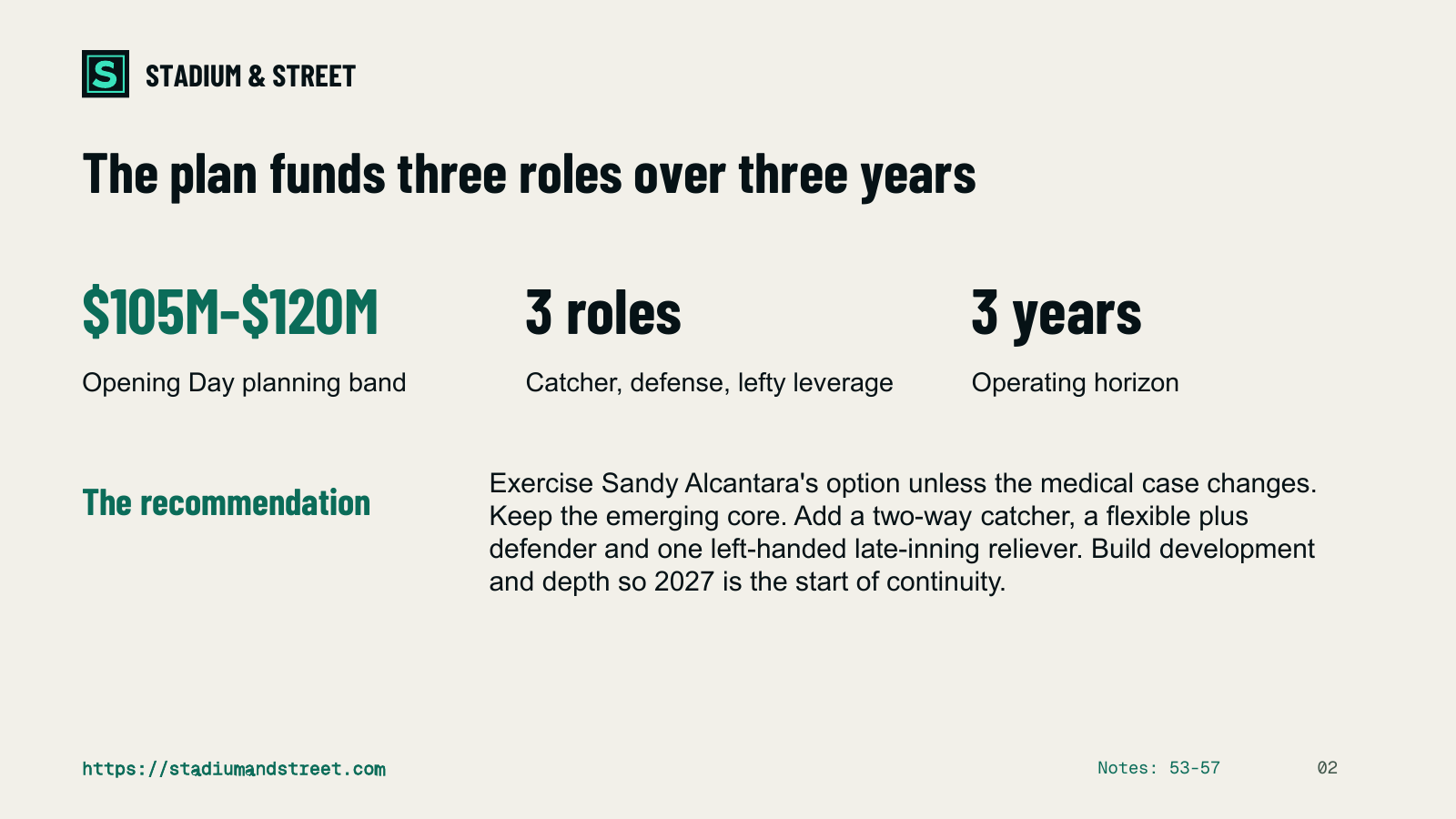
Miami's next step should be a stronger floor, not another cycle in which progress becomes a reason to start over. This review argues for keeping the emerging core, filling specific roster needs and funding the depth that lets a club survive injuries and disappointing stretches.
The download contains the complete original 58-page October 17 analysis, preceded by a November 1 acquisition amendment. It combines roster construction with attendance history, payroll comparisons and a three-year operating plan. Original research ends October 10 and roster checks October 17; the amendment does not relabel those inputs as current.
Keep the core. Fund the missing roles.
The revised priority is a two-way catching complement and left-handed late-inning relief, with utility spending conditional on a demonstrated coverage gap. The original $105-120 million Opening Day payroll band remains a dated planning recommendation requiring a complete club cash calculation, not evidence of an approved budget.
The baseball case favors continuity and adequate rotation cover. Sandy Alcantara's option is treated as a dated decision requiring a medical and workload review. Named external players are conditional targets, with availability, price, player interest and trade terms unresolved. The report does not claim private medical access or club discussions.
Winning cannot be the entire business plan
The strongest objection is affordability. Public attendance data do not establish realized ticket revenue, sponsor renewals or cash available for players. The review's attendance models cannot isolate a reliable return from additional wins. Its ticket scenarios are gross illustrations before costs, not profit forecasts.
That limitation is central to the recommendation. A payroll commitment needs a funding plan that survives a slower attendance response. Tampa Bay, Milwaukee and Cleveland provide useful comparisons, but none supplies a business model Miami can simply copy. Development, replacement quality and continuity have to be judged over several seasons.
Read the evidence and the limits together
Pages 3-5 contain the dated roster snapshot; pages 9-27 cover audience, economics and the operating model. Pages 28-44 examine roster construction and development. Pages 45-57 cover execution, methods and qualifications. The historical WAR comparisons are not projected 2027 wins, and errors alone are not a complete measure of defense.
Later context: MLB's October 24 review adds range-based defensive measures, reinforcing why errors alone cannot establish the quality of team defense.
Richard Brown is the publisher of Stadium & Street. This is independent analysis, not a Marlins-endorsed plan. Readers may share the page link; republication inquiries can be directed through our contact page.
Go to the sources
See something that needs attention? Read our corrections process.