Team analysis · 2027 roster planning
The Mets need more ways to score
November 1, 2026 edition
The complete review
Completed 2026 performance, with official roster and transaction checks dated November 1, 2026.
The decision
The Mets should buy a dependable middle-of-the-order bat, protect their young outfield and build a second answer at the infield positions where the expensive incumbents slipped. They also need starting innings. The mistake would be to treat the entire winter as a search for pitching while assuming the offense will repair itself.
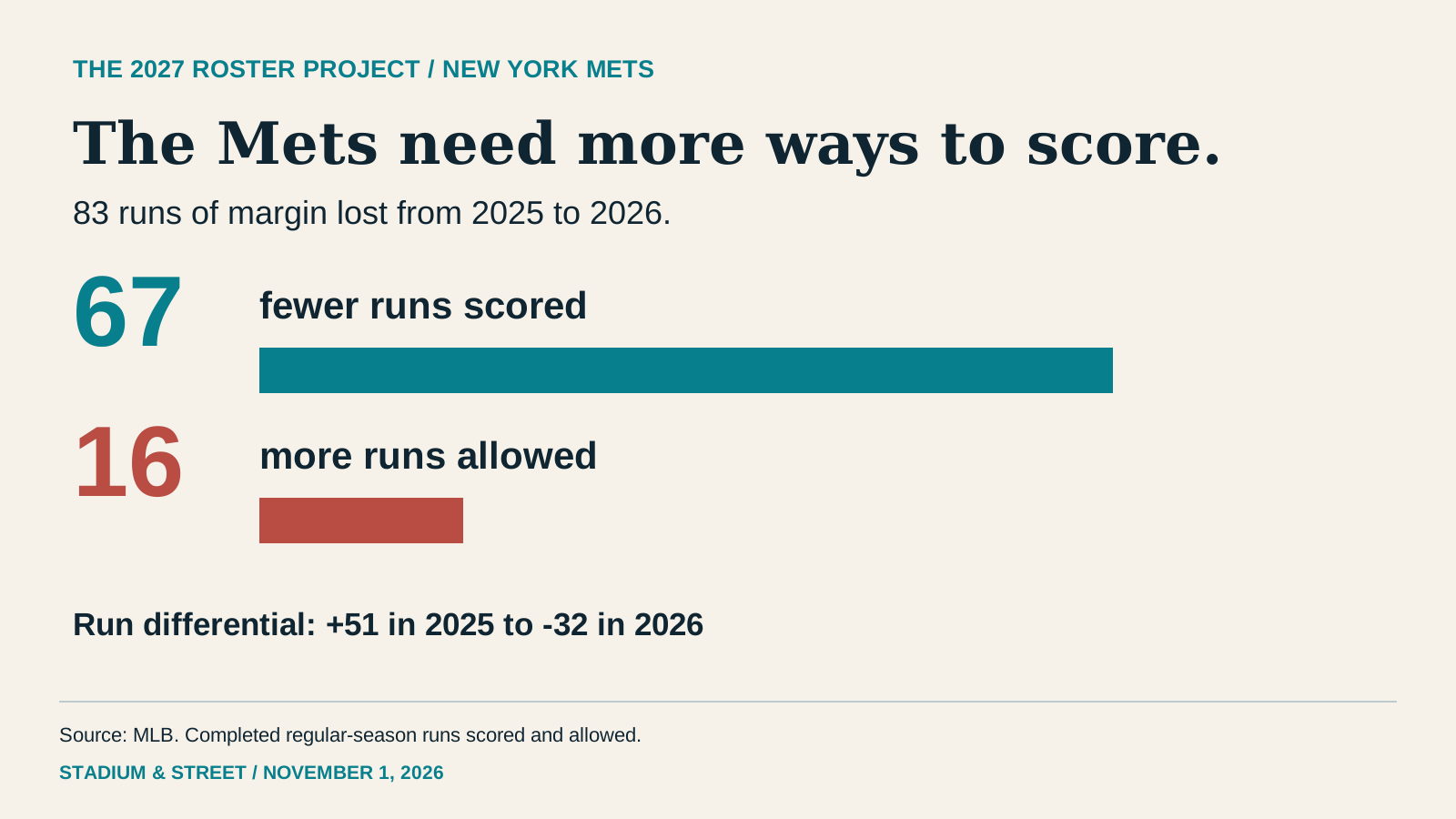
New York finished 74-88 with 699 runs scored and 731 allowed. The previous year's differential was plus-51; this year's was minus-32. Scoring fell by 67 runs, while runs allowed increased by 16. The larger part of the deterioration came from the lineup. There is enough useful pitching and young position-player performance here to justify a targeted attempt to contend, but too many incumbent jobs require a fallback.
The priority is a batting upgrade and dependable starting innings. Seiya Suzuki is a candidate at three years and $66-72 million, with Kevin Gausman at two years and $32-40 million and a $5-7 million one-year relief allowance. Those three commitments total $43-51 million annually. Reserve a further $7-9 million for infield coverage only if a specific uncovered job survives the internal review. The fully funded allocation is $50-60 million, or $330.10-350.10 million including the incumbent baseline, before tax and other excluded costs. These are S&S spending limits, not reported demands or offers.
The strongest objection is that Suzuki would add to an already crowded DH and corner mix. That objection is valid. His signing should reduce playing time for the weakest incumbent combinations, rather than remove A.J. Ewing from center field or Carson Benge from everyday work. Jorge Polanco's salary cannot be the reason to reserve the DH position for him. The retained players still need to win their jobs.
Plan B allocates $48-60 million to two starters, relief and the conditional infield reserve. Plan C allocates $26-34 million to one starter, value relief and that reserve. Both leave the batting upgrade unresolved. These are spending scenarios with shared dependencies, not three independently available rosters. If Suzuki or Gausman signs elsewhere, the missing job remains open until a different candidate clears the same role, workload and cost tests.
Choose Plan A only if the club is willing to make the resulting playing-time decisions. If the incumbents are all going to keep full-time roles regardless of performance, the new bat will not be used well enough to justify the commitment. The first organizational choice is therefore how the lineup will be selected, followed by whom to sign.
Where the season went backward
| Season | Record | Runs / allowed | Margin | HR / OPS |
|---|---|---|---|---|
| 2024 | 89-73 | 768 / 697 | +71 | 207 / .734 |
| 2025 | 83-79 | 766 / 715 | +51 | 224 / .753 |
| 2026 | 74-88 | 699 / 731 | -32 | 204 / .706 |
Runs fell from ninth in the majors in 2025 to twentieth in 2026. Home runs dropped from 224 to 204, and OPS from .753 to .706. This was a broad offensive retreat, not merely a change in the timing of a handful of hits. The club's 4.15 ERA ranked seventeenth, close enough to the middle of the league that a better offense could have changed the shape of the season.
There is an important limit to that comparison. Subtracting the 67-run scoring decline from the 83-run differential decline describes what happened; it does not allocate responsibility among hitters, injuries, roster turnover or schedule effects. A transaction plan has to identify actual plate appearances and defensive innings it can improve.
The 2026 lineup posted a .687 OPS in 1,825 plate appearances against left-handed pitching and .713 in 4,286 against right-handers. The left-handed matchup is a useful shopping criterion, but the larger volume against right-handers prevents a narrow platoon fix from becoming the whole plan. A hitter who helps against both offers more ways to keep the order functioning.
The simplest competitive benchmark is 32 additional runs scored or prevented, enough to erase the negative differential. A better ambition is a positive margin that can withstand an injury or an unsuccessful acquisition. There is no automatic conversion from either benchmark into a playoff berth. The report's scenarios show how quickly apparently comfortable gains can disappear when replacement innings are poor.
The lineup has anchors and vacancies
| Player | PA | AVG / OBP / SLG | HR | BB% / K% |
|---|---|---|---|---|
| Juan Soto | 482 | .275 / .393 / .515 | 27 | 16.2% / 13.5% |
| Carson Benge | 654 | .282 / .346 / .430 | 20 | 7.6% / 21.7% |
| A.J. Ewing | 492 | .252 / .324 / .376 | 11 | 9.3% / 25.4% |
| Francisco Lindor | 469 | .225 / .309 / .423 | 21 | 9.8% / 20.3% |
| Bo Bichette | 696 | .260 / .312 / .390 | 18 | 7.0% / 18.2% |
| Marcus Semien | 547 | .215 / .280 / .340 | 15 | 8.2% / 19.0% |
| Francisco Alvarez | 420 | .233 / .311 / .399 | 16 | 9.3% / 30.7% |
| Luis Torrens | 281 | .235 / .295 / .396 | 9 | 6.4% / 21.0% |
| Jared Young | 342 | .266 / .330 / .429 | 9 | 7.3% / 18.4% |
| Brett Baty | 473 | .238 / .311 / .374 | 11 | 9.3% / 26.4% |
| Mark Vientos | 295 | .212 / .258 / .394 | 13 | 5.1% / 24.1% |
| Jorge Polanco | 145 | .148 / .201 / .230 | 2 | 6.2% / 24.8% |
All batting rows above are Mets-only, completed 2026 regular-season totals. Walk and strikeout percentages are calculated from plate appearances. A player's season line does not establish his current roster status; the November 1 register appears later.
Juan Soto remained the strongest offensive foundation: a .393 on-base percentage and .908 OPS in 482 plate appearances. His 78 walks exceeded his 65 strikeouts. The opportunity is to give that level of production more support and, if he is available for more games, more plate appearances. It would be unreasonable to label his reduced season volume a new permanent ceiling or to forecast a precise rebound without knowing future availability.
Carson Benge gave the Mets 654 plate appearances, 20 home runs, a .346 OBP and 22 steals. That is an everyday player around whom to construct the next lineup. A.J. Ewing supplied 492 plate appearances, a .324 OBP and 25 steals, along with the positive center-field range evidence discussed below. Their combination gives the roster something its expensive infield lacks: useful production with room to develop.
Francisco Lindor's .732 OPS and 469 plate appearances were well below his .812 OPS in 732 plate appearances in 2025. Bo Bichette's .702 OPS came over a much larger 696-plate-appearance season. The distinction matters. Lindor's decline combined less playing time with weaker rate production; Bichette supplied volume without the earlier offensive quality. Both need credible recovery plans, and both need coverage that allows rest or a change in role without hollowing out the lineup.
Marcus Semien hit .215/.280/.340. Mark Vientos hit .212/.258/.394. Those on-base percentages are the immediate offensive problem at positions where the defense also grades poorly in the range review. The Mets cannot build a strong plan by assigning full-time plate appearances to both and then placing every hoped-for improvement in a projection column.
Jared Young's .759 OPS in 342 plate appearances merits a real first-base opportunity. Brett Baty's .685 OPS in 473 plate appearances supports a more competitive role than an automatic everyday assignment. Polanco's 145-plate-appearance sample was sharply worse, at .431 OPS, and his current 60-day IL designation prevents any assumption that he can cover a full defensive role. The club announced a two-year contract when it signed him; that commitment does not settle his 2027 workload.
Which rebounds are worth relying on?
| Player | 2024 OPS / PA | 2025 OPS / PA | 2026 OPS / PA |
|---|---|---|---|
| Juan Soto | .988 / 713 | .921 / 715 | .908 / 482 |
| Francisco Lindor | .844 / 689 | .812 / 732 | .732 / 469 |
| Bo Bichette | .599 / 336 | .840 / 628 | .702 / 696 |
| Marcus Semien | .699 / 718 | .669 / 534 | .620 / 547 |
| Mark Vientos | .838 / 454 | .702 / 463 | .652 / 295 |
| Brett Baty | .633 / 171 | .748 / 432 | .685 / 473 |
These are each player's MLB season totals with his then-current club, rather than a Mets-only three-year history. Soto played for the Yankees in 2024, Bichette for Toronto in 2024-25 and Semien for Texas in 2024-25. The table is a record of performance, not a forecast.
Soto's rate production has remained strong across all three seasons. For him, preserving useful plate appearances is more persuasive than asking for a new offensive level. A DH rotation that limits defensive demands on selected days has a concrete purpose, provided it does not remove the additional bat from the order whenever Soto needs that slot.
Bichette's path is less stable: .599 OPS in 2024, .840 in 2025 and .702 in 2026. His return to a high-contact offensive role is a reasonable upside case. It is not a sound reason to leave the rest of the infield without alternatives. His 2026 strikeout rate was 18.2%, up from 14.5% in 2025, calculated from the official counts. Getting back some of that contact would help more than merely describing him as due to rebound.
Semien's OPS declined in each of the three seasons, from .699 to .669 to .620. His range measures also moved in the wrong direction in 2026. That combination makes second base the position where the Mets most need a credible alternative before Opening Day. Keeping him in the mix is reasonable; making every other decision on the assumption that his earlier level returns is not.
Vientos has moved from .838 to .702 to .652 OPS. His 2026 walk rate was only 5.1%. A power-only recovery would still leave a low-OBP problem unless the damage on contact improved enough to compensate. The appropriate response is a competition with clear offensive and defensive criteria, not a promise of everyday first-base work based on 2024.
Baty's OBP has been relatively steady across these samples, while his slugging contribution has varied. He offers a different use from Vientos: coverage across positions with a more useful recent range result. Neither needs to be discarded simply to create a clean winter narrative. Their roles need to match the evidence, and the 26-man roster cannot carry every overlapping corner bat at once.
Protect the outfield, repair the infield
| Player | OAA | 2026 position innings |
|---|---|---|
| A.J. Ewing | 5 | LF 143.0; RF 17.0; CF 841.2; 2B 10.0 |
| Carson Benge | 1 | CF 81.0; RF 1140.0; LF 117.0 |
| Nick Morabito | 3 | LF 93.0; CF 16.0; RF 3.0 |
| Brett Baty | 1 | 2B 184.0; RF 158.0; 1B 154.2; 3B 457.0; LF 41.0; SS 13.0 |
| Francisco Lindor | 0 | SS 894.1 |
| Bo Bichette | -1 | 3B 943.2; SS 391.1; 2B 1.0 |
| Juan Soto | -3 | LF 572.0 |
| Marcus Semien | -9 | 2B 1203.2 |
| Mark Vientos | -9 | 3B 11.0; 1B 519.1 |
Outs Above Average measures range performance relative to the opportunities a fielder faced. It is not the same as fielding percentage, and it does not include every part of defense. The Mets team view supplies the OAA values; official position innings show the workload and positional mixture. OF aggregate rows are excluded from the innings display to avoid counting the same outfield work twice.
Ewing's plus-five OAA is an argument for preserving meaningful center-field innings. Benge's plus-one and Nick Morabito's plus-three offer additional positive outfield evidence, though Morabito's smaller offensive and defensive samples do not establish an everyday major-league player. The team should use these players to make its alignment more flexible, not displace them merely to fit another familiar corner name.
Semien and Vientos each finished at minus-nine OAA in the team view. Their assignments were different, and first-base receiving has dimensions that OAA does not capture. Even with those limits, the range evidence makes it difficult to defend a plan that assigns both unquestioned full-time work. Baty's plus-one provides one internal route to changing the mix, while Dubon's shortstop experience offers insurance that a corner-only bench player cannot supply.
Lindor finished at zero OAA and Bichette at minus-one. Those results do not make their innings interchangeable. Lindor remains the shortstop in the proposed alignment; moving him to solve another position would create a larger coverage question. Bichette's 2026 work was mainly at third, so using an old shortstop reputation to forecast his third-base value would miss the relevant assignment.
Soto's minus-three OAA supports a plan that can occasionally move him to DH while retaining competent outfield coverage. It does not establish that a fixed number of DH days will create a fixed number of runs. The tradeoff is lineup access: Suzuki, Soto and Polanco cannot all use the same DH plate appearance. That is why Plan A requires a decision about Polanco's role, rather than treating the DH position as already occupied by contract.
Three-year defense and the catching tandem
| Player | 2024 | 2025 | 2026 | Context |
|---|---|---|---|---|
| Marcus Semien | +14 | +6 | -8 | Whole player-season FRV |
| Francisco Lindor | +13 | +3 | 0 | Whole player-season FRV |
| Bo Bichette | 0 | -10 | -2 | SS to mainly 3B |
| Juan Soto | 0 | -13 | -5 | RF to mainly LF |
| Mark Vientos | -7 | -6 | -7 | 3B to mainly 1B |
| Luis Torrens | Unknown | +11 | +10 | Catching value |
| Francisco Alvarez | +2 | -6 | -2 | Catching value |
Fielding Run Value is a runs-based Statcast measure. The preceding OAA table is measured in outs. They are different views of overlapping defensive performance and must not be added together as independent gains. The FRV rows cover the whole qualified player-season across clubs. Position changes, opportunity and playing time affect comparisons.
Semien's FRV path, plus-14 to plus-six to minus-eight, is the clearest warning. His range component similarly moved from plus-14 to plus-five to minus-seven. One poor season is not a verdict on every future inning, but it makes a second-base alternative a necessary part of the roster design.
Lindor's FRV moved from plus-13 to plus-three to zero. Bichette improved from minus-ten to minus-two while changing his primary assignment from shortstop toward third base. Soto improved from minus-13 to minus-five while shifting toward left field and playing fewer games. The latter two changes are useful descriptive evidence, not proof that an identical improvement will repeat.
The catching comparison deserves its own treatment. Luis Torrens supplied plus-ten in qualified catching value in 2026 after plus-eleven in 2025. Francisco Alvarez improved from minus-six to minus-two. Alvarez's latest components included plus-two framing, minus-three blocking and minus-two in the ABS measure. The practical question is how to divide the actual work, not which catcher receives a single flattering or unfavorable label.
Alvarez's .710 OPS exceeded Torrens' .691, but the gap is small enough that catching responsibilities should matter in the allocation. Use both. Give Alvarez a development plan that specifically addresses blocking and challenge decisions, and use Torrens for substantial innings rather than treating the second catcher as emergency storage. No fixed defensive credit is assigned to a coaching change. Torrens' absent 2024 qualified row remains unknown, not zero.
A rotation led by McLean, not by old salary rankings
| Pitcher | IP / GS | ERA / WHIP | K / BB | HR per 9 |
|---|---|---|---|---|
| Nolan McLean | 179.2 / 31 | 3.16 / 1.17 | 194 / 70 | 0.85 |
| Christian Scott | 110.0 / 23 | 3.85 / 1.27 | 134 / 47 | 0.98 |
| Zac Thornton | 84.1 / 15 | 3.42 / 1.14 | 63 / 18 | 1.49 |
| Sean Manaea | 150.2 / 19 | 4.78 / 1.30 | 144 / 44 | 1.49 |
| Kodai Senga | 61.1 / 8 | 7.34 / 1.65 | 75 / 41 | 2.05 |
| Jonah Tong | 30.2 / 4 | 3.82 / 1.24 | 34 / 14 | 0.59 |
| Tobias Myers | 53.2 / 3 | 5.53 / 1.34 | 41 / 16 | 1.51 |
The pitching rows are Mets-only regular-season totals, including all roles. A pitcher with relief appearances is not being credited with all those innings as a starter. Innings notation uses baseball thirds: .1 is one out and .2 is two outs.
Nolan McLean is the clearest starting point: 31 starts, 179.2 innings, a 3.16 ERA and 194 strikeouts. His 70 walks identify a specific next improvement. The 2027 plan should protect what he has already established while looking for fewer free baserunners, rather than demanding an even larger workload because the rotation needs one.
Christian Scott's 3.85 ERA, 134 strikeouts and 47 walks over 110 innings offer a second credible building block. Zac Thornton's 3.42 ERA over 84.1 innings is encouraging, but his 14 home runs and 63 strikeouts make the run-prevention profile less comfortable than the ERA alone suggests. Thornton allowed 1.49 homers per nine innings. Treating him as a finished top-of-the-rotation answer would overstate the sample.
Sean Manaea gave the club 150.2 innings with a 4.78 ERA. His 25 homers, 1.49 per nine, are another reason to improve the defense and avoid assuming every established starter will suppress damage. His volume still has a use. The club needs a competitive rotation assignment and another source of innings, rather than a binary choice between declaring the contract a success and removing him from the plan.
Kodai Senga's 7.34 ERA, 41 walks and 14 home runs over 61.1 innings demand a much smaller planning commitment. Eight saves do not erase the traffic or make him an established answer at the back of the bullpen. His next role must be earned through current performance and availability. We allocate a conditional mixed-role season in the workload exercise, not a guaranteed rotation place.
Jonah Tong's 30.2 innings and 3.82 ERA represent depth with room to grow, not a completed season of dependable starting work. The same restraint applies to Jonathan Santucci's minor-league case. McLean, Scott and Thornton make the rotation worth building around. They do not make an outside starter unnecessary.
The bullpen cannot borrow departed innings
| Pitcher | IP | ERA / WHIP | K / BB | Current role case |
|---|---|---|---|---|
| Devin Williams | 40.2 | 4.43 / 1.57 | 52 / 21 | Late innings, needs traffic reduction |
| Nate Lavender | 21.2 | 1.66 / 0.74 | 26 / 4 | Left-handed high-leverage trial |
| Daniel Duarte | 29.2 | 2.12 / 0.81 | 30 / 7 | Retain meaningful leverage work |
| Dedniel Nunez | 19.0 | 3.32 / 0.89 | 20 / 0 | Promising, only 19 innings |
| Austin Warren | 50.1 | 4.11 / 1.37 | 55 / 24 | Middle innings, watch walks |
| Cionel Perez | 29.1 | 3.99 / 1.33 | 35 / 8 | Left-handed coverage |
| Jack Weisenburger | 12.2 | 2.13 / 1.11 | 14 / 4 | Depth, only 12.2 innings |
The Mets' starters worked 791 innings with a 4.47 ERA. Relievers covered 650.2 with a 3.76 ERA, almost 45.2% of the club's total innings. That relief performance helped keep the overall ERA near the middle of the league. Asking the bullpen to carry that much again would leave too much dependent on small samples and new roles.
Devin Williams struck out 52 in 40.2 innings, but 21 walks and a 1.57 WHIP limited the value of that strikeout ability. His 4.43 ERA follows 4.79 with the Yankees in 2025. The Mets should seek a rebound in strike-throwing and traffic management, while acquiring another pitcher capable of handling important innings. His contract is not an argument for leaving every late-game contingency to him.
Nate Lavender's 26 strikeouts against four walks in 21.2 innings and Daniel Duarte's 30 against seven in 29.2 are promising. Dedniel Nunez walked none in 19 innings. These are reasons to retain meaningful opportunities, not to multiply each sample into a guaranteed full season of elite relief. Their combined workloads remain small enough that one additional dependable option has a clear purpose.
Austin Warren offers more volume, with 50.1 innings, but his 24 walks keep him from being treated as a frictionless bridge. Cionel Perez adds left-handed coverage. Jack Weisenburger's 12.2-inning major-league sample belongs in the depth discussion rather than the projected core of the bullpen.
Luke Weaver, Brooks Raley, A.J. Minter and Huascar Brazoban contributed to the 2026 results, but the current Mets roster does not include them. Their historical work cannot be counted a second time as retained 2027 relief. Reed Garrett and Tylor Megill remain on the 60-day IL listing. This analysis reserves no Opening Day workload for either and makes no medical return claim.
Development needs a job description
| Player / ID | 2026 combined minor-league line | Decision |
|---|---|---|
| Jefferson Rojas / 800473 | 489 AB; .274/.338; .843 OPS; 27 HR; 21 SB | Syracuse infielder; power competition, no reserved MLB job |
| Emilien Pitre / 692150 | 415 AB; .306/.420; .847 OPS; 6 HR; 35 SB | Syracuse infielder; test second-base coverage and on-base role |
| Jonathan Santucci / 695558 | 27 starts; 125 IP; 4.03 ERA; 163 K; 1.34 WHIP | Syracuse left-hander; rotation depth before full-season promise |
These minor-league totals combine teams and levels over the 2026 season. Rojas and Pitre's lines include work before they joined the Mets. They are not post-trade organizational splits or estimates of major-league performance. Official profiles list both as infielders, with shortstop as their primary position. A second-base assignment would need to be tested rather than inferred from that label.
Jefferson Rojas brings the clearest power evidence: 27 homers and an .843 OPS in 489 at-bats. He reached Syracuse in September after arriving in the Clay Holmes and Tyrone Taylor trade. The logical development task is to determine whether his damage on contact and strike-zone decisions carry into more advanced pitching while establishing which infield position he can cover consistently.
Emilien Pitre presents a different case: a .420 OBP, 35 steals and six home runs. He joined the organization in the Peralta transaction and reached Syracuse in August. For this roster, the interesting question is whether that on-base skill and mobility can support an infield role that reduces pressure on Semien. Calling him a solution before testing the position and the major-league bat would turn a useful prospect into an unsupported assumption.
Santucci struck out 163 in 125 innings, or 11.74 per nine, across 27 minor-league starts. His 4.03 ERA and 1.34 WHIP temper the strikeout case. He belongs in the next-starter group, with an opportunity to earn innings when the major-league rotation requires them. The plan does not require him to arrive as a finished 150-inning starter.
Rojas' winter assignment to Gigantes del Cibao remains within a record identifying the Mets as his parent organization. Winter-league listings for other Mets likewise do not establish a transfer of MLB rights. The useful organizational distinction is major-league roster, minor-league development and seasonal assignment, not simply whichever team name appears first on a player page.
The Mets should preserve Rojas, Pitre, Santucci, Tong, Benge and Ewing in these plans. None is proposed as outgoing currency for a short-term patch. If an eventual trade asks for one of them, the club would need a separately evaluated return with enough control and role value to justify that development cost. The free-agent plans below require no invented prospect package.
What the money actually measures
| 2027 annual allocation | Millions | Basis |
|---|---|---|
| Soto | 57.50 | Includes bonus allocation; base salary differs |
| Bichette | 42.00 | Reported 2027 player option exercised |
| Lindor | 34.10 | Listed annual amount; deferrals matter |
| Semien | 26.00 | Listed annual amount |
| Manaea | 25.00 | Listed annual amount; deferrals matter |
| Polanco | 23.00 | Listed annual amount |
| Williams | 17.00 | Listed annual amount; deferrals matter |
| Senga | 14.00 | Listed annual amount |
| Torrens | 5.75 | 2027-28 extension |
| Nine-player subtotal | 244.35 | Sum of listed figures |
| Other listed obligations | 9.75 | McNeil / Weaver / Nimmo trade or bonus items |
| Committed allocation subtotal | 254.10 | Before retained arbitration and depth |
| S&S arbitration allowance | 16-22 | Nine current cases; no Pache allocation |
| S&S pre-arb / call-up reserve | 10-14 | Planning allowance, not a 2027 minimum-salary claim |
| Shared planning baseline | 280.10-290.10 | Annual allocation basis, not cash or CBT |
The nine-player figures use RosterResource's listed annual allocation presentation. The $9.75 million of other items consists of $2 million connected with the McNeil trade, $6 million with the Weaver trade, a $1.5 million Weaver bonus item and a $250,000 Nimmo bonus item. They total $254.10 million before our separate arbitration and depth allowances. No speculative salary-dump savings are deducted.
Soto illustrates why this is not a cash-disbursement schedule. The Associated Press reported a $42.5 million 2027 salary and a $75 million signing bonus payable shortly after contract approval. The $57.5 million listed annual figure is $15 million higher, consistent with allocating that bonus across the first five years. It must not be described as a new $57.5 million cash payment in 2027.
Bichette reportedly exercised his $42 million 2027 player option. That is distinct from his later 2028 decision. The earlier displayed payroll subtotal still reflected a different option treatment, so this report sums the individual obligations rather than copying the headline total.
Deferrals also matter. Lindor's agreement included deferred compensation, and the listed tax valuations for Manaea and Williams differ from their annual salary figures. A full cash calendar would need every payment date, while a CBT calculation would need the applicable tax rules and present-value treatment. This report uses neither label for its planning envelope.
Our $16-22 million arbitration allowance covers current cases involving Alvarez, Baty, Vientos, Morel, Perez, Garrett, Megill, Warren and Nunez. It is an editorial reserve, not nine reported agreements. Pache's October 29 DFA is excluded from that retained-player group; no release or salary recovery is assumed. A further $10-14 million covers pre-arbitration major-league work and call-up depth. Those amounts are budget assumptions, not a claim about a finalized 2027 minimum salary.
The resulting $280.10-290.10 million common baseline lets the alternatives be compared consistently. Incentives, benefits, tax, unlisted obligations, transaction costs and changes in labor terms remain outside it. A budget decision should authorize those separately, rather than disguise them as headroom created by a partial payroll table.
The candidates and the price discipline
| External candidate / ID | 2026 evidence | Role and price ceiling |
|---|---|---|
| Seiya Suzuki / 673548 | .270/.368/.473, 26 HR, 634 PA; .966 OPS vs L, .797 vs R | DH/RF bat; proposed S&S 3 years, $66-72M |
| Mauricio Dubon / 643289 | .276/.321/.399, 619 PA; 456.2 SS innings | Conditional SS-cover candidate only; 2 years, $14-18M maximum if role warrants |
| Kevin Gausman / 592332 | 177.2 IP, 4.51 ERA, 184 K / 47 BB, combined TOR/CHC | Rotation volume; S&S 2 years, $32-40M |
| Freddy Peralta / 642547 | 169 IP, 4.42 ERA, 156 K / 63 BB, combined NYM/TB | Pitching-first alternative; S&S 3 years, $60-72M |
Suzuki, Dubon, Gausman and Peralta elected free agency in the official October 29 records, rechecked November 1. They are external candidates, not Mets signings, and the prices above are our proposed ceilings. Qualifying-offer or compensation consequences must be evaluated when their actual status is established; no unverified draft-pick cost is assigned here.
Suzuki offers the most direct offensive fit. His .368 OBP and .841 OPS over 634 plate appearances would add another hitter who can extend an inning and drive the ball. The .966 OPS against left-handers addresses the weaker side of the Mets' team split, while .797 against right-handers supports more than a narrow platoon role. The 168-plate-appearance left-handed sample still needs to be treated as a sample, not a guaranteed new level.
He played 972.2 innings in right field in 2026. That establishes experience at the position, not a defensive upgrade over Benge. Plan A uses Suzuki primarily to strengthen the DH/corner batting rotation, preserves Benge's everyday work and keeps Ewing in center. It does not sell the signing as simultaneous offensive and defensive improvement at every position.
Dubon brings 456.2 innings at shortstop in 2026, plus other infield and outfield work. His .720 OPS is useful coverage rather than a middle-order solution. He had a .675 OPS against left-handers and .743 against right-handers, so this report does not call him a demonstrated 2026 lefty-mashing platoon specialist. That is a reason to investigate him for a demonstrated shortstop-cover need. It does not justify buying the same utility player for every roster. Start with the jobs Baty, Pitre and Rojas can actually cover; none is assumed ready to replace Lindor at shortstop. Dubon is a conditional candidate, not a required purchase in all three plans.
Gausman worked 177.2 innings across Toronto and Chicago, striking out 184 and walking 47 with a 4.51 ERA. The attraction is volume with a better strikeout-to-walk foundation than the ERA alone captures. At 26 homers allowed, he is not a risk-free run-prevention purchase. Our two-year, $32-40 million limit reflects that distinction. If the market prices him as an ace, pursue the same role elsewhere instead of changing the description to justify the price.
Peralta's combined season was 169 innings and a 4.42 ERA. His Mets portion was 4.99 over 113.2 innings; his Tampa Bay portion was 3.25 over 55.1. The latter is encouraging but too small to erase the former. Plan B is a workload-diversification alternative, not a claim that reacquiring him restores the best version of his career. His 156 strikeouts against 63 walks help define the risk being purchased.
The unnamed relief allowance is deliberate. It buys a role after current medical, workload and acquisition checks, rather than manufacturing certainty about a specific reliever's availability. Plan A and B allow $5-7 million annually; Plan C allows $3-5 million. Keep any commitment short enough that an unsuccessful bullpen bet does not become the next obstacle to improving the roster.
The alternatives need to survive the same scrutiny. Rhys Hoskins is a free agent, but his 2026 .682 OPS in 317 plate appearances and 100 strikeouts do not establish the dependable everyday upgrade sought here. Chris Bassitt reached only 102 innings, with a 4.41 ERA and 74 strikeouts against 38 walks; replacing Gausman's 165 planned innings with that record would leave 63 more innings to source. Zac Gallen recorded a 6.07 ERA in 105.1 innings, with 64 strikeouts and 35 walks. He is a recovery investigation, not verified volume insurance. Ryan O'Hearn's .770 OPS in 451 plate appearances merits a separate baseball assessment, but Pittsburgh still holds his rights in the checked record. No trade availability or price is established. None is promoted to a preferred acquisition merely to make this list different.
If Gausman is unavailable, Peralta can be evaluated as the single outside starter instead of being added beside him. At the report's existing prices, Suzuki plus Peralta plus relief would require $47-55 million annually, or $54-64 million with the infield reserve. That purchases a different risk: Peralta's 156 strikeouts against 63 walks and 169 innings offer a weaker 2026 strikeout-to-walk foundation than Gausman's 184 against 47 over 177.2. The proposed 165-inning slot is a workload scenario, not a promise. If neither starter clears, leave the slot visibly unfilled and reduce the claimed coverage; do not turn Bassitt or Gallen into interchangeable replacements.
If Suzuki is unavailable within the proposed limit, do not replace his proposed 600 plate appearances with another name and retain the same offensive expectation. Use the no-Suzuki allocations below, retain the unspent batting budget and reopen the search for an actual improvement. Plan B is justified by a changed pitching need, not simply by losing a batting negotiation.
Three plans, with real tradeoffs
| Scenario, including conditional IF reserve | Annual allocation | Planning total | Unresolved risk |
|---|---|---|---|
| A: bat + starter + relief; IF only if needed | $50-60M | $330.10-350.10M | Suzuki/Gausman acquisition; DH congestion |
| B: two starters + relief; IF only if needed | $48-60M | $328.10-350.10M | No outside everyday batting upgrade |
| C: starter + value relief; IF only if needed | $26-34M | $306.10-324.10M | Largest dependence on incumbent bats |
Plan A's proposed purchases are Suzuki at $22-24 million annually, Gausman at $16-20 million and relief at $5-7 million. That is $43-51 million in annual additions and $103-119 million in new guarantees under the stated terms. Conditional infield coverage adds a $7-9 million annual reserve; if it takes a two-year contract, the fully funded totals become $50-60 million annually and $117-137 million guaranteed. The Suzuki ceiling is a provisional S&S spending limit based on the proposed role and roster fit, not a reported market price.
A conditional 13-hitter group would include Alvarez and Torrens; Lindor, Bichette and Semien; Benge, Ewing and Soto; Suzuki; Baty; one place for verified infield coverage; and two places contested by Young, Vientos, Polanco and the remaining depth. That describes the roster problem rather than pretending all four corner candidates fit. Current health, position coverage, option rights and actual performance determine those last places. No player is assumed optionable, waived or traded by this analysis.
The preferred first-base opportunity goes to Young, with Baty and Vientos providing competition rather than redundant full-time promises. Polanco can earn a role if available and productive. Suzuki's addition would leave fewer DH plate appearances for that group, which is the intended offensive selection pressure. A contract already owed is not a marginal reason to choose the weaker lineup.
Plan B's purchases are Gausman at $16-20 million annually, Peralta at $20-24 million and relief at $5-7 million, plus the conditional $7-9 million infield reserve. The purchases alone total $41-51 million annually and $97-119 million guaranteed. Including two years of infield coverage raises those totals to $48-60 million and $111-137 million. More established innings reduce the burden on Scott, Thornton, Tong and Santucci, but the plan asks incumbent bats to produce nearly all the offensive gain. It becomes preferable if the internal pitching outlook worsens or Suzuki's price exceeds the role's value.
Plan C keeps the Gausman proposal and reduces relief to $3-5 million. These purchases total $19-25 million annually and $35-45 million guaranteed. With the conditional infield reserve, the allocation is $26-34 million annually and $49-63 million guaranteed if that coverage takes two years. It protects the most urgent coverage needs and leaves the greatest room for Pitre, Rojas and the young pitchers. Its honest cost is a larger chance that the offense remains near 2026's level. Choosing it means accepting that risk, not describing unchanged plate appearances as an improvement.
No plan credits a financial return from trading Semien, Polanco or Senga. A club may eventually find a useful transaction, but the salary retained, player returned, consent rights and roster consequences would determine its value. Inventing a willing buyer makes every winter plan look easier and leaves the real decision unanswered.
| Season plate-appearance allocation | Plan A | Plans B / C |
|---|---|---|
| Soto | 625 | 625 |
| Benge | 625 | 625 |
| Ewing | 475 | 550 |
| Lindor | 600 | 600 |
| Bichette | 625 | 625 |
| Semien | 375 | 375 |
| Suzuki | 600 | 0 |
| Alvarez | 375 | 375 |
| Torrens | 260 | 260 |
| Young | 350 | 500 |
| Baty | 350 | 425 |
| Infield-coverage pool (conditional) | 400 | 400 |
| Polanco | 175 | 325 |
| Vientos | 175 | 325 |
| Other depth | 101 | 101 |
| Total | 6111 | 6111 |
The plate-appearance exercise holds each plan at 6,111, the Mets' 2026 total. It describes a season, including replacements, rather than putting 15 hitters on an Opening Day roster. Plans B and C redistribute Suzuki's 600 plate appearances to Young, Polanco and Vientos, 150 each, plus 75 each to Ewing and Baty. That makes the offensive sacrifice explicit. Semien's allocation falls to 375 in every plan. The infield-coverage pool reserves 400 plate appearances. Those plate appearances must come from a real signing or earned internal roles; the pool receives no assumed offensive or defensive gain. If no candidate clears, the depth shortfall remains. Actual availability and performance would change these assignments; no production gain is credited merely for writing down a larger workload.
Budget the innings before promising the rotation
| Starter innings scenario | IP | Why it is a planning limit |
|---|---|---|
| McLean | 175 | Near 2026 workload, not a demand to exceed it |
| Gausman | 165 | Below 177.2 combined 2026 innings |
| Manaea | 145 | Near 2026 total; role/health dependent |
| Scott | 135 | 25 above 2026 MLB total, conditional |
| Thornton | 120 | 35.2 above 2026 MLB total, conditional |
| Tong | 65 | Development role, not guaranteed availability |
| Senga | 40 | Earned role; no automatic full rotation slot |
| Santucci | 35 | MLB opportunity scenario, not a projection |
| Other starter depth | 20 | Unassigned reserve |
| Total | 900 | Compared with 791 starter innings in 2026 |
These are conditional workload allocations for Plan A, not forecasts or medical clearances. The 900 starter innings would be 109 more than the Mets received in 2026. They require a functioning five-man core and useful depth. Scott and Thornton's increases require particular scrutiny; their major-league totals alone do not establish how much additional work is appropriate.
| Relief innings scenario | IP | Allocation |
|---|---|---|
| Williams | 55 | Rebound and availability required |
| Lavender | 45 | Growth from small sample, conditional |
| Duarte | 50 | Growth from small sample, conditional |
| Nunez | 40 | Growth from small sample, conditional |
| Warren | 55 | Near 2026 workload |
| Perez | 45 | Retained left-handed role |
| New reliever | 55 | Acquisition target workload |
| Myers | 80 | Multi-inning season depth |
| Senga | 30 | 70 total with starter scenario |
| Other relief depth | 86.2 | Unassigned reserve |
| Total | 541.2 | 900 + 541.2 = 2026 team innings of 1441.2 |
The two tables sum to 1,441.2 innings, the completed 2026 team workload, as a common accounting reference. Senga's 40 starter innings plus 30 relief innings equal 70 total; he is not counted twice as two full pitchers. The combined reserve includes 20 starter innings and 86.2 relief innings for depth not assigned to a named player.
An Opening Day staff cannot carry every pitcher in a season-long allocation. McLean, Scott, Thornton, Manaea and the acquired starter would anchor the rotation if available and effective. Williams, Lavender, Duarte, Nunez, Warren, Perez, an addition and a long-relief choice form the initial bullpen competition. Senga and Myers create a real roster decision. The analysis makes no assumption that either can be freely moved to the minors.
The small-sample relievers are not guaranteed to double their work at the same quality. If the club cannot support the proposed increase in starting innings, the relief budget must rise and the acquisition plan must change with it. Filling the printed table is not the objective. Avoiding a season in which the bullpen repeatedly absorbs short starts is.
What would change the recommendation?
| Illustrative change from 2026 | Runs scored | Runs allowed | Resulting margin |
|---|---|---|---|
| Baseline | 699 | 731 | -32 |
| Balanced improvement: +40 offense, -25 allowed | 739 | 706 | +33 |
| Strong batting recovery: +60, -35 allowed | 759 | 696 | +63 |
| Pitching-only gain: unchanged offense, -35 allowed | 699 | 696 | +3 |
| Balanced case plus 100 IP at 1.5 more runs/9 | 739 | 722.7 | +16.3 |
| Offense loses 20 more runs; pitching unchanged | 679 | 731 | -52 |
These scenarios deliberately use run totals rather than an invented WAR-to-wins formula. They hold the 2026 baseline fixed and vary offense and run prevention. The balanced case gains 40 runs scored and prevents 25, producing plus-33. The stronger case reaches plus-63. Neither assigns those gains automatically to a signing, promotion or coach.
The fragility test replaces 100 innings with pitching that allows 1.5 more runs per nine. That costs about 16.7 runs, reducing the balanced case from plus-33 to plus-16.3. It explains why depth still matters even when the primary recommendation begins with offense. One prolonged absence can consume much of the improvement purchased elsewhere.
The strongest case for Plan B is equally clear: the rotation delivered only 791 innings in 2026, Senga struggled, and several of the best internal alternatives have limited major-league workloads. If current assessments make the 900-inning starter allocation unrealistic, buying a second starter becomes more urgent than adding Suzuki. That change should follow evidence about the actual innings available, not a general belief that pitching always comes first.
The strongest case for Plan C is that Soto and Lindor lost considerable plate-appearance volume and Bichette has a recent .840-OPS season. A healthier, more productive version of those incumbents could generate much of the needed improvement. The counterargument is Semien's three-year offensive decline, Vientos' falling OBP and the uncertain Polanco role. Too many separate rebounds have to arrive together for the lower-addition plan to be comfortable.
Change the preferred plan if the batting market exceeds the proposed ceiling, if the club cannot create useful DH/corner plate appearances, if the pitching availability changes materially, or if an internal infielder proves ready for the exact coverage job. Preserve the principle behind the recommendation: every expensive acquisition and every incumbent role must solve a specific shortage in the next roster.
The order of operations
First, establish the current health and role outlook for the retained pitchers and Polanco through the club's actual evaluations. The public record here does not establish private medical readiness. That information determines whether one outside starter is enough and which DH/corner jobs are genuinely open.
Second, pursue the batting upgrade and rotation addition together, with explicit spending limits and playing-time consequences. Do not commit the DH slot to Suzuki and then discover that every incumbent was promised the same plate appearances. Do not commit to a second starter merely because the first negotiation was difficult.
Third, test the infield coverage before spending its reserve. Identify the position, expected workload and incumbent displaced. Dubon is a conditional option if that process establishes a shortstop-cover gap, not an automatic addition. The same review must show that a smaller role or internal solution cannot cover the need. Pitre and Rojas should have a development path, not an obligation to rescue a thin bench immediately.
Fourth, resolve the 26-man and 40-man consequences. The official November 1 list contains 43 names because three are designated on the 60-day IL. Adding several free agents and later reinstating injured players requires actual roster transactions. Pache's DFA and the Kyren Paris waiver claim are already reflected; they do not create unlimited additional space.
Finally, judge the roster by the combinations it can actually put on the field. The 2026 Mets had a productive new outfielder, a strong young starter and an elite on-base hitter. They also had too many stretches in which weak offensive positions and uncertain innings reinforced one another. A better 2027 team needs fewer such combinations, with enough depth to keep one missing player from undoing the plan.
Current roster and historical boundaries
| Mets listing / MLB ID | Position | November 1 status |
|---|---|---|
| A.J. Ewing / 805999 | CF | 40-man listing |
| Austin Warren / 681810 | P | 40-man listing |
| Bo Bichette / 666182 | 3B | 40-man listing |
| Brett Baty / 683146 | 3B | 40-man listing |
| Cameron Weston / 687721 | P | 40-man listing |
| Carson Benge / 701807 | RF | 40-man listing |
| Chayce McDermott / 694646 | P | 40-man listing |
| Christian Cairo / 686551 | SS | 40-man listing |
| Christian Scott / 681035 | P | 40-man listing |
| Christopher Morel / 666624 | 1B | 40-man listing |
| Cionel Perez / 672335 | P | 40-man listing |
| Daniel Duarte / 650960 | P | 40-man listing |
| Dedniel Nunez / 673380 | P | 40-man listing |
| Devin Williams / 642207 | P | 40-man listing |
| Dylan Ross / 697811 | P | 40-man listing |
| Eric Wagaman / 676572 | 1B | 40-man listing |
| Francisco Alvarez / 682626 | C | 40-man listing |
| Francisco Lindor / 596019 | SS | 40-man listing |
| Hayden Senger / 663584 | C | 40-man listing |
| Jack Weisenburger / 674073 | P | 40-man listing |
| Jared Young / 676724 | 1B | 40-man listing |
| Jefry Yan / 642376 | P | 40-man listing |
| Jonah Tong / 804636 | P | 40-man listing |
| Jonathan Pintaro / 702752 | P | 40-man listing |
| Jorge Polanco / 593871 | DH | 60-day IL |
| Juan Soto / 665742 | LF | 40-man listing |
| Justin Hagenman / 663795 | P | 40-man listing |
| Kodai Senga / 673540 | P | 40-man listing |
| Kyren Paris / 677347 | 2B | 40-man listing |
| Luis Torrens / 620443 | C | 40-man listing |
| Marcus Semien / 543760 | 2B | 40-man listing |
| Mark Vientos / 668901 | 1B | 40-man listing |
| Nate Lavender / 681320 | P | 40-man listing |
| Nick Morabito / 703492 | LF | 40-man listing |
| Nolan McLean / 690997 | P | 40-man listing |
| Philip Abner / 691769 | P | 40-man listing |
| Reed Garrett / 657585 | P | 60-day IL |
| Robert Stock / 476594 | P | 40-man listing |
| Ronny Mauricio / 677595 | SS | 40-man listing |
| Sean Manaea / 640455 | P | 40-man listing |
| Tobias Myers / 668964 | P | 40-man listing |
| Tylor Megill / 656731 | P | 60-day IL |
| Zac Thornton / 804267 | P | 40-man listing |
This is the official November 1 40-man endpoint's listing, including its three 60-day IL entries. Active in the source is an administrative roster designation, not a guarantee of health, an Opening Day assignment or a new contract. Winter-league current-team displays for Alvarez, Torrens, Morel and Yan do not override their Mets roster entries.
| Historical Mets contributor / ID | Latest Mets-log context | Use in report |
|---|---|---|
| Clay Holmes / 605280 | Departed during 2026; see transaction source | 2026 contribution only; not retained depth |
| Tyrone Taylor / 621438 | Departed during 2026; see transaction source | 2026 contribution only; not retained depth |
| Freddy Peralta / 642547 | Departed during 2026; see transaction source | 2026 contribution only; not retained depth |
| David Peterson / 656849 | Departed during 2026; see transaction source | 2026 contribution only; not retained depth |
| Luke Weaver / 596133 | Departed during 2026; see transaction source | 2026 contribution only; not retained depth |
| Brooks Raley / 548384 | Departed during 2026; see transaction source | 2026 contribution only; not retained depth |
| A.J. Minter / 621345 | Departed during 2026; see transaction source | 2026 contribution only; not retained depth |
| Huascar Brazoban / 623211 | Departed during 2026; see transaction source | 2026 contribution only; not retained depth |
| Luis Robert Jr. / 673357 | Departed during 2026; see transaction source | 2026 contribution only; not retained depth |
| Cristian Pache / 665506 | Designated for assignment October 29 | 2026 contribution only; not retained depth |
The historical contributors above are separated from the returning roster. Peralta is also evaluated as an external free-agent candidate after his subsequent Tampa Bay stint. A player's former Mets statistics do not establish current Mets rights. Pache's recorded DFA is not described as a completed release.
External candidates in this report: Suzuki 673548, Dubon 643289, Gausman 592332 and Peralta 642547. Organizational development cases: Rojas 800473, Pitre 692150 and Santucci 695558. Player IDs identify the exact official records used and prevent names or winter assignments from being confused with current MLB roster status.
Sources and definitions
The performance baseline is the completed 2026 regular season, with 2024-25 comparisons where shown. Team-only and combined-team samples are labeled. No postseason totals are folded into the season tables. Plate-appearance percentages and innings-based rates are calculated from the official counts; pitching thirds are converted to outs before arithmetic.
OAA and FRV are descriptive defensive measures with different units. Neither is added to the other, and neither is a forecast. Minor-league lines cover their stated teams and levels rather than an assumed major-league translation. Proposed workload and price ranges are Stadium & Street scenarios. The report uses an annual salary-allocation envelope and does not claim a complete cash-flow schedule, tax assessment, revenue estimate or profit forecast.
Go to the sources
See something that needs attention? Read our corrections process.