Team analysis · 2027 roster planning
Keep the Pirates' offense intact
November 3, 2026 edition
The complete review
November 3, 2026 edition. Completed 2026 regular-season performance with November 3 roster, transaction and market checks. The full website analysis includes 26 evidence and planning tables; the 31-page PDF is suitable for forwarding. Proposed prices and workloads are scenarios.
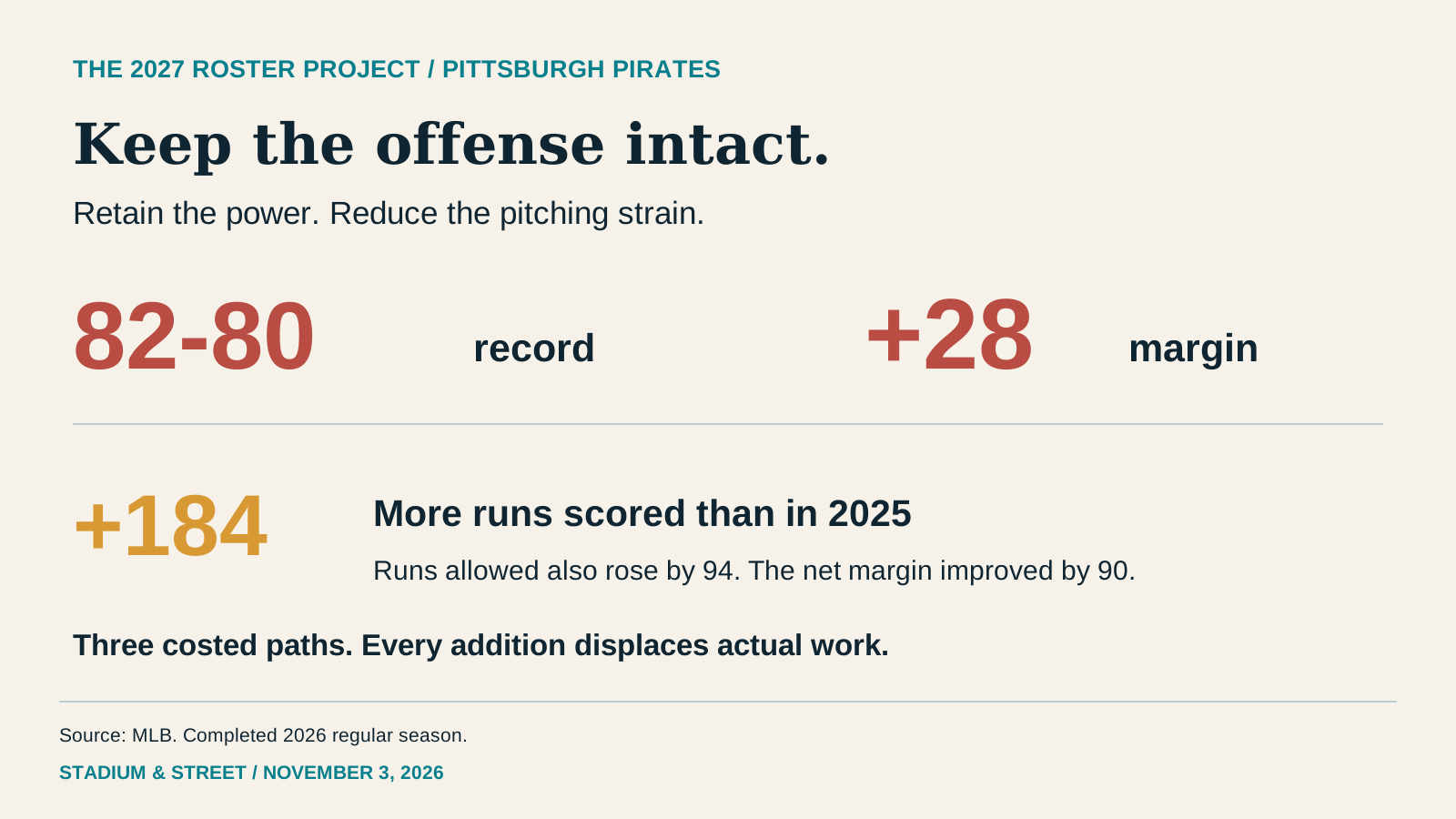
The recommendation: protect the gain, then prevent runs
The Pirates added 184 runs to their offense in one season. They also allowed 94 more. That combination explains both the opportunity in an 82-win team and the danger of assuming that a young rotation will take care of the rest. Pittsburgh finally had enough offense to make its pitching matter. The winter should preserve that progress while making the staff's workload more sustainable.
The preferred plan retains Brandon Lowe on a proposed three-year, $66-75 million contract and Gregory Soto on a proposed two-year, $14-18 million contract. Add a $6-8 million depth reserve. Annual additions are $35-42 million, bringing the estimated player-allocation envelope to $134.19-145.19 million. Counting all proposed guaranteed years and the first-year reserve, the new commitment is $86-101 million. These are S&S negotiating ceilings, not reported offers or a verified ownership budget.
Lowe is a free agent. His pending $23.15 million qualifying offer creates a separate one-year branch, not proof that he is returning. If he accepts, substitute that salary for the proposed multiyear allocation. With Soto and the same reserve, annual additions become $36.15-40.15 million. No plan counts both contracts or credits Lowe's production before he is retained.
The strongest objection to the preferred plan is that Pittsburgh would spend heavily to keep two players from a team that missed October. That objection matters. Lowe's 35 home runs helped transform the lineup, but his expected contact measures were less impressive than his results, and his defensive history contains large swings. Soto adds strikeouts without fully solving the bullpen's walk problem. The plan earns its case through defined jobs, limited terms and the young players it leaves room to develop.
If Lowe's market exceeds the ceiling, the alternative buys Eugenio Suarez for one year at $12-14 million, moves Nick Gonzales primarily to second base and retains Soto. That costs $25-31 million annually including the reserve. The internal-only path costs $6-8 million, replaces Lowe's work with existing infielders and accepts a meaningful offensive downside. The report tests all three rather than treating the cheapest path as equally productive.
The offense moved faster than the pitching
Pittsburgh went from 583 runs in 2025, last in MLB, to 767 in 2026, sixth. The club's OPS rose from .655 to .734. Its record improved by 11 wins, from 71-91 to 82-80. Those are substantial gains, even though a winning record did not bring a postseason berth.
The other side of the ledger explains why the improvement stopped there. Runs allowed rose from 645 to 739. ERA increased from 3.76 to 4.14, moving from seventh to 16th in the league-wide comparison. The net run margin improved by 90, from minus-62 to plus-28, but the Pirates surrendered much of the offense's advance through weaker run prevention.
| Season | Record | Runs for / against | Margin | OPS / ERA |
|---|---|---|---|---|
| 2024 | 76-86 | 665 / 739 | -74 | .672 / 4.15 |
| 2025 | 71-91 | 583 / 645 | -62 | .655 / 3.76 |
| 2026 | 82-80 | 767 / 739 | +28 | .734 / 4.14 |
The practical goal is to preserve most of the 2026 offense while recovering some of the lost pitching and defensive value. It would be a mistake to assume that all 184 additional runs are now permanent. Lowe is unsigned, several young hitters have short major-league records, and the lineup's actual contact results exceeded expected measures in several places.
The pitching challenge is equally specific. Starters supplied only 786.2 innings, leaving 658.1 for relievers. The bullpen walked 312 batters, about 4.27 per nine innings. Adding one late-inning arm will not remove that burden if starters continue to leave so much of the season uncovered.
A lineup with a foundation worth preserving
Bryan Reynolds supplied 699 plate appearances with a .365 on-base percentage and 89 walks. His 17 home runs were useful, but the ability to reach base repeatedly was the more important foundation. The proposed plan preserves a major role while shifting some of his workload to designated hitter.
Oneil Cruz produced a .280/.368/.486 line and 20 home runs in 419 plate appearances. His 139 strikeouts still impose a cost, but the power and on-base performance support a primary center-field job. A 540-plate-appearance allocation asks for more availability than in 2026 without assuming a full 700-appearance season.
Gonzales hit .303 and reached base at a .367 rate in 608 plate appearances. His six home runs show why he cannot simply replace Lowe's power. His contact skill nevertheless belongs in the lineup. The hard question is which infield position permits Pittsburgh to keep that offense without accepting too much defensive loss.
| Player / MLB ID | PIT PA | AVG / OBP / SLG | HR | BB / K; role |
|---|---|---|---|---|
| Bryan Reynolds / 668804 | 699 | .261 / .365 / .424 | 17 | 89 / 162; LF/DH |
| Brandon Lowe / 664040 | 656 | .260 / .331 / .493 | 35 | 62 / 189; FA; retention conditional |
| Nick Gonzales / 693304 | 608 | .303 / .367 / .388 | 6 | 43 / 99; 2B/3B |
| Jake Mangum / 663968 | 479 | .276 / .331 / .363 | 5 | 25 / 93; OF |
| Ryan O'Hearn / 656811 | 451 | .265 / .330 / .440 | 18 | 35 / 99; 1B/RF/DH |
| Spencer Horwitz / 687462 | 451 | .244 / .344 / .364 | 10 | 54 / 73; 1B |
| Oneil Cruz / 665833 | 419 | .280 / .368 / .486 | 20 | 47 / 139; CF |
| Jared Triolo / 669707 | 362 | .238 / .307 / .302 | 3 | 28 / 72; IF |
| Konnor Griffin / 804606 | 339 | .272 / .324 / .404 | 6 | 20 / 82; SS |
| Henry Davis / 680779 | 298 | .172 / .272 / .313 | 10 | 28 / 63; C |
| Esmerlyn Valdez / 699013 | 287 | .232 / .345 / .510 | 17 | 42 / 108; RF |
| Marcell Ozuna / 542303 | 280 | .203 / .286 / .327 | 8 | 27 / 80; Released; historical only |
| Rafael Flores Jr. / 804668 | 163 | .264 / .331 / .527 | 11 | 15 / 45; C/1B |
| Endy Rodríguez / 682848 | 159 | .267 / .373 / .467 | 7 | 23 / 41; C; hip surgery |
| Jacob Gonzalez / 694378 | 130 | .203 / .238 / .366 | 5 | 4 / 22; IF depth |
| Nick Yorke / 694377 | 117 | .212 / .284 / .279 | 1 | 9 / 26; 2B/IF |
| Tyler Callihan / 682997 | 107 | .211 / .283 / .389 | 3 | 9 / 38; IF/OF |
Ryan O'Hearn and Spencer Horwitz give the Pirates useful first-base and DH options, especially against right-handed pitching. Adding another first baseman would create a playing-time conflict before it solved the middle-infield decision. The acquisition priority therefore stays with Lowe's job or a third baseman who changes Gonzales' assignment.
Marcell Ozuna's 280 Pirates plate appearances remain part of the historical season. He was released in August and receives no retained playing time here. The same rule applies to every departed contributor: last year's team totals describe what happened, while the 2027 workload tables describe who could actually do the work.
How much of the offensive improvement should carry forward?
Lowe's .824 OPS followed two seasons at .784. His 2026 workload was also larger: 656 plate appearances compared with 553 in 2025 and 425 in 2024. A retention price should reflect his ability to supply scarce middle-infield power, while acknowledging that repeating the career-scale workload and 35 home runs is uncertain.
Reynolds returned to a .789 OPS after .720 in 2025, close to his .791 mark in 2024. That longer record makes his rebound a stronger foundation than a two-month rookie surge. Cruz's .854 OPS was well above his .676 in 2025 and .773 in 2024. His upside is real; a forecast that uses only the most recent season would still be too aggressive.
| Hitter | 2024 MLB PA / OPS | 2025 MLB PA / OPS | 2026 MLB PA / OPS |
|---|---|---|---|
| Brandon Lowe | 425 / .784 | 553 / .784 | 656 / .824 |
| Bryan Reynolds | 692 / .791 | 654 / .720 | 699 / .789 |
| Oneil Cruz | 599 / .773 | 544 / .676 | 419 / .854 |
| Nick Gonzales | 387 / .709 | 408 / .661 | 608 / .755 |
| Ryan O'Hearn | 494 / .761 | 544 / .803 | 451 / .770 |
| Spencer Horwitz | 381 / .790 | 411 / .787 | 451 / .708 |
| Henry Davis | 122 / .454 | 283 / .512 | 298 / .585 |
Expected wOBA and expected slugging describe the quality of contact and other measured offensive events. They are not next-season projections. The comparison is useful because several Pirates produced substantially more power than those estimates suggested, including Lowe, Esmerlyn Valdez and O'Hearn.
| Batter | wOBA | xwOBA | SLG / xSLG | Interpretation |
|---|---|---|---|---|
| Bryan Reynolds | 0.349 | 0.355 | 0.424 / 0.443 | Established on-base foundation |
| Brandon Lowe | 0.355 | 0.331 | 0.494 / 0.445 | Actual power exceeds contact estimate |
| Nick Gonzales | 0.339 | 0.327 | 0.388 / 0.386 | Contact skill; defensive assignment matters |
| Oneil Cruz | 0.371 | 0.352 | 0.486 / 0.472 | Strong production in 419 PA |
| Esmerlyn Valdez | 0.368 | 0.332 | 0.510 / 0.440 | Power ahead of contact estimate; 287 PA |
| Konnor Griffin | 0.320 | 0.316 | 0.404 / 0.404 | Reasonably aligned small-sample offense |
| Rafael Flores Jr. | 0.367 | 0.350 | 0.527 / 0.506 | Power upside in only 163 PA |
| Endy Rodríguez | 0.370 | 0.338 | 0.467 / 0.403 | Good short sample; surgery limits opening role |
| Ryan O'Hearn | 0.336 | 0.314 | 0.440 / 0.396 | Preserve platoon/DH value |
| Spencer Horwitz | 0.319 | 0.310 | 0.364 / 0.345 | On-base value with limited power |
| Jake Mangum | 0.310 | 0.285 | 0.363 / 0.331 | Actual offense ahead of expected contact |
| Henry Davis | 0.267 | 0.290 | 0.313 / 0.342 | Expected offense also below desired level |
Reynolds' .355 expected wOBA was slightly above his .349 actual figure. Lowe's .331 expected figure was below his .355 actual figure. Valdez's .510 slugging percentage compared with a .440 expected slugging estimate. These gaps argue for a range of outcomes, not a deduction of a fixed number of runs from each player.
The MLB statistics and Savant tables use their own sample definitions. For Lowe, MLB reports 656 plate appearances and .493 slugging; the saved Savant row uses 655 and .494. The report preserves that small source difference rather than silently replacing the primary season line.
Build platoons around evidence, not handedness alone
Lowe had a .910 OPS against right-handed pitching and .648 against left-handers. That is an argument for selective rest and a capable right-handed infield alternative. It is not an argument for discarding a middle infielder who can do major damage across the larger share of the schedule.
O'Hearn's split was similarly pronounced: .839 against right-handers and .620 against left-handers. Horwitz produced .734 and .596. A lineup that starts both against every left-handed pitcher would ignore a clear opportunity to use its bench more intelligently.
| Batter / full MLB season | LHP: PA / OPS | RHP: PA / OPS |
|---|---|---|
| Brandon Lowe | 211 / .648 | 445 / .910 |
| Nick Gonzales | 195 / .681 | 413 / .790 |
| Konnor Griffin | 91 / .832 | 248 / .690 |
| Oneil Cruz | 139 / .847 | 280 / .858 |
| Bryan Reynolds | 239 / .807 | 460 / .779 |
| Ryan O'Hearn | 140 / .620 | 311 / .839 |
| Spencer Horwitz | 90 / .596 | 361 / .734 |
| Jake Mangum | 134 / .678 | 345 / .700 |
| Esmerlyn Valdez | 111 / 1.011 | 176 / .761 |
| Jared Triolo | 143 / .662 | 219 / .574 |
| Henry Davis | 92 / .426 | 206 / .658 |
| Rafael Flores Jr. | 78 / .924 | 85 / .800 |
| Endy Rodríguez | 28 / .547 | 131 / .901 |
| Mauricio Dubón | 210 / .675 | 409 / .743 |
| Edmundo Sosa | 138 / .835 | 112 / .564 |
| Eugenio Suárez | 129 / .714 | 369 / .748 |
| Alec Bohm | 192 / .816 | 437 / .644 |
Cruz's 2026 splits were unusually balanced, with an .847 OPS against left-handers and .858 against right-handers. His 139 plate appearances against lefties are still one season's evidence, but they support letting him earn a broader role rather than automatically treating him as a platoon player.
Valdez and Rafael Flores Jr. hit left-handed pitching well in short samples. Their roles should grow through repeated exposure, not through a promise that those exact split lines will persist. Konnor Griffin's stronger result against lefties also came in only 91 plate appearances. Small-sample success earns an audition, not a permanent exemption from adjustment.
The bench has a job beyond resting starters: protect vulnerable matchups without turning the lineup into a daily experiment. Jake Mangum's ability to cover three outfield positions and Jared Triolo's infield coverage help preserve that flexibility. Neither needs to be presented as a middle-of-the-order replacement for Lowe.
Range is a roster decision, not a fielding percentage
Gonzales finished at minus-11 Outs Above Average in 2026, while Griffin was minus-7. The young left side of the infield therefore carries a development task that cannot be dismissed because both players can hit. The response should include positioning, instruction and workload management, with actual performance determining whether the assignment remains viable.
Lowe's plus-15 in 2026 followed minus-14 in 2025 and zero in 2024. That volatility is a warning against pricing the most recent defensive number as a permanent skill level. Retaining him can preserve an established second baseman, but the financial case should not require another plus-15 season.
| Fielder | 2024 OAA | 2025 OAA | 2026 OAA | 2026 opportunities |
|---|---|---|---|---|
| Brandon Lowe | 0 | -14 | +15 | 507 |
| Nick Gonzales | +2 | +4 | -11 | 406 |
| Konnor Griffin | No row | No row | -7 | 274 |
| Oneil Cruz | -1 | 0 | -1 | 237 |
| Bryan Reynolds | -13 | -2 | -3 | 258 |
| Ryan O'Hearn | -2 | +5 | -3 | 179 |
| Spencer Horwitz | +2 | +1 | -5 | 231 |
| Jake Mangum | No row | +6 | -1 | 285 |
| Esmerlyn Valdez | No row | No row | +2 | 126 |
| Jared Triolo | +3 | +6 | 0 | 299 |
| Nick Yorke | -2 | 0 | +1 | 77 |
| Mauricio Dubón | +10 | +19 | +6 | 449 |
| Edmundo Sosa | +4 | +5 | +4 | 210 |
| Eugenio Suárez | +3 | -6 | -7 | 127 |
| Alec Bohm | +5 | -2 | -11 | 435 |
OAA estimates outs relative to average from the opportunities tracked by Statcast. The table preserves both prior seasons and current opportunities. It does not equate a small-sample plus-2 with a full-season plus-15, or add every individual figure to an independent team defensive total.
Reynolds was minus-3, Horwitz minus-5 and O'Hearn minus-3. Those values help explain why DH time is a resource. Moving a player there may reduce a defensive burden, but it uses an opportunity another hitter could have received. The defensive-start allocation makes that tradeoff visible.
The Suarez alternative is a power purchase, not an asserted range upgrade. His minus-7 in 2026 follows minus-6 in 2025. Moving Gonzales to second could improve the fit of the infield, but the report cannot simply add an imagined number of saved runs to justify the signing.
Give each defender an actual assignment
Gonzales played 884.1 innings at third base, 236 at second and 32 at shortstop in 2026. The preferred plan keeps a substantial third-base role while giving Triolo more work there. The alternative plan moves Gonzales principally to second and assigns third to Suarez. Those are different rosters with different risks.
| Player | 2026 PIT defensive innings | 2027 allocation |
|---|---|---|
| Brandon Lowe | 2B 1181.0 | Retained 2B only if contract clears |
| Nick Gonzales | 2B 236.0; 3B 884.1; SS 32.0 | A: 3B/2B; B/C: primary 2B |
| Konnor Griffin | SS 664.1 | Primary SS, measured development |
| Oneil Cruz | CF 756.1 | Primary CF; preserve coverage |
| Bryan Reynolds | RF 152.0; LF 939.0 | LF with a defined DH share |
| Esmerlyn Valdez | 1B 1.0; LF 49.0; RF 503.1 | RF opportunity |
| Ryan O'Hearn | 1B 335.1; RF 335.1 | 1B/RF/DH, especially against righties |
| Spencer Horwitz | 1B 871.2 | Primary 1B share |
| Jake Mangum | CF 492.1; LF 329.2; RF 164.1 | All three OF positions |
| Jared Triolo | 1B 27.0; 3B 260.1; SS 527.2; RF 24.0; CF 1.0 | More 3B and SS cover |
| Rafael Flores Jr. | 1B 89.0; C 269.1 | C/1B opportunity |
| Henry Davis | C 744.2 | Receiving cover; bat must improve |
Griffin remains the primary shortstop. A nine-year contract does not eliminate the need for ordinary development, and minus-7 OAA does not establish that a young shortstop must immediately move. The plan gives him 140 defensive starts, with Triolo and Ronny Simon providing coverage rather than requiring Griffin to play every inning.
Valdez receives the largest right-field opportunity. His positive OAA in a limited sample is encouraging, but the assignment is justified by a combination of offensive potential and an available job. O'Hearn and Jhostynxon Garcia supply alternatives without forcing another full-time outfielder onto an already crowded roster.
| Pos. | 162-start allocation | Purpose |
|---|---|---|
| C | Flores 75; Davis 65; Endy 22 | Endy later only; if unavailable Flores +10, Davis +12 |
| 1B | Horwitz 100; OHearn 50; Flores 9; Endy 3 | If Endy unavailable, Horwitz takes three |
| 2B | Lowe 125; Gonzales 27; Yorke 10 | Retention conditional |
| 3B | Gonzales 95; Triolo 50; Gray 7; Brannigan 10 | Limit exposure; no assumed immediate Gray readiness |
| SS | Griffin 140; Triolo 17; Simon 5 | Young starter with established coverage |
| LF | Reynolds 110; Mangum 25; Garcia 15; Baddoo 12 | DH relief for Reynolds |
| CF | Cruz 120; Mangum 35; Baddoo 7 | Preserve actual center-field coverage |
| RF | Esmerlyn Valdez 120; OHearn 20; Garcia 15; Mangum 7 | Power audition with cover |
| DH | Reynolds 40; OHearn 60; Horwitz 25; Valdez 10; Cruz 10; Gonzales 10; Flores 4; Endy 3 | If Endy unavailable, Flores takes three |
Every listed position totals 162 starts, including designated hitter. These are planning allocations, not a prediction of the actual schedule. Endy Rodriguez's catching and DH starts are conditional later-season work after surgery. If he is unavailable, Flores and Henry Davis absorb the catching work, and existing first-base/DH players absorb the remainder.
Catching is an audition with a health constraint
Davis hit .172/.272/.313 in 298 plate appearances. His offensive record has improved from an extremely low base, but a .585 OPS still creates a substantial lineup cost. His qualified Statcast catching fielding value was approximately plus-2.7 runs, including more than framing. That defensive contribution deserves credit without being used to erase the bat.
Flores hit 11 home runs in 163 major-league plate appearances. The exciting result sits beside a .704 OPS and four home runs in 276 Triple-A plate appearances. He deserves more major-league work, but a projection built entirely from the MLB power burst would be fragile.
| Catcher | 2026 PIT catching IP | Framing runs | Receiving decision |
|---|---|---|---|
| Henry Davis | 744.2 | +0.2 | Full qualified catching value +2.7; weak bat |
| Rafael Flores Jr. | 269.1 | +0.7 | Larger audition; limited receiving sample |
| Endy Rodríguez | 273.2 | +1.0 | Post-surgery; no opening role, conditional later work |
Rodriguez underwent hip labrum surgery in August with a reported seven-to-nine-month recovery period. The offseason roster's active label does not establish opening-day readiness. The plan assigns him no opening role and only 100 conditional later plate appearances. If he cannot return during the season, Flores and Davis each gain 50.
Framing runs are only one component of receiving. The smaller samples for Flores and Rodriguez do not support a precise ranking of their complete catching value. Pittsburgh should measure receiving, throwing, blocking and offensive performance together as the roles develop. A guaranteed veteran catcher would displace those auditions; no such acquisition is funded in the preferred plan.
The rotation can improve without an expensive new name
Paul Skenes produced 200 strikeouts and 49 walks in 174.1 innings. His 3.82 ERA exceeded his 3.30 expected ERA. The roster should be built around his ability to prevent runs and work deep into games, without treating a statistical gap as a promise that he will recover a particular number of runs.
Braxton Ashcraft's 173 strikeouts and 35 walks in 165.1 innings make him a second important foundation. His 3.65 ERA and 3.45 expected ERA point in the same broad direction. Together, Skenes and Ashcraft give the Pirates a reason to spend on retention and support rather than immediately purchase another expensive starter.
| Pitcher / MLB ID | GS / PIT IP | ERA / full MLB xERA | K / BB / HR | Treatment |
|---|---|---|---|---|
| Paul Skenes / 694973 | 32 / 174.1 | 3.82 / 3.30 | 200 / 49 / 20 | Rotation foundation; maintain recovery |
| Braxton Ashcraft / 677952 | 28 / 165.1 | 3.65 / 3.45 | 173 / 35 / 22 | Strong strikeout/command evidence |
| Bubba Chandler / 696149 | 30 / 154.0 | 4.50 / 4.30 | 140 / 80 / 15 | 80 walks are the main improvement task |
| Jared Jones / 683003 | 21 / 101.2 | 3.72 / 3.18 | 123 / 31 / 12 | Build workload carefully |
| Mitch Keller / 656605 | 22 / 115.2 | 5.29 / 5.51 | 89 / 42 / 15 | Contract retained; performance must improve |
| Carmen Mlodzinski / 669387 | 12 / 123.0 | 3.95 / 4.89 | 97 / 44 / 10 | Starter/bulk flexibility |
| Hunter Barco / 682995 | 0 / 17.2 | 7.64 / 6.51 | 14 / 13 / 4 | Minor-league depth; MLB command unresolved |
| Thomas Harrington / 802419 | 0 / 0 | No MLB season | No MLB season | AAA results do not establish readiness |
Bubba Chandler's 80 walks in 154 innings are a much more concrete development priority than a general appeal for maturity. His 4.50 ERA and 4.30 expected ERA show that command improvement must translate into actual outs. The plan preserves his opportunity but does not award him a breakout season in the financial case.
Jared Jones supplied 101.2 major-league innings with 123 strikeouts, 31 walks and a 3.72 ERA. His proposed 140 innings represent an increase that requires a managed progression and current availability checks. Mitch Keller's 5.29 ERA and 5.51 expected ERA provide a different warning: the retained contract cannot be assumed to produce a rebound simply because the salary is already committed.
No Keller trade is necessary to make the preferred budget balance. A trade could become sensible at an actual price, but subtracting his contract and adding an invented return would conceal the roster's cost rather than solve it.
More starter innings would change the bullpen's job
The proposed rotation allocation is 870 innings, 83.1 more than Pittsburgh's 2026 starters supplied. That is a consequential target. It requires a fuller contribution from the top five and useful depth starts, not merely a healthier label next to a roster name.
| Pitcher | Starts / IP | Workload condition |
|---|---|---|
| Skenes | 32 / 180 | Modest rise from 174.1 MLB IP; health/recovery gate |
| Ashcraft | 30 / 170 | Near 165.1 prior MLB IP |
| Chandler | 28 / 145 | Below 154 prior IP; command must improve |
| Jones | 26 / 140 | Build from 101.2 MLB IP; readiness gate |
| Keller | 24 / 125 | Contract retained; 5.29 ERA/5.51 xERA require improvement |
| Barco | 10 / 50 | AAA command and health gate |
| Harrington | 5 / 25 | AAA 6.02 ERA does not guarantee readiness |
| Wietgrefe | 5 / 25 | 151.1 combined AAA/AA IP; conditional audition |
| Mlodzinski | 2 / 10 | Plus 65 relief IP; flexible coverage |
| TOTAL | 162 / 870 | Coverage scenario, not a health forecast |
The 162 starts include 32 for Skenes, 30 for Ashcraft, 28 for Chandler, 26 for Jones and 24 for Keller. Hunter Barco, Thomas Harrington, Connor Wietgrefe and Carmen Mlodzinski cover the remaining 22. The plan does not assume that every depth starter is ready for a permanent rotation job.
Wietgrefe's combined 151.1 innings at Double-A and Triple-A create a plausible depth foundation. Harrington's 6.02 Triple-A ERA requires improvement before he can be called a reliable replacement. Barco's 41 walks in 78.1 Triple-A innings, followed by 13 in 17.2 MLB innings, make strike throwing the gate to a larger role.
If the rotation falls 80 innings short, those innings must be reassigned to bulk relief or an actual acquisition. The reserve can finance a response, but the report credits it with no automatic production. If a starter becomes a material health concern, Pittsburgh should revisit the whole allocation before spending the same money on optional offense.
Retaining Soto helps, but command still has to improve
Mason Montgomery struck out 105 batters and walked 26 in 68.2 innings. His 2.88 ERA and 2.53 expected ERA make him one of the strongest reasons to trust the bullpen's upper end. Yohan Ramirez added 102 strikeouts in 85 innings, but 44 walks show why that ERA alone does not settle the reliability question.
Luke Weaver's Pittsburgh sample was only 16.1 innings with a 4.96 ERA. Across his full season with the Mets and Pirates, he worked 60.1 innings with a 2.69 ERA, 65 strikeouts and 16 walks. The full-season record is the appropriate basis for evaluating his retained role, while the club-only line remains in the historical table.
| Pitcher | PIT IP | ERA / full MLB xERA | K / BB | Treatment |
|---|---|---|---|---|
| Mason Montgomery | 68.2 | 2.88 / 2.53 | 105 / 26 | Major leverage candidate; retain relief volume |
| Yohan Ramírez | 85.0 | 2.86 / 3.32 | 102 / 44 | Strong strikeouts, but walks remain |
| Luke Weaver | 16.1 | 4.96 / 3.08 | 20 / 5 | Retained under contract; use full-season evidence |
| Gregory Soto | 67.0 | 3.63 / 3.03 | 79 / 29 | FA; preferred retention candidate |
| Evan Sisk | 44.2 | 3.02 / 3.76 | 50 / 25 | Useful left-handed depth; 25 walks |
| Wilber Dotel | 42.1 | 4.46 / 3.81 | 41 / 16 | Develop middle relief |
| Lake Bachar | 28.0 | 2.57 / 3.39 | 32 / 15 | Starter/bulk mix; small PIT sample |
| Brandon Eisert | 16.2 | 4.86 / 3.76 | 17 / 6 | Left-handed coverage |
| Noah Murdock | 3.1 | 0.00 / 2.79 | 4 / 3 | Small MLB sample; AAA depth evidence |
| Khristian Curtis | 21.0 | 4.71 / 3.73 | 13 / 12 | Command/development work |
| Antwone Kelly | 18.2 | 4.82 / 5.12 | 14 / 8 | Depth, not guaranteed late innings |
| Isaac Mattson | 38.2 | 5.35 / 6.23 | 36 / 18 | Claimed by Seattle; not retained |
| Kirby Yates | 15.0 | 1.80 / 3.39 | 13 / 5 | FA and retirement reported; not retained |
Soto supplies a specific missing job: 60 innings of left-handed relief with strikeout ability. He worked 67 innings with 79 strikeouts, 29 walks and a 3.63 ERA in 2026; his expected ERA was 3.03. A proposed two-year, $14-18 million retention price reflects that role. It does not make him a low-walk pitcher or guarantee the ninth inning.
| Pitcher / coverage | IP | Condition |
|---|---|---|
| Weaver | 55 | Under contract; full-season evidence matters |
| Yohan Ramirez | 70 | Below 85 prior MLB IP; control gate |
| Montgomery | 65 | Keep leverage relief role |
| Soto | 60 | Only if retained; below 67 prior IP |
| Sisk | 45 | Walk reduction needed |
| Mlodzinski | 65 | Plus ten starter IP |
| Eisert | 35 | Left-handed depth |
| Bachar | 40 | Starter/bulk history; use total workload |
| Dotel | 35 | Middle relief development |
| Murdock | 30 | Small MLB sample; AAA evidence |
| Curtis | 25 | Command gate |
| Kelly | 20 | Depth with walk concerns |
| Barco | 10 | Plus 50 starter IP |
| Other healthy depth | 15 | Unfilled coverage, no assigned performance |
| TOTAL | 570 | 870 starter + 570 relief = 1,440 innings |
| Change from retained-Soto plan | IP adjustment | Consequence |
|---|---|---|
| Remove Soto | -60 | No retained relief production credited |
| Sisk / Eisert | +15 / +15 | 60 / 50 IP |
| Montgomery / Murdock / Dotel | +10 / +10 / +10 | 75 / 40 / 45 IP |
| If Adam replaces Soto | Adam 45; internal +15 | 45-IP health-conditioned purchase, not 60 from a 34.1-IP baseline |
| TOTAL | 570 relief IP | Same volume; different workload and performance risk |
The 570-inning relief allocation is smaller than the 2026 workload because the rotation plan absorbs more of the season. Without Soto, Evan Sisk and Brandon Eisert each gain 15 innings, Montgomery and Noah Murdock each gain 10, and Wilber Dotel gains 10. The total stays intact, but the concentration of risk changes.
Jason Adam is a distinct alternative at a proposed one-year, $6-8 million ceiling, conditional on health and a current contract check. His 34.1 innings in 2026 do not justify assigning him Soto's 60. An Adam branch uses 45 innings and distributes the remaining 15 internally. John Schreiber's 26 walks in 60.1 innings make him a less convincing answer to the staff's command problem despite his 3.28 ERA.
The farm offers choices, not free production
Valdez's 13 home runs and .914 OPS in 237 Triple-A plate appearances support his major-league opportunity. His 17 MLB home runs then established that the power could appear against better pitching. The task is to preserve enough contact and defense for that power to remain valuable over a longer season.
Flores, Garcia, Simon and Jack Brannigan occupy different readiness levels. Simon's .898 Triple-A OPS supports an infield depth chance. Brannigan's .680 at the same level leaves more offensive work to do. A good prospect label should not erase those differences when assigning the next 200 plate appearances.
| Player / MLB ID | 2026 level and sample | Readiness decision |
|---|---|---|
| Esmerlyn Valdez / 699013 | AAA: 237 PA, .914 OPS, 13 HR; 41 BB / 51 K | Protect RF audition; separate Esmerlyn from Enmanuel |
| Rafael Flores Jr. / 804668 | AAA: 276 PA, .704 OPS, 4 HR; 46 BB / 69 K | MLB power burst exceeds AAA line |
| Termarr Johnson / 702261 | AAA: 406 PA, .655 OPS, 8 HR; 68 BB / 101 K | Walks alone do not establish MLB readiness |
| Mitch Jebb / 694991 | AAA: 250 PA, .839 OPS, 8 HR; 28 BB / 40 K | Utility depth candidate; no automatic 40-man slot |
| Jhostynxon Garcia / 691373 | AAA: 287 PA, .768 OPS, 10 HR; 23 BB / 68 K | OF depth; MLB transition unresolved |
| Ronny Simon / 682927 | AAA: 499 PA, .898 OPS, 7 HR; 65 BB / 85 K | IF depth after strong AAA season |
| Jack Brannigan / 687394 | AAA: 196 PA, .680 OPS, 3 HR; 27 BB / 49 K | 3B coverage; bat must improve |
| Murf Gray / 809092 | AA: 195 PA, .879 OPS, 9 HR; 29 BB / 43 K | Small late-season 3B audition only if ready |
| Edward Florentino / 821273 | A+: 435 PA, .844 OPS, 24 HR; 65 BB / 115 K | A+ development; no 2027 opening production |
| Wyatt Sanford / 815608 | A+: 341 PA, .974 OPS, 17 HR; 48 BB / 100 K | A+ development; no shortstop replacement assumption |
| Seth Hernandez / 815825 | A+: 46.0 IP, 3.33 ERA; 68 K / 24 BB | 46 A+ IP; no MLB workload credited |
| Connor Wietgrefe / 809733 | AAA: 84.2 IP, 3.08 ERA; 65 K / 27 BB | Measured depth starts after 151.1 combined AAA/AA IP |
| Thomas Harrington / 802419 | AAA: 101.2 IP, 6.02 ERA; 99 K / 42 BB | 6.02 ERA; improvement required |
| Hunter Barco / 682995 | AAA: 78.1 IP, 3.79 ERA; 80 K / 41 BB | Command must improve |
| Antwone Kelly / 699008 | AAA: 91.1 IP, 4.24 ERA; 71 K / 49 BB | Depth after 91.1 AAA IP |
| Derek Diamond / 682981 | AAA: 43.0 IP, 3.14 ERA; 39 K / 8 BB | 43 AAA IP; potential internal relief path |
Termarr Johnson's 68 walks in 406 Triple-A plate appearances are useful evidence of strike-zone judgment. A .655 OPS still leaves a substantial offensive hurdle. Mitch Jebb's .839 OPS in 250 Triple-A appearances makes him an internal option to evaluate, but a major-league roster spot and a stable role are separate decisions.
Murf Gray receives only a conditional late third-base audition. Edward Florentino, Wyatt Sanford and Seth Hernandez remain developmental assets; their A+ work is not counted as opening major-league production. Hernandez's 46 innings are particularly far from a credible substitute for a missing veteran starter's full season.
The preferred plan trades none of these players. Keeping the farm preserves future choices, but it also means that the winter's improvement must come from the actual dollars spent and the incumbents' development. An unnamed prospect return cannot make the payroll cheaper or the lineup deeper.
Start the budget with the obligations already present
The existing-roster envelope is $99.19-103.19 million before proposed additions. It combines listed salary and allocated signing-bonus amounts, estimated arbitration salaries, specified offsets and buyouts, and a $12-16 million allowance for pre-arbitration players, minor-league roster salaries and callups. It is a planning allocation, not an official competitive-balance-tax calculation or a complete club expense statement.
| Player | 2027 allocation | Basis |
|---|---|---|
| Konnor Griffin | $3.333M | $2M salary + $1.333M allocated signing bonus |
| Mitch Keller | $18.412M | $18M salary + $0.412M allocated bonus |
| Ryan O'Hearn | $15M | Guaranteed 2027 salary |
| Bryan Reynolds | $15.25M | $15M salary + $0.25M allocated bonus |
| Luke Weaver | $12.50M gross | Then subtract $1.5M bonus adjustment and $6M Mets payment |
| TOTAL | $64.495M | Gross allocations before listed offsets |
Griffin's reported nine-year, $140 million agreement runs through 2034. The 2027 salary is $2 million. This allocation adds one-ninth of the $12 million signing bonus, or about $1.333 million. The reported actual 2027 bonus payment is $3.5 million, so the cash requirement differs from the annual allocation. That difference must remain visible when ownership evaluates funding.
| Player | Estimate, $M | Basis |
|---|---|---|
| Yohan Ramirez | 1.50 | Published projection; unsigned |
| Oneil Cruz | 6.30 | Published projection; unsigned |
| Carmen Mlodzinski | 1.60 | Published projection; unsigned |
| Jared Triolo | 1.80 | Published projection; unsigned |
| Endy Rodriguez | 1.20 | Published projection; unsigned |
| Henry Davis | 1.40 | Published projection; unsigned |
| Nick Gonzales | 3.10 | Published projection; unsigned |
| Jared Jones | 2.10 | Published projection; unsigned |
| Paul Skenes | 7.20 | Published projection; unsigned |
| Spencer Horwitz | 2.50 | Published projection; unsigned |
| TOTAL | 28.70 | Ten retained cases; no assumed salary dump |
The ten arbitration estimates total $28.7 million. Skenes, Cruz and Gonzales account for a significant share, but none of those projected salaries is treated as a signed contract. The budget does not assume a non-tender or trade merely to create room for the preferred plan.
| Component | Annual allocation | Definition |
|---|---|---|
| Five guaranteed contracts | $64.495M | Salary and allocated signing bonuses |
| Arbitration pool | $28.70M | Ten published estimates |
| Weaver adjustments | -$7.50M | -$1.5M allocated bonus adjustment; -$6M Mets obligation |
| Ozuna buyout carried | $1.50M | 2027 obligation; no retained option salary or roster slot |
| Pre-arb, minors and callups | $12-16M | S&S allowance; includes minor-league roster salaries |
| Existing-roster envelope | $99.19-103.19M | Before proposed additions; benefits/tax excluded |
RosterResource lists Weaver at $12.5 million gross, then a $1.5 million bonus adjustment and a $6 million Mets obligation. The resulting net allocation is $5 million. The official trade announcement confirms cash considerations, while the amount comes from RosterResource. Those are different levels of evidence, and the same payment must never be deducted twice.
The plan also carries a $1.5 million Ozuna buyout shown in the payroll source. It carries neither a $16 million option salary nor a retained DH role. Benefits, taxes and broader operating expenses are excluded, so none of these totals should be presented as the full cost of running the club.
Lowe is the priority, with a real walk-away point
Lowe supplied 35 of Pittsburgh's home runs from a position that rarely offers that much power. Removing him would leave an immediate production gap and change Gonzales' defensive assignment. The proposed three-year ceiling buys a known job while limiting the length of the commitment.
The offer range is $66-75 million over three years, equivalent to $22-25 million annually. There is no assumption that this price wins the bidding. If the market requires a fourth guaranteed year or a total above the ceiling, Pittsburgh should compare the actual terms against the alternative rather than raise the budget by reflex.
| Candidate / MLB ID | Full 2026 MLB evidence | S&S ceiling / decision |
|---|---|---|
| Brandon Lowe / 664040 | 656 PA, .824 OPS, 35 HR; 0.355/0.331 wOBA/xwOBA | Preferred retention: 3 years / $66-75M; separate $23.15M QO branch |
| Gregory Soto / 642397 | 67.0 IP, 3.63 ERA, 3.03 xERA; 79 K / 29 BB | Preferred relief retention: 2 years / $14-18M |
| Eugenio Suárez / 553993 | 498 PA, .740 OPS, 26 HR; 0.324/0.303 wOBA/xwOBA | Power alternative: 1 year / $12-14M |
| Mauricio Dubón / 643289 | 619 PA, .720 OPS, 12 HR; 0.317/0.304 wOBA/xwOBA | Conditional bridge: prior S&S ceiling 2 years / $20-24M |
| Edmundo Sosa / 624641 | 250 PA, .712 OPS, 9 HR; 0.307/0.328 wOBA/xwOBA | Limited-role fallback: 1 year / $6-8M |
| Alec Bohm / 664761 | 629 PA, .698 OPS, 15 HR; 0.309/0.327 wOBA/xwOBA | Pass as preferred 3B; range cost unresolved |
| Ha-Seong Kim / 673490 | 147 PA, .359 OPS, 0 HR; 0.180/0.222 wOBA/xwOBA | Recovery inquiry only; no acquired production |
| Yoán Moncada / 660162 | 130 PA, .605 OPS, 3 HR; 0.281/0.269 wOBA/xwOBA | Pass as principal 3B answer; knee and offense gates |
| Luis Rengifo / 650859 | 354 PA, .636 OPS, 4 HR; 0.289/0.304 wOBA/xwOBA | Conditional depth; not a Lowe replacement |
| John Schreiber / 670167 | 60.1 IP, 3.28 ERA, 4.03 xERA; 40 K / 26 BB | Pass as main command upgrade: 26 walks / 60.1 IP |
| Jason Adam / 592094 | 34.1 IP, 2.62 ERA, 3.78 xERA; 22 K / 10 BB | Alternative: 1 year / $6-8M; 45 IP only after health check |
The one-year qualifying offer is a separate branch at $23.15 million, with the decision due November 17. Acceptance would reduce long-term commitment while preserving the immediate role. Rejection would keep the free-agent decision open. Neither outcome is known at this edition's research cutoff.
The risk is not confined to salary. Lowe's power and defensive production both exceeded some of the underlying measures in 2026. The case for retaining him rests on replacing a difficult-to-replace job, not on forecasting another 35 homers and plus-15 OAA. If the club loses him, it must remove his 550 planned plate appearances before reallocating money or projecting the lineup.
Three funded plans, with distinct consequences
Plan A retains Lowe and Soto, preserves the main young-player auditions and funds a depth reserve. Its $134.19-145.19 million envelope is the largest of the three. The return is continuity in two scarce roles, not a claim that continuity alone produces a playoff berth.
Plan B substitutes Suarez for Lowe, moves Gonzales primarily to second and retains Soto. Suarez's 26 home runs in 498 plate appearances support a power role. His .740 OPS, .303 expected wOBA and minus-7 OAA also explain why a one-year ceiling is appropriate. The plan spends less because it purchases a different, narrower package of skills.
| Plan | Annual additions | Total allocation | New commitment* |
|---|---|---|---|
| A: Lowe + Soto retained | $35-42M | $134.19-145.19M | $86-101M |
| B: Suarez + Soto | $25-31M | $124.19-134.19M | $32-40M |
| C: Internal roster | $6-8M | $105.19-111.19M | $6-8M |
New commitment includes all proposed contract years plus the first-year reserve. The reserve is not a guaranteed player contract. Plan A: Lowe $66-75M, Soto $14-18M, reserve $6-8M. Plan B: Suarez $12-14M, Soto $14-18M, reserve $6-8M. Plan C: reserve only.
Plan C keeps the internal roster after Lowe leaves and spends only the reserve. Gonzales becomes the primary second baseman. Triolo, Simon, Brannigan and a conditional Gray audition cover more third base. The lineup loses a proven source of power and asks more of players who have not yet supplied comparable production.
| Contingency | Annual additions / total | Treatment |
|---|---|---|
| Lowe accepts $23.15M QO | $36.15-40.15M / $135.34-143.34M | Replace proposed multi-year salary; keep Soto and $6-8M reserve |
| QO accepted; no Soto | $29.15-31.15M / $128.34-134.34M | Lowe retained; redistribute 60 relief IP internally |
| QO declined; no acquisitions | $6-8M / $105.19-111.19M | Plan C; do not count Lowe production |
| Lowe market exceeds ceiling | Do not assume retention | Reprice alternative and remove his PA before spending |
| Griffin cash timing | Separate from allocated bonus | Reported $3.5M 2027 bonus payment; allocation only $1.333M |
| Weaver trade offsets | Verify actual obligation at release | No double credit for Mets payment and bonus adjustment |
| Ozuna released | Carry $1.5M buyout, not $16M option | No retained DH work |
| Other expenses | Benefits, tax and operations excluded | Not a full club budget or official CBT calculation |
The qualifying-offer branches must be evaluated before committing the same money elsewhere. If Lowe accepts and the club declines to retain Soto, the total envelope becomes $128.34-134.34 million. If Lowe leaves, the cheaper internal path is $105.19-111.19 million. Those outcomes differ by a real player, not merely by a line in a budget spreadsheet.
Allocate the plate appearances before signing the player
The preferred plan totals 6,200 plate appearances. It gives Griffin 600, Valdez 500 and Flores 360, while retaining central roles for Reynolds, Cruz and Gonzales. That is enough room to learn about the young players without asking the lineup to be composed entirely of auditions.
| Player | PA | Opportunity |
|---|---|---|
| Reynolds | 620 | LF/DH |
| Cruz | 540 | CF/DH |
| Griffin | 600 | SS |
| Gonzales | 530 | 3B/2B/DH |
| Lowe | 550 | 2B; only if retained |
| Esmerlyn Valdez | 500 | RF/DH |
| OHearn | 480 | 1B/RF/DH |
| Horwitz | 430 | 1B/DH |
| Flores | 360 | C/1B/DH |
| Davis | 270 | C |
| Mangum | 350 | OF |
| Triolo | 280 | 3B/SS |
| Endy Rodriguez | 100 | Conditional later C/1B/DH; no opening work |
| Garcia | 180 | OF |
| Yorke | 120 | 2B/IF |
| Simon | 100 | IF |
| Callihan | 60 | IF/OF |
| Baddoo | 50 | OF |
| Brannigan | 40 | 3B |
| Gray | 40 | Conditional late 3B audition |
| TOTAL | 6,200 | Season coverage, not 20 simultaneous active hitters |
The allocation is a full-season coverage plan, not a proposal to carry 20 hitters at once. Some depth work occurs after injuries, option moves or later promotions. Gray's 40 appearances are conditional late-season development, and Rodriguez's 100 depend on recovery from surgery.
| Change from A | PA adjustment | Consequence |
|---|---|---|
| B: remove Lowe; add Suarez | -550 / +500 | Different position and defensive tradeoff |
| B: Gonzales | +50 | 580 PA; primary 2B |
| C: remove Lowe | -550 | No retained power credited |
| C: Gonzales / Yorke | +50 / +180 | 580 / 300 PA |
| C: Simon / Triolo / Gray | +120 / +100 / +100 | 220 / 380 / 140 PA; more developmental risk |
| Endy unavailable all season | -100; Flores +50, Davis +50 | Remove conditional work; preserve 6,200 PA |
| TOTAL | 6,200 in every plan | No acquisition creates free playing time |
Suarez's 500 appearances replace Lowe's 550, with Gonzales receiving the remaining 50. The internal path distributes all 550 among Gonzales, Yorke, Simon, Triolo and Gray. The bookkeeping is exact because an acquisition cannot create extra games for everyone else.
The proposed lineup also preserves DH flexibility. Reynolds, O'Hearn, Horwitz and Valdez receive meaningful shares. A second expensive bat who needs the same position would require a new allocation and a fresh marginal-value argument. The club cannot justify that purchase by counting both players' preferred workloads.
Repeated targets need different jobs, not different sales pitches
Suarez also appears in the Cardinals' prepared alternative. In St. Louis, he would take a larger third-base role and reduce the auditions for Blaze Jordan and Nolan Gorman. In Pittsburgh, he would replace Lowe's power while moving Gonzales to second. The same one-year $12-14 million ceiling can fit both arguments, but only one club could sign him, and neither plan assumes availability beyond the current free-agent check.
Mauricio Dubon was considered elsewhere as a versatile bridge. His six OAA in 2026 and 19 in 2025 are attractive, but his current defensive work included only 46 innings at third base. A general utility reputation is not enough to make him Pittsburgh's automatic third-base answer. At the prior S&S ceiling of two years and $20-24 million, he remains a conditional alternative, not the preferred Lowe replacement.
Edmundo Sosa is the Cardinals' preferred limited-role infield purchase at one year and $6-8 million. Pittsburgh can test the same candidate, but 250 plate appearances and seven walks in 2026 do not establish a full-season replacement for Lowe. Sosa would compete directly with Triolo and other internal coverage while leaving a larger power gap.
Alec Bohm's minus-11 OAA fails the principal range test for this roster. Ha-Seong Kim and Yoan Moncada require recovery and performance checks before a substantial role could be justified. Luis Rengifo would be a depth inquiry rather than a substitute for 35 home runs. The report gives none of these conditional names purchased production.
Lowe and Soto are retention priorities unique to the Pirates' current decisions. No outgoing prospects or draft selections are assumed in those retention paths. For an external signing, current qualifying-offer and compensation status must be checked before final terms are evaluated. The comparison measures the exact job, displaced incumbent, workload, term and price, rather than choosing a new name merely to make the report look different.
Test the upside against the cost of losing offense
A plus-28 run margin supports cautious optimism. It does not establish an 88-win floor. The simplest way to see the sensitivity is to vary runs scored and allowed, holding everything else inside a deliberately limited arithmetic model.
| Illustrative change from 2026 | RS / RA | Margin | Simple run-ratio wins* |
|---|---|---|---|
| Unchanged runs | 767 / 739 | +28 | 84.0 |
| Score 20 more; prevent 20 | 787 / 719 | +68 | 88.3 |
| Offense flat; prevent 35 | 767 / 704 | +63 | 87.9 |
| Lose 35 runs; prevent 20 | 732 / 719 | +13 | 82.5 |
| Lose 50 runs; allow 20 more | 717 / 759 | -42 | 76.4 |
Illustrative wins use 162 × RS² / (RS² + RA²). This simple run-ratio calculation is not a player projection, betting forecast or estimate of postseason probability. Actual 2026 wins were 82; the unchanged-run illustration is about 84.
Scoring 20 more runs and preventing 20 produces a plus-68 margin and about 88.3 illustrative wins. Holding offense flat while preventing 35 produces a similar result. Both paths require concrete improvement, not a new label for the existing roster.
Losing 35 offensive runs while preventing 20 leaves a plus-13 margin and about 82.5 illustrative wins. Losing 50 while allowing 20 more moves the illustration down to about 76.4. That is why the internal-only plan cannot be sold as a cost-free version of the preferred plan.
The model does not assign exact run values to Lowe, Soto, Gonzales' position change or Griffin's development. Those effects depend on availability, replacement performance and context. Its purpose is to show how much of the 2026 offensive gain Pittsburgh can afford to surrender while expecting the pitching staff to carry the difference.
Sequence the winter around decisions that change the roster
First, resolve the Lowe qualifying-offer branch. An accepted one-year contract and a declined offer create different budgets and different negotiating leverage. Pittsburgh should retain a priced alternative while the decision is pending, but not commit the same salary allocation twice.
Second, decide whether Soto's retention terms fit the $14-18 million two-year ceiling. If they do not, compare a shorter Adam proposal with the internal relief distribution and current health evidence. Avoid adding a familiar veteran whose walk profile merely reproduces the bullpen's existing weakness.
Third, reconcile Jones' projected workload, the depth starters' readiness and Rodriguez's recovery before setting the opening roster. The medical record available publicly cannot establish private clearance, and an offseason active designation cannot replace it. The plan's conditional work remains conditional.
Fourth, assign Gonzales, Griffin and the third-base alternatives actual defensive work during preparation. The results should determine whether the preferred alignment is viable. If Gonzales' range remains a material cost at third, the club must revisit the alignment even if Lowe's contract makes second base less available.
Finally, protect the reserve for needs that actually emerge. Spending it early on a redundant first baseman would reduce the ability to respond to a rotation shortage. The reserve's value is the choice it preserves; no wins are credited to it until a player and a job are identified.
What would change the recommendation?
An accepted Lowe qualifying offer would replace the proposed multiyear deal immediately. A market price above three years and $75 million would move the recommendation toward the Suarez or internal branch. A new contract, qualifying offer or material health development for any external candidate would require a new comparison before the player could remain in a funded plan.
A substantial reduction in Jones' or another starter's credible workload would move pitching depth ahead of optional offensive spending. The 870-inning starter target is ambitious relative to 2026. If it becomes unrealistic, the bullpen cannot be expected to absorb the missing innings without cost.
A stronger, sustained receiving and offensive performance from Flores would justify a larger catching share. A full-season absence for Rodriguez would remove his 100 conditional appearances and redistribute them to Flores and Davis. Neither change requires pretending that Rodriguez has already recovered or that Flores' first 163 MLB appearances establish his ceiling.
A credible internal third-base emergence could reduce the need for Suarez if Lowe leaves. Gray's Double-A work and Brannigan's Triple-A record do not establish that outcome yet. The cheaper plan becomes more attractive only when a player supplies evidence for the job, not when the budget needs an optimistic assumption.
The preferred plan is a measured effort to keep the offense intact and reduce the strain on the pitching staff. Its strongest countercase is the cost of retention for an 82-win team. That countercase wins if the prices rise beyond the stated limits or the starter workload cannot support the relief plan. It does not win merely because retaining familiar players produces less winter excitement than adding new names.
The roster and the departures are different lists
The November 3 major-roster source contains 38 players, all carrying an administrative active designation. That list is a transaction snapshot, not a healthy opening-day roster. Rodriguez remains the explicit no-opening-workload exception because of the documented hip surgery.
| Current major-roster player / MLB ID | Bats / throws | Administrative status |
|---|---|---|
| Akil Baddoo / 668731 | L / L | Active |
| Antwone Kelly / 699008 | R / R | Active |
| Billy Cook / 695257 | R / R | Active |
| Brandon Eisert / 685126 | L / L | Active |
| Braxton Ashcraft / 677952 | L / R | Active |
| Bryan Reynolds / 668804 | S / R | Active |
| Bubba Chandler / 696149 | S / R | Active |
| Carmen Mlodzinski / 669387 | R / R | Active |
| Endy Rodríguez / 682848 | S / R | Active; no opening workload after hip surgery |
| Esmerlyn Valdez / 699013 | R / R | Active |
| Evan Sisk / 681895 | L / L | Active |
| Henry Davis / 680779 | R / R | Active |
| Hunter Barco / 682995 | L / L | Active |
| Jack Brannigan / 687394 | R / R | Active |
| Jacob Gonzalez / 694378 | L / R | Active |
| Jake Mangum / 663968 | S / L | Active |
| Jared Jones / 683003 | L / R | Active |
| Jared Triolo / 669707 | R / R | Active |
| Jhostynxon Garcia / 691373 | R / R | Active |
| Khristian Curtis / 694753 | R / R | Active |
| Konnor Griffin / 804606 | R / R | Active |
| Lake Bachar / 669199 | R / R | Active |
| Luke Weaver / 596133 | R / R | Active |
| Mason Montgomery / 682254 | L / L | Active |
| Mitch Keller / 656605 | R / R | Active |
| Nick Gonzales / 693304 | R / R | Active |
| Nick Yorke / 694377 | R / R | Active |
| Noah Murdock / 668716 | R / R | Active |
| Oneil Cruz / 665833 | L / R | Active |
| Paul Skenes / 694973 | R / R | Active |
| Rafael Flores Jr. / 804668 | R / R | Active |
| Ronny Simon / 682927 | S / R | Active |
| Ryan O'Hearn / 656811 | L / L | Active |
| Spencer Horwitz / 687462 | L / R | Active |
| Thomas Harrington / 802419 | R / R | Active |
| Tyler Callihan / 682997 | L / R | Active |
| Wilber Dotel / 696062 | R / R | Active |
| Yohan Ramírez / 670990 | R / R | Active |
Lowe and Soto are free agents and receive only conditional retained workloads. Kirby Yates is also a free agent, with retirement reported on the official Pirates update. Isaac Mattson's Seattle waiver claim is corroborated by the current Seattle roster even though an individual team label lagged. He receives no Pirates innings.
| Player / MLB ID | Classification | 2027 treatment |
|---|---|---|
| Brandon Lowe / 664040 | Free Agent Qo Pending | Retention conditional; not currently signed |
| Gregory Soto / 642397 | Free Agent | Retention conditional; not currently signed |
| Kirby Yates / 489446 | Free Agent Retirement Reported | No 2027 PIT workload; past contributions separate |
| Marcell Ozuna / 542303 | External Or Historical | No 2027 PIT workload; past contributions separate |
| Isaac Mattson / 676755 | Departed | No 2027 PIT workload; past contributions separate |
| Camilo Doval / 666808 | External Or Historical | No 2027 PIT workload; past contributions separate |
| Joey Bart / 663698 | External Or Historical | No 2027 PIT workload; past contributions separate |
| Shawn Ross / 676566 | External Or Historical | No 2027 PIT workload; past contributions separate |
| Justin Lawrence / 664875 | Free Agent | No 2027 PIT workload; past contributions separate |
| Dennis Santana / 642701 | Free Agent | No 2027 PIT workload; past contributions separate |
| Brandan Bidois / 684049 | External Or Historical | No 2027 PIT workload; past contributions separate |
| Ron Marinaccio / 676760 | External Or Historical | No 2027 PIT workload; past contributions separate |
| Hunter Stratton / 676702 | External Or Historical | No 2027 PIT workload; past contributions separate |
| José Urquidy / 664353 | Free Agent | No 2027 PIT workload; past contributions separate |
| Cam Sanders / 676742 | External Or Historical | No 2027 PIT workload; past contributions separate |
| Davis Wendzel / 673995 | Departed | No 2027 PIT workload; past contributions separate |
Historical statistics remain attached to the team for which they were recorded. They do not imply current affiliation. The individual register retains MLB IDs, current roster evidence and transaction history for every named player. When a cached team label conflicts with an official transaction, the report follows the reconciled transaction rather than inventing a return to Pittsburgh.
Definitions and the limits of the estimates
All season totals are completed MLB regular-season statistics unless a minor-league level or another scope is explicitly stated. Club-only lines and full-season lines are labeled separately. Baseball innings use outs, so 101.2 means 101 innings and two outs, not 101.2 decimal innings. Totals and per-nine rates are calculated from outs.
OPS adds on-base and slugging percentages. wOBA values offensive events on a common scale. Expected wOBA and expected slugging use Statcast's measured-event framework and are not forward projections. Expected ERA is another descriptive estimate; it does not assign responsibility for every run or promise regression in a particular direction.
OAA measures tracked fielding opportunities relative to average. Prior seasons, opportunity counts and actual positions provide context. Catcher framing runs and complete catching fielding value are different measures and must not be added together as independent contributions. A missing qualified row is unknown, not zero.
The payroll envelope uses salary allocations, estimated arbitration amounts, listed obligations and explicit S&S reserves. It differs from actual cash timing and official CBT payroll. All proposed prices are editorial ceilings. There are no assumed completed signings, private medical findings, trade agreements or guaranteed ownership commitments.
The workload plans total 6,200 plate appearances, 162 starts and 1,440 pitching innings. They describe a complete season allocation, not a forecast of every player's availability. Conditional work must be reassigned if its conditions fail. The no-acquisition plan removes purchased production before redistributing opportunities.
Research and roster checks are dated November 3, 2026. The report preserves the original statistical periods and source-specific qualifications. A later transaction or medical update can change the recommendation without changing what the completed 2026 record showed.
Go to the sources
See something that needs attention? Read our corrections process.