Team analysis · 2027 roster planning
Build the Rays' next margin
November 3, 2026 edition
The complete review
November 3, 2026 edition. Completed 2026 regular-season performance with November 3 roster, transaction and market checks. The full website analysis includes 22 evidence and planning tables; the 30-page PDF is suitable for forwarding. Proposed prices and workloads are scenarios.
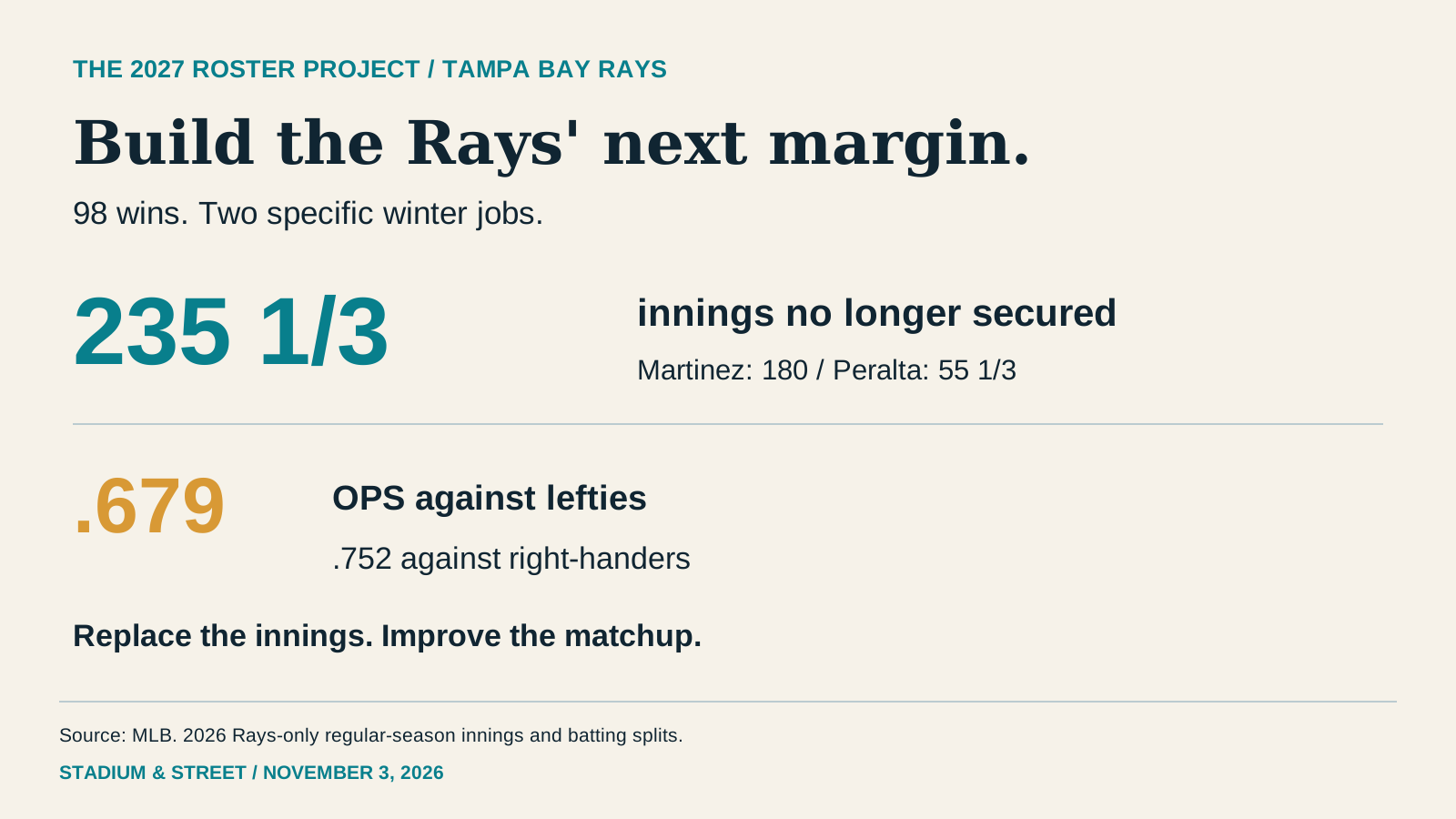
The recommendation: protect the innings, improve the matchup
Tampa Bay won 98 games and the American League pennant with a roster that scored 736 runs and allowed 650. That is a strong team. It is also a team facing a specific winter problem: Nick Martinez and Freddy Peralta supplied 235 1/3 innings for the Rays, and both are now free agents. Returning the rest of the roster does not return those innings.
Keep Drew Rasmussen at the center of the rotation. Investigate retaining Martinez at an S&S ceiling of two years and $26-30 million, and add a limited right-handed outfield bat, with Randal Grichuk the preferred one-year inquiry at $6-8 million. Preserve a separate $5-7 million depth reserve. These are proposed negotiating limits, not reported offers or an assertion that the players will accept them.
The offensive purchase has a defined purpose. Tampa Bay produced a .679 OPS against left-handed pitching and .752 against right-handers. Grichuk would receive roughly 260 plate appearances, principally in favorable outfield matchups. He would not displace Junior Caminero, Jonathan Aranda or Yandy Diaz from the middle of the order. He would reduce some of the weakest left-handed-pitching exposures while leaving the young outfield a substantial path to playing time.
Plan A requires $24-30 million in annual additions and reserve capacity, above an existing-roster planning envelope of $106.30-110.30 million. The resulting $130.30-140.30 million allocation is a meaningful increase from RosterResource's estimated $89.85 million final 2026 payroll. The definitions differ in timing and included allowances, so that comparison is a scale check, not a cash-flow reconciliation. Ownership must decide whether it will fund this level.
If that level is unavailable, Plan B buys the platoon bat and uses internal pitching. Plan C makes neither major purchase and carries only the reserve. The alternatives reduce spending, but they increase the work assigned to less established pitchers and hitters. They are shown with the same 162-start, 1,440-inning and 6,200-plate-appearance framework so the missing purchase remains visible.
What improved, and what the record conceals
| Season | Record | Runs for / against | Margin | Offense / pitching |
|---|---|---|---|---|
| 2024 | 80-82 | 604 / 663 | -59 | .668 OPS / 3.77 ERA |
| 2025 | 77-85 | 714 / 683 | +31 | .714 OPS / 3.94 ERA |
| 2026 | 98-64 | 736 / 650 | +86 | .728 OPS / 3.70 ERA |
The Rays moved from a minus-59 run differential in 2024 to plus-31 in 2025 and plus-86 in 2026. The latest improvement came from both sides: 22 more runs scored and 33 fewer allowed. The offense's home-run total actually fell from 182 to 169. Better contact, more walks and a substantially lower strikeout total helped the club score more without relying on another power surge.
Tampa Bay struck out 1,145 times in 6,106 plate appearances, down from 1,397 in 6,045 the year before. Walks rose from 468 to 514. Those changes create more opportunities for a roster that can run and pressure a defense. They also explain why the winter should not begin with an indiscriminate search for a slugger who costs contact, defense and playing time somewhere else.
The venue changed as well. Tampa Bay's 81 home games in 2025 were at George M. Steinbrenner Field; the 2026 club returned to Tropicana Field. The year-to-year totals are descriptive and unadjusted for park or schedule. The contact and walk evidence helps explain the change without assigning the entire scoring difference to personnel.
The 98 wins should not become the starting point for a mechanical 2027 forecast. A simple runs-squared comparison, 162 multiplied by 736 squared divided by the sum of 736 squared and 650 squared, yields approximately 91 wins. That diagnostic is deliberately basic. It measures the relationship between runs and wins, not managerial quality, clutch ability or the club's future record. Tampa Bay won more games than that simple relationship suggests.
The previous season offers the corresponding warning in the other direction. A plus-31 margin accompanied a 77-85 record. The two seasons show why a front office should investigate the underlying work rather than assume every difference between runs and wins will persist. The 2026 pennant is earned history. A 2027 plan still needs enough scoring and prevention to withstand ordinary variation.
October confirms the achievement, not a complete roster
The Rays swept the Yankees in three Division Series games, beat Cleveland in six to win the pennant, then lost the World Series to Milwaukee in five. The completed postseason record was 8-6. The schedule contains a postponed entry for an ALCS game as well as its later final; only the completed game belongs in that count.
The World Series began with Milwaukee wins of 3-2 and 5-4. Milwaukee won Game 3 by 10-1, Tampa Bay won Game 4 by 4-3, and Milwaukee took the clincher 4-1. Two close opening losses and a late survival win make a different argument from five games of uniform inferiority. They do not erase the opponent's stronger overall series, and they do not identify a single offseason purchase that would have reversed it.
The useful lesson is the strain placed on the roster's usable depth. A short series makes a vulnerable matchup harder to conceal, and a postseason staff cannot endlessly borrow innings from tomorrow. The winter plan should improve the options available to Kevin Cash before those choices narrow again. It should not be built around finding a player who resembles one isolated October hero.
Rasmussen belongs in that conversation as an established rotation anchor. The exercised $20 million option includes the performance escalator. Treat the salary as a real cost of retaining an important player. Removing him to make the spreadsheet cheaper would create a new baseball problem requiring its own return and workload analysis.
The roster after the option decisions
The current roster is not the list of everyone who appeared for Tampa Bay during the regular season. Martinez and Cedric Mullins became free agents after their mutual options were declined. Peralta and Jorge Mateo also reached free agency. Hunter Feduccia was traded to the Dodgers in August, and Jake Fraley was released in September. Their Tampa Bay statistics remain historical evidence, not retained production.
The November 2 changes also matter at the margins. The club added Alexander Alberto and Jack Suwinski to the 40-man roster, reinstated Ryan Pepiot, Edwin Uceta and Jacob Melton, and parted with Nick Madrigal and Jonathan Heasley. The reconciled count is 39. Walls' option was exercised and Diaz's vested option confirmed.
Reinstatement from an injured list is an administrative act. Pepiot and Uceta did not pitch for the Rays in 2026, and Melton did not appear for them in the Majors. Their 2027 availability and effectiveness remain separate questions from membership. The plans below reserve opportunity for them without describing them as proven replacements for an entire lost season of production.
One open 40-man place is not enough for two outside signings. Plan A therefore requires at least one additional roster decision. A non-tender, waiver move or trade may create it, but this analysis does not book salary savings or a return before a specific move is justified. Payroll space, roster space and useful playing time are three different resources.
The offensive core is worth protecting
| Player / MLB ID | PA | AVG / OBP / SLG | HR | BB / K and context |
|---|---|---|---|---|
| Junior Caminero / 691406 | 702 | .276 / .360 / .524 | 42 | 79 / 129; Core 3B |
| Yandy Díaz / 650490 | 686 | .293 / .359 / .446 | 22 | 56 / 98; Primary DH |
| Jonathan Aranda / 666018 | 668 | .274 / .358 / .434 | 22 | 69 / 163; Primary 1B |
| Chandler Simpson / 802415 | 612 | .306 / .333 / .356 | 0 | 26 / 48; LF / speed |
| Cedric Mullins / 656775 | 502 | .205 / .284 / .344 | 15 | 43 / 97; Departed FA |
| Taylor Walls / 670764 | 433 | .222 / .309 / .298 | 2 | 45 / 105; SS |
| Richie Palacios / 680700 | 399 | .235 / .330 / .374 | 10 | 46 / 68; 2B |
| Jonny DeLuca / 676356 | 370 | .266 / .300 / .429 | 11 | 17 / 78; CF / RF |
| Nick Fortes / 663743 | 323 | .258 / .304 / .376 | 6 | 12 / 45; C |
| Ben Williamson / 810938 | 286 | .238 / .302 / .318 | 3 | 22 / 54; 2B / SS |
| Ryan Vilade / 668723 | 278 | .245 / .321 / .429 | 11 | 26 / 65; 1B / OF |
| Victor Mesa Jr. / 683748 | 262 | .260 / .327 / .498 | 14 | 23 / 53; RF |
| Hunter Feduccia / 676439 | 160 | .234 / .306 / .340 | 2 | 14 / 44; Traded to LAD |
| Liam Hicks / 689414 | 145 | .288 / .379 / .440 | 4 | 16 / 16; C / 1B |
| Carson Williams / 700246 | 40 | .108 / .154 / .216 | 1 | 2 / 13; SS prospect sample |
Caminero's 42 home runs and .884 OPS in 702 plate appearances provide the clearest foundation. He also drew 79 walks against 129 strikeouts. A hitter with that combination can carry an offense without requiring every supporting player to become an above-average power threat. The challenge is preserving his offensive contribution while addressing the defensive cost examined below.
Diaz supplied a .359 on-base percentage and .446 slugging percentage over 686 plate appearances. Aranda followed with .358 and .434 in 668. Their contact-quality figures are close enough to their observed results to support their importance in the plan. They already occupy the bulk of the first-base and designated-hitter work. Adding another player whose main value requires those positions would need a corresponding subtraction.
Chandler Simpson brings a different skill set: a .306 average, 46 stolen bases and only 48 strikeouts in 612 plate appearances. He also hit no home runs, walked 26 times and was caught stealing 14 times. His speed has value, but the club must turn his opportunities into runs efficiently. A successful steal percentage of 76.7 is descriptive evidence, not a blanket authorization to run in every game state.
The next tier contains useful possibilities rather than settled everyday answers. Victor Mesa Jr. hit 14 home runs in 262 plate appearances. Jonny DeLuca offered strong range and a .729 OPS. Ryan Vilade produced an .818 OPS against lefties. Those are reasons to give them meaningful roles, with different workload and matchup conditions, rather than fill every opening with an outside veteran.
Contact quality should shape the size of the bet
| Batter | wOBA | xwOBA | SLG / xSLG | Interpretation |
|---|---|---|---|---|
| Junior Caminero | 0.375 | 0.364 | 0.524 / 0.499 | Core power supported by contact quality |
| Yandy Díaz | 0.350 | 0.346 | 0.446 / 0.439 | Stable middle-order production |
| Jonathan Aranda | 0.348 | 0.343 | 0.434 / 0.438 | Strong two-way first-base case |
| Chandler Simpson | 0.305 | 0.263 | 0.356 / 0.297 | Speed matters; low expected contact output |
| Jonny DeLuca | 0.317 | 0.261 | 0.429 / 0.325 | Large gap limits an offensive extrapolation |
| Victor Mesa Jr. | 0.355 | 0.329 | 0.498 / 0.439 | Promising 262-PA sample; retain uncertainty |
| Richie Palacios | 0.316 | 0.306 | 0.374 / 0.334 | Useful against righties; limited impact |
| Taylor Walls | 0.278 | 0.251 | 0.298 / 0.261 | Glove-first job has an offensive cost |
| Ryan Vilade | 0.327 | 0.327 | 0.429 / 0.421 | Useful internal platoon alternative |
| Liam Hicks | 0.352 | 0.319 | 0.434 / 0.358 | Full MLB season, not just Tampa Bay |
Caminero's .375 wOBA and .364 xwOBA are close enough to support the broad power-and-on-base argument. Diaz was at .350 and .346, and Aranda at .348 and .343. These measures are not projections, but they provide a more useful check than assuming every hot season is either completely sustainable or entirely luck.
Simpson requires a different reading. His .305 wOBA exceeded a .263 xwOBA, and his .356 slugging percentage exceeded a .297 expected figure. Speed and the particular shape of a contact hitter's game can create differences that a contact model does not fully summarize. Even so, the gap argues against treating a .306 batting average as a guaranteed offensive floor.
DeLuca's gap is also substantial: .317 wOBA against .261 expected, with .429 slugging against .325 expected. His defense can support a regular role even if the bat retreats. The financial and lineup plan should not require both his glove and every extra-base hit to repeat at their strongest observed levels.
Mesa's .355 wOBA and .329 expected figure support an opportunity with less certainty than the .825 OPS headline alone implies. His 262-plate-appearance sample is an audition that went well. Increasing that workload to 450 plate appearances is a considered development choice, not a claim that the team has already found a full-season star.
Hicks' expected-stat row covers his entire MLB season, including work before joining Tampa Bay. His Rays-only .819 OPS came in 145 plate appearances. Mixing that short club sample with a full-season defensive or contact metric would overstate the precision of the case. The report keeps the scopes separate.
Fix the left-handed-pitching problem without creating another one
| Batter / sample basis | Against LHP: PA / OPS | Against RHP: PA / OPS |
|---|---|---|
| Junior Caminero | 195 / .916 | 507 / .871 |
| Yandy Díaz | 202 / .780 | 484 / .816 |
| Jonathan Aranda | 190 / .678 | 478 / .837 |
| Chandler Simpson | 211 / .633 | 401 / .718 |
| Jonny DeLuca | 155 / .666 | 215 / .773 |
| Victor Mesa Jr. | 66 / .868 | 196 / .811 |
| Taylor Walls | 155 / .541 | 278 / .644 |
| Richie Palacios | 64 / .478 | 335 / .748 |
| Ben Williamson | 133 / .585 | 153 / .649 |
| Ryan Vilade | 170 / .818 | 108 / .641 |
| Liam Hicks (all MLB) | 118 / .505 | 436 / .883 |
| Randal Grichuk (all MLB) | 178 / 1.026 | 102 / .636 |
| Lane Thomas (all MLB) | 165 / .804 | 209 / .623 |
The team split is large enough to warrant a targeted response. Against lefties, the Rays hit .248/.315/.364 in 1,972 plate appearances. Against righties, they hit .263/.332/.420 in 4,134. The issue is not that the entire lineup needs to be replaced. Caminero remained highly productive against both sides, while several supporting hitters had much narrower paths to value.
Simpson managed a .293 on-base percentage against lefties, with three walks in 211 plate appearances. Palacios had a .478 OPS in only 64 such appearances. Walls was at .541, Williamson at .585 and DeLuca at .666. Each sample deserves its own uncertainty, but the collection makes it difficult to dismiss the weakness as a single player's small-sample anomaly.
Vilade is a meaningful internal counterargument to buying Grichuk. His .341 on-base percentage and .477 slugging against lefties came in 170 plate appearances. Keeping more of that work inside the organization would save money. The limit is defensive deployment: his range evidence is weaker than that of the primary outfield, and his opportunities also intersect with first-base coverage.
Grichuk's combined-team 2026 split was 1.026 OPS against lefties in 178 plate appearances and .636 against righties in 102. This is a specialized job. The proposed 260 plate appearances should not expand into an everyday commitment simply because his full-season OPS was .880. The majority-side coverage remains with Simpson, Mesa and the rest of the existing roster.
Mesa's .868 OPS against lefties came in 66 plate appearances. That is a useful observation, but not enough to conclude he has solved a reverse-platoon problem for the next five years. Give him a chance to retain work against both sides and adjust as evidence accumulates. Do not automatically bench a young hitter solely to justify an offseason signing.
The defensive problem is concentrated
| Fielder | 2024 OAA | 2025 OAA | 2026 OAA | 2026 opportunities / implication |
|---|---|---|---|---|
| Junior Caminero | -1 | -3 | -14 | 525 / tracked plays |
| Taylor Walls | -3 | +1 | -3 | 467 / tracked plays |
| Chandler Simpson | No row | -5 | +9 | 376 / tracked plays |
| Jonny DeLuca | +7 | +1 | +14 | 281 / tracked plays |
| Victor Mesa Jr. | No row | +1 | +8 | 186 / tracked plays |
| Richie Palacios | +2 | -4 | -8 | 403 / tracked plays |
| Ben Williamson | No row | 0 | -5 | 294 / tracked plays |
| Jonathan Aranda | +1 | +1 | +3 | 414 / tracked plays |
| Ryan Vilade | +1 | 0 | -4 | 161 / tracked plays |
| Carson Williams | No row | -2 | -2 | 40 / tracked plays |
| Cedric Mullins | +2 | +4 | +11 | 342 / departed |
Caminero's minus-14 OAA is the clearest individual warning. It followed minus-three in 2025 and minus-one in a smaller 2024 sample. The offensive value is substantial enough that the initial answer is to improve his work at third base, investigate the plays he is missing and use appropriate late-game coverage. An immediate position change would shift costs into an already crowded first-base and DH structure.
The alternatives must be evaluated honestly. Williamson's 2026 work was primarily at second base and shortstop, with just 12 1/3 innings at third. Vilade played six innings at third. Carson Williams played two. None of those small major-league samples proves that a ready-made defensive upgrade is sitting on the bench. More training and scouting may justify a change, but the evidence here does not award free runs for it.
The outfield has a stronger range foundation. DeLuca recorded plus-14 OAA, Mesa plus-eight and Simpson plus-nine. Mullins' departure also removes plus-11, so the club cannot simply add the returning totals and announce a better defense. Different players will cover different innings. The correct question is how the next alignment performs at its actual positions and workload.
Walls' Gold Glove and his minus-three OAA measure different things. The award recognizes a broader evaluation of the season; OAA is a particular range-based model. Neither should be edited to make it agree with the other. His cheap secured salary and extensive shortstop experience support retaining the role, while the offensive cost and competing defensive evidence still belong in the decision.
Palacios at minus-eight and Williamson at minus-five identify another area for review. The club's infield should not be described as uniformly elite because its reputation is strong. Use positioning, individual play review and the available personnel to find attainable improvements. Do not turn a negative one-year number into a permanent verdict either.
Positions are a constraint, not a footnote
| Player | 2026 Rays positions / innings | 2027 implication |
|---|---|---|
| Junior Caminero | 3B 1401.2; 1B 1.0 | Keep 3B initially; evaluate positioning and late defense |
| Jonny DeLuca | LF 22.0; CF 324.0; RF 441.0 | Move primary opportunity to CF |
| Chandler Simpson | CF 16.0; LF 1264.0 | LF remains the tested role |
| Victor Mesa Jr. | LF 53.0; CF 17.0; RF 510.1 | RF opportunity after Mullins departure |
| Richie Palacios | 3B 10.0; 2B 863.2; LF 8.0; RF 2.0 | 2B work must justify defensive tradeoff |
| Ben Williamson | 3B 12.1; 2B 442.1; SS 170.0 | 2B/SS backup, not proven 3B upgrade |
| Ryan Vilade | 3B 6.0; LF 89.0; RF 255.0; 1B 152.0; 2B 40.0 | Platoon offense with limited defensive certainty |
| Carson Williams | 2B 23.0; SS 65.1; 3B 2.0 | SS audition; bat must earn it |
| Liam Hicks | C 258.0; 1B 19.0 | Catcher workload needs gradual expansion |
DeLuca is the logical first center-field candidate after Mullins' departure, but most of his 2026 outfield innings were in right: 441, against 324 in center. Simpson played 1,264 innings in left and just 16 in center. Mesa played 510 1/3 in right and 17 in center. The preferred alignment preserves Simpson's most tested position and gives DeLuca the largest center-field opportunity.
A corner platoon can help the offense without asking Grichuk to replace Mullins' center-field coverage. His role is primarily a limited corner assignment and occasional DH flexibility, with the latter constrained by Diaz. DeLuca and Simpson remain the more credible center-field options in this plan; Melton can compete when healthy and ready.
The infield has fewer easy rearrangements. Aranda played 1,271 innings at first base. Diaz's major-league fielding record for the year is DH-only. Caminero logged 1,401 2/3 at third. Moving one of those three creates an opportunity problem for the others. A new first baseman is therefore low on the acquisition list even when an appealing free-agent stat line exists.
An illustrative 13-hitter opening group contains Hicks and Fortes; Aranda, Palacios, Walls, Caminero, Williamson and Vilade; Simpson, DeLuca, Mesa and Grichuk; and Diaz. Williams and the other prospects remain part of the season's coverage rather than imaginary extra bench spots. The final composition depends on health, options and actual spring competition.
Catching: use Hicks' bat, preserve a credible partner
| Catcher / season scope | Catching run value | Components: framing / throwing / blocking / ABS |
|---|---|---|
| Nick Fortes / TB | -0.8 | -1.8 / +0.3 / +0.2 / +0.4 |
| Liam Hicks / all MLB | +3.2 | +1.4 / +1.7 / -1.4 / +1.6 |
| Hunter Feduccia / all MLB | +1.6 | +4.6 / -2.9 / -1.4 / +1.2 |
Hicks offers the most promising offensive route behind the plate, but his workload needs to be built from what he has actually done. He caught 258 innings for Tampa Bay in 2026 and 539 across his full MLB season. His overall catching run value was plus-3.2, with positive framing and throwing components offset partly by blocking. Those components describe different tasks and are already included in the total.
Fortes caught 739 2/3 innings for the Rays. His catching run value was minus-0.8, close enough to neutral that the underlying components matter: framing was negative, while throwing, blocking and the ABS component were positive. His .680 OPS does not demand an everyday offensive role, but he supplies an experienced partner and a different batting-side option.
Feduccia's positive framing figure is historical context after his trade to Los Angeles. It cannot be carried into a Tampa Bay projection. Likewise, Caden Bodine's strong minor-league contact record should earn a serious look without being used to eliminate the need for a second established catcher before he has faced major-league pitching.
The allocation gives Hicks 380 plate appearances, Fortes 220 and smaller opportunities to Bodine and Kenny Piper. Some of Hicks' work may come at first base or DH when another regular rests. A practical catching workload could begin near 85 starts for Hicks and 55 for Fortes, with the remaining 22 handled by readiness-dependent depth. That is a deployment scenario, not a medical or performance guarantee.
The rotation: a strong anchor and a real volume gap
| Pitcher / MLB ID | GS / IP | ERA / xERA* | K / BB / HR | Current context |
|---|---|---|---|---|
| Drew Rasmussen / 656876 | 30 / 172.0 | 2.67 / 3.06 | 174 / 32 / 14 | Option exercised |
| Nick Martinez / 607259 | 31 / 180.0 | 3.10 / 3.98 | 109 / 26 / 22 | Free agent |
| Ian Seymour / 693855 | 16 / 132.2 | 4.21 / 3.55 | 158 / 36 / 25 | Internal candidate |
| Shane McClanahan / 663556 | 24 / 118.0 | 3.36 / 4.30 | 106 / 39 / 10 | Spring return reported |
| Griffin Jax / 643377 | 23 / 112.1 | 3.53 / 4.27 | 116 / 35 / 15 | Internal starter/bulk |
| Steven Matz / 571927 | 11 / 80.1 | 5.49 / 5.05 | 61 / 25 / 15 | Contract through 2027 |
| Freddy Peralta / 642547 | 10 / 55.1 | 3.25 / 3.84 | 43 / 15 / 6 | Free agent; TB-only IP |
| Joe Boyle / 671212 | 3 / 19.0 | 5.21 / 3.98 | 21 / 9 / 1 | Depth; command risk |
Rasmussen supplied 172 innings in 30 starts, a 2.67 ERA and 174 strikeouts against 32 walks. His 3.06 xERA supports a strong underlying season while allowing room for some retreat from the observed ERA. Paying the exercised option retains that record and its associated risk. Trading him solely to return to an old payroll level would remove the most convincing current rotation foundation.
Martinez's 180 innings and Peralta's 55 1/3 Tampa Bay innings account for 235 1/3 that are no longer secured. Peralta's full-season numbers belong to a different scope from his Rays stint. The table shows club innings with full-season expected ERA explicitly labeled. A late-season acquisition cannot be counted as though all of his year's work occurred for his final club.
McClanahan delivered 118 innings with a 3.36 ERA, but his 4.30 expected ERA and 106 strikeouts against 39 walks argue for more caution than the ERA alone. The November 3 injury update reports a full-go offseason and anticipated spring return for McClanahan. Pepiot completed a multi-inning October bullpen session and graduated from rehabilitation, with a spring return expected after missing 2026. Neither expected return establishes a guaranteed number of innings or the quality of those innings.
Seymour is the most interesting internal growth case. His 4.21 ERA over 132 2/3 innings came with 158 strikeouts and 36 walks, and a 3.55 xERA. The combination makes a larger role defensible. It does not require the team to believe every internal pitcher will improve simultaneously. Giving him 125 starter innings plus 15 in relief is a measured increase in the starting assignment, not an unlimited workload.
Jax produced 112 1/3 innings across his expanded role, with 23 starts. His 3.53 Rays ERA and 4.27 full-season xERA suggest useful flexibility with performance uncertainty. Matz's 5.49 ERA over 80 1/3 innings makes him a different kind of asset: an already-paid swingman whose role should be earned. The $7.5 million contract is a cost to account for, not a reason to award him 30 starts.
A bullpen should not depend on repeating every low ERA
| Pitcher | TB IP | ERA / full-season xERA | K / BB | Usage evidence |
|---|---|---|---|---|
| Bryan Baker | 62.1 | 1.44 / 3.08 | 63 / 22 | 0 starts included; all roles |
| Kevin Kelly | 73.2 | 2.44 / 3.37 | 63 / 11 | 0 starts included; all roles |
| Cam Booser | 41.0 | 1.98 / 2.64 | 45 / 6 | 0 starts included; all roles |
| Garrett Cleavinger | 41.1 | 4.79 / 4.27 | 54 / 22 | 0 starts included; all roles |
| Tyler Wells | 18.0 | 1.50 / 2.94 | 19 / 5 | 0 starts included; all roles |
| Casey Legumina | 60.0 | 3.60 / 4.24 | 46 / 16 | 6 starts included; all roles |
| Cole Sulser | 56.1 | 4.31 / 4.38 | 56 / 17 | 2 starts included; all roles |
| Jesse Scholtens | 47.2 | 4.34 / 5.19 | 37 / 15 | 2 starts included; all roles |
| Mason Englert | 39.1 | 5.95 / 6.19 | 38 / 9 | 4 starts included; all roles |
| Manuel Rodríguez | 6.2 | 2.70 / 5.37 | 10 / 8 | 0 starts included; all roles |
| Ty Johnson | 7.2 | 3.52 / 3.87 | 11 / 4 | 0 starts included; all roles |
The Rays' relief-role total was 632 innings with a 3.99 ERA, 590 strikeouts and 220 walks. That is different from adding the full-season totals of players called relievers, some of whom also started. The staff budget must respect those roles or it will count the same innings twice.
Baker's 1.44 ERA and 41 saves were major contributions. His 3.08 xERA is still strong, but materially above the result. Kelly had a 2.44 ERA against 3.37 expected, and Booser 1.98 against 2.64. Those differences do not invalidate the season. They argue against making a repeat of all three results essential to the next pennant bid.
Wells' 18 Tampa Bay innings are a small part of his full MLB season. His full-season 2.94 xERA should not be presented as a model fitted only to that Rays sample. Cleavinger, Legumina, Sulser and the remaining depth provide a range of alternatives, with different command, contact and workload concerns. The useful bullpen is the collection of available options, not simply the best six ERAs from the previous year.
Uceta underwent an arthroscopic shoulder cleanup in October. The November 3 team update puts his possible return around June and says he likely will not be ready until midway through 2027. The principal plan therefore gives him zero innings and assigns the previously conditional 30 innings to the organizational coverage pool. A successful later return would provide upside, with any workload displacing other innings rather than being counted twice.
The $5-7 million reserve is divided into a $3-4 million pitching-depth component and a $2-3 million infield/roster contingency. It is not a second closer budget. Spend it where an actual readiness failure appears, and record the corresponding change in the roster and workload plan. An unspent allowance supplies no innings.
The farm system can improve the roster without being rushed
| Player / MLB ID | Dated 2026 level and sample | Readiness decision |
|---|---|---|
| Carson Williams / 700246 | AAA: 476 PA, .707 OPS, 12 HR, 58 BB / 158 K | SS competition; 158 K require progress |
| Caden Bodine / 805207 | AAA: 61 PA, .970 OPS, 3 HR, 7 BB / 6 K | 61 AAA PA do not settle a starting-C decision |
| Caden Bodine / 805207 | AA: 179 PA, .844 OPS, 5 HR, 20 BB / 12 K | Excellent contact foundation at AA |
| Theo Gillen / 815394 | AA: 268 PA, .894 OPS, 10 HR, 36 BB / 53 K | Future outfield path, not assumed April starter |
| Jacob Melton / 689200 | AAA: 186 PA, .821 OPS, 7 HR, 22 BB / 62 K | Health and strikeouts limit certainty |
| Jadher Areinamo / 699130 | AA: 303 PA, .745 OPS, 13 HR, 18 BB / 58 K | Infield depth after upper-level adjustment |
| Brody Hopkins / 811315 | AAA: 94.0 IP, 5.17 ERA, 122 K / 92 BB | 92 BB in 94 IP block guaranteed MLB volume |
| Ty Johnson / 694494 | AAA: 62.1 IP, 3.03 ERA, 84 K / 25 BB | Real strikeout evidence; workload still builds |
| Joe Boyle / 671212 | AAA: 66.2 IP, 7.97 ERA, 91 K / 52 BB | 91 K and 52 BB; no automatic rotation job |
| Alexander Alberto / 693739 | AAA: 31.2 IP, 4.55 ERA, 33 K / 16 BB | New 40-man arm; 31.2 AAA IP |
| Jack Suwinski / 669261 | AAA: 143 PA, .596 OPS, 1 HR, 11 BB / 38 K | Depth contract, not replacement for Mullins output |
| Kodi Whitley / 676831 | AAA: 32.0 IP, 2.81 ERA, 31 K / 8 BB | Non-roster relief competition |
| Nathan Flewelling / 807083 | A+: 486 PA, .816 OPS, 21 HR, 71 BB / 132 K | Longer-term catching depth |
| Grady Emerson / 815690 | A: 60 PA, .499 OPS, 0 HR, 8 BB / 13 K | Development asset; no 2027 MLB PA allocated |
Bodine's contact record is the most compelling near-term offensive development. Across the three listed levels he had 391 plate appearances, 38 walks and 28 strikeouts. The 61-plate-appearance Triple-A finish was excellent, but short. The next question is how his receiving, throwing, game preparation and bat translate over a larger upper-level workload. That is enough reason for a legitimate catching path, not enough to declare the job settled.
Gillen produced an .894 OPS in 268 Double-A plate appearances after a 1.038 mark in High-A. He offers a possible future outfield solution from within. The preferred plan's short commitment to Grichuk protects that opportunity. It also avoids assigning Gillen a full major-league season before he has demonstrated readiness at the next level.
Williams' Triple-A line presents a more difficult decision. Twelve home runs and 58 walks in 476 plate appearances show useful skills, but 158 strikeouts and a .707 OPS do not make him an obvious immediate offensive upgrade. His 40 major-league plate appearances are too few to settle the question. The plan gives him a path to win work while retaining Walls as the present shortstop.
Hopkins struck out 122 in 94 Triple-A innings, but also walked 92. Boyle struck out 91 and walked 52 in 66 2/3. Those are command problems a workload spreadsheet cannot solve. Ty Johnson's 84 strikeouts against 25 walks in 62 1/3 Triple-A innings provide a more balanced immediate case, though his major-league sample is also small.
The younger layer has value on its own timetable. Flewelling's 21 home runs and 71 walks at High-A belong to a longer catching-development plan. Emerson's 60 Single-A plate appearances are a starting point, not a verdict. Neither receives assumed 2027 major-league production here. Protecting their development is an alternative to using them as unnamed currency in a speculative trade.
The payroll bridge must include the raises already earned
| Player | 2027 allocation, $M | Basis |
|---|---|---|
| Drew Rasmussen | 20.00 | Exercised option including $12M escalator |
| Yandy Diaz | 13.00 | Vested option, now confirmed |
| Steven Matz | 7.50 | Second contract year |
| Taylor Walls | 3.10 | Exercised club option |
| TOTAL | 43.60 | Four contracts/options; no second Rasmussen escalator charge |
Four secured contract and option amounts total $43.6 million. Rasmussen's $20 million includes the $12 million performance escalator, so adding the escalator again would overstate the cost. Diaz's $13 million and Walls' $3.1 million are now part of the base, alongside Matz's $7.5 million.
| Player | Estimate, $M | Status |
|---|---|---|
| Shane McClanahan | 6.60 | Published projection; not a signed salary |
| Tyler Wells | 4.00 | Published projection; not a signed salary |
| Cole Sulser | 1.90 | Published projection; not a signed salary |
| Griffin Jax | 5.70 | Published projection; not a signed salary |
| Garrett Cleavinger | 3.70 | Published projection; not a signed salary |
| Nick Fortes | 3.40 | Published projection; not a signed salary |
| Bryan Baker | 4.10 | Published projection; not a signed salary |
| Ryan Pepiot | 3.10 | Published projection; not a signed salary |
| Kevin Kelly | 2.60 | Published projection; not a signed salary |
| Richie Palacios | 2.00 | Published projection; not a signed salary |
| Edwin Uceta | 1.50 | Published projection; not a signed salary |
| Manuel Rodriguez | 0.90 | Published projection; not a signed salary |
| Jonny DeLuca | 1.70 | Published projection; not a signed salary |
| Jesse Scholtens | 0.90 | Published projection; not a signed salary |
| Jonathan Aranda | 4.10 | Published projection; not a signed salary |
| TOTAL | 46.20 | 15 retained cases; no guessed non-tender savings |
The retained arbitration estimates total $46.2 million across 15 cases. These are published projections, not agreements. The bridge removes Madrigal and moves Walls out of arbitration into the exercised-option line. It does not assume savings from non-tendering every inconvenient salary. A player removed from the cost model must also be removed from the baseball plan.
The estimates illustrate why a familiar roster can become significantly more expensive. McClanahan, Jax, Baker, Aranda and several others enter larger salary cases. The club's low-cost development success has produced players with greater compensation rights. Repeating the roster is therefore not the same financial decision as repeating the prior year's payroll.
| Component | Annual allocation | Definition |
|---|---|---|
| Four contracts/options | $43.60M | Rasmussen $20M is inclusive |
| Arbitration pool | $46.20M | 15 estimates; Walls moved to contracts, Madrigal departed |
| Listed 2027 buyouts | $4.50M | Martinez $4M; Mullins $0.5M; retained conservatively |
| Pre-arb, minors and callups | $12-16M | S&S allowance includes 40-man minor salaries |
| Existing-roster envelope | $106.30-110.30M | Excludes additions, benefits, tax and unverified obligations |
The $4.5 million buyout allowance retains the listed 2027 Martinez and Mullins amounts conservatively. The $12-16 million pre-arbitration, minor-league and call-up pool is an S&S planning allowance. It includes the minor-league 40-man salary component, so that component should not be added again. The result is an annual allocation envelope, not an audited cash schedule or a competitive-balance-tax calculation.
Benefits, tax, incentives outside the identified lines and unresolved obligations are excluded rather than invented. Future labor terms could also change costs. Any adopted agreement must replace the relevant assumptions before execution. This report makes no claim about the club's private cash, borrowing capacity, profitability or ownership's approved ceiling.
The market test: buy the job the roster needs
| Candidate / MLB ID | Full 2026 MLB record | S&S limit / decision |
|---|---|---|
| Nick Martinez / 607259 | 180.0 IP, 3.10 ERA, 3.98 xERA, 109 K / 26 BB | Retention: 2 years / $26-30M |
| Randal Grichuk / 545341 | 280 PA, .880 OPS, 15 HR; 0.370/0.335 wOBA/xwOBA | Platoon purchase: 1 year / $6-8M |
| Lane Thomas / 657041 | 374 PA, .701 OPS, 11 HR; 0.313/0.311 wOBA/xwOBA | Alternative: 1 year / $5-7M ceiling |
| Rob Refsnyder / 608701 | 129 PA, .465 OPS, 4 HR; 0.207/0.255 wOBA/xwOBA | Pass as funded batting solution |
| David Peterson / 656849 | 148.1 IP, 4.79 ERA, 4.76 xERA, 137 K / 65 BB | Alternative inquiry only; not superior command |
| Jameson Taillon / 592791 | 86.0 IP, 5.65 ERA, 5.96 xERA, 76 K / 32 BB | Pass as central innings solution |
| Chris Bassitt / 605135 | 102.0 IP, 4.41 ERA, 4.92 xERA, 74 K / 38 BB | 102 IP do not supply 155-IP role |
| Ty France / 664034 | 500 PA, .865 OPS, 21 HR; 0.373/0.327 wOBA/xwOBA | Pass: 1B/DH already occupied |
| Luis Rengifo / 650859 | 354 PA, .636 OPS, 4 HR; 0.289/0.304 wOBA/xwOBA | Pass as established infield upgrade |
Martinez is the preferred retention inquiry because the roster needs innings more than another speculative upside starter. His 109 strikeouts and 26 walks in 180 innings show precise strike throwing with a modest strikeout rate. The 3.98 xERA is a useful limit on enthusiasm for the 3.10 ERA. A two-year, $26-30 million ceiling prices the volume candidate while recognizing that he turns 37 during the 2027 season.
He is ineligible for another qualifying offer, so this case does not include a new qualifying-offer compensation burden. The $4 million buyout remains in the existing-roster envelope rather than disappearing because a reunion is proposed. A new contract is a new negotiation, and Tampa Bay has no exclusive claim to the player after free agency begins.
Grichuk's .370 wOBA exceeded his .335 expected figure. His actual .566 slugging was also above the .478 expected mark. Those are reasons to cap both term and role despite the excellent left-handed-pitching split. The one-year $6-8 million proposal is a deliberate premium for a useful narrow job, not an extrapolation of a 280-plate-appearance season into 600.
Lane Thomas provides a different right-handed alternative. His .804 OPS against lefties came in 165 plate appearances, and his .313 wOBA was close to the .311 expected figure. The negative defensive evidence, minus-seven OAA, keeps him from being treated as interchangeable center-field coverage. At a one-year S&S ceiling of $5-7 million, he is a conditional alternative for the batting job, with the defensive compromise explicit.
Refsnyder's .465 OPS in 129 plate appearances does not clear the present funded-bat test. Taillon's 86 innings and 5.65 ERA do not establish the volume protection sought from Martinez. Peterson's 148 1/3 innings are more substantial, but 65 walks and a 4.76 xERA do not supply the same command case. Bassitt's 102 innings also leave a larger coverage problem. These are evaluated alternatives, not names added merely to make the shopping list look varied.
France's .865 OPS is attractive, but first base and DH are already occupied. Rengifo's .636 OPS and negative range evidence do not establish the infield improvement this roster needs. Neither purchase clears the marginal-value test without an additional roster change. No trade availability, asking price or outgoing package is assumed.
Compare the shared targets by role and price
The Brewers review treats Martinez as a conditional alternative if its first-base commitment falls away. This Rays review treats him as a preferred retention inquiry because two departing starters supplied 235 1/3 club innings. The same two-year, $26-30 million limit is used in both cases. The difference is the incumbent work displaced, not an invented claim that the same pitcher is cheaper for a different club.
For Milwaukee, Martinez would take starts primarily from Shane Drohan and Brandon Sproat. For Tampa Bay, he reduces the larger assignments that otherwise fall to Jax, Matz, Ty Johnson and the Hopkins/Boyle group. The Rays' use is therefore a coverage decision tied to a specific lost workload. The two clubs cannot both acquire him, and neither plan receives his innings until a contract exists.
The Phillies' Grichuk alternative carried a one-year $7-9 million range as a compromise for a larger outfield need. Tampa Bay's $6-8 million ceiling funds a narrower 260-plate-appearance platoon role, with Vilade available internally and younger outfielders needing opportunity. The lower ceiling is a judgment about incremental value and opportunity cost. It is not a reported market quote or a promise that the player will accept less.
France has a more direct positional case in the Brewers' first-base alternatives than he does in Tampa Bay. Bassitt's limited 2026 volume is a concern in both the Mets' and Rays' innings plans. Reusing that concern is appropriate because the same evidence applies. Reusing a proposed acquisition without identifying the job, displaced work and price would not be.
No plan here spends prospects. That is intentional: the preferred purchases are free-agent negotiations, and the internal alternative is credible enough to avoid inventing a trade. If a club-controlled upgrade becomes available, the evaluation must include the named outgoing talent, remaining control, salary, roster places and lost future opportunity. A vague willingness to trade prospects is not a completed acquisition case.
Three plans with different costs and different risks
| Plan | Annual additions | Total allocation | New commitment* |
|---|---|---|---|
| A: Martinez + Grichuk + reserve | $24-30M | $130.30-140.30M | $37-45M |
| B: Grichuk + internal pitching | $11-15M | $117.30-125.30M | $11-15M |
| C: Internal roster + reserve | $5-7M | $111.30-117.30M | $5-7M |
New commitment includes the full proposed Martinez guarantee where applicable and the entire reserve as a conservative funding allowance. The reserve is not a signed obligation. Annual allocation excludes benefits, applicable tax and the other costs identified in the payroll section.
Plan A combines Martinez at $13-15 million annually, Grichuk at $6-8 million and $5-7 million of reserve capacity. It requires $24-30 million in annual additions and $37-45 million of total new funding commitments if every proposed amount is used. The existing-roster base brings the annual envelope to $130.30-140.30 million.
Plan B removes the Martinez contract and keeps the Grichuk purchase and reserve. It costs $11-15 million in additions, producing $117.30-125.30 million in total annual allocation. The offensive improvement is retained, but more starts move to Jax, Matz and developing pitchers. This is the preferred lower-spend alternative if ownership will not fund Plan A or Martinez's price exceeds the ceiling.
Plan C makes no major outside purchase and keeps $5-7 million available for actual depth needs. Its total envelope is $111.30-117.30 million. Vilade and the existing outfield absorb the missing platoon work; the internal staff absorbs the missing Martinez role. The cheaper price does not produce the same roster. It leaves more uncertainty concentrated in command, health and the weak side of the offensive split.
The reserve cannot finance two full emergency solutions at once. If the pitching need consumes the entire amount, an additional infield purchase requires a revised total. If ownership's limit is below even Plan C's fully funded envelope, the next step is a specific retention and subtraction plan. It would be misleading to present all current salaries, all current production and a lower total as though they coexist automatically.
The plate appearances have to fit
| Player / role | PA | Opportunity |
|---|---|---|
| Caminero | 660 | 3B; selective DH |
| Diaz | 600 | Primary DH |
| Aranda | 570 | Primary 1B |
| Simpson | 500 | LF; protect LHP exposure |
| DeLuca | 500 | Primary CF |
| Mesa | 450 | Primary RF audition |
| Walls | 430 | Primary SS |
| Palacios | 400 | 2B, favor RHP |
| Hicks | 380 | C / occasional 1B-DH |
| Fortes | 220 | C; more LHP exposure |
| Grichuk | 260 | OF platoon purchase, conditional |
| Vilade | 220 | 1B / OF platoon alternative |
| Williamson | 300 | 2B / SS reserve |
| Carson Williams | 180 | Readiness-dependent SS/2B |
| Melton | 120 | OF health and contact gate |
| Bodine | 80 | C readiness-dependent |
| Gillen | 80 | OF readiness-dependent |
| Areinamo | 70 | IF depth |
| Piper | 30 | C depth |
| Suwinski | 50 | OF depth |
| Other coverage | 100 | Injuries and roster turnover |
| TOTAL | 6,200 | Season coverage, not 21 simultaneous roster spots |
The 6,200-plate-appearance budget is a season-coverage framework, slightly above the completed 6,106. It is not a projection of team offense. It includes injuries, promotions, demotions and turnover rather than assuming 21 hitters occupy a 13-man position-player group together. The core retains the largest assignments, while the proposed purchase receives a limited job.
Caminero, Diaz and Aranda combine for 1,830 plate appearances. Simpson, DeLuca and Mesa receive 1,450, enough to test the outfield's internal upside without treating every 2026 result as fixed. Walls and Palacios keep major roles with room for Williams and Williamson to earn more. Hicks' work increases without eliminating Fortes' place.
Grichuk's 260 plate appearances should be drawn principally from vulnerable outfield matchups and pinch-hitting opportunities. His presence is not a reason to remove a productive Mesa against a lefty merely because the veteran was signed for that purpose. Actual performance and readiness should govern the final distribution within the stated roster constraints.
| Change from A/B | PA change | Result |
|---|---|---|
| Grichuk | -260 | No acquired bat credited |
| Vilade | +120 | 340 PA; more favorable OF/1B matchups |
| Mesa | +60 | 510 PA; larger sample risk |
| Melton | +50 | 170 PA conditional on health/readiness |
| Suwinski | +30 | 80 PA; depth, not assumed production |
| NET | 0 | Same 6,200-PA season |
If no platoon bat is acquired, Vilade gains 120 plate appearances, Mesa 60, Melton 50 and Suwinski 30. Those changes total the missing 260 exactly. The allocation exposes the fallback instead of replacing the player's name with an imaginary league-average hitter. Melton's added work remains conditional on health and contact progress; Suwinski's limited role reflects his weak Triple-A finish.
The innings have to fit, too
| Pitcher / coverage | Starts / IP | Role and workload test |
|---|---|---|
| Rasmussen | 28 / 155 | 17 IP below his completed 2026 total |
| Martinez | 28 / 155 | Only if retained; 25 IP below 2026 |
| McClanahan | 24 / 125 | 7 IP above 2026; spring readiness matters |
| Pepiot | 22 / 115 | Return from a missed MLB season |
| Seymour | 24 / 125 | Larger starting role; 15 relief IP separate |
| Jax | 20 / 100 | Starting/bulk flexibility; 15 relief IP separate |
| Matz | 10 / 45 | 45 starter + 35 relief IP = 80 total |
| Ty Johnson | 4 / 20 | Build from 62.1 AAA IP and 7.2 MLB IP |
| Hopkins / Boyle / other | 2 / 10 | Readiness-dependent depth; command must improve |
| TOTAL | 162 / 850 | Plan A; all roles separated from relief |
Plan A assigns 162 starts and 850 starter innings. Rasmussen and Martinez each receive 28 starts and 155 innings. McClanahan and Pepiot have more cautious workloads, while Seymour, Jax and Matz share the remaining established work. The two-start final pool is a visible contingency, not a claim that one unproven pitcher is already a finished starter.
The budget allows fewer innings from Rasmussen than his completed 172 and fewer from Martinez than his 180. It does not demand career-level durability from either. Pepiot's 115 innings remain a meaningful return from a missed year. If that return is delayed, the plan needs additional coverage rather than simply rewriting his availability assumption.
| Pitcher / coverage | IP | Role and workload test |
|---|---|---|
| Kelly | 65 | Flexible leverage; below 73.2 TB innings |
| Baker | 60 | Primary closing option; ERA need not repeat |
| Booser | 50 | LHP leverage; nine IP above 2026 |
| Cleavinger | 45 | LHP matchup and leverage work |
| Wells | 60 | Multi-inning coverage; full-season record matters |
| Uceta | 0 | Possible midseason return; upside outside principal budget |
| Legumina | 65 | Bulk relief; prior starts not counted again |
| Matz | 35 | Additional to 45 starter IP |
| Seymour | 15 | Additional to 125 starter IP |
| Jax | 15 | Additional to 100 starter IP |
| Rodriguez | 30 | Larger role requires availability and command |
| Sulser | 35 | Middle relief; below 2026 workload |
| Englert | 20 | Depth rather than automatic leverage work |
| Alberto / Cook / Johnson / other | 95 | Organizational coverage; includes 30 IP previously conditional on Uceta |
| TOTAL | 590 | 850 starter + 590 relief = 1,440 innings |
The 590 relief innings are separate from the starter assignments. Matz, Seymour and Jax have additional relief work shown explicitly. Kelly and Baker anchor the leverage group, with flexibility for Booser, Cleavinger and Wells. Uceta receives no principal innings. The organizational pool carries 95 innings, making the additional burden from his delayed return visible.
| Change from Plan A | Starts / IP change | Result |
|---|---|---|
| Martinez | -28 / -155 | No retained innings credited |
| Jax | +6 / +30 | 26 starts / 130 starter IP |
| Matz | +8 / +35 | 18 starts / 80 starter IP |
| Ty Johnson | +8 / +40 | 12 starts / 60 starter IP |
| Hopkins / Boyle / other | +6 / +30 | 8 starts / 40 starter IP |
| Relief coverage | 0 / +20 | Other relief pool rises from 95 to 115 |
| TOTAL | 162 starts / 1,440 IP | 830 starter + 610 relief; larger unproven burden |
Plans B and C remove Martinez's 28 starts and 155 innings. Jax gains six starts and 30 innings; Matz gains eight and 35; Ty Johnson gains eight and 40; the Hopkins/Boyle group gains six and 30. That replaces the starts but only 135 of the innings. The remaining 20 move to relief, leaving 830 starter and 610 relief innings. The lower-spend alternatives carry a larger bullpen burden as well as less established starters.
No part of that accounting proves the innings will be effective. Hopkins' and Boyle's walk totals are the clearest warning. If they cannot handle their shares, the reserve must buy a usable alternative or the plan must acknowledge an unfilled workload. Increasing the number in a spreadsheet does not solve command.
How much margin can the Rays afford to lose?
| Illustrative change from 2026 | RS change | RA change | Run margin |
|---|---|---|---|
| Retained scoring/prevention | 0 | 0 | +86 |
| Offense -20; prevention slips 20 | -20 | +20 | +46 |
| Offense -35; prevention slips 35 | -35 | +35 | +16 |
| Offense +15; prevention slips 10 | +15 | +10 | +91 |
A plus-86 run margin leaves less room for simultaneous setbacks than Milwaukee's plus-214. If scoring falls by 20 runs and prevention slips by 20, Tampa Bay's margin becomes plus-46. If each side worsens by 35, it becomes plus-16. These are arithmetic stress cases, not probabilistic forecasts or claims about a particular player's expected decline.
The exercise explains the preference for spreading improvements across two needs. An innings addition reduces the burden placed on uncertain returnees and depth. A narrow offensive addition attacks the weaker handedness matchup. Neither is guaranteed to succeed, but the combined plan is less dependent on a single prospect breakout or another cluster of exceptionally low relief ERAs.
The strongest case for Plan C is that the organization may develop enough improvement internally. Seymour, Mesa, Hicks, Bodine and Gillen each supply a different possible source. The strongest case against it is that several of those improvements would need to arrive while other players remain healthy and retain their best production. A list of plausible gains is not the same as a diversified plan.
A fair evaluation also gives the existing players room to improve. Caminero could save more runs at third. Palacios could perform better defensively. Williams could improve his contact. Those possibilities should guide coaching and opportunity, but they receive no automatic run credit in the financial case. The reserve and the alternatives exist because improvement is uncertain.
What would change the recommendation?
First, a price above the Martinez ceiling changes the preferred plan. His age, strikeout rate and expected-stat profile do not justify an unlimited pursuit. Move to the internal plan or evaluate a genuinely different starter with a new cost and workload comparison. Do not relabel Taillon, Bassitt or Peterson as equivalent simply to keep an acquisition line filled.
Second, a strong internal outfield evaluation could remove the need for Grichuk. If Vilade supplies enough favorable-side offense, Mesa sustains his work against both hands and Melton is healthy and making contact, the marginal value of 260 purchased plate appearances falls. The saved money should remain available for the more urgent job rather than being spent because a bat was on the original list.
Third, a delayed return by Pepiot or McClanahan raises the value of reliable innings. It may also require an entirely different plan if both are unavailable. The preferred budget has not secretly purchased a second full starter. A material health change must produce a new workload and cost case before the public recommendation is treated as current.
Fourth, a viable defensive improvement at third or second base could change the offensive tradeoffs. That requires evidence that the replacement can handle the position and enough playing time to matter. A utility label, a few innings at third or a better-looking error total is not sufficient. Keep range, positioning, arm work and batting cost in the same decision.
Finally, ownership's funded ceiling matters. The recommendation is an argument for using resources to defend a pennant-winning roster, not evidence that those resources have been approved. If the ceiling is lower, choose explicit subtractions and expose the baseball cost. The club should not drift into a cheaper roster while continuing to describe every lost contribution as retained.
Execution order and the current player register
Begin with a funded payroll ceiling and the actual roster decisions needed to support it. Resolve the arbitration and option base, retain the buyout allowances until payment treatment is verified, and keep the depth reserve separate. Then test the Martinez and Grichuk negotiations against the stated limits and the internal alternatives.
The next priority is a usable spring pitching map. Establish realistic spring availability for Pepiot and McClanahan, plan for Uceta's possible midseason return, confirm the intended starter/bulk roles for Seymour and Jax, and test the command of the upper-minors candidates. The purpose is to know which innings need outside help before the club spends its last flexible dollar.
On the position-player side, make DeLuca's center-field opportunity, Mesa's right-field opportunity and Hicks' catching expansion concrete. Preserve a path for Williams, Bodine and Gillen without awarding jobs on prospect status alone. Revisit the weakest left-handed-pitching matchups and the infield's range evidence as the actual roster develops.
The roster below reflects the November 3 membership reconciliation. A listed position is an administrative designation, not a guarantee of an opening-day role or a claim that a player can handle every position in a proposed plan. Historical contributors and external candidates are identified separately in the relevant tables.
| Player / MLB ID | Position | November 3 membership |
|---|---|---|
| Alex Cook / 702047 | P | Current 40-man; role not guaranteed |
| Alexander Alberto / 693739 | P | November 2 contract selected |
| Ben Williamson / 810938 | 2B | Current 40-man; role not guaranteed |
| Brody Hopkins / 811315 | P | Current 40-man; role not guaranteed |
| Bryan Baker / 641329 | P | Current 40-man; role not guaranteed |
| Cam Booser / 592155 | P | Current 40-man; role not guaranteed |
| Carson Williams / 700246 | SS | Current 40-man; role not guaranteed |
| Casey Legumina / 668984 | P | Current 40-man; role not guaranteed |
| Chandler Simpson / 802415 | LF | Current 40-man; role not guaranteed |
| Cole Sulser / 642121 | P | Current 40-man; role not guaranteed |
| Drew Rasmussen / 656876 | P | Current 40-man; role not guaranteed |
| Edwin Uceta / 670955 | P | November 2 reinstated from 60-day IL |
| Garrett Cleavinger / 664076 | P | Current 40-man; role not guaranteed |
| Griffin Jax / 643377 | P | Current 40-man; role not guaranteed |
| Ian Seymour / 693855 | P | Current 40-man; role not guaranteed |
| Jack Suwinski / 669261 | CF | November 2 contract selected |
| Jacob Melton / 689200 | LF | November 2 reinstated from 60-day IL |
| Jadher Areinamo / 699130 | 2B | Current 40-man; role not guaranteed |
| Jesse Scholtens / 669947 | P | Current 40-man; role not guaranteed |
| Joe Boyle / 671212 | P | Current 40-man; role not guaranteed |
| Jonathan Aranda / 666018 | 1B | Current 40-man; role not guaranteed |
| Jonny DeLuca / 676356 | RF | Current 40-man; role not guaranteed |
| Junior Caminero / 691406 | 3B | Current 40-man; role not guaranteed |
| Kenny Piper / 700652 | C | Current 40-man; role not guaranteed |
| Kevin Kelly / 687330 | P | Current 40-man; role not guaranteed |
| Liam Hicks / 689414 | C | Current 40-man; role not guaranteed |
| Manuel Rodríguez / 655889 | P | Current 40-man; role not guaranteed |
| Mason Englert / 669438 | P | Current 40-man; role not guaranteed |
| Nick Fortes / 663743 | C | Current 40-man; role not guaranteed |
| Richie Palacios / 680700 | 2B | Current 40-man; role not guaranteed |
| Ryan Pepiot / 686752 | P | November 2 reinstated from 60-day IL |
| Ryan Vilade / 668723 | RF | Current 40-man; role not guaranteed |
| Shane McClanahan / 663556 | P | Current 40-man; role not guaranteed |
| Steven Matz / 571927 | P | Current 40-man; role not guaranteed |
| Taylor Walls / 670764 | SS | Current 40-man; role not guaranteed |
| Ty Johnson / 694494 | P | Current 40-man; role not guaranteed |
| Tyler Wells / 669330 | P | Current 40-man; role not guaranteed |
| Victor Mesa Jr. / 683748 | RF | Current 40-man; role not guaranteed |
| Yandy Díaz / 650490 | DH | Current 40-man; role not guaranteed |
The Rays have enough established talent to defend their pennant. Their best winter is a precise one: keep the rotation's strongest anchor, replace a meaningful portion of the lost innings, improve a specific offensive matchup and preserve the development paths that make a smaller-payroll club competitive. The price and the fallback should be visible from the beginning.
Definitions and sources
Regular-season team statistics are Tampa Bay-only and exclude postseason games. Full-player expected statistics and explicitly labeled combined-team splits may include other clubs. Pitching .1 and .2 represent one and two outs. OAA is a range measure; fielding run value includes additional components. Catching components are already included in their reported total and must not be added twice.
Expected statistics describe the quality and outcomes of observed events under the model; they are not predictions. The simple run-ratio calculation and sensitivity table are illustrative diagnostics. Proposed salaries, playing time and innings are S&S planning judgments. No player availability, medical certainty, private negotiations, trade package or club-approved budget is inferred.
The analysis uses the completed 2026 season and a November 3 roster and market snapshot. A later transaction, injury update, labor agreement or price can change the recommendation. The cited source dates and the differing statistical samples are part of the analysis, not interchangeable labels.
Go to the sources
See something that needs attention? Read our corrections process.