Team analysis · 2027 roster planning
Give the Reds a more dependable foundation
November 3, 2026 edition
The complete review
November 3, 2026 edition. Completed 2026 regular-season performance with November 3 roster, transaction and market checks. The full website analysis includes 26 evidence and planning tables; the 32-page PDF is suitable for forwarding. Proposed prices and workloads are scenarios.
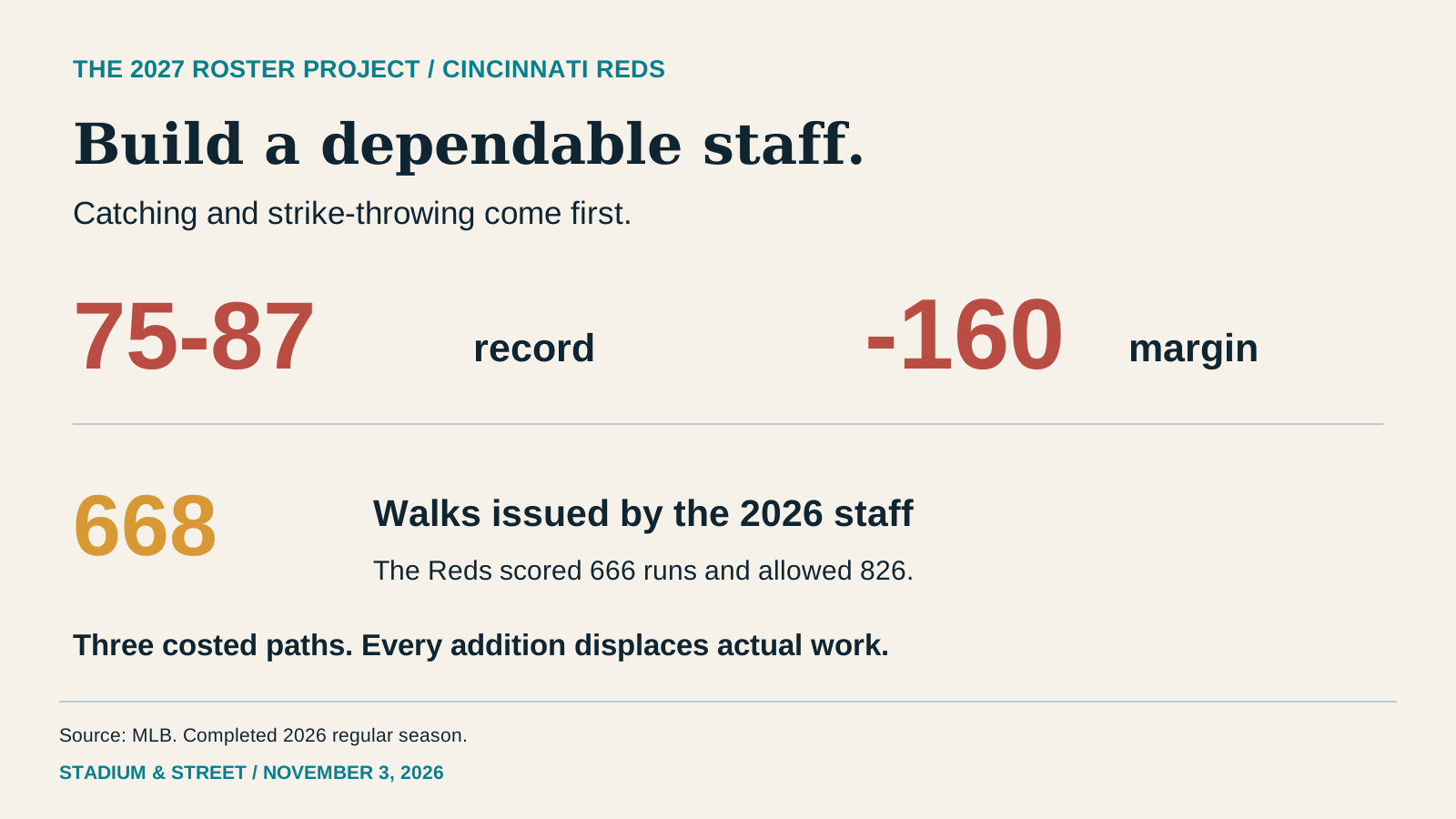
The recommendation: buy dependable work around the young core
The Reds allowed 160 more runs than they scored in 2026. A club with Elly De La Cruz, Sal Stewart and Chase Burns has important reasons to keep building, but that deficit demands more than another power hitter. Cincinnati needs to get more outs from its pitchers, improve the catching behind them and stop treating every rebound candidate as a dependable starter.
The preferred plan signs Carson Kelly for two years and $16-20 million, Nick Martinez for two years and $26-30 million, and Steven Okert for one year and $8-10 million. A separate $6-8 million reserve covers depth and contingencies. The annual additions total $35-43 million. Against the existing player-allocation estimate, that produces a $123.97-135.97 million envelope. The proposed new commitment, including all guaranteed years and the first-year reserve, is $56-68 million.
Those figures are S&S negotiating ceilings. They are not reported offers, a forecast of the market or a verified ownership budget. The plan does not assume that three independently available players will all accept these terms. It gives Cincinnati a disciplined sequence: solve catching, secure a starter with a convincing strike-throwing record, then add a reliever whose performance addresses the bullpen's central weakness.
The strongest objection is that this spends heavily without buying a middle-of-the-order star. That is fair. The offense ranked 27th in runs, and the proposed additions do not manufacture a replacement for every departed home run. The case for this approach is that young hitters already occupy several important offensive opportunities, while the staff's walks and the catching vacancy impose immediate costs on everyone else.
An alternative retains the Kelly proposal but substitutes Tyler Mahle and Taylor Clarke for Martinez and Okert. It costs $32-40 million annually, with different health, workload and contact risks. An internal-only path costs the $6-8 million reserve and accepts a much weaker catching arrangement and greater exposure to unproven pitchers. None of the three is presented as a complete cure for a minus-160 team.
The size of the repair
Cincinnati fell from 83-79 in 2025 to 75-87 in 2026. Runs scored declined from 716 to 666. Runs allowed rose from 681 to 826. That is a 195-run deterioration in the margin between offense and prevention, far more severe than the eight-win change alone suggests.
The offense was poor, but the larger movement occurred on the other side. The Reds allowed 145 additional runs. Their team ERA rose from 3.86 to 4.83. The 2026 staff walked 668 batters, and the bullpen alone walked 326 in 616 innings. Those are problems of volume and repeated baserunners, not merely a few ninth innings that went wrong.
| Season | Record | Runs for / against | Margin | OPS / ERA |
|---|---|---|---|---|
| 2024 | 77-85 | 699 / 694 | +5 | .693 / 4.09 |
| 2025 | 83-79 | 716 / 681 | +35 | .706 / 3.86 |
| 2026 | 75-87 | 666 / 826 | -160 | .699 / 4.83 |
The club's 75 wins should therefore be treated carefully as the starting point for next season's expectations. A simple run-ratio calculation using the actual runs scored and allowed yields about 64 wins. That is not a replacement for the games Cincinnati actually won. It is evidence that the distribution of those runs was more favorable than their aggregate relationship.
There is enough young talent to improve sharply. There is also enough unresolved pitching and offense to remain below .500 even after meaningful progress. The winter should be evaluated by how much dependable work it adds and how well it preserves development, rather than by whether a familiar name makes the roster look more complete.
Keep the two strongest bats in clearly defined jobs
De La Cruz hit .283/.365/.515 with 30 home runs in 636 plate appearances. He reached base through both hits and 72 walks. His 175 strikeouts remain a cost, but the complete offensive line gives Cincinnati a player around whom a lineup can be organized without needing to invent a breakthrough.
Stewart supplied 700 plate appearances, 32 home runs and a .263/.330/.457 line. The ability to sustain that workload matters almost as much as the power. Cincinnati should preserve his everyday opportunity while avoiding a defensive arrangement that asks him to solve every vacancy around the infield.
| Player / MLB ID | CIN PA | AVG / OBP / SLG | HR | BB / K; status |
|---|---|---|---|---|
| Sal Stewart / 701398 | 700 | .263 / .330 / .457 | 32 | 63 / 155; 1B/3B core |
| Elly De La Cruz / 682829 | 636 | .283 / .365 / .515 | 30 | 72 / 175; SS core |
| JJ Bleday / 668709 | 545 | .217 / .324 / .416 | 24 | 72 / 121; OF/DH |
| Eugenio Suárez / 553993 | 498 | .212 / .307 / .433 | 26 | 52 / 169; Free agent |
| Matt McLain / 680574 | 496 | .185 / .274 / .334 | 15 | 48 / 139; 2B rebound case |
| Tyler Stephenson / 663886 | 468 | .241 / .323 / .404 | 15 | 49 / 128; Free agent |
| Spencer Steer / 668715 | 384 | .238 / .319 / .421 | 16 | 35 / 86; Wrist recovery |
| Dane Myers / 667472 | 334 | .257 / .344 / .377 | 8 | 37 / 82; CF/OF |
| Nathaniel Lowe / 663993 | 276 | .266 / .341 / .480 | 12 | 28 / 70; Traded to Cleveland |
| TJ Friedl / 670770 | 272 | .172 / .255 / .255 | 4 | 22 / 63; Free agent |
| Ke'Bryan Hayes / 663647 | 242 | .141 / .194 / .225 | 5 | 13 / 48; 3B defense, weak bat |
| Noelvi Marte / 682622 | 201 | .189 / .229 / .321 | 6 | 10 / 52; OF audition |
| Edwin Arroyo / 695490 | 160 | .223 / .266 / .264 | 0 | 6 / 38; Young IF |
| Jose Trevino / 624431 | 156 | .217 / .221 / .336 | 5 | 1 / 29; Retained catcher |
| Blake Dunn / 694362 | 155 | .282 / .335 / .387 | 2 | 10 / 33; Elbow recovery |
| Héctor Rodríguez / 699302 | 152 | .229 / .270 / .410 | 6 | 7 / 39; Young OF |
| Juan Brito / 682877 | 59 | .309 / .339 / .509 | 3 | 3 / 9; IF audition |
| Oswaldo Cabrera / 665828 | 14 | .308 / .357 / .462 | 0 | 1 / 5; 2027 contract signed |
The proposed plan gives De La Cruz 650 plate appearances and Stewart 650. De La Cruz remains primarily at shortstop. Stewart receives most of his defensive starts at first base, with selected third-base and DH work. Their jobs should be stable enough that the club can judge the surrounding competition against a consistent foundation.
Neither player is credited with a free extra tier of production. The plan can succeed if they remain strong contributors while other positions become less damaging. If the offense requires both to improve substantially merely to offset weakness elsewhere, Cincinnati has not built enough support around them.
JJ Bleday's 24 home runs and 72 walks in 545 plate appearances also deserve room. His .217 average is a limitation, but his .324 on-base percentage supplied value in a lineup with few reliable ways to reach base. The assignment is a corner-outfield and DH mix, with less pressure to make him the principal center fielder.
Separate a plausible rebound from a necessary miracle
Matt McLain hit .185/.274/.334 in 496 plate appearances. His expected contact measures were better than his actual results, but they were still modest. A .293 expected wOBA does not turn a .272 actual wOBA season into evidence of a hidden star-level offense. It supports a measured rebound case with competition behind it.
Ke'Bryan Hayes presents an even larger gap. His .191 wOBA was far below a .287 expected mark, and his .225 slugging percentage was below a .371 expected figure. Some improvement is a reasonable possibility. The expected values themselves still do not justify building an everyday offensive role without a limit on how long the club waits.
| Batter | wOBA | xwOBA | SLG / xSLG | Reading |
|---|---|---|---|---|
| Sal Stewart | 0.339 | 0.343 | 0.457 / 0.466 | Production supported by contact |
| Elly De La Cruz | 0.380 | 0.376 | 0.515 / 0.506 | Strong actual and expected offense |
| JJ Bleday | 0.326 | 0.340 | 0.416 / 0.421 | Expected contact modestly better |
| Matt McLain | 0.272 | 0.293 | 0.334 / 0.361 | Some room to improve; still weak |
| Ke'Bryan Hayes | 0.191 | 0.287 | 0.225 / 0.371 | Very large gap, but xwOBA still modest |
| Spencer Steer | 0.325 | 0.342 | 0.421 / 0.452 | Useful bat if recovery permits |
| Edwin Arroyo | 0.240 | 0.291 | 0.264 / 0.348 | Short sample; improvement case |
| Noelvi Marte | 0.242 | 0.237 | 0.321 / 0.304 | Actual and expected offense both weak |
| Héctor Rodríguez | 0.295 | 0.251 | 0.410 / 0.329 | 152-PA burst exceeds contact estimate |
| Dane Myers | 0.324 | 0.309 | 0.377 / 0.356 | Useful OBP; do not assume repeat |
| Tyler Stephenson | 0.320 | 0.326 | 0.404 / 0.426 | Better offense than internal catching |
| Carson Kelly | 0.320 | 0.311 | 0.376 / 0.372 | Moderate offense, lower proposed cost |
Spencer Steer's .325 wOBA and .342 expected wOBA give a stronger offensive reason to preserve his role, subject to recovery. Bleday's expected line also offers some support beyond his actual results. Those are different cases from simply assuming that every disappointing hitter will improve at once.
The youngest players require the same discipline. Edwin Arroyo's 160 major-league plate appearances are too small a sample to settle his future. Noelvi Marte's .242 actual wOBA and .237 expected wOBA provide little statistical basis for declaring his major-league offense repaired. Hector Rodriguez's six home runs in 152 plate appearances were encouraging, but his expected contact measures were less convincing.
Expected statistics describe the quality and outcomes of recorded contact under their model. They are not guaranteed future batting lines, and they do not capture every component of a player's value. The useful question is whether several independent pieces of evidence point in the same direction.
Use the longer record without ignoring the present
One season can contain injuries, mechanical changes, favorable bounces and unfavorable ones. A three-year view helps distinguish an established skill from a brief arrival or a prolonged deterioration. It should sharpen decisions, not become an excuse to disregard the most recent evidence.
| Hitter | 2024 MLB PA / OPS | 2025 MLB PA / OPS | 2026 MLB PA / OPS |
|---|---|---|---|
| Elly De La Cruz | 696 / .810 | 699 / .776 | 636 / .880 |
| Sal Stewart | No MLB season | 58 / .838 | 700 / .787 |
| Matt McLain | No MLB season | 577 / .643 | 496 / .608 |
| Ke'Bryan Hayes | 396 / .573 | 570 / .596 | 242 / .419 |
| Spencer Steer | 656 / .721 | 568 / .723 | 384 / .740 |
| JJ Bleday | 642 / .761 | 344 / .698 | 545 / .740 |
| Tyler Stephenson | 515 / .782 | 342 / .737 | 468 / .727 |
| Carson Kelly | 313 / .687 | 421 / .761 | 425 / .712 |
De La Cruz has a major offensive role because of what he is doing now, not merely because of his tools. Stewart's short career requires more uncertainty, but his full 2026 workload gives the club something more substantial than a September impression. They belong in a different decision category from players whose recent major-league offense has repeatedly fallen below the demands of their position.
McLain's proposed 400 plate appearances leave a meaningful opportunity without preassigning the entire second-base job. Hayes receives 280, with defensive work extending beyond his starts. Those are choices about opportunity cost. More time for either player must come from Arroyo, Juan Brito or another hitter, rather than appearing as an extra line in the plan.
Kelly and Tyler Stephenson also deserve a longer view. Cincinnati should buy a catching role based on offense, receiving, availability and price together. Familiarity with Stephenson is useful context, but it is not a substitute for comparing the work and cost of the alternatives.
The roster after the departures
Stephenson, Brady Singer and Brock Burke became free agents after the season. Emilio Pagan declined his player option, while Cincinnati declined the mutual options on Eugenio Suarez and Pierce Johnson. None receives a signed 2027 role in this analysis. The declined option salaries are not added to the current payroll estimate.
Nathaniel Lowe's Cincinnati production remains in the historical batting table, but he was traded to Cleveland in August. Rece Hinds and Michael Toglia also belong in the departure record. A player can be important to explaining the past season without being available to fill next year's job.
| Player / MLB ID | Classification | 2027 treatment |
|---|---|---|
| Tyler Stephenson / 663886 | Free Agent | Retention alternative only; no signed role |
| Eugenio Suárez / 553993 | Free Agent | No retained CIN workload; past contributions separate |
| Emilio Pagán / 641941 | Free Agent | No retained CIN workload; past contributions separate |
| Pierce Johnson / 572955 | Free Agent | No retained CIN workload; past contributions separate |
| Brock Burke / 656271 | Free Agent | No retained CIN workload; past contributions separate |
| Brady Singer / 663903 | Free Agent | No retained CIN workload; past contributions separate |
| Nathaniel Lowe / 663993 | Free Agent | No retained CIN workload; past contributions separate |
| TJ Friedl / 670770 | Free Agent | No retained CIN workload; past contributions separate |
| Will Benson / 666181 | Free Agent | No retained CIN workload; past contributions separate |
| P.J. Higgins / 664731 | Free Agent | No retained CIN workload; past contributions separate |
| Rece Hinds / 677956 | External Or Historical | No retained CIN workload; past contributions separate |
| Michael Toglia / 669911 | External Or Historical | No retained CIN workload; past contributions separate |
| Sam Moll / 594580 | Free Agent | No retained CIN workload; past contributions separate |
| Caleb Ferguson / 657571 | Free Agent | No retained CIN workload; past contributions separate |
| Julian Aguiar / 687924 | External Or Historical | No retained CIN workload; past contributions separate |
| Chris Paddack / 663978 | Free Agent | No retained CIN workload; past contributions separate |
| Kyle Nicolas / 693312 | External Or Historical | No retained CIN workload; past contributions separate |
| Ron Marinaccio / 676760 | External Or Historical | No retained CIN workload; past contributions separate |
| Lyon Richardson / 680689 | Free Agent | No retained CIN workload; past contributions separate |
| Yunior Marte / 628708 | Free Agent | No retained CIN workload; past contributions separate |
TJ Friedl, Will Benson and P.J. Higgins elected free agency after being outrighted. A lingering affiliate label is not sufficient reason to include their plate appearances in an internal-only plan. Sam Moll's release and Caleb Ferguson's subsequent release by St. Louis also matter when reading old roster or player-page labels.
The current major-league roster contains 37 players in the dated official snapshot, including November waiver additions Duncan Davitt and Paxton Schultz. The return of players from the injured list after the season is an administrative change. Greene, Dunn and other recovering players still need separate workload decisions.
The financial record also contains obligations that have no corresponding roster role. Jeimer Candelario's buyout belongs in the cost model; an imagined Candelario comeback does not belong in the lineup. The same separation prevents a declined option from being counted as both a savings opportunity and a retained player.
Catching is the first purchase
Kelly is the preferred catching target at two years and $16-20 million. His 2026 offense was moderate: a .712 OPS and 10 home runs in 425 plate appearances. The recommendation is not based on expecting a major offensive breakthrough. It buys a credible primary catcher while keeping the term and annual cost below the proposed Stephenson alternative.
Stephenson supplied a .727 OPS and 15 home runs in 468 plate appearances. He is a defensible retention option at two years and $24-28 million. The concern is the full receiving picture. Statcast credited him with approximately minus-9.7 framing runs and minus-8.4 total catching runs, compared with Kelly's plus-1.0 framing runs and minus-1.0 total catching runs.
| Catcher | 2026 catching IP | Framing runs | Overall catching value / decision |
|---|---|---|---|
| Tyler Stephenson | 921.1 | -9.7 | -8.4 runs |
| Jose Trevino | 369.0 | +1.6 | No qualified row |
| Will Banfield | 58.0 | -0.8 | No qualified row |
| Carson Kelly | 848.1 | +1.0 | -1.0 runs |
Those values do not mean that a catcher change automatically saves the difference next season. Workloads differ, receiving components vary and the pitching staff changes the opportunities. They do mean that Cincinnati should not pay a premium for the familiar catcher without a concrete explanation of how the receiving weakness will improve.
Jose Trevino remains under contract and can support either acquisition. His 156 plate appearances produced a .557 OPS, so simply increasing his workload is not an equivalent offensive replacement for Stephenson. Will Banfield offers depth, but 21 major-league plate appearances cannot establish him as a dependable primary catcher.
Alfredo Duno is an important prospect, not an opening-day solution in this plan. His 138 Double-A plate appearances are a development checkpoint. Rushing that timetable to avoid a two-year bridge would transfer the cost of the winter's inaction onto a young player.
Make the infield competition real
The handedness splits offer one way to organize the competition. Bleday's OPS was .779 against right-handers and .644 against left-handers. McLain's split went the other way, .777 against lefties and .552 against righties. Those samples support selective matchups, not rigid promises about every future plate appearance.
| Batter / full MLB season | LHP: PA / OPS | RHP: PA / OPS |
|---|---|---|
| Sal Stewart | 183 / .802 | 517 / .782 |
| Elly De La Cruz | 188 / .990 | 448 / .834 |
| JJ Bleday | 153 / .644 | 392 / .779 |
| Matt McLain | 126 / .777 | 370 / .552 |
| Tyler Stephenson | 117 / .655 | 351 / .748 |
| Spencer Steer | 96 / 1.062 | 288 / .638 |
| Dane Myers | 145 / .777 | 189 / .678 |
| Ke'Bryan Hayes | 61 / .454 | 181 / .407 |
| Noelvi Marte | 53 / .542 | 148 / .552 |
| Edwin Arroyo | 43 / .573 | 117 / .513 |
| Jose Trevino | 40 / .410 | 116 / .607 |
| Blake Dunn | 42 / .666 | 113 / .744 |
| Héctor Rodríguez | 41 / .415 | 111 / .782 |
| Juan Brito | 44 / 1.043 | 71 / .456 |
| Oswaldo Cabrera | 7 / .429 | 18 / .517 |
| Carson Kelly | 136 / .871 | 289 / .638 |
| Cedric Mullins | 119 / .565 | 383 / .647 |
| Daulton Varsho | 135 / .615 | 391 / .644 |
| Trent Grisham | 136 / .691 | 348 / .708 |
Steer and Kelly also performed better against left-handed pitching in their 2026 samples. The catching alternative therefore has an offensive countercase: Stephenson supplied better results against right-handers. Cincinnati should weigh that matchup cost alongside receiving and price, rather than calling Kelly a universal upgrade.
The infield has enough young players to generate opportunity and enough uncertainty to generate congestion. The answer is a map of actual jobs. De La Cruz keeps shortstop. Stewart starts primarily at first base. McLain, Arroyo and Brito compete for second-base and adjacent work, while Hayes provides a reduced third-base role and late defense.
Arroyo hit .891 in OPS over 354 Triple-A plate appearances before his difficult major-league introduction. That earns a serious opportunity. It does not require Cincinnati to promise him a specific batting outcome or move De La Cruz away from a productive established role.
| Player | 2026 CIN defensive innings | 2027 assignment |
|---|---|---|
| Sal Stewart | 1B 948.0; 3B 306.2; 2B 57.0 | 1B first, selected 3B/DH |
| Elly De La Cruz | SS 1140.2 | Primary SS |
| Matt McLain | 2B 848.2; CF 15.0; SS 250.2 | 2B with performance checkpoint |
| Ke'Bryan Hayes | 3B 655.1 | 3B defense, reduced starts |
| Edwin Arroyo | 3B 34.0; 2B 318.2; SS 25.0 | 2B/3B/SS development |
| Juan Brito | 2B 80.0; 3B 27.0; SS 1.0; RF 21.0 | IF/DH, not automatic everyday job |
| Spencer Steer | CF 15.0; 1B 265.1; RF 211.2; 2B 115.0; LF 201.0; 3B 4.0 | LF/1B/3B after recovery |
| JJ Bleday | RF 65.0; LF 985.1 | LF/RF/DH; limited CF use |
| Dane Myers | CF 663.2 | Primary CF with coverage |
| Noelvi Marte | CF 16.0; RF 435.2 | RF/OF audition |
| Héctor Rodríguez | CF 8.0; RF 291.0 | OF audition |
| Oswaldo Cabrera | LF 17.0; SS 16.0; 3B 1.1 | Utility cover |
| Blake Dunn | CF 162.0; RF 108.0; LF 23.0 | Later-season OF only if cleared |
Brito's 59 Cincinnati plate appearances were productive, but they are only part of his full-season major-league record. The full-season Statcast view is less dramatic than the short club-specific line. His 350-plate-appearance allocation therefore represents an audition with room to expand, rather than a conclusion drawn from a few weeks.
Cabrera's agreed contract gives the club a relatively inexpensive utility option. He receives 300 plate appearances in the model, spread across injury cover and positional flexibility. He should make the roster easier to operate without displacing the best young hitter merely because he can stand at more positions.
The practical checkpoint is performance against opportunity. If McLain continues to struggle, Arroyo or Brito should receive the next block of starts. If Hayes' offense remains damaging, his defensive contribution should be deployed more selectively. Competition only has meaning if the playing-time allocation changes when the evidence does.
Defense needs ranges and positions
De La Cruz recorded plus-7 Outs Above Average in 2026, McLain plus-4 and Hayes plus-5. Those contributions help explain why an indiscriminate offensive replacement at every infield position could create new problems. They also show why a player's overall value cannot be reduced to his batting average.
The outfield evidence is more mixed. Bleday was minus-2, Myers plus-1, Marte minus-4 and Rodriguez even in a smaller sample. Dunn supplied plus-2 before his season was interrupted. The club should preserve genuine center-field coverage and avoid making corner offense carry responsibilities that weaken the defense behind the pitchers.
| Fielder | 2024 OAA | 2025 OAA | 2026 OAA | 2026 opportunities |
|---|---|---|---|---|
| Elly De La Cruz | +14 | -3 | +7 | 498 |
| Sal Stewart | No row | +1 | -2 | 382 |
| Matt McLain | No row | +4 | +4 | 480 |
| Ke'Bryan Hayes | +6 | +21 | +5 | 231 |
| Spencer Steer | -3 | +4 | -2 | 234 |
| JJ Bleday | -3 | -8 | -2 | 274 |
| Dane Myers | 0 | +2 | +1 | 245 |
| Edwin Arroyo | No row | No row | +3 | 161 |
| Noelvi Marte | -11 | -5 | -4 | 122 |
| Héctor Rodríguez | No row | No row | 0 | 76 |
| Blake Dunn | +1 | +2 | +2 | 97 |
| TJ Friedl | -4 | +1 | +4 | 212 |
| Cedric Mullins | +2 | +4 | +11 | 342 |
| Daulton Varsho | +15 | +9 | +7 | 345 |
| Trent Grisham | +2 | -2 | -6 | 280 |
The three-year table is a range of observed outcomes, not a forecast interval. Different samples, positions and opportunities affect the totals. A small positive number should not be treated as a guarantee of elite defense, and one negative season should not erase an established skill without further examination.
The same principle applies to possible additions. Cedric Mullins' plus-11 OAA is relevant to a defensive inquiry, but his .628 OPS and .264 expected wOBA limit the price and offensive expectations. Daulton Varsho's plus-7 OAA comes with a .636 OPS. Trent Grisham's better expected batting line does not make his minus-6 OAA season a range upgrade by definition.
Cincinnati's preferred plan spends first on catching and pitching, leaving the existing outfield competition intact. A separate defensive purchase can be evaluated if the market allows it, but it must displace real plate appearances and receive separate funding.
The rotation begins with Burns, not a Greene return date
Burns finished with a 2.86 ERA, 185 strikeouts and 56 walks in 154.1 innings. His ability to miss bats separates him from much of the staff. The proposed workload is 30 starts and 170 innings, conditional on recovery and preparation after the groin strain that ended his season.
Greene underwent a second Tommy John operation in August. No 2027 innings are assigned to him here. His contract remains in the payroll calculation. That choice prevents the same optimistic recovery assumption from doing two jobs at once: filling the rotation and making its cost appear smaller.
| Pitcher / MLB ID | GS / CIN IP | ERA / full MLB xERA | K / BB / HR | Treatment |
|---|---|---|---|---|
| Chase Burns / 695505 | 29 / 154.1 | 2.86 / 3.25 | 185 / 56 / 17 | Core; groin recovery and workload check |
| Andrew Abbott / 671096 | 32 / 166.0 | 4.61 / 4.92 | 131 / 76 / 26 | Command must improve |
| Nick Lodolo / 666157 | 21 / 108.2 | 4.97 / 6.47 | 83 / 46 / 20 | Health and workload check |
| Rhett Lowder / 695076 | 26 / 133.1 | 5.74 / 5.44 | 103 / 56 / 18 | Development with measurable limits |
| Brandon Williamson / 682227 | 9 / 52.2 | 5.30 / 6.03 | 36 / 30 / 9 | Starter/bulk reserve |
| Chase Petty / 695534 | 3 / 31.2 | 4.83 / 5.73 | 15 / 9 / 6 | Depth; AAA command unresolved |
| Hunter Greene / 668881 | 5 / 27.2 | 6.83 / 4.51 | 33 / 9 / 4 | No 2027 innings budgeted |
| Brady Singer / 663903 | 31 / 157.0 | 5.85 / 5.99 | 126 / 62 / 32 | Free agent; not retained by default |
Andrew Abbott's 166 innings were useful volume, but 76 walks and a 4.61 ERA require a more demanding assessment than simply counting starts. Nick Lodolo's 108.2 innings and 4.97 ERA leave both workload and performance questions. Rhett Lowder's 133.1 innings came with a 5.74 ERA and 56 walks.
All three retain meaningful roles. They do not receive identical guarantees of effectiveness. A healthier season, fewer walks and better execution would each matter, but none is already in hand. Cincinnati needs enough depth that a developmental setback does not force a struggling starter to absorb every available inning.
Singer's 157 innings are departing volume, not automatically departing quality that must be repurchased at any price. His 5.85 ERA, 62 walks and 32 home runs give Cincinnati a reason to compare the market carefully. The aim is to replace work with a stronger process, not merely replace a name in the rotation.
Why Martinez, and why the ceiling stays limited
Martinez threw 180 innings for Tampa Bay with 26 walks. His 3.10 ERA was substantially better than his 3.98 expected ERA, and 109 strikeouts do not create much margin when contact quality deteriorates. Both sides belong in the recommendation.
The appeal is dependable strike-throwing and a demonstrated starter workload. Cincinnati's 668 team walks make that skill especially relevant. The proposed two-year, $26-30 million ceiling buys 165 planned innings, below his latest total. It does not assume that his 2026 ERA will survive unchanged in a different defense and home environment.
Mahle is the principal alternative at two years and $28-32 million. His 149 innings, 137 strikeouts and 46 walks offer more missed bats with a lower recent workload. The alternate plan budgets 140 innings and explicitly gives the remaining 25 innings to internal depth. His Cincinnati history is not part of the valuation.
Michael Soroka's 116 innings and 114 strikeouts make him a useful lower-volume inquiry at one year and $8-10 million. They do not make him a like-for-like substitute for 165 Martinez innings. Chris Bassitt's 102 innings, 4.41 ERA and 4.92 expected ERA are a weaker foundation for the main purchase at this stage.
The free-agent register identifies these candidates, while some individual and roster feeds retain old affiliations. The report treats them as external choices, not signed Reds. No trade return, medical assurance or market acceptance is assumed.
The bullpen must throw more strikes
Cincinnati's relievers walked 326 batters in 616 innings, approximately 4.76 per nine. A bullpen can survive a few uncertain roles. It becomes much harder to manage when the uncertainty is concentrated in the ability to throw strikes.
Tejay Antone's 55 innings, 57 strikeouts and 17 walks provide a useful retained contribution. Graham Ashcraft, Luis Mey, Connor Phillips and Zach Maxwell all need more control before larger workloads can be treated as dependable help. Phillips walked 31 in 30 major-league innings. Mey struck out 50 in 34.2 innings but also walked 22.
| Pitcher | 2026 CIN IP | ERA / full MLB xERA | K / BB | Treatment |
|---|---|---|---|---|
| Tejay Antone | 55.0 | 3.11 / 3.70 | 57 / 17 | Retain; protect post-recovery workload |
| Graham Ashcraft | 35.1 | 4.08 / 3.81 | 40 / 24 | Control is the limiting factor |
| Luis Mey | 34.2 | 6.23 / 4.57 | 50 / 22 | Strikeouts with too many walks |
| Connor Phillips | 30.0 | 5.40 / 6.19 | 29 / 31 | 31 walks in 30 IP |
| Zach Maxwell | 13.0 | 8.31 / 5.92 | 12 / 10 | AAA/MLB control gate |
| Zach McCambley | 13.1 | 4.05 / 5.96 | 14 / 6 | Develop measured middle relief |
| Jose Franco | 20.1 | 4.43 / 5.23 | 15 / 16 | Starter/bulk flexibility |
| Julian Garcia | 46.0 | 3.13 / 2.97 | 41 / 19 | Elbow recovery; conditional workload |
| Tony Santillan | 40.2 | 6.42 / 6.68 | 36 / 28 | Hip recovery; no opening workload assumed |
| Brock Burke | 74.1 | 2.30 / 3.65 | 74 / 40 | Free agent; 40 walks limit ERA case |
| Emilio Pagán | 42.2 | 3.38 / 3.42 | 45 / 11 | Free agent; player option declined |
| Pierce Johnson | 48.2 | 4.62 / 4.92 | 42 / 19 | Free agent; mutual option declined |
| Sam Moll | 56.1 | 4.79 / 4.48 | 56 / 30 | Released; no retained work |
Okert is the preferred addition at one year and $8-10 million. He recorded 68 strikeouts and 14 walks in 67.2 innings, with a 2.13 ERA and 3.13 expected ERA. The plan assigns 60 innings. It buys a specific combination of strikeouts and control, not a closer title or a promise that his ERA will repeat.
Clarke is the lower-cost alternative at one year and $4-6 million. His 14 walks in 73 innings fit the command objective, but 45 strikeouts and a 4.42 expected ERA limit how much should be inferred from a 2.96 actual ERA. Kittredge is another conditional option, with a smaller 45-inning budget rather than an assumed full substitute.
Burke's 2.30 Cincinnati ERA makes retention worth examining, but 40 walks in 74.1 innings do not address the staff's principal weakness as directly. Pagan's command was better, but the declined option means his return would require a new price and agreement. The plan should not be steered solely by which reliever already knows the clubhouse.
Recovery is a branch of the plan
Steer's wrist surgery was expected to permit a Spring Training return. The 450-plate-appearance allocation remains conditional. If he is unavailable, those appearances move to Bleday, Marte, Rodriguez, Brito and Cabrera. The budget does not receive a salary saving, and the substitute offense is not assumed to be equal.
September reporting described another planned elbow procedure for Dunn. He receives no opening-day role and only 120 conditional later plate appearances. If he cannot supply them, Myers takes 100 and Jorge 20. This is a coverage decision, not a prediction of a medical timetable.
Santillan's hip recovery also needs a conservative workload. The bullpen table includes 20 conditional later innings, with no opening role assumed. Julian Garcia's elbow recovery supports a separate 30-inning conditional branch. If both are unavailable, five internal pitchers each receive ten additional innings.
Those replacements have costs. More work for Schultz, Franco, McCambley, Acuna and Benschoter increases exposure to uncertain control and major-league readiness. A table that still totals 570 relief innings has solved a counting problem; it has not demonstrated that the pitching will be good enough.
Burns, Lodolo, Antone and other retained pitchers also need normal health and workload checks. The club should monitor their ability to prepare and recover rather than use an administrative active listing as evidence that every risk has disappeared.
The farm system offers opportunity at different speeds
Arroyo and Rodriguez have substantial Triple-A evidence and have already reached Cincinnati. Their next step is to translate those skills consistently against major-league pitching. Marte's strong Louisville line and weak Cincinnati line make the transition itself the central question.
Duno's Double-A performance is encouraging, but the sample remains short. Cam Collier's .654 OPS in 576 Double-A plate appearances argues for continued development rather than an immediate solution at third base. Steele Hall and Tyson Lewis are much farther from the majors and receive no 2027 production in the plan.
| Player / MLB ID | 2026 level and sample | Readiness decision |
|---|---|---|
| Héctor Rodríguez / 699302 | AAA: 455 PA, .880 OPS, 27 HR; 42 BB / 93 K | RF/LF opportunity; verify contact translation |
| Edwin Arroyo / 695490 | AAA: 354 PA, .891 OPS, 15 HR; 29 BB / 68 K | Real IF opportunity, not instant star assumption |
| Noelvi Marte / 682622 | AAA: 279 PA, .864 OPS, 9 HR; 14 BB / 46 K | AAA rebound does not erase MLB problems |
| Will Banfield / 677943 | AAA: 296 PA, .731 OPS, 11 HR; 16 BB / 69 K | Catching depth, not established No. 1 |
| Carlos Jorge / 699115 | AA: 259 PA, .854 OPS, 6 HR; 25 BB / 52 K | AA performance stronger than short AAA/MLB samples |
| Leo Balcazar / 699114 | AA: 443 PA, .692 OPS, 10 HR; 46 BB / 88 K | Development and utility coverage |
| Alfredo Duno / 806957 | AA: 138 PA, .894 OPS, 3 HR; 17 BB / 23 K | Only 138 AA PA; no opening MLB work |
| Cam Collier / 702253 | AA: 576 PA, .654 OPS, 18 HR; 49 BB / 150 K | Further development; no immediate 3B solution |
| Jay Allen II / 695481 | AA: 377 PA, .857 OPS, 15 HR; 35 BB / 80 K | Late audition only after AAA test |
| Cade Hunter / 687192 | AA: 321 PA, .696 OPS, 8 HR; 36 BB / 98 K | Emergency catching pathway; no established MLB bat |
| Steele Hall / 829162 | A: 121 PA, .639 OPS, 1 HR; 24 BB / 39 K | A-ball development; no 2027 MLB workload |
| Tyson Lewis / 815653 | A: 236 PA, .687 OPS, 4 HR; 18 BB / 78 K | A/A+ development; no MLB work credited |
| Chase Petty / 695534 | AAA: 58.1 IP, 6.17 ERA; 57 K / 25 BB | AAA 6.17 ERA; opportunity must be earned |
| Jose Acuna / 691641 | AAA: 40.2 IP, 6.42 ERA; 34 K / 30 BB | AA success followed by difficult AAA transition |
| Sam Benschoter / 680397 | AAA: 66.2 IP, 4.86 ERA; 56 K / 25 BB | Depth with 4.86 AAA ERA |
| Zach Maxwell / 687209 | AAA: 46.1 IP, 4.66 ERA; 59 K / 33 BB | 59 K but 33 BB; delivery/control gate |
The pitching depth also requires realistic expectations. Petty's 6.17 Triple-A ERA is not evidence that he can simply absorb a large share of a departing veteran's workload. Acuna showed stronger results at Double-A than Triple-A. Benschoter provides depth, while Maxwell's strikeout ability still comes with too many walks.
Davitt and Solesky can be evaluated as starter or bulk depth after their waiver moves. Their 2026 minor-league ERAs were 6.04 in 76 innings and 5.63 in 78.1, respectively. Their small major-league samples do not establish them as rotation answers. Schultz is another opportunity to improve the back of the staff, not a reason to count the bullpen repair as complete.
The most valuable development decision may be refusing to accelerate the wrong player. A bridge catcher can protect Duno's timetable. A veteran starter can prevent a struggling young pitcher from being forced through every fifth day. Money spent on those jobs can support the farm system rather than compete with it.
Compare the market by job
Kelly, Stephenson and an internal catching pair solve different versions of the same vacancy. Martinez, Mahle and Soroka do not supply identical innings. Okert, Clarke and Kittredge offer different combinations of strikeouts, control, contact risk and workload. The table gives each candidate a job and a limit.
| Candidate / MLB ID | Full 2026 MLB evidence | S&S ceiling / decision |
|---|---|---|
| Carson Kelly / 608348 | 425 PA, .712 OPS, 10 HR; 0.320/0.311 wOBA/xwOBA | Preferred C: 2 years / $16-20M |
| Tyler Stephenson / 663886 | 468 PA, .727 OPS, 15 HR; 0.320/0.326 wOBA/xwOBA | Retention alternative: 2 years / $24-28M |
| Nick Martinez / 607259 | 180.0 IP, 3.10 ERA, 3.98 xERA; 109 K / 26 BB | Preferred SP: 2 years / $26-30M |
| Tyler Mahle / 641816 | 149.0 IP, 3.99 ERA, 3.95 xERA; 137 K / 46 BB | Alternative SP: 2 years / $28-32M |
| Michael Soroka / 647336 | 116.0 IP, 3.41 ERA, 4.12 xERA; 114 K / 29 BB | Lower-volume inquiry: 1 year / $8-10M |
| Chris Bassitt / 605135 | 102.0 IP, 4.41 ERA, 4.92 xERA; 74 K / 38 BB | Pass as main rotation addition |
| Steven Okert / 595345 | 67.2 IP, 2.13 ERA, 3.13 xERA; 68 K / 14 BB | Preferred RP: 1 year / $8-10M |
| Taylor Clarke / 664199 | 73.0 IP, 2.96 ERA, 4.42 xERA; 45 K / 14 BB | Alternative RP: 1 year / $4-6M |
| Andrew Kittredge / 552640 | 48.1 IP, 3.54 ERA, 4.01 xERA; 40 K / 11 BB | Fallback: 1 year / $5-7M; 45 IP |
| Cedric Mullins / 656775 | 502 PA, .628 OPS, 15 HR; 0.281/0.264 wOBA/xwOBA | Defensive-only inquiry: 1 year / $5-7M; not in funded plan |
| Daulton Varsho / 662139 | 526 PA, .636 OPS, 12 HR; 0.281/0.283 wOBA/xwOBA | Pass at premium everyday price |
| Trent Grisham / 663757 | 484 PA, .703 OPS, 18 HR; 0.311/0.337 wOBA/xwOBA | Pass as a range upgrade after -6 OAA |
The preferred purchases require no outgoing players because they are proposed free-agent signings. That does not mean they are costless acquisitions. They consume salary, roster space and the opportunities of existing players. If any candidate instead requires a trade or carries a material new acquisition condition, the proposal must be repriced before it is accepted.
Mullins is a separate defensive inquiry at one year and $5-7 million. He is not part of a funded plan. A 350-plate-appearance role would have to come from Myers, Bleday, Rodriguez and the conditional Dunn allocation. Given the offensive deficit, Cincinnati should require a clear defensive and price advantage before making that tradeoff.
Varsho and Grisham remain comparison cases rather than preferred purchases. Their evidence shows why a recognizable center fielder is not automatically the best use of scarce funds. Cincinnati already has several outfield auditions and has more immediate vacancies behind the plate and in the pitching staff.
The no-acquisition outcome is deliberately retained. It is less expensive because it leaves more work to players who have not established that they can handle it. That is an honest budget choice, but it should be described as accepting risk rather than discovering equivalent production for free.
The existing obligations
The five guaranteed allocations total approximately $31.369 million for 2027. This includes Hayes, Greene, Trevino, Burns and Cabrera. The figures combine salary with allocated signing bonuses where shown, so they are not identical to annual cash payments or an official competitive-balance-tax calculation.
| Player / MLB ID | 2027 allocation | Basis |
|---|---|---|
| Ke'Bryan Hayes / 663647 | $7M | Guaranteed salary |
| Hunter Greene / 668881 | $15.333M | $15M salary plus allocated bonus; no 2027 IP |
| Jose Trevino / 624431 | $5.25M | Guaranteed salary |
| Chase Burns / 695505 | $2.786M | $2.5M salary plus $2M signing bonus allocated over seven years |
| Oswaldo Cabrera / 665828 | $1M | Agreed salary; up to $0.2M incentive covered by reserve |
| TOTAL | $31.369M | Allocation, not identical to annual cash or CBT |
Burns' agreement covers seven years and $105 million beginning in 2027. His first-year salary and allocated bonus make the immediate budget smaller than the later annual obligations. That creates room now, but the club should evaluate any new multiyear deal against the later growth in his contract as well.
Cabrera's agreed $1 million base replaces an arbitration estimate. Up to $200,000 in performance incentives is covered within the depth reserve. It is not added as a second salary or assumed to have been earned.
| Player | Estimate, $M | Basis |
|---|---|---|
| Tejay Antone | 1.50 | Published projection; unsigned |
| Nick Lodolo | 5.70 | Published projection; unsigned |
| Graham Ashcraft | 2.20 | Published projection; unsigned |
| Tony Santillan | 2.50 | Published projection; unsigned |
| Spencer Steer | 5.70 | Published projection; unsigned |
| JJ Bleday | 4.80 | Published projection; unsigned |
| Matt McLain | 4.00 | Published projection; unsigned |
| Brandon Williamson | 1.30 | Published projection; unsigned |
| Andrew Abbott | 4.50 | Published projection; unsigned |
| Elly De La Cruz | 7.90 | Published projection; unsigned |
| Dane Myers | 1.50 | Published projection; unsigned |
| TOTAL | 41.60 | 11 cases; Cabrera agreed contract counted separately |
The other 11 arbitration estimates total $41.6 million. They are projections, not agreed salaries. The model carries all of them rather than manufacturing savings through unannounced non-tenders or trades. A decision to remove a player would need a replacement workload and a revised financial case.
The buyout allowance is $4 million: $3 million for Candelario and $1 million for Johnson. The model does not retain Candelario's option salary or Johnson's declined option salary. It also does not count Suarez or Pagan as signed players.
Three fully funded paths
Adding $12-16 million for pre-arbitration players, minor-league roster salaries and callups produces an existing player-allocation envelope of $88.97-92.97 million. This is a planning estimate, not a complete club operating budget. Benefits, tax and other baseball operations are outside it.
| Component | Annual allocation | Definition |
|---|---|---|
| Five guaranteed contracts | $31.369M | Includes agreed Cabrera salary |
| Arbitration pool | $41.60M | 11 published estimates |
| Buyouts carried | $4M | $3M Candelario and $1M Pierce Johnson |
| Pre-arb, minors and callups | $12-16M | S&S allowance; no additional duplicate minor pool |
| Existing-roster envelope | $88.97-92.97M | Before additions; excludes benefits/tax/operations |
Plan A adds Kelly, Martinez, Okert and the reserve. Kelly and Martinez each receive two proposed guaranteed years; Okert receives one. The $35-43 million annual addition and $56-68 million new commitment answer different questions. The former estimates the next season's allocation; the latter counts all proposed guaranteed years plus the first-year reserve.
| Plan | Annual additions | Total allocation | New commitment* |
|---|---|---|---|
| A: Kelly / Martinez / Okert | $35-43M | $123.97-135.97M | $56-68M |
| B: Kelly / Mahle / Clarke | $32-40M | $120.97-132.97M | $54-66M |
| C: Internal roster | $6-8M | $94.97-100.97M | $6-8M |
Plan B keeps the catcher proposal and changes the pitching purchases. Mahle's two-year, $28-32 million ceiling is higher annually than Martinez's, while Clarke's one-year, $4-6 million price is lower than Okert's. The net annual addition is $32-40 million, with a $54-66 million new commitment. The lower total comes with a smaller purchased starter workload and a weaker expected-contact case in relief.
Plan C adds only the $6-8 million reserve, bringing the total to $94.97-100.97 million. It has no new guaranteed player purchase. The reserve can support future depth decisions, but no unnamed player is credited with batting runs, strikeouts or wins merely because money has been set aside.
The proposal should be compared with the club's actual budget when that is established. If the available amount is lower, the first decision should be which job to reduce or defer. Quietly removing the reserve while keeping every optimistic workload would create an underfunded plan.
The branches that can change the cost
Stephenson can replace Kelly in the preferred plan at an additional $4 million annually under the proposed ceilings. The resulting envelope is $127.97-139.97 million. That branch buys the same 400-plate-appearance catching role, with different offense and receiving evidence. It does not add a third major catching salary on top of Kelly and Trevino.
| Contingency | Annual change / total | Treatment |
|---|---|---|
| Stephenson instead of Kelly | +$4M annual; A total $127.97-139.97M | Proposed 2 years / $24-28M; 400 PA; no duplicate catcher salary |
| Cabrera incentives | Up to $0.2M | Covered inside $6-8M reserve |
| Greene remains unavailable | No payroll saving assumed | Guaranteed allocation retained; no 2027 innings |
| Declined options | No $16M Suarez, $10M Pagan or $8M Johnson salary | Carry Johnson buyout; do not count free-agent workload |
| Candelario obligation | $3M buyout, no $18M option | Financial obligation only; no retained player role |
| Mullins inquiry | $5-7M additional if separately chosen | Not in A/B/C; remove 350 internal PA first |
| All candidates unavailable | Plan C remains costed | Reserve does not produce unassigned wins |
| Other club costs | Not included | Benefits, tax, operations and official CBT differ |
Greene's absence does not create discretionary spending room by itself. His guaranteed allocation remains. Likewise, the buyouts remain even though the associated players receive no playing time. An honest plan carries obligations that no longer contribute to the roster.
A separately chosen Mullins purchase would add $5-7 million and remove 350 internal plate appearances. That is why it remains outside the preferred budget. Combining every interesting alternative would turn a disciplined set of choices into an unpriced collection of names.
The reserve also needs to survive ordinary uncertainty: an arbitration estimate can move, an incentive can be earned and depth may be needed earlier than expected. Those are reasons to retain flexibility. They are not reasons to assign production to a player whose identity, contract and role have not been determined.
Give every plate appearance a source
The preferred plan allocates 6,200 plate appearances across the season. The number is a coverage framework, not a prediction of the exact team total. It includes reserves, injuries and changes in opportunity rather than assuming that all listed players are active at once.
| Player | PA | Opportunity |
|---|---|---|
| Elly De La Cruz | 650 | SS/DH |
| Sal Stewart | 650 | 1B/3B/DH |
| Bleday | 500 | LF/RF/DH |
| McLain | 400 | 2B/DH |
| Steer | 450 | LF/1B/3B after recovery |
| Myers | 400 | CF/OF |
| Arroyo | 450 | 2B/3B/SS |
| Hayes | 280 | 3B, including late defense |
| Marte | 400 | RF/OF |
| Hector Rodriguez | 320 | Corner OF; limited CF experience |
| Kelly | 400 | Only if signed; primary C |
| Trevino | 220 | C |
| Banfield | 60 | C depth |
| Brito | 350 | IF/DH |
| Cabrera | 300 | Utility |
| Jorge | 200 | CF/OF development |
| Dunn | 120 | Later OF only if cleared |
| Balcazar | 50 | IF depth |
| TOTAL | 6,200 | Season coverage, not 18 simultaneous active hitters |
The largest commitments go to De La Cruz and Stewart. Bleday, Steer, Myers, Arroyo, Marte and Rodriguez receive substantial work, with the recovery conditions stated separately. McLain and Hayes have room to contribute without being insulated from competition.
| Change from A | PA adjustment | Consequence |
|---|---|---|
| B: same hitting plan | No change | Kelly retained as the proposed C purchase |
| C: remove Kelly | -400 | No purchased catching offense |
| C: Trevino / Banfield / Cade Hunter | +100 / +250 / +50 | 320 / 310 / 50 PA; major offensive and readiness risk |
| Steer unavailable | -450; Bleday +100, Marte +100, Hector +100, Brito +100, Cabrera +50 | Same volume with weaker established offense |
| Dunn unavailable | -120; Myers +100, Jorge +20 | No opening-day clearance assumed |
| Stephenson alternative | Kelly -400; Stephenson +400 | Same catcher job; cost rises $4M annually |
| TOTAL | 6,200 in each plan | No double counting of displaced work |
Without Kelly, the internal plan gives Trevino 100 additional appearances, Banfield 250 additional appearances and Cade Hunter 50. That preserves the volume but changes the offensive and readiness risk sharply. Hunter's minor-league evidence makes this an emergency developmental pathway, not a claim that an equivalent catcher is already waiting.
The Steer and Dunn contingencies are also explicit. They cannot be counted as healthy starters in the preferred plan and then appear again as bonus production in its upside case. When their work is removed, someone else receives it, and the quality of that replacement must be assessed honestly.
Cover 162 starts without hiding the extra innings
The preferred rotation allocation totals 162 starts and 870 innings. The bullpen receives 570, bringing the full season framework to 1,440 innings. Actual season totals will vary with extra innings, home losses and other game conditions. The framework makes the workload burden visible.
| Pitcher | Starts / IP | Workload condition |
|---|---|---|
| Burns | 30 / 170 | Recovery first; 15.2-IP rise from 154.1 MLB innings |
| Abbott | 30 / 160 | Below 166 prior MLB IP; control improvement required |
| Lodolo | 26 / 135 | Increase from 108.2 MLB IP; health gate |
| Martinez | 30 / 165 | Only if signed; below 180 prior innings |
| Lowder | 26 / 135 | Near 133.1 prior MLB IP; performance gate |
| Williamson | 10 / 55 | Starter/bulk cover after 52.2 MLB innings |
| Petty | 6 / 30 | AAA/MLB command and readiness gate |
| Solesky | 2 / 10 | New claim; minor-league workload supports depth only |
| Davitt | 2 / 10 | New claim; minor-league workload supports depth only |
| TOTAL | 162 / 870 | No Greene innings; 570 relief innings budgeted separately |
The staff supplied only 817.1 starter innings in 2026. The proposed increase is 52.2 innings, not simply a promise that five names will take every turn. Burns, Abbott, Lodolo and Lowder carry most of the retained rotation work. Martinez supplies a conditional purchased block, while Williamson, Petty, Solesky and Davitt provide the rest.
| Pitcher / coverage | IP | Condition |
|---|---|---|
| Antone | 55 | Near prior 55-IP total; recovery monitoring |
| Ashcraft | 60 | Control gate; more volume than 2026 MLB sample |
| Okert | 60 | Only if signed; below 67.2 prior IP |
| Mey | 50 | Strike-throwing must improve |
| Phillips | 40 | Do not confuse velocity with control |
| Maxwell | 40 | Minor-league walks remain a concern |
| McCambley | 40 | Measured middle relief |
| Franco | 45 | Bulk coverage; walks limit leverage |
| Schultz | 35 | Waiver claim, not an established late-inning arm |
| Julian Garcia | 30 | Conditional elbow recovery |
| Santillan | 20 | Later-season only after hip recovery; no opening role |
| Spiers | 25 | Health and total-workload check |
| Solesky | 20 | Plus ten starter IP |
| Acuna | 25 | AAA development and roster-selection gate |
| Benschoter | 25 | AAA depth and roster-selection gate |
| TOTAL | 570 | 870 starter + 570 relief = 1,440 innings |
The relief allocation contains genuine uncertainty. Several pitchers have command problems, some need roster selection, and Garcia and Santillan have recovery conditions. Antone's return and Okert's proposed arrival cannot make all of those other questions disappear.
| Change from A | IP / starts adjustment | Consequence |
|---|---|---|
| B: Mahle for Martinez | Martinez -30 GS/165 IP; Mahle +26/140 | Williamson +2/10, Petty +2/10, Solesky +0/5 |
| B: Clarke for Okert | -60 / +60 relief IP | Lower strikeout and expected-contact case |
| C: no Martinez | -30 starts / -165 IP | Williamson +12/65, Petty +10/50, Solesky +4/25, Davitt +4/25 |
| C: no Okert | -60 relief IP | Ashcraft, Mey, McCambley, Franco, Acuna, Benschoter +10 each |
| Garcia and Santillan unavailable | -50 relief IP | Schultz, Franco, McCambley, Acuna, Benschoter +10 each |
| TOTAL | 162 starts; 870 + 570 IP | Volume holds; quality and readiness do not automatically hold |
Without Martinez, the internal plan transfers 165 innings and 30 starts to Williamson, Petty, Solesky and Davitt. Without Okert, six internal pitchers each receive ten additional relief innings. Those are materially weaker assurances of performance. The accounting remains complete precisely so that the baseball cost of spending less cannot be hidden in an empty workload line.
Protect positions, not just totals
A plate-appearance table can look balanced while leaving the defense impossible to arrange. The proposed defensive map assigns 162 starts at every position, including DH. It keeps De La Cruz at shortstop, puts Stewart primarily at first base and creates real infield competition.
| Pos. | 162-start allocation | Purpose |
|---|---|---|
| C | Kelly 100; Trevino 55; Banfield 7 | C: Trevino 80, Banfield 70, Hunter 12 |
| 1B | Stewart 110; Steer 30; Brito 22 | If Steer absent, Brito takes 30 |
| 2B | McLain 90; Arroyo 60; Brito 12 | Performance-based competition |
| 3B | Hayes 65; Arroyo 45; Stewart 35; Cabrera 17 | Hayes also supplies late defense |
| SS | Elly 137; Arroyo 25 | Keep Elly at his established position |
| LF | Steer 65; Bleday 60; Hector 22; Cabrera 15 | If Steer absent, Bleday +30, Hector +20, Cabrera +15 |
| CF | Myers 100; Jorge 37; Dunn 25 | Dunn later only; absent: Myers +20, Jorge +5 |
| RF | Marte 95; Hector 40; Bleday 22; Myers 5 | Protect young OF auditions |
| DH | Stewart 15; Elly 15; Bleday 30; Steer 15; Brito 40; McLain 10; Marte 15; Cabrera 22 | If Steer absent, Brito takes 15 |
The outfield map gives Myers the largest center-field share. Dunn's later conditional starts have explicit replacements. Jorge receives the remaining center-field development work; Rodriguez stays mainly in the corners after only 32 combined MLB and Triple-A center-field innings. Bleday receives corner and DH work, while Marte and Rodriguez have meaningful opportunities that do not depend on another player's production being counted twice.
Hayes' role also includes late defense, so his total value need not be judged only by the number of starts. The reverse is equally important: late defensive value should not be used to justify unlimited plate appearances if his offense remains damaging.
These are opening planning assignments, not a permanent lineup card. The strongest young performers should earn more work. The purpose of the map is to make every proposed acquisition and every internal promotion answer the same question: whose job changes, and why is that change worth making?
Repeated targets need the same discipline across clubs
Martinez also fits Milwaukee and Tampa Bay in the broader series planning. The job differs. Cincinnati wants 165 starter innings because its current staff walked too many hitters and Greene is not in the workload budget. Tampa Bay's deeper rotation can use a smaller purchased block. Milwaukee's alternative is tied to a different retention decision. The same two-year, $26-30 million ceiling reflects a common valuation limit, not three guaranteed opportunities to sign him.
Kelly is an alternative in Minnesota's catching decision and the preferred purchase here. Cincinnati's comparison is against a departing Stephenson and a weak internal offensive pair. Minnesota's decision also involves its own retention branch. The price is not raised merely because another club needs him; the marginal value and available alternatives have to justify it.
Okert appears in Minnesota's bullpen planning because his strikeout and walk profile addresses a specific weakness there. Cincinnati has an even more severe bullpen walk rate, but that does not create unlimited value. The one-year, $8-10 million ceiling remains bounded by age, recent health and the difference between actual and expected ERA.
Mahle and Clarke are also useful in the Cardinals' planning. Their proposed roles here are priced consistently, with Mahle supplying 140 starter innings and Clarke 60 relief innings. Soroka is a lower-volume alternative, not a cheaper way to claim the same 165 purchased innings. Each repeated name has a distinct job, displaced workload and price basis.
No outgoing talent is assumed in these free-agent proposals. The internal path remains fully costed, and a different pitcher/catcher combination has been tested. If Cincinnati cannot obtain the preferred players, it must choose among those alternatives and their consequences rather than assume that the market will leave the original plan intact.
What would make this a successful winter?
A successful winter would give Cincinnati a credible primary catcher, a more dependable block of starter innings and a bullpen addition who reduces the walk burden. It would also preserve real opportunities for Arroyo, Brito, Marte, Rodriguez and the rest of the young core. Buying every open job would be expensive; refusing to buy the most consequential ones would make development harder.
| Illustrative change from 2026 | RS / RA | Margin | Simple run-ratio wins* |
|---|---|---|---|
| Unchanged runs | 666 / 826 | -160 | 63.8 |
| Score 30 more; prevent 40 | 696 / 786 | -90 | 71.2 |
| Score 50 more; prevent 70 | 716 / 756 | -40 | 76.6 |
| Score 70 more; prevent 90 | 736 / 736 | 0 | 81.0 |
| Offense flat; allow 30 more | 666 / 856 | -190 | 61.1 |
The run sensitivity shows why expectations must remain grounded. Scoring 50 more runs and preventing 70 would still leave a minus-40 margin. Adding 70 on offense and preventing 90 would bring the totals level at 736 apiece. Those are large improvements. The simple squared run-ratio formula is illustrative and does not predict actual wins or assign a value to a particular signing.
The strongest countercase to spending is that Cincinnati may need another year of evaluation before making larger commitments. That argument is reasonable for some positions. It is less persuasive as a reason to leave catching thin or force excessive innings onto pitchers whose control is already unresolved. Shorter, job-specific purchases can support evaluation without pretending that the club is one transaction from a pennant.
| Current major-roster player / MLB ID | Bats / throws | Administrative status |
|---|---|---|
| Andrew Abbott / 671096 | L / L | Active |
| Blake Dunn / 694362 | R / R | Active; recovery gate |
| Brandon Williamson / 682227 | R / L | Active |
| Carlos Jorge / 699115 | L / R | Active |
| Carson Spiers / 686730 | R / R | Active |
| Chase Burns / 695505 | R / R | Active; recovery gate |
| Chase Petty / 695534 | R / R | Active |
| Chase Solesky / 686678 | R / R | Active |
| Connor Phillips / 683175 | R / R | Active |
| Dane Myers / 667472 | R / R | Active |
| Duncan Davitt / 701474 | R / R | Active |
| Edwin Arroyo / 695490 | S / R | Active |
| Elly De La Cruz / 682829 | S / R | Active |
| Graham Ashcraft / 668933 | L / R | Active |
| Hunter Greene / 668881 | R / R | Active; no 2027 IP budgeted |
| Héctor Rodríguez / 699302 | L / R | Active |
| JJ Bleday / 668709 | L / L | Active |
| Jose Franco / 683742 | R / R | Active |
| Jose Trevino / 624431 | R / R | Active |
| Juan Brito / 682877 | S / R | Active |
| Julian Garcia / 670062 | L / R | Active; recovery gate |
| Ke'Bryan Hayes / 663647 | R / R | Active |
| Leo Balcazar / 699114 | R / R | Active |
| Luis Mey / 682825 | R / R | Active |
| Matt McLain / 680574 | R / R | Active |
| Nick Lodolo / 666157 | L / L | Active |
| Noelvi Marte / 682622 | R / R | Active |
| Oswaldo Cabrera / 665828 | S / R | Active |
| Paxton Schultz / 687606 | L / R | Active |
| Rhett Lowder / 695076 | R / R | Active |
| Sal Stewart / 701398 | R / R | Active |
| Spencer Steer / 668715 | R / R | Active; recovery gate |
| Tejay Antone / 622088 | R / R | Active |
| Tony Santillan / 663574 | R / R | Active; recovery gate |
| Will Banfield / 677943 | R / R | Active |
| Zach Maxwell / 687209 | R / R | Active |
| Zach McCambley / 685112 | L / R | Active |
The recommendation is to strengthen the conditions in which the young core can succeed. Keep De La Cruz and Stewart central. Treat Burns as a valuable developing starter with a workload to protect. Make the next tier earn additional playing time. Carry the real financial obligations, and keep every missing inning and plate appearance visible.
The Reds have enough talent to make progress worth pursuing. The work of the winter is to turn that talent into a more dependable team, one role at a time.
Go to the sources
See something that needs attention? Read our corrections process.