Team analysis · 2027 roster planning
The Rockies need a pitching floor beneath their young offense
November 3, 2026 edition
The complete review
November 3, 2026 edition. Completed 2026 regular-season performance with November 3 roster, transaction and market checks. The full website analysis includes 25 evidence and planning tables; the 32-page PDF is suitable for forwarding. Proposed prices and workloads are scenarios.
The decision
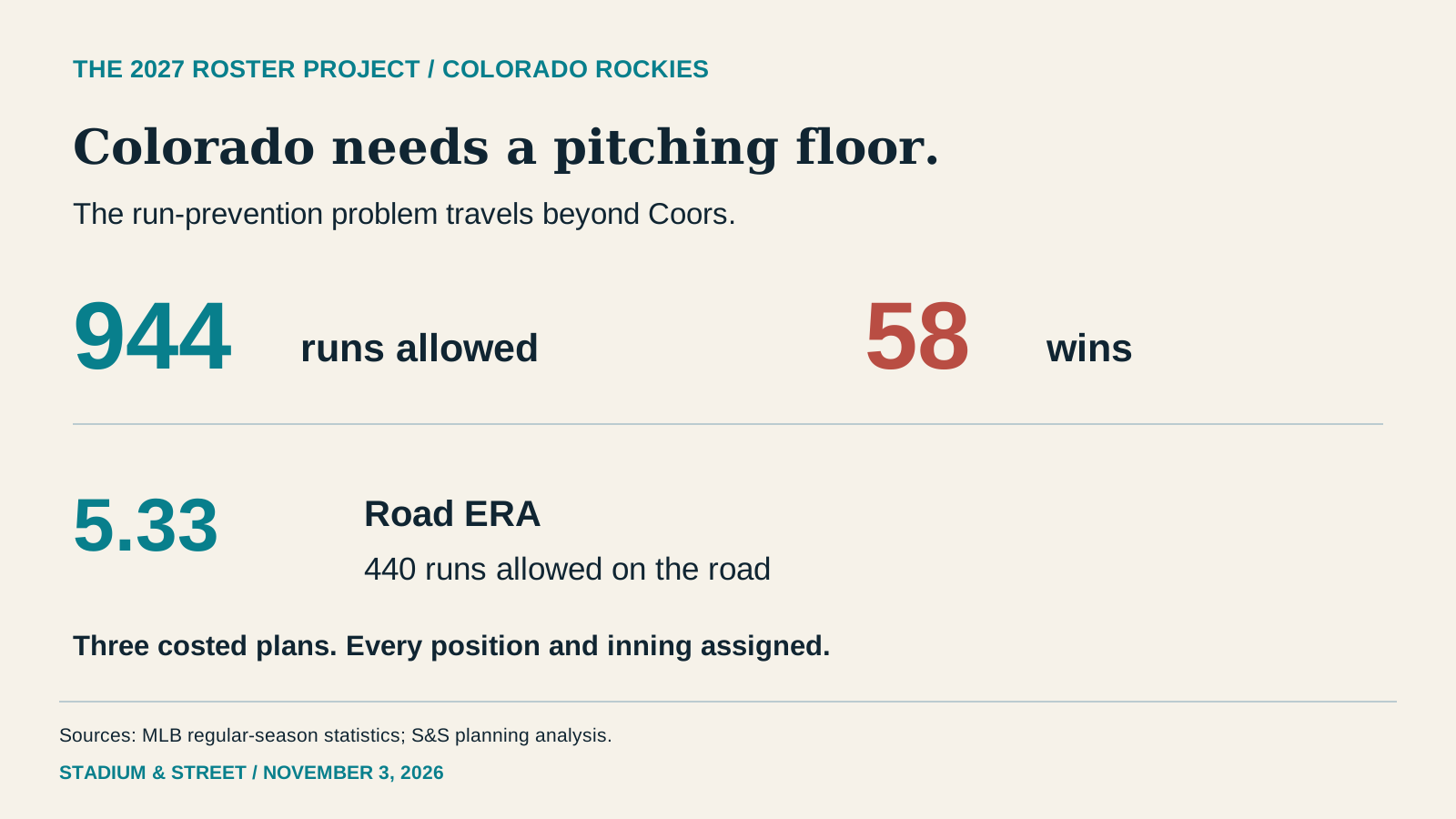
Colorado scored 155 more runs than it had a year earlier and still lost 104 games. The improvement was real. So was the distance remaining. A club that allowed 944 runs cannot build its next offseason around another corner bat and a hopeful list of recovering pitchers. It needs a staff that can carry the schedule while its young hitters reveal which parts of the offensive rebound will last.
Our preferred plan offers Erick Fedde one year at $7-9 million, Michael Soroka one year at $8-10 million and Jordan Romano one year at $4-6 million. A separate $6-8 million reserve covers needs that emerge. Annual additions total $25-33 million, producing a player-allocation envelope of approximately $110.81-122.81 million. These are S&S negotiating ceilings, subject to current medical and market review. None is a reported offer or an approved Colorado budget.
Fedde receives a proposed 30 starts and 155 innings. Soroka receives 24 starts and 125 innings. Romano receives 50 relief innings without a closer guarantee. Together they occupy meaningful jobs, but leave 108 starts and 560 relief innings for the organization. The proposal buys enough outside work to keep every young pitcher from having to solve the same problem at once.
The position-player recommendation is more restrained. Keep substantial roles for TJ Rumfield, Hunter Goodman, Kyle Karros, Cole Carrigg and Ezequiel Tovar. Give Adael Amador a genuine second-base opportunity. Create specific routes for Sterlin Thompson, Zac Veen and Charlie Condon, rather than promising full-time work to every prospect. Retain Kris Bryant's $27 million allocation while assigning him no principal plate appearances. A return would require a new playing-time decision, not an assumption that his salary disappears if he cannot play.
There are two complete alternatives. Plan B replaces Fedde with Nick Martinez at two years and $26-30 million, raising annual additions to $31-39 million. Plan C buys none of the three pitchers and carries only the $6-8 million reserve. The internal staff is fully assigned later in this report. Its lower price comes with heavier workloads for pitchers who have not yet established reliable major-league performance.
What improved, and what did not
The Rockies moved from 43-119 in 2025 to 58-104 in 2026. Runs scored rose from 597 to 752; runs allowed fell from 1,021 to 944. The resulting 232-run improvement in differential is substantial. It also begins from a minus-424 season, so the better team still finished at minus-192. The proper response is to identify the gains worth preserving while refusing to confuse recovery from an extreme low with competitive balance.
| Season | Record | Runs for / against | Margin | OPS / ERA |
|---|---|---|---|---|
| 2024 | 61-101 | 682 / 929 | -247 | .704 / 5.47 |
| 2025 | 43-119 | 597 / 1021 | -424 | .679 / 5.97 |
| 2026 | 58-104 | 752 / 944 | -192 | .739 / 5.59 |
The offensive change was larger than the run-prevention change: 155 additional runs against 77 fewer allowed. Team OPS improved from .679 to .739. Yet the pitching staff's 5.59 ERA and the volume of runs conceded kept even a more productive lineup under constant pressure. A meaningful next step must reduce the number of games in which the offense is asked to score six or seven merely to stay involved.
Colorado went 17-25 in one-run games and 3-7 in extra innings, counted from 162 unique official regular-season finals. Better late-game execution would help. It would not erase the much larger problem shown by the full-season run margin. Using the simple squared-run formula, 752 runs scored and 944 allowed correspond to roughly 63 wins over 162 games. That descriptive calculation suggests some room above 58 without establishing an 80-win roster.
The offseason should therefore be judged by specific improvements: fewer free baserunners, fewer emergency pitching assignments, steadier middle-infield defense and more evidence about the young hitters. A larger win total would be welcome. It should follow from those changes rather than stand in for an explanation of how the roster gets better.
Coors explains part of the problem
The home-road split gives the report an essential boundary. Colorado produced a .774 OPS and 406 runs at home, compared with a .704 OPS and 346 runs away. Those are actual outcomes in different environments and against different schedules. The gap is useful evidence, but it is not a precise estimate of the park's causal effect on any individual hitter.
| 2026 split | Record | Runs for / against | Batting OPS | Pitching ERA |
|---|---|---|---|---|
| Home | 32-49 | 406 / 504 | .774 | 5.83 |
| Road | 26-55 | 346 / 440 | .704 | 5.33 |
The pitching contrast is more revealing than an all-purpose appeal to altitude. The Rockies allowed 504 runs at home and 440 on the road. Their road ERA was 5.33. Opponents posted an .830 OPS away from Coors, and Colorado pitchers walked 280 batters in 686.2 road innings. The club needs better pitching even before debating how much extra difficulty its home park creates.
Buying a pitcher solely because he is described as a ground-ball fit would be too simple. Contact quality, strike throwing, workload, defense and price all matter. The expected-statistics tables provide another lens on the same players, but xERA and xwOBA are not complete park-adjusted forecasts of what a player will do in Denver. Neither a road split nor an expected number should be presented as the player's one true ability.
That distinction affects the spending recommendation. The club should pay for a defined, affordable job, then test whether the pitcher can execute it in Colorado. It should not pay a premium for an unverified promise that a particular repertoire defeats Coors. The preferred pitchers have limitations that remain visible in their full-season records.
The roster after the transactions
Both fresh official roster surfaces contain 36 names. Colorado returned Rule 5 selection RJ Petit to Detroit on November 3; the individual transaction record also shows his assignment to Toledo. He is outside the retained Colorado roster and receives no principal innings. The team update confirms Shook, Castellano and Stevens became free agents.
The larger departures are clear. Kyle Freeland, Tomoyuki Sugano, Jose Quintana and Romano elected free agency. Michael Lorenzen was released during the season and is not a retained starter. Antonio Senzatela was traded to Milwaukee and later became a free agent. Victor Vodnik went to Miami, Seth Halvorsen to the Dodgers and Brenton Doyle to the White Sox. Their Colorado statistics explain the completed season; they do not belong in a retained 2027 roster.
Tyler Freeman's free agency removes another former contributor. Edouard Julien and Blake Adams were outrighted and are treated as organizational depth, subject to subsequent status changes. Neither receives an automatic major-league job. Pierson Ohl was claimed by the Mets. A familiar name on an older depth chart is not enough to restore any of these players to Colorado's plan.
The proposed outside signings, Brooks selection and eventual Condon promotion each need actual roster capacity. Their moves would not necessarily occur on the same day. No player is silently waived to make the arithmetic fit. The report's season-long allocations describe a sequence of opportunities, not an oversized active roster that could legally appear in one game.
The offense that earned another look
Rumfield's 631 plate appearances, .843 OPS and 72 walks give Colorado a substantial first-base sample to build around. Goodman followed a .843 OPS in 2025 with .839 and 41 home runs in 2026. Karros improved from .585 in a short 2025 trial to .761 across 475 plate appearances. Carrigg produced an .818 OPS in 372 plate appearances. These are different sizes and types of evidence, but together they justify patience with the core of the lineup.
| Player / MLB ID | COL PA | AVG / OBP / SLG | HR | BB / K |
|---|---|---|---|---|
| TJ Rumfield / 681198 | 631 | .300 / .390 / .453 | 16 | 72 / 86 |
| Jake McCarthy / 664983 | 596 | .291 / .334 / .475 | 15 | 30 / 95 |
| Hunter Goodman / 696100 | 574 | .245 / .310 / .529 | 41 | 46 / 175 |
| Ezequiel Tovar / 678662 | 506 | .219 / .264 / .353 | 13 | 29 / 129 |
| Willi Castro / 650489 | 477 | .260 / .331 / .417 | 15 | 41 / 129 |
| Kyle Karros / 691720 | 475 | .253 / .347 / .414 | 13 | 54 / 100 |
| Troy Johnston / 687859 | 449 | .277 / .348 / .393 | 4 | 37 / 83 |
| Mickey Moniak / 666160 | 436 | .238 / .278 / .480 | 23 | 22 / 120 |
| Cole Carrigg / 694249 | 372 | .279 / .341 / .477 | 12 | 28 / 89 |
| Tyler Freeman / 671289 | 288 | .247 / .317 / .314 | 3 | 11 / 34 |
| Edouard Julien / 666397 | 276 | .208 / .322 / .292 | 3 | 39 / 71 |
| Brett Sullivan / 664954 | 237 | .225 / .268 / .390 | 7 | 13 / 40 |
| Jordan Beck / 687597 | 180 | .200 / .261 / .291 | 1 | 14 / 57 |
| Connor Norby / 681393 | 150 | .302 / .387 / .457 | 3 | 16 / 38 |
| Adael Amador / 691182 | 95 | .277 / .362 / .482 | 4 | 10 / 12 |
| Braxton Fulford / 690924 | 85 | .176 / .259 / .270 | 1 | 8 / 34 |
| Zac Veen / 691728 | 79 | .232 / .312 / .435 | 3 | 7 / 31 |
| Sterlin Thompson / 694514 | 77 | .232 / .312 / .377 | 2 | 5 / 21 |
McCarthy's .809 OPS was a sharp rebound from .592 in 2025. His 15 home runs and 95 strikeouts in 596 plate appearances gave the lineup a different shape from its higher-strikeout corner options. The plan retains him as both an outfield regular and the first alternative in center. His role is valuable even if the offensive peak proves difficult to repeat.
Tovar is the central unresolved incumbent. His OPS has fallen from .764 to .694 to .617 over three seasons, while his 2026 line included 129 strikeouts and 29 walks. A long-term contract makes development especially important, but does not itself establish the answer. The plan preserves 550 PA and 132 shortstop starts, with actual alternatives if the bat remains a problem.
Norby's .844 OPS in 150 Colorado plate appearances should not obscure a .719 full MLB season across 383 PA. The acquired player deserves a fair opportunity at second, third and DH, but the larger sample argues against immediately handing him the entire second-base job. Julien's .614 Colorado OPS and subsequent outright further change the competition. The recommendation is based on the roster now available, not the lineup as it looked in April.
Contact quality challenges the headline numbers
Several of the Rockies' best-looking batting lines outran their expected production. Rumfield's .373 wOBA exceeded a .333 xwOBA. McCarthy was at .349 and .321; Goodman at .355 and .321; Carrigg at .352 and .316. The gaps do not make the actual hits imaginary. They make a straight-line assumption that every hitter repeats his 2026 output less convincing.
| Full MLB season | wOBA | xwOBA | SLG / xSLG |
|---|---|---|---|
| TJ Rumfield | 0.373 | 0.333 | 0.453 / 0.386 |
| Jake McCarthy | 0.349 | 0.321 | 0.475 / 0.410 |
| Hunter Goodman | 0.355 | 0.321 | 0.529 / 0.456 |
| Ezequiel Tovar | 0.270 | 0.281 | 0.353 / 0.371 |
| Willi Castro | 0.330 | 0.309 | 0.417 / 0.390 |
| Kyle Karros | 0.336 | 0.334 | 0.414 / 0.402 |
| Troy Johnston | 0.329 | 0.323 | 0.393 / 0.375 |
| Mickey Moniak | 0.322 | 0.279 | 0.480 / 0.392 |
| Cole Carrigg | 0.352 | 0.316 | 0.477 / 0.407 |
| Tyler Freeman | 0.289 | 0.309 | 0.314 / 0.353 |
| Edouard Julien | 0.287 | 0.338 | 0.292 / 0.401 |
| Brett Sullivan | 0.285 | 0.281 | 0.390 / 0.354 |
| Jordan Beck | 0.248 | 0.253 | 0.291 / 0.293 |
| Connor Norby | 0.323 | 0.310 | 0.377 / 0.367 |
| Adael Amador | 0.365 | 0.274 | 0.482 / 0.311 |
| Braxton Fulford | 0.242 | 0.209 | 0.270 / 0.226 |
| Zac Veen | 0.327 | 0.275 | 0.435 / 0.338 |
| Sterlin Thompson | 0.308 | 0.295 | 0.377 / 0.357 |
Karros provides a useful counterpoint: .336 wOBA and .334 xwOBA are much closer. His 54 walks and 100 strikeouts also support a more complete offensive discussion than a home-run total alone. That is why the plan preserves a large third-base share rather than turning him into the expendable part of a generic veteran upgrade.
Moniak's .322 wOBA and .279 xwOBA create a more pronounced warning. Amador's .365 and .274 came in only 95 PA; Veen's .327 and .275 in 79. Those small samples cannot settle their futures. They can prevent the report from assigning a full season of the most flattering number to each player and then adding all the improvements together.
The young hitter with a quieter major-league line may still have a better development case than a teammate with a brief hot stretch. This is where the minor-league record, defensive role and plate discipline belong beside the expected metrics. The final recommendation preserves competition while putting limits on how much unproven production the financial plan needs.
Three-year evidence and platoon use
Goodman's consecutive productive full seasons provide more support than a single late-season burst. Tovar's three-year decline requires a different response. McCarthy's rebound follows a poor year; Beck's .552 in 180 PA follows .733 in 588. Those histories argue for individualized decisions. One universal instruction to play the young players more would ignore both the different evidence and the limited number of jobs.
| Hitter | 2024 MLB PA / OPS | 2025 MLB PA / OPS | 2026 MLB PA / OPS |
|---|---|---|---|
| TJ Rumfield | No MLB season | No MLB season | 631 / .843 |
| Jake McCarthy | 495 / .749 | 222 / .592 | 596 / .809 |
| Hunter Goodman | 224 / .645 | 579 / .843 | 574 / .839 |
| Ezequiel Tovar | 695 / .764 | 390 / .694 | 506 / .617 |
| Willi Castro | 635 / .716 | 454 / .679 | 477 / .748 |
| Kyle Karros | No MLB season | 156 / .585 | 475 / .761 |
| Troy Johnston | No MLB season | 121 / .751 | 449 / .741 |
| Mickey Moniak | 418 / .646 | 461 / .824 | 436 / .758 |
| Cole Carrigg | No MLB season | No MLB season | 372 / .818 |
| Jordan Beck | 184 / .521 | 588 / .733 | 180 / .552 |
| Connor Norby | 194 / .732 | 337 / .689 | 383 / .719 |
| Adael Amador | 36 / .394 | 128 / .521 | 95 / .844 |
| Zac Veen | No MLB season | 37 / .424 | 79 / .747 |
| Sterlin Thompson | No MLB season | No MLB season | 77 / .689 |
Moniak is the clearest platoon candidate among the regulars. He produced an .807 OPS against right-handers and .573 against left-handers in 2026. His proposed 475 PA and 105 right-field starts leave room for right-handed alternatives and rest. That use is compatible with the two-year extension; the contract need not turn him into an automatic starter against every opponent.
| Batter / full MLB season | LHP PA / OPS | RHP PA / OPS |
|---|---|---|
| TJ Rumfield | 197 / .775 | 434 / .875 |
| Hunter Goodman | 189 / .848 | 385 / .835 |
| Ezequiel Tovar | 169 / .593 | 337 / .628 |
| Mickey Moniak | 91 / .573 | 345 / .807 |
| Cole Carrigg | 156 / .757 | 216 / .863 |
| Connor Norby | 136 / .746 | 247 / .704 |
| Adael Amador | 37 / .780 | 58 / .882 |
| Jordan Beck | 97 / .760 | 83 / .313 |
| Zac Veen | 11 / .222 | 68 / .821 |
| Sterlin Thompson | 15 / .553 | 62 / .723 |
Goodman's .848 OPS against left-handers and .835 against right-handers support a broad offensive role. Rumfield's .775 against lefties was below his .875 against righties, but still argues against an automatic full platoon. Norby's full-season split, .746 against lefties and .704 against righties, is more moderate than the Colorado-only slice suggests. It offers a reason to consider matchups, not proof that he solves every left-handed opponent.
Tovar struggled against both sides. Splitting his work by pitcher handedness alone would miss the larger issue. Amador's encouraging platoon numbers are drawn from fewer than 100 total PA. He should receive the opportunity to establish a repeatable approach, with the review focused on swing decisions and contact quality rather than treating those tiny split samples as permanent strengths.
Defense needs defined jobs
The Rockies should preserve Tovar at shortstop initially, while acknowledging the trend in range results. His Outs Above Average moved from plus-15 in 2024 to plus-3 in 2025 and minus-1 in 2026. That is a meaningful loss of the margin that once supported a weak offensive night. It does not establish why the change occurred, and the report makes no diagnosis from the statistic.
| Fielder | 2024 OAA | 2025 OAA | 2026 OAA | 2026 opportunities |
|---|---|---|---|---|
| Ezequiel Tovar | +15 | +3 | -1 | 490 |
| Kyle Karros | No row | +4 | +1 | 394 |
| Adael Amador | +0 | -3 | +0 | 59 |
| Willi Castro | +0 | -9 | -6 | 406 |
| Connor Norby | -6 | -4 | -3 | 235 |
| Jake McCarthy | +5 | +3 | +1 | 393 |
| Cole Carrigg | No row | No row | -2 | 307 |
| Mickey Moniak | +1 | -8 | +0 | 185 |
| Jordan Beck | -2 | -2 | -2 | 107 |
| Zac Veen | No row | +0 | -4 | 52 |
| Sterlin Thompson | No row | No row | +0 | 24 |
| TJ Rumfield | No row | No row | +2 | 392 |
Karros' plus-1 over 394 opportunities in 2026 follows plus-4 in a smaller sample. Rumfield was plus-2 at first. Those are reasons to retain their jobs. Castro's minus-9 and minus-6 in the last two seasons, and Norby's three negative seasons, make a large defensive role for either a choice that needs scrutiny. Utility experience is not the same as above-average range at every listed position.
McCarthy has three positive OAA seasons, plus-5, plus-3 and plus-1. Carrigg's minus-2 in his first MLB season is less reassuring, but his actual center-field work gives the club a base for development. Veen's minus-4 came in only 52 opportunities. That sample is too small for a fixed long-term verdict, yet large enough to require a real defensive review before awarding everyday outfield work.
| Fielder | 2026 COL position | Starts / innings |
|---|---|---|
| Cole Carrigg | RF | 0 / 5.0 |
| Willi Castro | 1B | 6 / 51.1 |
| Willi Castro | LF | 2 / 25.0 |
| Connor Norby | 1B | 2 / 25.0 |
| Sterlin Thompson | RF | 2 / 24.0 |
| Willi Castro | 2B | 51 / 439.1 |
| Adael Amador | 2B | 16 / 145.0 |
| Ezequiel Tovar | SS | 133 / 1158.2 |
| Cole Carrigg | CF | 71 / 634.2 |
| Cole Carrigg | SS | 12 / 103.0 |
| Connor Norby | 2B | 23 / 207.0 |
| Kyle Karros | 3B | 116 / 1027.2 |
| Willi Castro | 3B | 36 / 305.0 |
| Willi Castro | SS | 15 / 138.0 |
| Connor Norby | 3B | 7 / 60.0 |
| Sterlin Thompson | LF | 7 / 62.0 |
| Willi Castro | CF | 0 / 2.0 |
The preferred alignment gives Amador 100 starts at second and Karros 125 at third. Castro supplies 50 at second and 15 at third. Norby receives smaller shares there, with DH work preserving his offensive opportunity. Carrigg receives 110 starts in center and 20 at short; McCarthy provides 45 center-field starts. These are defined roles, supported by actual positional experience, rather than an assumption that every flexible player can be moved anywhere without cost.
Keep Goodman's bat and manage the catching load
Goodman's 41 home runs create an unusual offensive advantage at catcher, but the club still needs to decide how many innings he should catch. He worked 816.1 innings behind the plate. The full-season framing measure was about minus-0.77 runs and the broader catching value about plus-0.70. The latter includes components beyond receiving. It should not be described as the same measure twice.
| Catcher | 2026 COL catching IP | Full MLB framing | Full MLB catching value |
|---|---|---|---|
| Hunter Goodman | 816.1 | -0.77 | +0.70 |
| Brett Sullivan | 506.2 | -4.30 | -3.59 |
| Braxton Fulford | 98.2 | -1.72 | Unknown |
Brett Sullivan caught 506.2 innings, with approximately minus-4.30 framing runs and minus-3.59 total catching runs. Fulford's framing estimate was minus-1.72 in a much smaller catching sample; a total catching-value row was not available in the saved extract. The absence remains unknown. None of these figures justifies calling the reserve catching a solved strength.
The plan gives Goodman 115 catching starts and 25 at DH, with Sullivan taking 30 behind the plate and Fulford 17. That protects a path to 600 PA without requiring Goodman to catch every day he hits. The reserves remain important even with modest offensive projections, because a catching injury cannot be replaced by simply moving an outfielder into the lineup.
Cole Messina stays on a development track after a .693 OPS in 364 Double-A PA. He does not receive invented major-league production to make the catching future look deeper. If Goodman is unavailable, the explicit fallback expands Sullivan and Fulford, with additional DH work for Condon. It is a materially weaker offensive outcome, which is why catching health belongs among the report's largest risks.
The starting rotation needs purchased coverage
Colorado's starters worked 757.2 innings with a 6.28 ERA. They allowed 146 home runs, struck out 555 and walked 261. The bullpen then supplied another 664 innings. Better starters would help both by preventing runs and by reducing how often the club has to seek fresh relief coverage. The preferred plan raises the starting allocation to 830 innings, a meaningful increase that still leaves a substantial bullpen burden.
| Pitcher / MLB ID | GS / COL IP | ERA / full MLB xERA | K / BB / HR | Planning treatment |
|---|---|---|---|---|
| Ryan Feltner / 663372 | 22 / 123.1 | 5.40 / 4.89 | 92 / 53 / 20 | 26 starts / 135 IP |
| Gabriel Hughes / 687312 | 13 / 64.0 | 6.33 / 3.92 | 56 / 24 / 7 | 22 / 110; command and workload |
| Tanner Gordon / 685299 | 12 / 103.2 | 6.68 / 5.16 | 85 / 24 / 21 | 20 / 105; reduce damage |
| Mason Adams / 690279 | 6 / 29.0 | 4.03 / 5.09 | 31 / 12 / 6 | 12 / 60; developmental role |
| Sean Sullivan / 807743 | 5 / 22.1 | 8.87 / 4.82 | 16 / 11 / 5 | 8 / 40 after health review |
| Blas Castaño / 680604 | 0 / 27.1 | 3.62 / 5.96 | 21 / 9 / 4 | 4 / 20 plus 55 relief IP |
| Chase Dollander / 801403 | 3 / 44.0 | 3.89 / 3.98 | 47 / 18 / 6 | Zero principal IP; rehabilitation |
| Tomoyuki Sugano / 608372 | 29 / 154.1 | 5.37 / 6.35 | 96 / 36 / 33 | Free agent; no retained innings |
| Kyle Freeland / 607536 | 26 / 135.1 | 6.65 / 5.54 | 108 / 29 / 29 | Free agent; no retained innings |
| Michael Lorenzen / 547179 | 25 / 115.2 | 7.08 / 6.15 | 82 / 49 / 19 | Released; no retained innings |
| Jose Quintana / 500779 | 11 / 48.0 | 5.44 / 5.58 | 25 / 20 / 10 | Free agent; no retained innings |
Feltner's 123.1 innings and 5.40 ERA are a useful workload foundation, but 53 walks and 20 home runs constrain the upside. His 4.89 xERA is more favorable without being an assurance of quality. The plan asks for 26 starts and 135 innings, a modest workload increase whose usefulness depends on better execution.
Hughes is a more interesting development wager. His 6.33 ERA in 64 innings is poor, but the 3.92 xERA and 56 strikeouts against 24 walks offer a different reading of the contact. He receives 22 starts and 110 innings. That expansion must be reviewed against his complete workload and readiness; the lower expected figure is not credited as an automatic reduction in future runs.
Gordon's 103.2 innings came with a 6.68 ERA, 21 home runs and a 5.16 xERA. He retains 20 starts and 105 innings because the club needs usable internal volume, not because the results demand a large role. Mason Adams receives 12 starts and 60 innings. His 29-inning Colorado sample included a 4.03 ERA but six home runs and a 5.09 xERA, another reason to resist reading a small ERA as a finished answer.
Sean Sullivan receives eight starts and 40 innings after health and workload review. His 22.1 MLB innings and 61 Triple-A innings do not justify a large immediate assignment. Castaño's four starting assignments and 20 innings are depth coverage alongside 55 relief innings, not a claim that he already established himself as a starter. Brooks supplies the remaining developmental starting share after an actual roster selection.
Injured pitchers cannot be the missing budget line
Dollander produced 44 innings before his elbow-related injured-list sequence. Brown and Herrera also carry major interrupted-season concerns. Their November administrative activations do not establish when they can pitch effectively. The principal plan assigns none of them innings. Any successful return would allow the club to reconsider other workloads rather than supply production it had already spent in the forecast.
Petit's November 3 return to Detroit resolves his organizational status. Earlier differences in injury descriptions do not establish a recovery date. No Petit innings are assigned to Colorado, and his administrative activation is not presented as medical clearance.
Soroka's proposed purchase also needs caution. His individual transactions show an August right-arm inflammation stint followed by a September activation. A one-year offer and a 125-inning assignment acknowledge that history. The plan should not become more aggressive simply because several other options also carry medical questions.
Bryant's absence is treated consistently on the other side of the roster. His 2026 transaction record identifies the back condition, and there is no MLB batting sample for the season. Colorado still owes the signed allocation. A healthier spring would justify reevaluation, but neither a zero-salary assumption nor 500 penciled-in PA belongs in the principal plan. This separation between financial obligation and usable production is central to the entire review.
Relief command before bullpen titles
Bernardino is the clearest internal control anchor: 64 innings, 49 strikeouts, 15 walks and a 2.81 ERA. The 3.73 xERA is a useful caution, but the walk record still distinguishes him from several teammates. The plan assigns 70 relief innings without assuming he alone can stabilize every important inning.
| Pitcher | COL IP | ERA / full MLB xERA | K / BB | Treatment |
|---|---|---|---|---|
| Brennan Bernardino | 64.0 | 2.81 / 3.73 | 49 / 15 | 70 IP; control anchor |
| Jaden Hill | 39.2 | 5.22 / 3.95 | 40 / 23 | 60 IP; walk reduction |
| Juan Mejia | 70.0 | 5.27 / 4.73 | 66 / 40 | 70 IP; walks constrain leverage |
| Jimmy Herget | 53.2 | 5.70 / 4.51 | 47 / 26 | 55 IP; no automatic closer |
| Zach Agnos | 91.0 | 5.93 / 5.30 | 58 / 35 | 90 IP; bulk workload |
| Mark Manfredi | 17.2 | 3.06 / 4.51 | 16 / 9 | 55 IP; minor/MLB transition |
| Hayden Harris | 0 | No sample / No row | 0 / 0 | 40 IP; current waiver acquisition |
| Jeff Criswell | 4.0 | 4.50 / 9.17 | 3 / 3 | 30 IP after shoulder review |
| Blas Castaño | 27.1 | 3.62 / 5.96 | 21 / 9 | 55 relief; 75 combined IP |
| Nick Frasso | 21.2 | 5.82 / 4.38 | 22 / 7 | 35 relief IP; no starting assumption |
| Victor Vodnik | 36.0 | 5.25 / 4.12 | 26 / 19 | Traded to Miami; zero retained IP |
| Seth Halvorsen | 19.0 | 4.74 / 6.27 | 17 / 15 | Traded to Dodgers; zero retained IP |
| Antonio Senzatela | 52.1 | 3.61 / 4.06 | 46 / 17 | Traded, then free agent; zero retained IP |
Mejia walked 40 in 70 innings. Hill walked 23 in 39.2. Herget walked 26 in 53.2. Those free baserunners matter in any park, and become especially costly when the next ball in play can find a large outfield gap. The proposed workloads keep these pitchers involved, but leverage should follow demonstrated execution rather than an offseason declaration that a particular inning belongs to someone.
Agnos' 91 innings provide a bulk precedent for a 90-inning relief assignment. His 5.93 ERA and 5.30 xERA mean that volume was not necessarily good volume. The club needs him to reduce damage as well as absorb work. Manfredi, Harris, Criswell, Castaño and Frasso fill smaller jobs, with readiness and performance conditions attached. Their presence on the list is coverage, not evidence that all will meet the proposed standard.
The former relief group must also be removed correctly. Vodnik, Halvorsen and Senzatela cannot be carried forward merely because their Colorado innings were useful. Romano would be a new agreement after free agency. His local sample was 25.2 innings with a 4.21 ERA, while his full MLB season was 33.2 innings with a 5.61 ERA. The preferred offer depends on the larger record and the next medical review, not nostalgia for a short stretch.
The farm should supply answers, not decoration
Condon's 598 Triple-A PA, .904 OPS, 27 home runs, 79 walks and 150 strikeouts provide a substantial basis for a major-league opportunity. The plan reserves 250 PA and specific first-base and DH starts after selection. That is enough work to test him while allowing timing to depend on actual readiness. It does not require the club to move Rumfield out of a productive first-base role before Condon earns the next step.
| Player / MLB ID | 2026 level and sample | Readiness decision |
|---|---|---|
| Charlie Condon / 809707 | AAA: 598 PA, .904 OPS, 27 HR; 79 BB / 150 K | 250 PA after selection; no guaranteed immediate promotion |
| Sterlin Thompson / 694514 | AAA: 408 PA, 1.005 OPS, 14 HR; 77 BB / 60 K | 300 PA with specific RF/DH role |
| Zac Veen / 691728 | AAA: 445 PA, 1.037 OPS, 24 HR; 48 BB / 91 K | 275 PA; defensive review |
| Adael Amador / 691182 | AAA: 434 PA, .795 OPS, 11 HR; 61 BB / 48 K | 425 PA; 100 second-base starts |
| Jordan Beck / 687597 | AAA: 114 PA, .883 OPS, 7 HR; 8 BB / 26 K | 225 PA; competition, not automatic job |
| Braxton Fulford / 690924 | AAA: 201 PA, .831 OPS, 8 HR; 23 BB / 52 K | 75 PA; catching reserve |
| Jake Brooks / 694860 | AAA: 80.1 IP, 4.15 ERA; 48 K / 16 BB | 16 starts / 80 IP after selection |
| Jake Brooks / 694860 | AA: 78.1 IP, 4.71 ERA; 66 K / 16 BB | Combined AA/AAA158.2 IP supports workload discussion |
| Jack Mahoney / 694968 | AAA: 33.1 IP, 6.21 ERA; 23 K / 18 BB | Reserve only; AAA control gap |
| Stu Flesland III / 687317 | AA: 86.0 IP, 1.88 ERA; 70 K / 28 BB | Reserve only; lower-level context |
| Sean Sullivan / 807743 | AAA: 61.0 IP, 5.31 ERA; 59 K / 22 BB | 8 starts / 40 IP; health check |
| Blake Adams / 687060 | AAA: 61.1 IP, 7.48 ERA; 47 K / 23 BB | Outrighted relief depth; not eight invented starts |
| Jared Thomas / 703606 | AA: 124 PA, .746 OPS, 4 HR; 8 BB / 46 K | No principal MLB quota |
| Cole Messina / 701783 | AA: 364 PA, .693 OPS, 8 HR; 42 BB / 99 K | No principal MLB quota |
| Ethan Holliday / 815787 | A: 152 PA, .952 OPS, 9 HR; 23 BB / 43 K | Recovery/development; no 2027 MLB quota |
Thompson's 408 Triple-A PA included a 1.005 OPS, 77 walks and 60 strikeouts. Veen had a 1.037 OPS and 24 home runs in 445 PA. Those are strong level-specific results. Albuquerque context, the quality of MLB pitching and defensive readiness all remain part of the translation. The preferred plan creates opportunities for both without assigning either an instant major-league star's production.
Amador's 61 walks against 48 strikeouts in 434 Triple-A PA are particularly relevant to a lineup that needs more repeatable offensive approaches. His .795 OPS there is less dramatic than some teammates' numbers, but the contact and walk balance support a real second-base trial. Beck's 114 Triple-A PA are a smaller sample. His seven home runs matter, yet the major-league regression still warrants competition rather than a protected everyday job.
Brooks worked 78.1 innings at Double-A and 80.1 at Triple-A, with 32 walks across the two stops. The combined 158.2 innings make a proposed 80 MLB innings more grounded than assigning a large starting role to a reliever with two Triple-A starts. His 48 strikeouts in the higher-level sample also warn that a successful transition cannot be assumed. The plan gives him work to earn after selection, with a named fallback if he does not.
Mahoney's 1.99 Double-A ERA rose to 6.21 at Triple-A; Flesland's 1.88 Double-A ERA is encouraging but belongs to that level. Neither is credited with principal MLB innings. Jared Thomas, Messina and Ethan Holliday remain developmental options, with Holliday's recovery reviewed separately. A strong prospect list is most useful when it clarifies who is near a defined job and who still needs time.
The acquisition choices
Fedde's 141 innings, 3.83 ERA, 99 strikeouts and 52 walks make him a credible short-term volume candidate. His 4.79 xERA is the strongest argument against treating him as a reliable run-prevention upgrade. At $7-9 million for one year, the case is for coverage with a firm limit on commitment. The proposed 155 innings exceed his 2026 total by 14 and require a fresh workload assessment.
| Candidate / MLB ID | Full 2026 MLB evidence | S&S ceiling / decision |
|---|---|---|
| Erick Fedde / 607200 | 141.0 IP, 3.83 ERA, 4.79 xERA; 99 K / 52 BB | A: 1 year / $7-9M; 30 starts / 155 IP |
| Michael Soroka / 647336 | 116.0 IP, 3.41 ERA, 4.12 xERA; 114 K / 29 BB | A/B: 1 year / $8-10M; 24 starts / 125 IP |
| Jordan Romano / 605447 | 33.2 IP, 5.61 ERA, 3.63 xERA; 39 K / 19 BB | A/B: 1 year / $4-6M; 50 relief IP; medical/command gate |
| Nick Martinez / 607259 | 180.0 IP, 3.10 ERA, 3.98 xERA; 109 K / 26 BB | B: 2 years / $26-30M; 30 starts / 155 IP instead of Fedde |
| Taylor Clarke / 664199 | 73.0 IP, 2.96 ERA, 4.42 xERA; 45 K / 14 BB | Alternative: 1 year / $4-6M; 50 IP instead of Romano |
| Raisel Iglesias / 628452 | 60.0 IP, 2.55 ERA, 3.50 xERA; 64 K / 17 BB | Alternative: 1 year / $10-12M; costs more than preferred relief slot |
| Patrick Corbin / 571578 | 80.0 IP, 5.51 ERA, 5.51 xERA; 63 K / 25 BB | 5.51 ERA/xERA and injury record; no principal offer |
| Adrian Houser / 605288 | 109.2 IP, 4.02 ERA, 4.95 xERA; 75 K / 34 BB | Contracted Giant; no assumed availability or free-agent price |
| Kyle Freeland / 607536 | 135.1 IP, 6.65 ERA, 5.54 xERA; 108 K / 29 BB | Free agent; no automatic $17M option carryover |
| Tomoyuki Sugano / 608372 | 154.1 IP, 5.37 ERA, 6.35 xERA; 96 K / 36 BB | Free agent; 33 HR allowed in154.1 IP; no main purchase |
Soroka offers more strikeouts relative to walks: 114 and 29 in 116 innings, with a 3.41 ERA and 4.12 xERA. He receives a slightly larger annual ceiling despite a smaller proposed workload because that balance offers something different from the internal staff. The right-arm history prevents a long guaranteed assignment in this recommendation. If the medical review does not support the job, the club should use the alternative plan rather than quietly retain his projected innings.
Romano is the higher-variance relief choice. His 39 strikeouts in 33.2 innings address a staff that too often depends on contact, and the 3.63 xERA is better than his actual 5.61. His 19 walks are a serious objection. A one-year, $4-6 million limit and a 50-inning job make this a bounded rebound attempt. It is not a claim that expected ERA erases command problems or that returning to Colorado guarantees improvement.
Clarke is the distinct alternative at the same $4-6 million ceiling. His 14 walks in 73 innings offer better control, but 45 strikeouts and a 4.42 xERA temper a 2.96 ERA. Substituting him for Romano buys a different risk profile, with the same 50-inning job and unchanged budget. Iglesias is another alternative at $10-12 million, but that would add $6 million at each end of the annual range. The current roster does not provide a strong enough reason to make that the preferred expense.
Martinez is the more expensive rotation alternative. His 180 innings, 26 walks and 3.98 xERA provide a stronger workload-and-control case than Fedde's record. Two years and $26-30 million buy the same proposed 30-start, 155-inning role. Houser is contracted to San Francisco and is not priced as a free agent. Freeland, Sugano and Corbin remain separately evaluated alternatives rather than automatic purchases based on familiarity or handedness.
Compare the same players across clubs
Fedde's $7-9 million ceiling is below the $8-10 million retention alternative in our private White Sox preparation. Chicago's modeled role was 165 innings; Colorado's is 155. The more important difference is marginal value: a 58-win club should be cautious about paying additional guaranteed money for a pitcher whose expected performance is substantially less favorable than his ERA. This is a negotiating limit tied to the job, not a prediction that Fedde will accept a Denver discount.
Soroka's $8-10 million one-year range is consistent with Cleveland, Arizona and Washington preparation. Colorado assigns 24 starts and 125 innings, the same workload used for Washington and slightly below Arizona's 130 innings. The displaced work belongs to Gordon, Hughes, Mason Adams, Brooks and Sullivan through the alternatives table. None of those opportunities is costless. The case for a veteran is to prevent the entire development group from carrying the full schedule immediately.
Martinez's $13-15 million annual ceiling also matches several earlier dossiers. Here he is an alternative to Fedde, with 155 innings rather than Washington's 165. The shared price range does not establish that multiple clubs can sign him, or that a smaller inning assignment earns a lower market price. His availability, actual interest and competing offers remain external constraints.
Clarke's repeated use as a control-oriented alternative is explicit. St. Louis and the Cubs were modeled with larger 60-inning jobs at the same $4-6 million price. Colorado's alternative is 50 innings, with extra internal work preserved. Romano is preferred here for a higher-strikeout rebound profile at a short commitment, not to satisfy a novelty quota. The countercase for Clarke is strong enough that the club should compare actual medical and contract information before deciding.
All of the preferred additions are free-agent proposals. No outgoing prospect package is hidden in the financial totals, and no contracted player is assumed obtainable for cash alone. A trade for Houser or another controlled pitcher would require a separate seller decision, acquisition price and displaced-work analysis. The fully specified no-acquisition staff tests whether the club can tolerate losing every negotiation.
Contracts that stay in the budget
The four signed 2027 allocations total approximately $49.764 million: Bryant at $27 million, Tovar at $8.214 million, Castro at $7.3 million and Moniak at $7.25 million. These are dated RosterResource allocations. They are not a reconstructed cash ledger or competitive-balance-tax calculation. Tovar's displayed allocation, for example, should not be casually relabeled as his base salary.
| Player / MLB ID | 2027 allocation | Basis |
|---|---|---|
| Kris Bryant / 592178 | $27.000M | Guaranteed despite uncertain availability; through2028 |
| Ezequiel Tovar / 678662 | $8.214M | RosterResource allocation; not simply base cash |
| Willi Castro / 650489 | $7.300M | Signed through2027 |
| Mickey Moniak / 666160 | $7.250M | 2027 allocation; $9M in2028 |
| TOTAL | $49.764M | Allocation, not tax AAV or cash schedule |
Moniak's extension covers 2027 and 2028, with a reported $16.25 million total. The 2027 and 2028 allocations are $7.25 million and $9 million. That commitment is already part of the roster's financial baseline; it is not counted again as an offseason addition. His role can still be shaped by the platoon evidence and the performance of the young outfielders.
Freeland's old $17 million 2027 player option required 170 innings in 2026. He threw 135.1 and elected free agency. The option is not carried into this budget. Any return would be a new agreement at a newly justified price. Lorenzen's former $9 million club option is likewise not a retained player salary after his release and later free agency. The source's $250,000 buyout allocation is held as a reserve pending liability and cash-timing reconciliation.
The treatment of Bryant is deliberately strict. No assumed insurance recovery, settlement, retirement savings or release relief reduces the $27 million allocation. Those would require actual information and terms. Assigning zero principal PA does not predict that he will never play again. It prevents uncertain future production from being used to justify other roster decisions today.
Arbitration and the full roster pool
The six current arbitration estimates total $19.8 million: Goodman $6.2 million, McCarthy $4.6 million, Feltner $3.8 million, Herget $2.4 million, Bernardino $1.6 million and Beck $1.2 million. They are unsigned estimates, not completed contracts. The principal plan assumes no non-tender savings and no automatic agreement at a lower figure.
| Player | Estimate, $M | Treatment |
|---|---|---|
| Jimmy Herget | 2.40 | Unsigned; no non-tender savings assumed |
| Jake McCarthy | 4.60 | Unsigned; no non-tender savings assumed |
| Ryan Feltner | 3.80 | Unsigned; no non-tender savings assumed |
| Brennan Bernardino | 1.60 | Unsigned; no non-tender savings assumed |
| Hunter Goodman | 6.20 | Unsigned; no non-tender savings assumed |
| Jordan Beck | 1.20 | Unsigned; no non-tender savings assumed |
| TOTAL | 19.80 | Six current-roster cases |
Those six players do not all carry equal certainty. Goodman's bat and Bernardino's control give their proposed roles stronger support. Beck's poor major-league season and Herget's command create more difficult decisions. The relatively modest projected salaries make it reasonable to retain competition in this model, but that judgment should be revisited if an actual agreement, injury update or better alternative changes the comparison.
| Component | Annual allocation | Definition |
|---|---|---|
| Four signed salaries | $49.764M | Bryant, Tovar, Castro, Moniak |
| Six arbitration estimates | $19.80M | No assumed discounts or automatic tenders |
| Lorenzen buyout reserve | $0.25M | Verify current liability and cash timing |
| Pre-arb, minors and callups | $16-20M | S&S roster pool, not a fixed new minimum |
| Existing-roster envelope | $85.81-89.81M | Excludes benefits, tax, and separately timed cash |
| RosterResource 2027 headline | $69.814286M | Signed allocations + arbitration + buyout; roster pool added |
| RosterResource 2026 estimate | $120.101775M | Historical estimate, not approved 2027 budget |
| Freeland $17M option | Not carried forward | 170-IP trigger not met;135.1 IP and free agency |
| Bryant production assumption | 0 PA; $27M retained | Medical uncertainty creates no automatic salary savings |
The $69.814286 million headline combines signed allocations, the six arbitration estimates and the Lorenzen buyout provision. It does not fund the rest of the roster by itself. Adding a $16-20 million pool for pre-arbitration players, minor-league contracts and callups produces an existing-roster envelope of $85.814286-89.814286 million. The pool is a planning allowance, not a claim about a settled 2027 minimum salary or a final count of every paid roster day.
Benefits, tax calculations and separately timed cash obligations remain outside that player-allocation definition. The 2026 RosterResource estimate of approximately $120.102 million provides historical context, not authority to spend the same amount next season. An actual budget review must reconcile what is paid, when it is paid and what future labor rules apply. A plausible range is more useful than a falsely precise all-in payroll number.
Three complete spending paths
Plan A's annual additions are $7-9 million for Fedde, $8-10 million for Soroka, $4-6 million for Romano and $6-8 million in reserve. The total is $25-33 million. Because all three offers are for one year, the proposed new commitment, including the reserve, is also $25-33 million. Combined with the existing roster, the annual allocation is approximately $110.81-122.81 million.
| Plan | Annual additions | Total allocation | New commitment |
|---|---|---|---|
| A: Fedde / Soroka / Romano | $25-33M | $110.81-122.81M | $25-33M |
| B: Martinez replaces Fedde | $31-39M | $116.81-128.81M | $44-54M |
| C: Internal staff | $6-8M | $91.81-97.81M | $6-8M |
Plan B replaces Fedde with Martinez at $13-15 million annually for two years. It keeps Soroka, Romano and the reserve. Annual additions rise to $31-39 million, and the total allocation to $116.81-128.81 million. The new commitment is $44-54 million because Martinez's second year remains payable beyond the first-season analysis. That extra obligation is the real price of buying his stronger workload-and-control record.
Plan C retains the $6-8 million reserve but signs none of the three preferred pitchers. The total allocation becomes $91.81-97.81 million. The roster does not receive their innings at a discount. Gordon, Hughes, Mason Adams, Brooks, Sullivan and Castaño take the starting work, while the internal relief group absorbs Romano's share. The next sections specify those assignments and their limits.
Substituting Clarke for Romano leaves Plan A's budget unchanged. Substituting Iglesias raises annual additions to $31-39 million and the total allocation to $116.81-128.81 million, but it remains a different plan from Martinez's two-year alternative. Identical first-year ranges do not imply identical commitments, workloads or risk. The club should compare the actual jobs purchased, not just the sum on the final line.
Give the hitters enough work to learn
The position-player plan totals 6,200 PA. Goodman and Rumfield receive 600 each; Tovar and Carrigg 550; McCarthy and Karros 525; Moniak 475; Amador 425. Norby, Castro and Thompson receive 300 each, followed by defined smaller shares for Veen, Beck, Condon and the reserves. It is a season-long allocation that requires ordinary options, selections, rest and changes in form.
| Hitter | PA | Condition |
|---|---|---|
| Hunter Goodman | 600 | Performance, health and seasonal rotation |
| TJ Rumfield | 600 | Performance, health and seasonal rotation |
| Ezequiel Tovar | 550 | Performance, health and seasonal rotation |
| Jake McCarthy | 525 | Performance, health and seasonal rotation |
| Kyle Karros | 525 | Performance, health and seasonal rotation |
| Cole Carrigg | 550 | Performance, health and seasonal rotation |
| Adael Amador | 425 | Performance, health and seasonal rotation |
| Mickey Moniak | 475 | Performance, health and seasonal rotation |
| Connor Norby | 300 | Performance, health and seasonal rotation |
| Willi Castro | 300 | Performance, health and seasonal rotation |
| Sterlin Thompson | 300 | Performance, health and seasonal rotation |
| Zac Veen | 275 | Performance, health and seasonal rotation |
| Jordan Beck | 225 | Performance, health and seasonal rotation |
| Charlie Condon | 250 | Selection and readiness required |
| Brett Sullivan | 125 | Performance, health and seasonal rotation |
| Braxton Fulford | 75 | Performance, health and seasonal rotation |
| Ryan Ritter | 50 | Performance, health and seasonal rotation |
| Troy Johnston | 50 | Performance, health and seasonal rotation |
| TOTAL | 6200 | Not simultaneous active-roster places |
Johnston's reduction from 449 Colorado PA to 50 is a real displacement. His .741 OPS and four home runs do not justify preserving a large corner/DH role ahead of Rumfield and the younger alternatives. Norby also receives 300 PA rather than a full season based on his strongest 150-PA segment. Castro's value is concentrated in coverage instead of another large everyday assignment with negative range results.
| Pos. | 162-start allocation | Condition |
|---|---|---|
| C | Goodman 115; Brett Sullivan 30; Fulford 17 | Season plan; failure branches separate |
| 1B | Rumfield 135; Johnston 10; Condon 17 | Season plan; failure branches separate |
| 2B | Amador 100; Castro 50; Norby 12 | Season plan; failure branches separate |
| 3B | Karros 125; Norby 22; Castro 15 | Season plan; failure branches separate |
| SS | Tovar 132; Ritter 10; Carrigg 20 | Season plan; failure branches separate |
| LF | McCarthy 85; Veen 45; Beck 32 | Season plan; failure branches separate |
| CF | Carrigg 110; McCarthy 45; Beck 7 | Season plan; failure branches separate |
| RF | Moniak 105; Thompson 35; Beck 12; Veen 10 | Season plan; failure branches separate |
| DH | Goodman 25; Rumfield 12; Moniak 10; Thompson 35; Norby 35; Condon 40; Veen 5 | Season plan; failure branches separate |
The defensive-start plan assigns 162 starts at each of the nine lineup positions, including DH, and keeps every individual below 162 total starts. Rumfield's 147 combined first-base and DH starts are the largest allocation. Condon's 57 starts across first and DH show how he can get a meaningful trial without displacing every established hitter. Thompson's 70 starts across right field and DH give his strong Triple-A plate discipline a concrete route into the season.
Performance should change this distribution. If Amador cannot hold second, Castro and Norby take the work. If Carrigg cannot hold center, McCarthy moves across and Beck's opportunity expands, with Veen and Thompson covering the vacated left-field starts. Those changes should be made for observed performance and readiness, not because the original table has become a promise to a player.
Account for all 1,440 innings
The main staff assigns 162 starts and 830 starter innings. Fedde and Soroka supply 54 starts and 280 innings. Feltner, Hughes and Gordon provide another 68 starts and 350 innings. Brooks, Mason Adams, Sullivan and Castaño fill 40 starts and 200 innings. That distribution leaves substantial developmental work while reducing the need to turn every temporary vacancy into a full-season role.
| Pitcher | GS / IP | Condition |
|---|---|---|
| Erick Fedde | 30 / 155 | Proposed agreement and medical review |
| Michael Soroka | 24 / 125 | Proposed agreement and medical review |
| Ryan Feltner | 26 / 135 | Workload, health and performance |
| Gabriel Hughes | 22 / 110 | Workload, health and performance |
| Tanner Gordon | 20 / 105 | Workload, health and performance |
| Jake Brooks | 16 / 80 | Selection and readiness |
| Mason Adams | 12 / 60 | Workload, health and performance |
| Sean Sullivan | 8 / 40 | Workload, health and performance |
| Blas Castaño | 4 / 20 | Workload, health and performance |
| TOTAL | 162 / 830 | No principal IP from Dollander, Brown, Herrera or Petit |
The relief group receives 610 innings, for 1,440 total. Romano takes 50; Bernardino and Mejia 70 each; Hill 60; Herget and Manfredi 55 each; Agnos 90; Harris 40; Criswell 30; Castaño 55; Frasso 35. Castaño's combined starting and relief assignment is 75 innings. Frasso is used only in relief in the principal plan; no large starter workload is inferred from his short 2026 Colorado sample.
| Pitcher | IP | Condition |
|---|---|---|
| Jordan Romano | 50 | Proposed agreement and medical review |
| Brennan Bernardino | 70 | Workload, health and performance |
| Jaden Hill | 60 | Workload, health and performance |
| Juan Mejia | 70 | Workload, health and performance |
| Jimmy Herget | 55 | Workload, health and performance |
| Zach Agnos | 90 | Workload, health and performance |
| Mark Manfredi | 55 | Workload, health and performance |
| Hayden Harris | 40 | Workload, health and performance |
| Jeff Criswell | 30 | Workload, health and performance |
| Blas Castaño | 55 | 75 combined starting/relief IP |
| Nick Frasso | 35 | Workload, health and performance |
| TOTAL | 610 | 830 starter innings plus relief = 1,440 |
The 1,440-inning total is a planning convention for a full season, allowing for the way actual schedules produce shortened road losses and extra innings. Colorado's completed 2026 staff total was 1,421.2. The plan does not claim that exactly 1,440 will be needed or that every assigned inning is equally effective. It ensures the proposed roster has a complete workload account instead of leaving the difficult final 150 innings unnamed.
Several internal assignments remain demanding. Hughes' MLB share rises, Manfredi and Harris must translate more limited experience, and Agnos is asked to combine volume with better prevention. These risks are the reason to buy two starters. If actual readiness cannot support the assignments, the club needs a revised player-specific plan before treating the offseason as complete.
What happens when the preferred plan fails
Replacing Fedde with Martinez is straightforward: 30 starts and 155 innings move to Martinez, with no second starter quietly retained in the same slot. The internal alternative is more demanding. Gordon adds eight starts and 40 innings, Hughes eight and 40, Mason Adams six and 30, Brooks four and 25, and Castaño four and 20. Castaño then sheds 20 relief innings, with Hill and Mejia taking ten each, preserving his 75-inning combined assignment.
| Change from A | Removed workload | Named replacement |
|---|---|---|
| B: Martinez for Fedde | 30 GS / 155 IP | Martinez30 /155; no second purchase |
| C: no Fedde | 30 GS / 155 IP | Gordon+8/40; Hughes+8/40; Mason Adams+6/30; Brooks+4/25; Castaño+4/20 |
| C: Castaño conversion | 20 relief IP | Hill+10, Mejia+10; Castaño stays75 combined |
| C: no Soroka | 24 GS /125 IP | Feltner+4/20; Sean Sullivan+8/45; Mason Adams+4/20; Brooks+8/40 |
| C: no Romano | 50 relief IP | Bernardino, Herget, Agnos, Hill, Harris+10 each |
| No Brooks | 16 GS /80 IP | Gordon+6/30; Hughes+6/30; Mason Adams+4/20 |
| No Sean Sullivan | 8 GS /40 IP | Gordon+4/20; Mason Adams+4/20 |
| No Criswell | 30 relief IP | Manfredi+10; Harris+10; Frasso+10 |
| No Condon | 250 PA;17 1B/40 DH starts | Johnston+100PA/17 1B/5 DH; Thompson+100/25 DH; Norby+50/10 DH |
| No Goodman | 600 PA;115 C/25 DH | Brett Sullivan+275PA/65 C; Fulford+225/50 C; Condon+100/25 DH |
| No Amador | 425 PA;100 2B starts | Castro+225PA/60 2B; Norby+200/40 2B |
| No Carrigg | 550 PA;110 CF/20 SS | McCarthy+200PA/50 CF; Beck+225/60 CF; Ritter+125/20 SS. Replace McCarthy50 LF with Veen30/Thompson20 |
| Multiple failures | Combined recalculation | Branches are not additive; no anonymous production assigned to cash reserve |
Without Soroka, Feltner adds four starts and 20 innings, Sullivan eight and 45, Mason Adams four and 20, and Brooks eight and 40. Under the combined no-acquisition rotation, Feltner reaches 155 innings, Hughes 150, Gordon 145, Brooks 145, Mason Adams 110, Sullivan 85 and Castaño 40 starting innings. Those totals still require a full workload review, particularly for pitchers coming from short major-league samples.
Without Romano, Bernardino, Herget, Agnos, Hill and Harris each add ten relief innings. Together with the Castaño conversion, the internal bullpen reaches 610. Agnos rises to 100 relief innings, Hill to 80 and Mejia to 80. This is a heavy burden on a group that already struggled. The arithmetic explains why Plan C costs less; it does not prove that the baseball consequences are acceptable.
The hitting branches are equally concrete. Without Condon, Johnston, Thompson and Norby replace his 250 PA and 57 starts. Without Goodman, Sullivan and Fulford take the catching work while Condon adds DH time. Without Amador, Castro and Norby take all 100 second-base starts. These branches preserve total PA and positional starts, but a simultaneous loss of several players requires a fresh combined calculation. The reserve buys flexibility; it earns no unassigned wins or innings.
The strongest argument against spending
A 58-win club may reasonably prefer to preserve cash and accept another year of extensive evaluation. Fedde's expected numbers are ordinary, Soroka's arm history matters and Romano's walks could remain damaging. If the hitters regress from several favorable 2026 outcomes, even a moderately more expensive pitching staff could leave Colorado far from contention. Plan A should be rejected if actual medical information or asking prices make its limited coverage benefits too expensive.
The response is to keep the commitments short and preserve the young players' jobs. The preferred plan does not buy a veteran corner bat, surrender a prospect package or require a large multiyear relief obligation. It spends to make the evaluation environment more stable. Young hitters still need to develop, but they should not routinely be asked to overcome a staff that concedes nearly six runs a game.
| Illustrative change from 2026 | RS / RA | Margin | Simple run-ratio wins |
|---|---|---|---|
| Unchanged runs | 752 / 944 | -192 | 62.9 |
| Lose30 runs; allow60 fewer | 722 / 884 | -162 | 64.8 |
| Same offense; allow100 fewer | 752 / 844 | -92 | 71.7 |
| Score40 more; allow100 fewer | 792 / 844 | -52 | 75.9 |
| Same offense; allow160 fewer | 752 / 784 | -32 | 77.6 |
The sensitivity table makes the distance visible. Holding offense at 752 runs while allowing 100 fewer produces a simple run-ratio result near 72 wins. Even a 160-run reduction in runs allowed reaches only about 78 wins by that measure. These are illustrations using changed run totals, not projections, probabilities or assigned wins above replacement for the proposed signings. They show why no reasonable modest purchase should be sold as a quick division challenge.
Colorado should approve a budget only after deciding which risk it prefers: the limited guaranteed cost of Plan A, the longer commitment and stronger control profile of Plan B, or the greater internal exposure of Plan C. The recommendation is A within its ceilings, with Clarke a genuine relief alternative. The stopping rule is equally important: do not increase every price or credit every injured pitcher merely to preserve the preferred conclusion.
Player register, definitions and sources
The following roster list preserves the dated research snapshot. Players listed as current are not automatically healthy, on the future active roster or guaranteed a role. Petit is recorded separately as returned to Detroit. The departed table distinguishes free agents, trades, waiver claims and organizational minor-league assignments. The November 3 release check incorporates the latest observed transactions while preserving each player's completed-season evidence.
| Player / MLB ID | Pos. | Snapshot treatment |
|---|---|---|
| Adael Amador / 691182 | 2B | November 3 roster membership; health reviewed separately |
| Blas Castaño / 680604 | P | November 3 roster membership; health reviewed separately |
| Braxton Fulford / 690924 | C | November 3 roster membership; health reviewed separately |
| Brennan Bernardino / 657514 | P | November 3 roster membership; health reviewed separately |
| Brett Sullivan / 664954 | C | November 3 roster membership; health reviewed separately |
| Chase Dollander / 801403 | P | November 3 roster membership; health reviewed separately |
| Cole Carrigg / 694249 | CF | November 3 roster membership; health reviewed separately |
| Connor Norby / 681393 | 2B | November 3 roster membership; health reviewed separately |
| Ezequiel Tovar / 678662 | SS | November 3 roster membership; health reviewed separately |
| Gabriel Hughes / 687312 | P | November 3 roster membership; health reviewed separately |
| Hayden Harris / 802686 | P | November 3 roster membership; health reviewed separately |
| Hunter Goodman / 696100 | C | November 3 roster membership; health reviewed separately |
| Jaden Hill / 677955 | P | November 3 roster membership; health reviewed separately |
| Jake McCarthy / 664983 | LF | November 3 roster membership; health reviewed separately |
| Jeff Criswell / 676105 | P | November 3 roster membership; health reviewed separately |
| Jimmy Herget / 623474 | P | November 3 roster membership; health reviewed separately |
| Jordan Beck / 687597 | RF | November 3 roster membership; health reviewed separately |
| Juan Mejia / 675848 | P | November 3 roster membership; health reviewed separately |
| Kris Bryant / 592178 | DH | November 3 roster membership; health reviewed separately |
| Kyle Karros / 691720 | 3B | November 3 roster membership; health reviewed separately |
| Mark Manfredi / 815081 | P | November 3 roster membership; health reviewed separately |
| Mason Adams / 690279 | P | November 3 roster membership; health reviewed separately |
| McCade Brown / 685326 | P | November 3 roster membership; health reviewed separately |
| Mickey Moniak / 666160 | LF | November 3 roster membership; health reviewed separately |
| Nick Frasso / 693308 | P | November 3 roster membership; health reviewed separately |
| Ryan Feltner / 663372 | P | November 3 roster membership; health reviewed separately |
| Ryan Ritter / 690022 | SS | November 3 roster membership; health reviewed separately |
| Sean Sullivan / 807743 | P | November 3 roster membership; health reviewed separately |
| Sterlin Thompson / 694514 | RF | November 3 roster membership; health reviewed separately |
| TJ Rumfield / 681198 | 1B | November 3 roster membership; health reviewed separately |
| Tanner Gordon / 685299 | P | November 3 roster membership; health reviewed separately |
| Troy Johnston / 687859 | RF | November 3 roster membership; health reviewed separately |
| Welinton Herrera / 700327 | P | November 3 roster membership; health reviewed separately |
| Willi Castro / 650489 | 2B | November 3 roster membership; health reviewed separately |
| Zac Veen / 691728 | LF | November 3 roster membership; health reviewed separately |
| Zach Agnos / 688642 | P | November 3 roster membership; health reviewed separately |
| RJ Petit /696275 | RHP | Returned to Detroit November 3; assigned to Toledo; no Colorado innings |
| Player / MLB ID | Latest relevant transaction | 2027 treatment |
|---|---|---|
| Kyle Freeland / 607536 | 2026-10-29: LHP Kyle Freeland elected free agency. | No retained main-plan work |
| Tomoyuki Sugano / 608372 | 2026-10-29: RHP Tomoyuki Sugano elected free agency. | No retained main-plan work |
| Jose Quintana / 500779 | 2026-10-29: LHP Jose Quintana elected free agency. | No retained main-plan work |
| Jordan Romano / 605447 | 2026-10-29: RHP Jordan Romano elected free agency. | Proposed new purchase only |
| Michael Lorenzen / 547179 | 2026-09-21: RHP Michael Lorenzen elected free agency. | No retained main-plan work |
| Antonio Senzatela / 622608 | 2026-11-02: RHP Antonio Senzatela elected free agency. | No retained main-plan work |
| Victor Vodnik / 680767 | 2026-08-04: Miami Marlins activated RHP Victor Vodnik. | No retained main-plan work |
| Seth Halvorsen / 678020 | 2026-10-16: Los Angeles Dodgers activated RHP Seth Halvorsen. | No retained main-plan work |
| Brenton Doyle / 686668 | 2026-08-04: Chicago White Sox activated CF Brenton Doyle. | No retained main-plan work |
| Tyler Freeman / 671289 | 2026-10-15: RF Tyler Freeman elected free agency. | No retained main-plan work |
| Edouard Julien / 666397 | 2026-09-05: Albuquerque Isotopes activated 2B Edouard Julien from the 7-day injured list. | Organizational depth; not major roster |
| Blake Adams / 687060 | 2026-11-02: Colorado Rockies sent RHP Blake Adams outright to Albuquerque Isotopes. | Organizational depth; not major roster |
| Eiberson Castellano / 682769 | 2026-11-02: Official team update reports free agency after waivers | No retained main-plan work |
| TJ Shook / 669298 | 2026-11-02: Official team update reports free agency after waivers | No retained main-plan work |
| Chad Stevens / 677060 | 2026-11-02: Official team update reports free agency after waivers | No retained main-plan work |
| Pierson Ohl / 701487 | 2026-11-02: New York Mets claimed RHP Pierson Ohl off waivers from Colorado Rockies. | No retained main-plan work |
Unless labeled otherwise, Colorado batting and pitching tables describe work performed for Colorado in the completed 2026 regular season. Candidate and expected-statistics comparisons use full MLB seasons. Minor-league rows name their level and remain separate from MLB performance. Innings use baseball notation: .1 is one out and .2 is two outs. Handedness splits describe observed samples, not guaranteed platoon talent.
OAA measures fielding range relative to modeled opportunities. It is not fielding percentage and does not alone describe throwing, receiving or every defensive contribution. Multi-position values are not silently relabeled as full-season ratings at one position. Catcher framing is distinct from total catching value. Missing rows remain unknown, and small samples receive correspondingly limited weight.
The salary tables separate existing allocations, unsigned arbitration estimates, buyout provisions, roster pools and proposed new contracts. Annual additions and total commitments are different when a proposal spans more than one year. They do not establish cash timing, tax treatment, insurance recoveries, actual club offers or player consent. Workloads and price ceilings are independent S&S judgments whose factual inputs are dated below.
Go to the sources
See something that needs attention? Read our corrections process.