Opinion · Yankees accountability
Boone has had enough Octobers. The Yankees need a real reset.
October 7 · Editorial
Updated
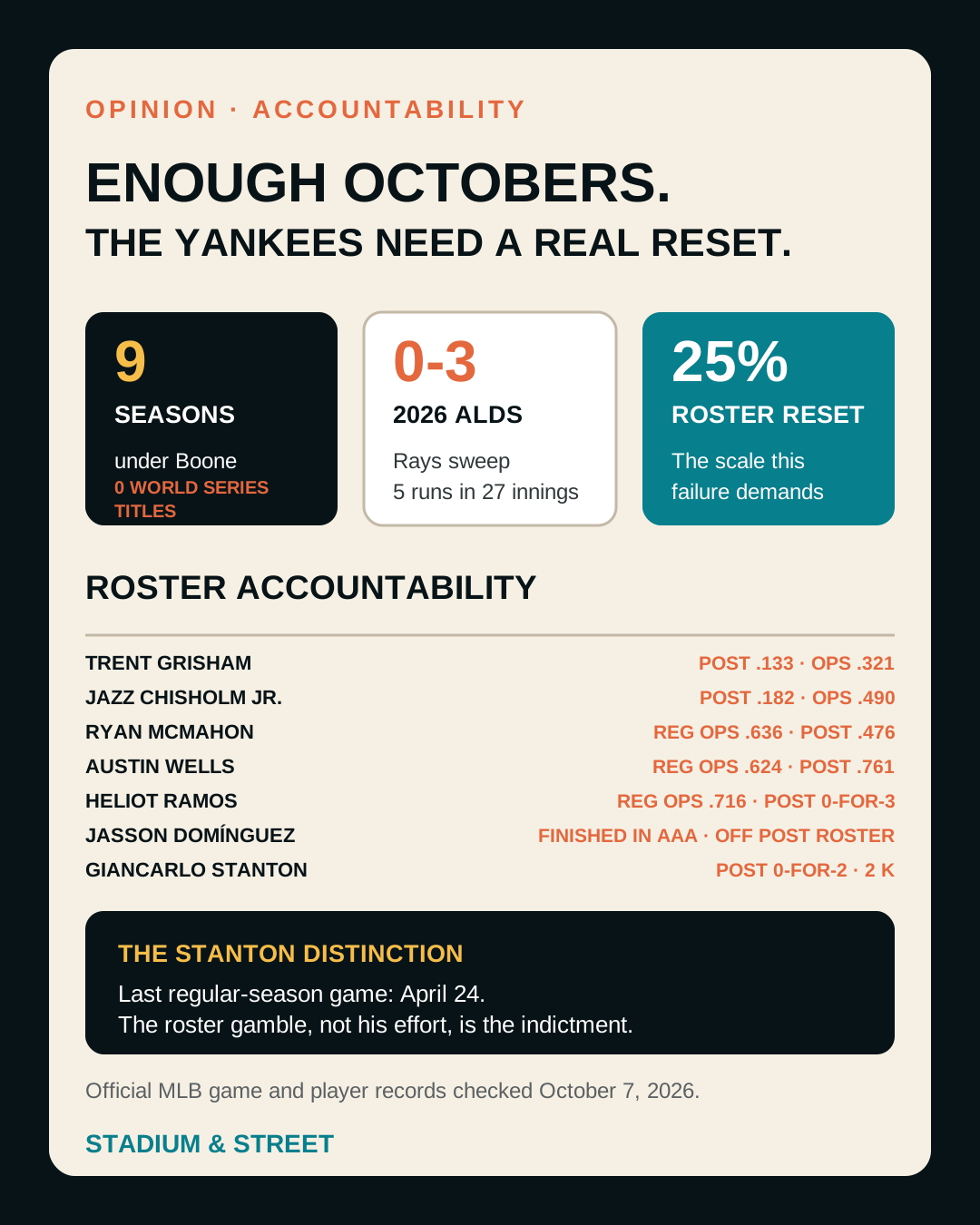
The Yankees should replace Aaron Boone. They should also resist the easy lie that changing the manager alone will repair a roster that just got swept by a division rival.
Tampa Bay won the American League Division Series in three games: 1-0, 5-2 and 4-3. The Yankees scored five runs in 27 innings, committed four errors in Game 2 and ended Game 3 with Trent Grisham striking out while Ben Rice waited on deck. That is not one cruel bounce. It is a failure of preparation, execution and roster construction.
The fan-interference replay in Game 3 was correctly resolved as an RBI double. It cut the deficit to one and left Volpe on second. The Yankees still had the rest of the sixth and three more innings. Blaming the ruling would be another way to avoid the harder verdict.
Boone owns the pattern
Boone has managed the Yankees since 2018. Nine seasons are enough evidence. He has won a pennant, reached October repeatedly and handled the daily pressure of the job. He has not won a World Series, and the same October complaints keep returning: loose defense, poor situational at-bats, curious lineup choices and a team that too often looks less composed than its opponent.
A manager cannot swing for a hitter or field a ground ball. He can set standards, choose who plays and build consequences into repeated mistakes. When the same failures survive across changing rosters, leadership becomes part of the result.
Boone moved Grisham to leadoff for Game 3. Grisham went 0-for-5 with three strikeouts, then made the final out with Rice on deck. The result does not prove that every lineup decision was foolish. It does show that the biggest adjustment of the elimination game placed five plate appearances in the hands of a hitter who did not deliver one successful trip.
The Yankees do not need another winter of explaining that Boone is respected, steady and good with players. Those qualities matter. They have not been enough. The organization needs a different voice and a different accountability structure because the current one has produced the same empty ending too many times.
Grisham and Jazz did not meet the moment
Grisham finished the postseason 2-for-15 with five strikeouts, one walk and no extra-base hit. His .133 average and .321 OPS belong in the decision about whether he should return, not only the memory of one final at-bat.
Jazz Chisholm Jr. finished 2-for-11 with no extra-base hit and no RBI. His speed still mattered, producing four stolen bases, but a .182 average and .490 OPS did not provide the middle-order force the Yankees needed. In Game 2, his aggressive attempt to complete a double play helped turn a difficult inning into a defensive collapse.
This is not an argument that one short series erases everything either player has done. Grisham hit 18 home runs in the regular season. Jazz hit 19 and stole 41 bases. It is an argument that October exposed the cost of carrying too many low-contact, high-variance at-bats at the same time.
The front office must decide which skills can survive better pitching and which names are being protected by familiarity. Grisham and Jazz should not be treated as automatic parts of the next core. The burden should be on the roster planners to explain why the same offensive shape will produce a different postseason ending.
McMahon, Wells, Ramos and Domínguez require different verdicts
Ryan McMahon also belongs in the review. He hit .213 with a .636 OPS across 124 regular-season games, then went 1-for-7 with a .476 OPS in four postseason games. He was 0-for-3 with one walk in the Tampa Bay series.
Austin Wells is a different case. His .186 average and .624 OPS across 122 regular-season games are not good enough to make his role untouchable. But he went 5-for-15 with four RBI and a .761 OPS in the postseason. The evidence supports reviewing his full-season value, not pretending he was one of October's worst hitters.
Heliot Ramos also came up empty in his only postseason game, going 0-for-3 with two strikeouts. His full-season .245 average and .716 OPS were stronger than several teammates' marks, so three plate appearances are not a serious case for removal. The better question is whether 13 home runs and 46 RBI fit an everyday role or a complementary one.
Jasson Domínguez did not merely have a quiet October. The Yankees optioned him to Triple-A on September 11, and his last major-league game was September 10. He finished the regular season out of the majors, then was omitted from the Wild Card roster and never appeared in the postseason. His .225 average and .635 OPS in 57 games make core-player status an unproven projection, not a current roster fact.
The honest roster review separates bad postseason performance from a bad full season. McMahon struggled in both samples. Wells and Ramos were not the same October problem. Domínguez ended the regular season in Triple-A and did not make the postseason roster. All four roles should be open to competition, but the case against each player is different.
Stanton's roster spot was hope dressed as a plan
Carrying Giancarlo Stanton was an embarrassment of process, not an indictment of his effort. Stanton's last regular-season game was April 24. Calf injuries wiped out the next five months. The Yankees then placed him on both postseason rosters as a one-at-bat weapon.
He received two postseason plate appearances and struck out in both. He pinch-hit in Game 3 and struck out with the Yankees down one. This was not Stanton failing over a meaningful sample. It was the organization spending a roster spot on the hope that reputation could substitute for current game timing.
Stanton had hit .256 with a .724 OPS in 24 regular-season games before the injuries. So the accurate criticism is not that he had been a bad hitter since April. He had not appeared in a regular-season game since April. Asking that version of a player to solve October pitching was an avoidable gamble.
A serious contender can carry one specialist or one health gamble. It cannot stack uncertainty and then act surprised when the bench lacks reliable answers. The Stanton decision belongs to Boone and the front office together.
A quarter of this roster should turn over
About a quarter of this roster should go. On a 26-man roster, that means six or seven spots, with the turnover concentrated in roles that failed rather than distributed for appearances. It is more than a backup catcher here and a middle reliever there.
The club should protect the players whose performance, age and role fit the next winning team. It should listen on veterans whose value is greater in theory than in October, stop guaranteeing roles to familiar names and create real competition for lineup spots.
Grisham, Jazz, McMahon, Wells, Ramos, Domínguez and Stanton are part of that review. So are the supporting infielders and bench pieces who made the postseason roster without giving Boone trustworthy alternatives. Contracts and trade value will limit the cleanest version of a reset. That is not an excuse to avoid the work.
The Yankees also need to decide whether the baseball operations group that built this roster should be trusted to redesign it. Replacing Boone while preserving every assumption above him would be cosmetic. Keeping Boone while changing a few names below him would be even less convincing.
The standard has to become visible again
The standard is not winning every series. Baseball is too uncertain for that. The standard is reaching October with a roster that can play clean defense, control the strike zone and respond when Plan A fails.
The 2026 Yankees did none of those things consistently against Tampa Bay. They were swept, at home, by the team that beat them for the division. Nine seasons into Boone's tenure, continuity would not be patience. It would be the refusal to accept the evidence.
Boone should go. A substantial part of the roster should follow. The next Yankees season should begin only after the organization proves it understands that this was more than another disappointing week. It was another warning that the current structure has reached its limit.
Go to the sources
See something that needs attention? Read our corrections process.