Opinion · Wayne Gretzky
Wayne Gretzky: measure the distance, not just the total
October 26, 2026 · 36 years after point No. 2,000
Wayne Gretzky reached 2,000 NHL points on October 26, 1990. The anniversary invites a familiar exercise: recite the career totals, marvel at their size, move on.
There is a better way to understand his place in the game. Measure the distance between Gretzky and the players competing in his own season. It does not settle every argument about hockey history. It makes the argument harder to dismiss.
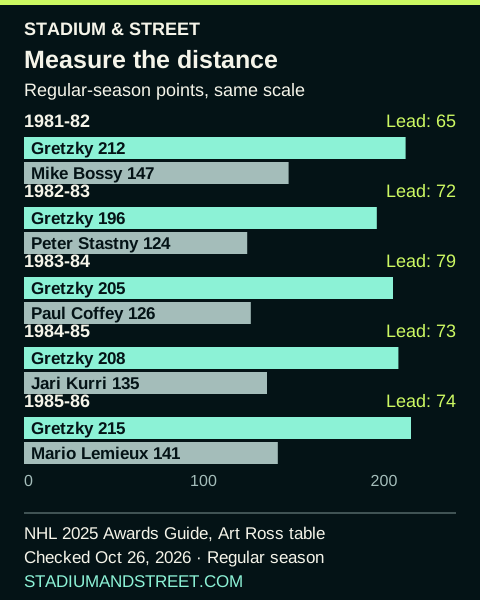
In 1985-86, Gretzky finished with 215 points. Mario Lemieux, the runner-up, had 141. That is a gap of 74 points, not between a superstar and an ordinary player, but between the scoring champion and his closest pursuer. Gretzky's 163 assists alone exceeded Lemieux's total points by 22.
The NHL's historical Art Ross table supplies the surrounding evidence. Gretzky led the runner-up by 65 points in 1981-82, 72 in 1982-83, 79 in 1983-84 and 73 in 1984-85. The opponents and totals changed. The separation persisted.
The era objection has limits
This is why the era objection, though necessary, is not sufficient. Raw totals from different periods cannot be treated as though the conditions never changed. But Gretzky's contemporaries were playing in that same period. The scoring environment belongs in the explanation; it cannot by itself explain why one player finished so far ahead of the rest.
There is a serious counterargument. A scoring title is not a complete measure of a hockey player. It does not isolate defense, account for every difference in opportunity or tell us how a player would perform with different teammates. Two players in the same season do not receive identical circumstances. A scoring-margin chart is evidence, not a machine that can choose the greatest player for everyone.
Nor does the comparison require diminishing Lemieux. His second-place finish gives the number meaning. The argument is stronger when the nearest challenger is treated as a great player, not reduced to a prop.
A career without imaginary seasons
Gretzky's final regular-season ledger contains 894 goals, 1,963 assists and 2,857 points. Those are separate from his playoff totals. They establish the scale of a career. The yearly margins show what it looked like while that career was being built.
The useful historical question is not whether we can transport a player into another decade and invent his statistics. We cannot. It is what he did against the competition actually in front of him, and how consistently he separated himself.
Gretzky's case needs no imaginary season. The real ones provide enough distance.
Go to the sources
See something that needs attention? Read our corrections process.