MLB · Hall of Fame
Baker, Bochy and six more reach the Hall’s December ballot
Ballot announced November 2, 2026
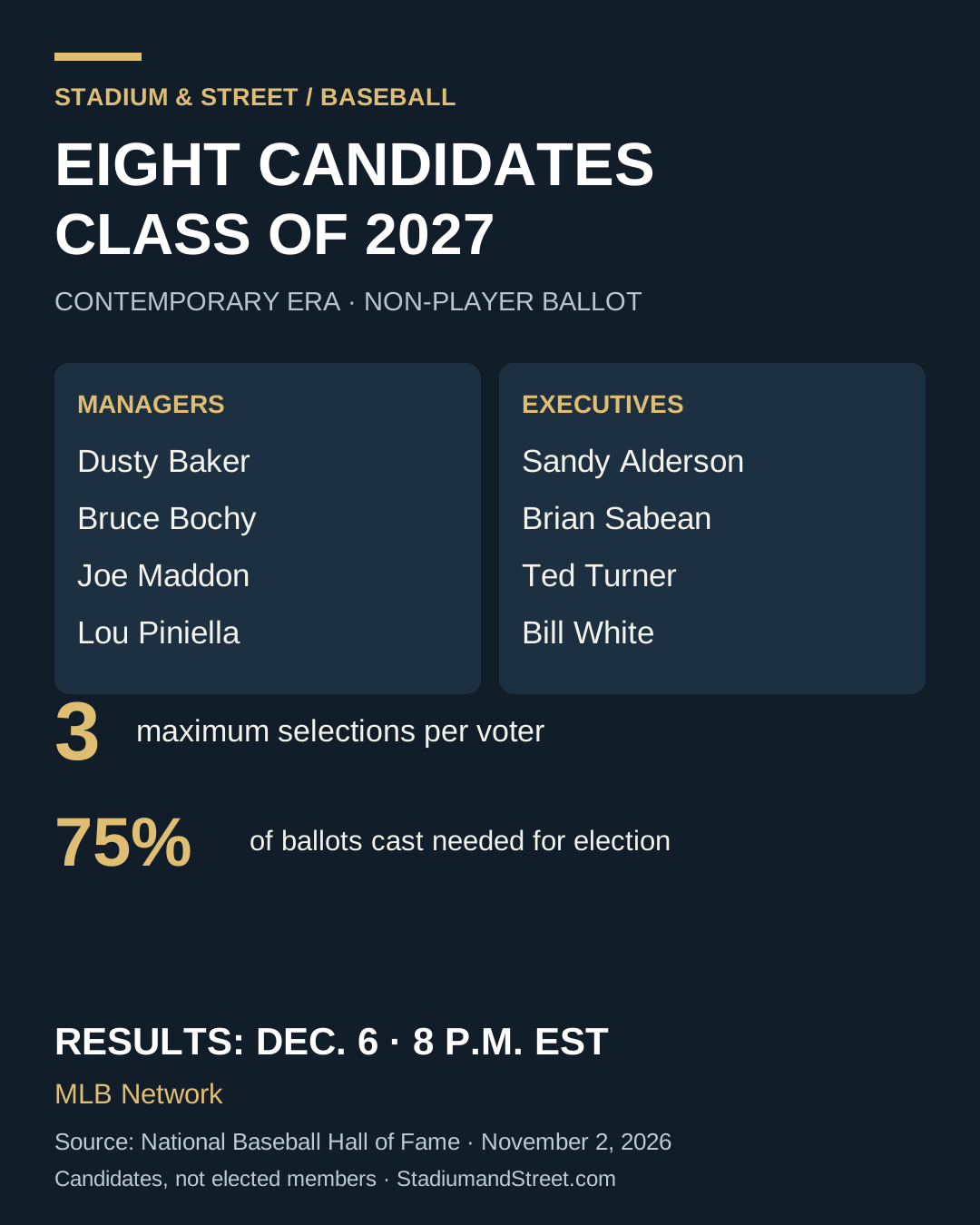
Dusty Baker and Bruce Bochy are on the National Baseball Hall of Fame’s next ballot, alongside six candidates whose careers stretch from the dugout to the front office and the broadcast booth.
The Hall announced its Contemporary Baseball Era non-player ballot Monday: managers Baker, Bochy, Joe Maddon and Lou Piniella; and executives Sandy Alderson, Brian Sabean, Ted Turner and Bill White. The committee meets December 6 in San Diego to consider them for the Class of 2027. MLB Network will announce the results at 8 p.m. Eastern standard time.
This election covers contributions made primarily since 1980. The category also permits umpires, although none appears among these eight. The Hall has not yet named the 16 voters. The historians who selected the candidates are a separate group, so their presence on the screening committee does not establish how an election vote will be cast.
Championships, team building and the reach of the game
Bochy’s four World Series titles and Baker’s 2022 championship anchor two substantial managerial records. Maddon led the Cubs to their 2016 title; Piniella won with Cincinnati in 1990 and managed Seattle’s 116-win team in 2001. Those achievements give the ballot several different tests of managerial impact: repeated championships, sustained competitiveness and exceptional individual seasons.
Alderson’s career includes Oakland’s championship-building front office and leadership of the Mets. Sabean built San Francisco’s three champions from 2010 through 2014. Turner’s national television distribution of Braves games offers a different kind of case, centered on how an owner expanded a club’s audience.
White’s candidacy has particular resonance in New York. He joined the Yankees broadcast team in 1971 and worked alongside Phil Rizzuto for most of the next 18 seasons. His earlier playing career included seven Gold Gloves and the Cardinals’ 1964 championship. As National League president from 1989 through 1994, he presided over the arrival of the Marlins and Rockies.
White received the Hall’s Buck O’Neil Lifetime Achievement Award this year. December’s election presents a separate opportunity for induction. His career illustrates why evaluating this ballot requires more than a championship count: leadership, access and the institutions around the sport belong in the discussion alongside success on the field.
Why the voting rules matter
Election requires 75 percent of the ballots cast, equivalent to 12 votes if all 16 committee members vote. Each elector may choose no more than three candidates. That limit makes the distribution of support consequential. An elector can regard four careers as worthy and still have to leave one name off.
The Hall’s criteria include ability, integrity, sportsmanship, character and contribution to baseball. Team victories are part of the evidence, but separating a manager’s decisions from the players and resources available to him remains a judgment. Executives and owners require a similarly careful distinction between a club’s achievements and an individual’s contribution.
Any electees will be inducted July 25, 2027. The separate BBWAA result is scheduled for January 19. The next Contemporary Era player election is in December 2028 for the Class of 2029. Monday’s announcement therefore opens a specific eight-person election, while the players’ routes continue on their own calendar.
Go to the sources
See something that needs attention? Read our corrections process.