Opinion · Cooperstown Court
Keith Hernandez belongs in Cooperstown. First base cannot be judged by home runs alone.
October 7 · Hall of Fame argument
Updated
Keith Hernandez belongs in the Baseball Hall of Fame.
That verdict does not require pretending 162 home runs look imposing at first base. It does not require turning the 1986 Mets into proof of individual greatness. It does not require treating a Gold Glove as perfect science.
It requires judging the whole player.
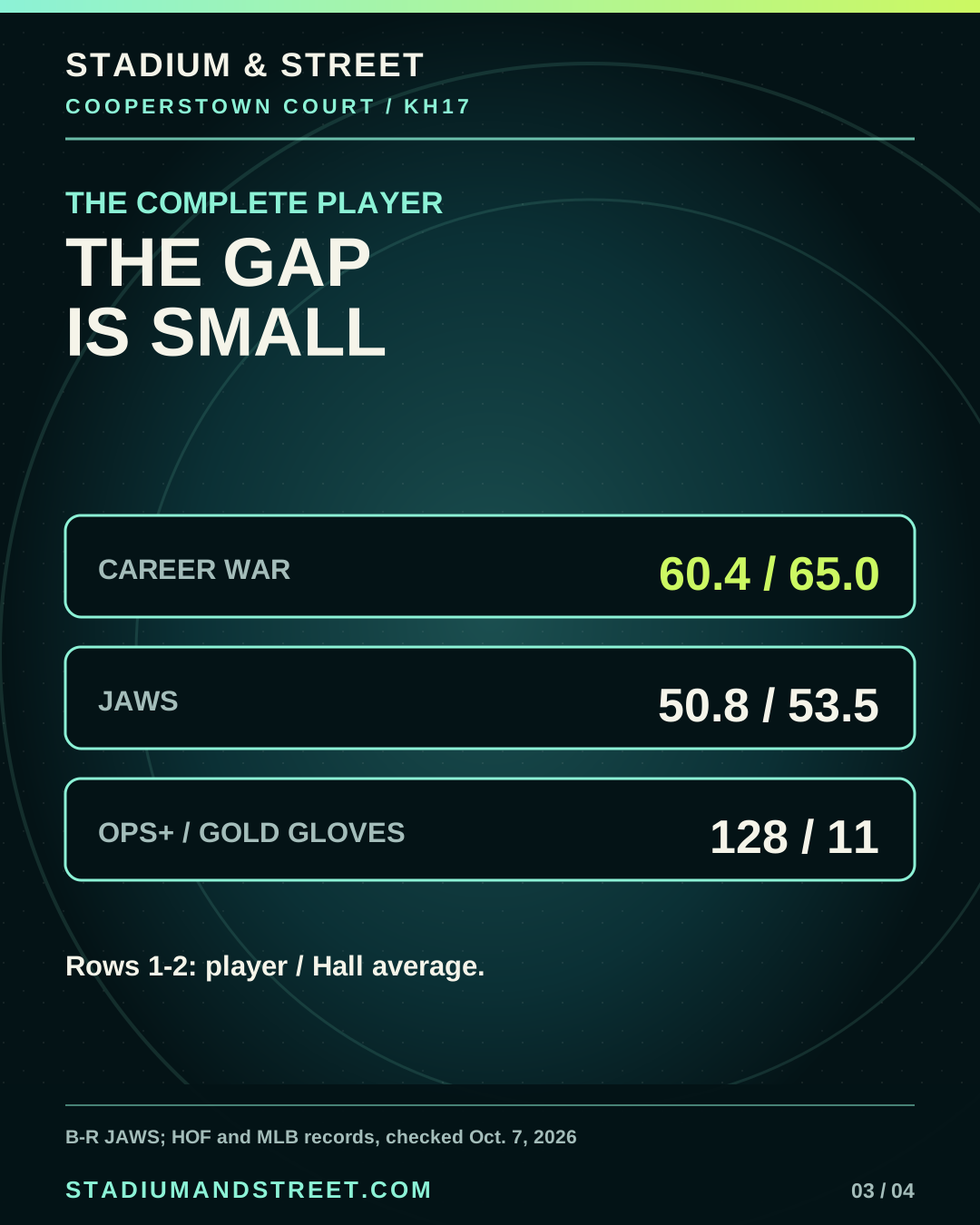
Hernandez finished with 60.4 Baseball-Reference WAR, a 41.3 seven-year peak and a 50.8 JAWS. The current averages for the 25 Hall of Fame first basemen in that model are 65.0 WAR, a 42.1 peak and a 53.5 JAWS. He falls short on career value and the combined score. His peak misses the Hall average by less than one win.
The bat was better than the home-run total suggests
The case against Hernandez usually begins with 162 career home runs. That number matters. First base is an offense-heavy position, and Cooperstown should not ignore the power gap merely because Hernandez was beloved in two baseball cities.
But the home-run total is not his complete offensive record.
Hernandez hit .296 with a .384 on-base percentage and a 128 OPS+. He collected 2,182 hits, 426 doubles and 1,070 walks. He drew more walks than his 1,012 strikeouts. In 1979, he led the National League with a .344 average, 116 runs and 48 doubles, then shared the MVP Award with Willie Stargell.
That is not light offense rescued by a famous glove. A 128 OPS+ means Hernandez created offense at a rate 28 percent better than league average after the metric adjusts for league and ballpark. His game was built on reaching base, controlling at-bats and driving gaps rather than chasing a first baseman's visual stereotype.
The glove cannot be treated as decoration
Hernandez won 11 consecutive Gold Gloves at first base. Major League Baseball identifies that as the position record, and the Hall of Fame's own history notes the same total.
Awards are not precise measurements. Defensive statistics covering the 1970s and 1980s also carry more uncertainty than modern tracking data. A responsible case should admit both limits.
The answer is not to erase the skill. Hernandez's defense was the defining strength that separated him from other very good offensive first basemen. If defense counts at shortstop, center field and catcher, it must count at first base too. The positional standard should affect how much it counts, not whether it counts at all.
Baseball-Reference's overall value model already applies a positional adjustment that makes first base harder to dominate through defense. Hernandez still produced 60.4 career WAR and a seven-year peak almost identical to the Hall average at the position.
The strongest objection is real
Hernandez is not an automatic selection by every reasonable standard.
His 50.8 JAWS is 2.7 wins below the current Hall average at first base. He did not reach 2,500 hits or 200 home runs. He made five All-Star teams. Voters who demand a larger offensive footprint from a first baseman can make a coherent case that his career sits just outside Cooperstown.
That objection deserves more respect than a lazy claim that defense alone settles the question.
It still does not carry the verdict.
Hernandez ranks 22nd on the current first-base JAWS list. He sits directly behind Hall of Famer Hank Greenberg and just ahead of Hall of Famers Bill Terry and Harmon Killebrew. JAWS is one framework, not a commandment, and the comparison does not mean Hernandez was a better hitter than those sluggers. It does show that his full career value lives inside established Hall territory rather than safely below it.
The ballot process missed the shape of his value
Hernandez never received more than 10.8 percent of the BBWAA vote. He later failed to reach Cooperstown through the Hall's committee routes and has not consistently appeared on their final ballots.
The low vote total is part of his history. It is not a permanent answer to the baseball question.
The Hall now separates Era Committee consideration into Classic and Contemporary timeframes, with eight-person final ballots and a 75 percent election threshold. Hernandez no longer has a writers' ballot path. Any future case must first survive the screening process before a committee can vote on him.
That makes clarity important. The argument is not that New York nostalgia should push him through a small committee. The argument is that his profile was easy to misread: not enough home runs for the position, defense that was hard to quantify and value split between two franchises.
The verdict
Keith Hernandez was not an inner-circle first baseman. Cooperstown does not require that.
He paired offense that was 28 percent better than league average with the most decorated defensive career the position has seen. His peak nearly matches the Hall standard. His career value and JAWS fall modestly short of the average, while still placing him among and above elected first basemen.
The Hall should reward the complete record it says voters must consider: record, ability, integrity, sportsmanship, character and contribution to the game.
On that complete record, Hernandez clears the line.
Go to the sources
By the Stadium & Street Editorial Desk.
More from MLB
NLDS · After the final ·
Yamamoto strikes out 10, Dodgers take a 2-1 series leadMets · Coaching staff ·
Three Mets coaches are out. Most of Andy Green's staff stays.Yankees · After the final ·
Four Yankees errors, four hits, and now one game from elimination.