Team analysis · 2027 roster planning
The Phillies should keep the rotation and fix the team around it
October 30, 2026 edition · Acquisition amendment November 1
The complete review
October 30, 2026 edition. Completed 2026 regular-season performance; roster and market checks October 30. The full review includes the player register, workload allocations, sources, proposed spending limits and downside scenarios. November 1 acquisition amendment now precedes the preserved original analysis in this download. This amendment controls conflicting acquisition priorities; the original roster-check date remains unchanged.
Read the Phillies review with amendment (PDF, 25 pages) → · 296 KB
Preserved original edition (before the November 1 acquisition revision)
Updated
November 1 acquisition amendment
Philadelphia has less DH flexibility than the Mets. Schwarber already occupies the primary role, so a Suzuki agreement must buy credible everyday corner-outfield work. The report's $22-24 million annual allowance should not be increased on the assumption that a DH fallback will absorb any defensive decline.
Dubon's 456.2 shortstop innings and the report's plus-six OAA at that position support investigating shortstop coverage. His 46 third-base innings do not establish that he is the answer at third. The original report acknowledged that limitation but still installed him as the preferred bridge. That ordering was too strong. Determine the third-base job and its alternatives before committing utility-player money to it.
Decision: Suzuki remains a conditional corner-bat target and Bednar a conditional leverage target. Dubon moves to a contingent shortstop-cover or position-fit inquiry. Do not count his shortstop range as an established third-base improvement. Grichuk remains a limited platoon alternative, with the report's right-handed-pitching weakness exposed. If no third-base solution clears, the vacancy stays unresolved; a nominal utility signing does not close it. Treat the original $10-12 million annual infield line as a conditional reserve. Before that reserve, Plan A allocates $38-44 million, Plan B $23-29 million and Plan C $9-13 million. A funded reserve is not an acquired third baseman or an assumed performance gain.
Philadelphia should keep the strength of its rotation and change the shape of the team around it. The best use of the next available dollar is an everyday outfield bat, a flexible infield solution and a second trusted late-inning arm. The club should also reserve enough money and roster space to survive injuries without rushing its best prospects.
That is a targeted retool, with an expensive condition: ownership must approve the whole package before the first major signing. Adding an outfielder and then discovering there is no room for the infield or bullpen work would leave much of the original problem intact.
The revised acquisition priorities are a playable corner bat and late-inning support, with infield spending conditional on a verified position fit. The dated proposals remain three years and $66-72 million for Suzuki, two years and $24-28 million for Bednar, and $4-6 million in first-year depth. The former two-year $20-24 million Dubon proposal is an optional ceiling for a demonstrated job, not an automatic commitment. These are S&S limits, not reported Phillies negotiations or a November 1 market valuation.
Suzuki addresses a recurring lineup problem only if he can handle the corner-outfield work without regular DH access. Bednar offers another choice when the most important outs arrive before the ninth. Dubon belongs in a separate shortstop-cover or position-fit inquiry, with third base still unresolved until a candidate demonstrates that role.
Keep Bryson Stott at second base initially. Prepare Trea Turner for an honest shortstop reassessment, with another alignment practiced in advance. Give Justin Crawford a meaningful center-field opportunity, with defined offensive and defensive checkpoints. Allocate no central-case innings to Brad Keller. Do not sell Andrew Painter, Aidan Miller, Bryan Rincon or Gage Wood merely to complete a veteran package.
The full preferred plan adds $48-56 million of annual salary assumptions. Combined with the retained-roster allowances in this report, the planning envelope is $307.13-327.13 million before tax, benefits and other excluded costs. That is a request for an ownership decision, not a claim about the Phillies' approved budget. If the envelope is unacceptable, use the less expensive plan before making commitments that close off the alternatives.
The strongest objection is that the club already won 88 games and has considerable money committed. A good portion of the improvement could come from Turner, Realmuto, Painter and the existing bullpen. That possibility deserves room in the plan. It should not be the plan's only source of improvement.
Where the margin went
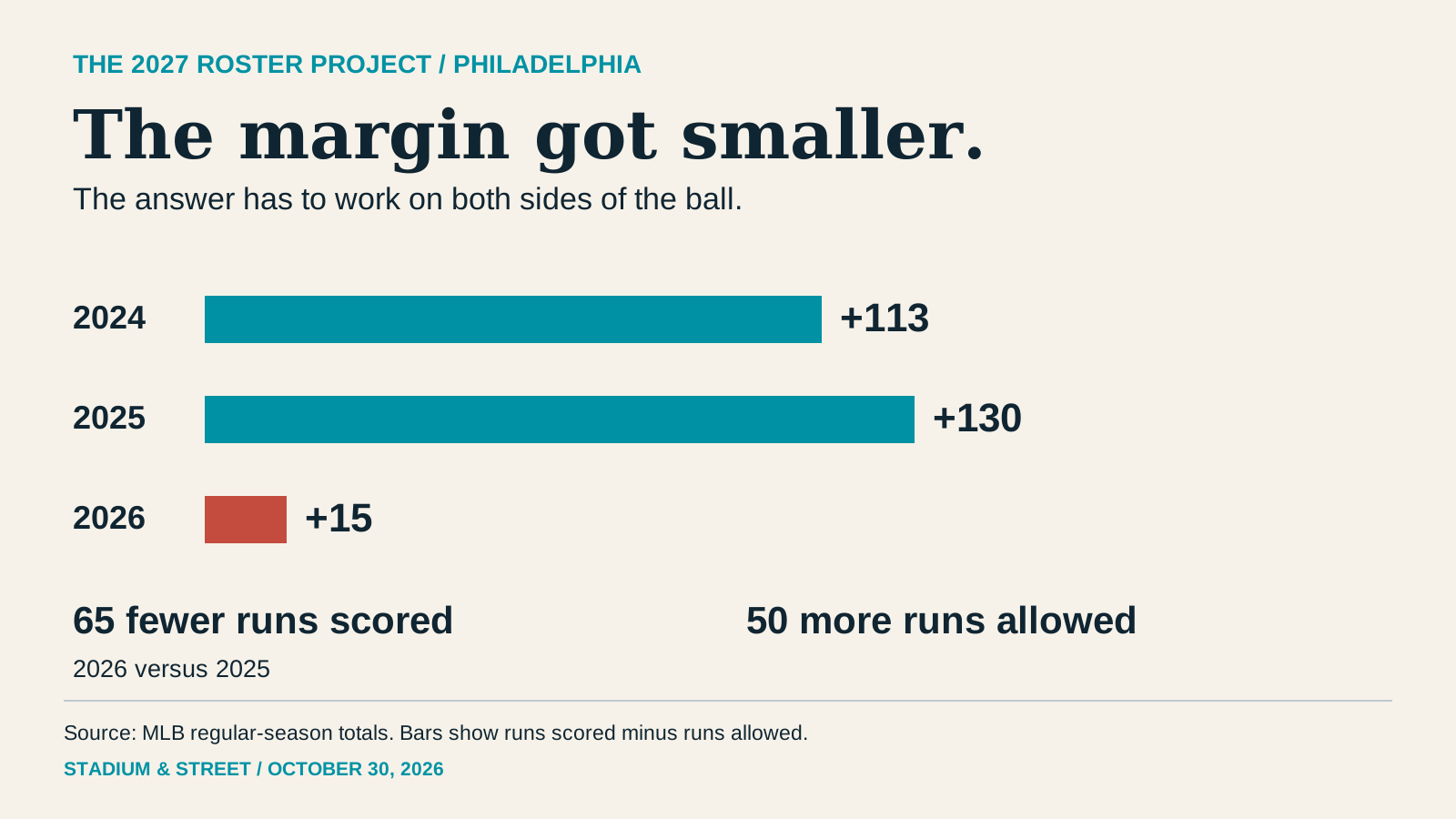
Philadelphia lost 115 runs of regular-season margin in one year: 65 fewer scored and 50 more allowed. The offense and run prevention both require attention. The decline cannot be explained by one bad postseason series.
The 88-74 record also rested on a 25-16 performance in one-run games. MLB's standings record lists an 83-79 expected record from the season's scoring. That is a description of 2026, not a 2027 forecast. It is a reason to build a larger scoring margin instead of treating 88 wins as a secure starting point.
The club led MLB with 1,577 pitching strikeouts. Its starters produced a 3.80 ERA in 883.1 innings. That is an existing strength worth protecting. Yet the offense ranked 23rd in on-base percentage and 24th in slugging, while relief pitchers allowed 307 runs in 555 innings. Better top-end starting pitching is not the clearest first purchase. More productive plate appearances and better coverage behind the starters are.
The priority is therefore complementary improvement. A stronger lineup can make a competent start sufficient. Better infield coverage can help starters finish an inning without another batter. Another trusted reliever can preserve Duran for the next difficult matchup. These are connected decisions, but their benefits must not be counted twice in a run estimate.
Build an offense beyond the two anchors
Harper and Schwarber combined for 74 of the team's 182 home runs, 40.7 percent. Their .865 and .857 OPS seasons were valuable, but the lineup could not produce enough around them. Turner, Realmuto and Crawford together took 1,632 plate appearances with an OPS below .700. Those opportunities are large enough to change the team even without another superstar.
This is not simply a lineup that needs to face fewer left-handers. Philadelphia posted a .705 OPS against lefties and .707 against righties. Right-handed pitching accounted for 4,164 of 6,079 plate appearances. The first new bat needs to help against righties as well as supply a favorable matchup against lefties.
Suzuki's 2026 split fits that requirement: .345 OBP and .452 slugging against righties over 466 plate appearances, and .429/.537 against lefties over 168. His 81 walks in 634 total plate appearances give the lineup another way to extend an inning. Still, his .366 wOBA exceeded his .340 expected wOBA. Price him as a useful regular with downside, not as a guaranteed repeat of his .841 OPS.
Marsh remains useful, but his .258 OBP and .355 slugging against lefties came with 48 strikeouts in 129 plate appearances. A right-handed reserve can take selected starts from that side. Crawford's 66 plate appearances against lefties are too few to settle his long-term role. A platoon should solve today's matchup without automatically denying him the experience needed to improve.
Avoid acquiring another hitter whose value depends on becoming the everyday DH. Schwarber already occupies that role, and occasional rest days for Harper or Realmuto need space too. Suzuki's verified 2026 outfield work is part of his fit. If a candidate's physical or defensive review points toward mostly DH work, the price and the recommendation change.
Two different recovery cases
Turner and Realmuto should not be placed in the same rebound category. Turner's 2026 .675 OPS followed .807 and .812 seasons. His .293 expected wOBA was slightly below his .298 actual wOBA, however. The contact results do not support describing his entire decline as bad luck. Realmuto's .317 expected wOBA was materially above his .275 actual mark, but his OPS has declined in each of the past two seasons.
For Turner, begin with pitch selection and the quality of decisions against breaking pitches. Against sliders he produced a .260 wOBA over 106 plate appearances ending on that pitch; against sweepers it was .206 over 74. His whiff rates were 35.5 and 40.1 percent, respectively. Those are diagnostic leads for video and coaching work, not instructions to guess a pitch. Pitch-type results describe the pitch ending the plate appearance and should not be treated as independent full at-bats against an entire sequence.
For Realmuto, a sensible workload and a credible second catcher matter more than assuming an expected-stat rebound will arrive on schedule. Marchan's 95 Philadelphia plate appearances and Stubbs' 65 were not evidence of a dependable offensive alternative. The catching group needs a competitive reserve process and a contingency acquisition allowance. Extra DH appearances are not a costless answer when Schwarber is already there.
Fix the infield as a unit
Outs Above Average (OAA) estimates range performance relative to an average fielder given the opportunities. It does not measure every part of defense. Stott's plus-nine OAA is a reason to preserve an advantage at second base. Turner's minus-ten is a reason to create a real alternative at shortstop. Moving Turner to second without accounting for Stott's replacement role can shift the problem rather than solve it.
Dubon is attractive because his 2026 record includes 456.2 innings at shortstop, with plus-six OAA at that position. His overall plus-six includes several positions; it is not six runs and it is not a third-base grade. He played only 46 innings at third. The proposed third-base bridge therefore requires a preseason position-specific evaluation.
Preserve Stott's second-base contribution and evaluate Turner's shortstop role as part of the full infield. Do not install Dubon at third based on his shortstop grade. Test the position and the alternative arrangements before committing, including the cost of moving Turner or displacing another player. If no third-base solution clears, carry that vacancy as unresolved.
When Miller or Rincon earns a major-league opportunity, decide the alignment from the combined value of all four infield positions. Do not force Miller to third solely to protect a veteran's current position. Do not force Stott to short solely because he has played there before. Evaluate current range, throwing, receiving and the likely loss at the vacated position.
Protect the rotation, improve its floor
Sanchez, Luzardo and Wheeler supplied 548.2 innings with ERAs below 3.01. Keeping that foundation makes more sense than breaking it up to solve an outfield or infield need. Their central allocation here totals 515 innings, leaving room for fewer innings than last year rather than requiring perfect availability.
Nola's 175.1 innings remain useful volume, but 37 home runs and a 4.67 ERA made the quality expensive. His 4.18 xERA suggests a less severe contact-based outcome than the actual ERA; it does not remove the home-run problem. The pitch-level record points toward work on the fastball family. Batters produced .441 wOBA against his four-seamer and .444 against his sinker, compared with .257 against the curveball.
That is a reason for a detailed location, count and sequencing review. It is not enough to tell him to throw more curves. Different pitches face different counts and hitters, and a pitch can lose effectiveness when its use becomes predictable. The club should test changes with its own pitch-quality and video evidence, then judge whether damaging contact is actually falling.
Painter's full-season 5.40 ERA obscures a better finish: his last 11 regular-season appearances covered 61.2 innings with 25 earned runs, a calculated 3.65 ERA. His overall 4.42 xERA also was better than his actual ERA. Both support patience. Neither establishes that the final two months are his new full-season level.
His four-seamer produced a .429 opposing wOBA over 188 plate appearances ending on the pitch. His changeup produced .197 over 73. The development question is whether he can make the fastball a better part of the sequence while preserving what works elsewhere. A 145-inning central allocation is an increase over 126.2 in 2026, with a broad 115-165 planning range and replacement innings already assigned.
Give the manager another late-inning choice
Duran's 1.82 ERA, 84 strikeouts and ten walks over 59.1 innings are a strong foundation. The problem is the distance between that foundation and the rest of the game. A club that relies on one elite reliever must either use him earlier and expose the ninth or save him and risk losing the lead before he enters.
Bednar is the preferred outside addition at our price. He recorded a 2.47 ERA with 76 strikeouts and 20 walks in 69.1 innings in 2026. The value is another credible high-leverage option, not a rigid promise that one man pitches the eighth and another the ninth. His role preferences and price could make this pairing unavailable. If so, keep the spending limit and search for the role rather than buy a name at any cost.
Mayza re-signed for 2027. His reported salary is $2.75 million. He is already in the baseline, not a future acquisition. Keller's July elbow surgery makes him unsuitable for central-case innings. Keep his committed salary in the plan.
Bowlan's 73 strikeouts against 15 walks in 56.1 innings warrant meaningful work. Kerkering's 34 walks in 58 innings warrant a command requirement before regular high-leverage assignment. His 3.87 xERA, compared with a 4.97 ERA, supports further evaluation; it does not explain away free baserunners. Banks, Shugart, Backhus and the optionable group should compete for specific coverage needs.
The farm can change the plan, but cannot be its insurance policy
The most useful development distinction is between ability, readiness and available workload. A prospect can be highly regarded without being ready to cover a major-league vacancy in April.
Miller's 2026 regular-season record contains three plate appearances at Clearwater and 11 at Reading. His back injury cost development time. Those tiny samples cannot support a full-season major-league batting assumption. His fall assignment is an opportunity to rebuild a playing routine and gather evidence, not a substitute for the missed season.
Use three readiness gates: sustained availability for the planned workload, competitive decisions against upper-level pitching, and usable defense at the position he would actually play. Do not make an arbitrary batting-average threshold the promotion rule. An extended period of strong decisions with modest hit results can be more informative than a short hot streak.
Rincon's 534 Double-A plate appearances, .410 OBP, 26 home runs and 95 walks give the club another substantive infield candidate. The next question is how those decisions and damage carry into tougher pitching. His .517 slugging is not a major-league projection. Give him a route to regular work at the next level rather than a major-league bench promise.
Wood threw 95 regular-season innings across Clearwater and Reading. The Double-A portion had 99 strikeouts and 18 walks in 68.2 innings, alongside 14 home runs. That combination deserves a specific contact-quality review, not simply praise for strikeouts. The 95-inning denominator excludes postseason and exhibition work. A rotation-depth role is earned by both readiness and an available workload.
The money: three plans, one baseline
The full report itemizes $219.13 million in known 2027 commitments, using Baseball-Reference's listed salary and prorated-bonus presentation plus Mayza's separately reported $2.75 million salary. Adding our $32-42 million retained arbitration allowance and $8-10 million pre-arbitration and call-up reserve gives a $259.13-271.13 million baseline before outside additions. This is an approximate salary planning envelope, not a cash-disbursement schedule or competitive-balance-tax calculation. Incentives, benefits, tax, transaction costs and unlisted obligations are excluded. No speculative trade or non-tender savings are credited.
The $32-42 million arbitration allowance is an S&S scenario for retaining the relevant group, including a contingency for unsettled eligibility. It covers Duran, Stott, Marsh, Kerkering, Marchan, Stubbs, De La Cruz, Hill, Banks and a Rojas contingency. It is not an arbitration forecast or a promise that all are tendered. The separate $8-10 million pre-arbitration and call-up allowance is a budgeting reserve, not a claim about the 2027 minimum salary.
Revised Plan A first allocates $38-44 million annually: Suzuki at $22-24 million, Bednar at $12-14 million and depth at $4-6 million. A conditional $10-12 million infield reserve brings the fully funded envelope to the original $48-56 million. The reserve requires a proven position fit before it becomes a commitment; no defensive improvement is credited simply because the money is budgeted.
Plan B replaces the Suzuki proposal with Grichuk at $7-9 million for one year, retaining the Bednar and depth allowances. Before the infield reserve, that is $23-29 million annually; fully funded, $33-41 million. It asks much more of the existing outfield against right-handed pitching, and the third-base question remains separate.
Plan C allocates $5-7 million in one-year relief and $4-6 million in depth, totaling $9-13 million annually. The conditional infield reserve raises the envelope to $19-25 million. It relies heavily on internal offensive recovery and does not promise a completed infield merely because a utility-player allowance exists.
Wheeler's listed $42 million and Keller's $13 million are scheduled to come off this annual presentation after 2027. That $55 million is not automatically free spending money: their roles may need replacement, other salaries change, and labor terms may change. The contract horizon creates choices, not a reason to spend the same future dollar twice.
What improvement must actually look like
These are outcome tests, not player projections or probability-weighted forecasts. The strong-execution case asks the team to score 40 more runs and allow 25 fewer than in 2026. That would restore 65 of the 115 runs of margin lost from 2025, leaving the club below its 2025 differential.
The 40-run offensive gain must come from the combined result of better outside production, fewer weak reserve appearances and selected internal improvement. Do not add a free agent's full historical WAR to last year's wins, then also credit the same improvement to lineup depth. His plate appearances replace somebody else's.
The 25-run prevention gain must similarly be shared among relief, defense and starting-pitching outcomes. A ball converted into an out can improve the fielder's result and the pitcher's ERA; it is still one event. The public data cannot establish a precise causal division between those components.
The injury stress test replaces 100 innings at a 3.50 run rate with innings at 5.50, costing 22.2 runs. Rounded to whole runs, the strong case becomes 753 scored and 695 allowed, a plus-58 margin. Those rates are illustrative runs per nine innings, not ERA projections for named pitchers. The calculation shows why depth can matter as much as another high-ceiling addition.
There is also a real downside case: 15 fewer runs scored and 20 more allowed produces a minus-20 differential. That can happen if older hitters decline, a new signing disappoints and pitching availability deteriorates together. The club needs an in-season decision process for that outcome, not a report that only describes the preferred path.
The strongest case against our recommendation
The Phillies could make a reasonable case for a lighter winter. Turner has a long record of better offense. Realmuto's expected contact results were better than his actual line. Painter finished strongly. Bowlan and Duran give the bullpen genuine strength. Internal improvement would cost less than buying the full preferred package.
There are acquisition risks too. Suzuki will play his age-32 season in 2027, and his actual 2026 production exceeded the expected-stat line. Dubon's third-base sample is limited, and his preferred role may be elsewhere. Bednar could command more money or insist on a different usage pattern. The proposed prices may not win any of the negotiations.
The objection becomes strongest if ownership sets a firm lower ceiling, a prospect clears the readiness gates sooner than expected, or the market prices the three preferred roles above our limits. Under those conditions, switch plans. Do not inflate the proposed ceiling merely to preserve the original names.
Our answer is that the lighter-winter case asks several uncertain improvements to arrive together. Turner's offense and defense must recover. The catching group must become more productive. Crawford must improve while covering center. The bullpen must bridge more reliably. The rotation must remain sufficiently available. Each is possible. Their combined success is less secure than any single story sounds on its own.
The recommendation therefore buys help in three places while keeping the rotation and development opportunities. It accepts that the club may pay for a year that is merely solid. It rejects a plan whose economics work only if every veteran rebounds and every prospect arrives on time.
Philadelphia's next advantage is a roster with more usable answers: another hitter who can reach base and do damage, another infielder who makes the alignment a choice, another reliever trusted with important outs, and enough depth to keep a setback from becoming a season-long problem.
Go to the sources
See something that needs attention? Read our corrections process.