Opinion · Sports media
Tony Romo lost the CBS booth. His contract may still cushion the fall.
October 6 · Editorial
Updated
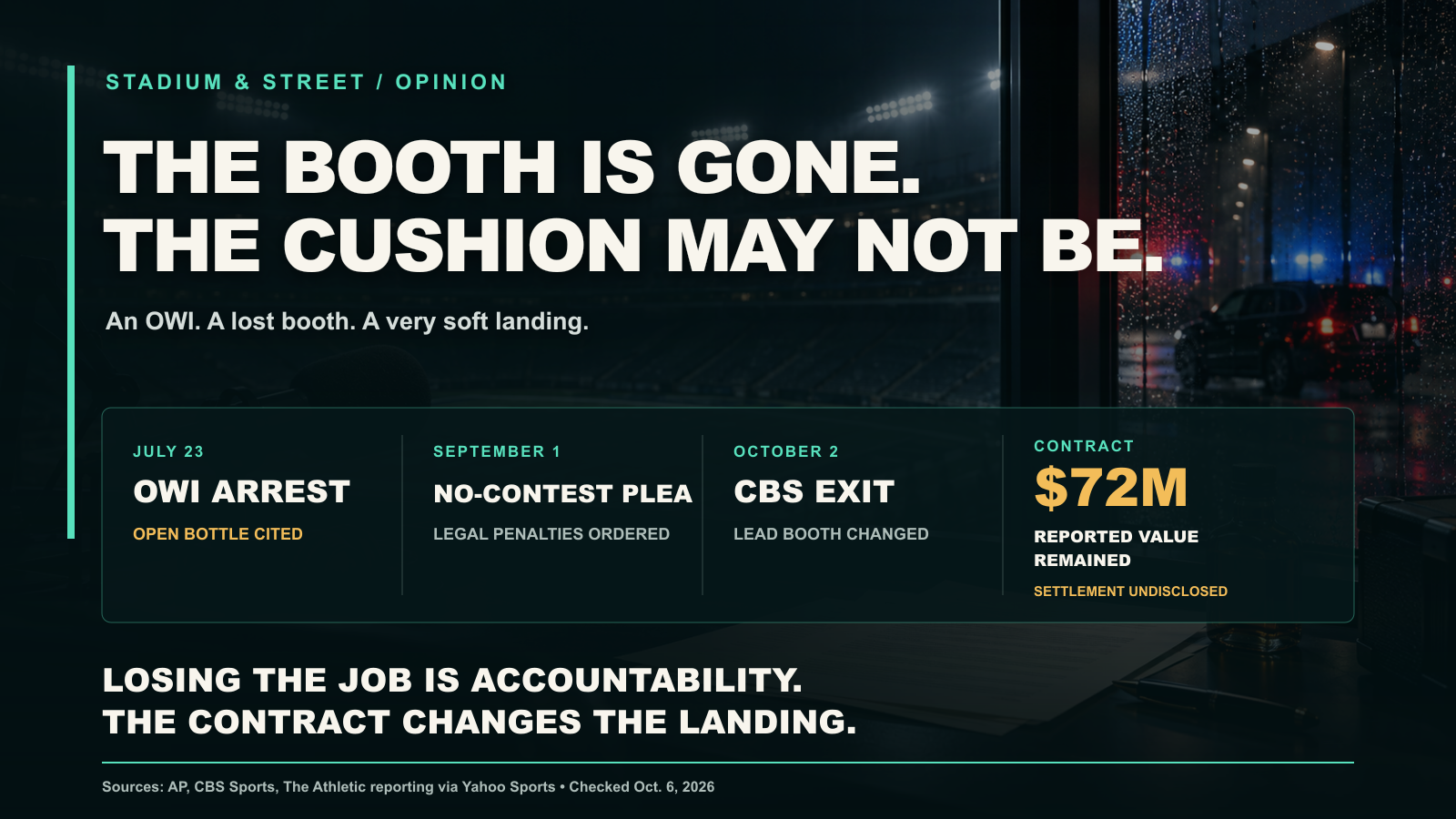
Tony Romo is not returning to the CBS broadcast booth. That is a real professional consequence. It is also hard to call the result satisfying when reports say he reached a financial settlement with four years and roughly $72 million remaining on his contract.
The public does not know the settlement amount. That matters. Romo was not handed a publicly confirmed $72 million check for leaving, and any headline that says otherwise outruns the evidence. The Athletic reported that CBS and Romo reached a settlement and that he would likely receive a good portion of the remaining money. The exact figure has not been disclosed.
Even with that limitation, the structure is jarring. Romo was arrested in Wisconsin on July 23 on suspicion of operating while intoxicated. A sheriff's citation said an open bottle of an alcoholic beverage was found in the passenger side of his vehicle. CBS placed him on leave. He pleaded no contest on September 1. On October 2, CBS announced that the sides had mutually agreed to part ways. The network then kept JJ Watt on its lead NFL team.
The OWI ended his CBS career in practical terms
Let's not pretend the timing is mysterious. The OWI put Romo on leave, the plea followed and CBS made the break permanent. CBS Sports president David Berson said in August that the network had to consider the effect on its image and brand. The OWI ended Romo's CBS career in every practical sense. CBS called the exit mutual instead of calling it a firing. That does not erase the order of events.
Romo faced legal penalties, too. According to Milwaukee County court records cited by the Associated Press, he lost his driving privileges for six months, was ordered to complete an alcohol assessment, owed $834 and must use an ignition interlock for at least one year after a license is issued. He also apologized publicly and said he had to own his mistakes.
Those consequences are real. So is the danger behind impaired driving. Nobody was reported hurt in this case, but accountability should not depend on whether a reckless decision happened to end without a victim.
The $72 million figure describes the reported value left on Romo's contract, not the amount CBS has confirmed paying him. That distinction belongs in every responsible account of this story. It does not make the larger question disappear.
Seventy-two million dollars was contract value, not a disclosed payout
Most workers who lose a prominent job after an alcohol-related driving case do not negotiate an eight-figure exit. They do not have a long-term talent contract, an experienced legal team and enough leverage to make a former employer pay for certainty. Romo did. That may be contract law working exactly as designed. It can still look like accountability built for two different economies.
CBS also had reasons to buy peace. A fight could have been expensive, public and uncertain. A negotiated settlement lets the network move forward with Watt and limits a legal battle over the contract. Paying to end a deal is not the same thing as rewarding the conduct that triggered the crisis.
But the distinction will feel academic to ordinary people who see the headline numbers. Romo loses one of broadcasting's best jobs and may still leave with generational wealth from the contract that covered it. The legal system imposed a penalty. The employment system may have wrapped the exit in a financial cushion.
CBS and Romo were entitled to settle. The terms should not be invented, and Romo should not be denied contractual rights by public anger alone. Transparency would still help. When a company invokes a mutual parting after conduct serious enough to trigger leave and a permanent change in the booth, the public deserves more than a polished phrase if millions of dollars remain at issue.
Accountability should not disappear inside a settlement
The honest verdict is not that Romo received $72 million for an OWI. We do not know that. It is that the OWI ended his CBS run, while the power of his contract appears likely to soften the financial consequence dramatically. Losing the booth is accountability. Leaving with a confidential multimillion-dollar settlement would show how differently accountability can land when the person involved is already rich, famous and heavily protected.
Go to the sources
By the Stadium & Street Editorial Desk.
More from NFL
Bills · After the final ·
Buffalo's 17-point quarter could not cover two scoreless ones.Giants · After the final ·
The Giants won by 12. Arizona was at the four with a chance to win.Jets · Week 4 brief ·
The Jets finally intercepted a pass. Chicago still controlled the game.